
4 layers75 × 35 mm
LASK5-V3-0
Open-Muscle/OpenMuscle-LASK5
Handheld labeler wand for training ML models on gesture inputs
56 parts3CERN-OHL-S-2.0
 Open-Muscle/OpenMuscle-Band1
Original OpenMuscle armband with 12 sensors (legacy design)
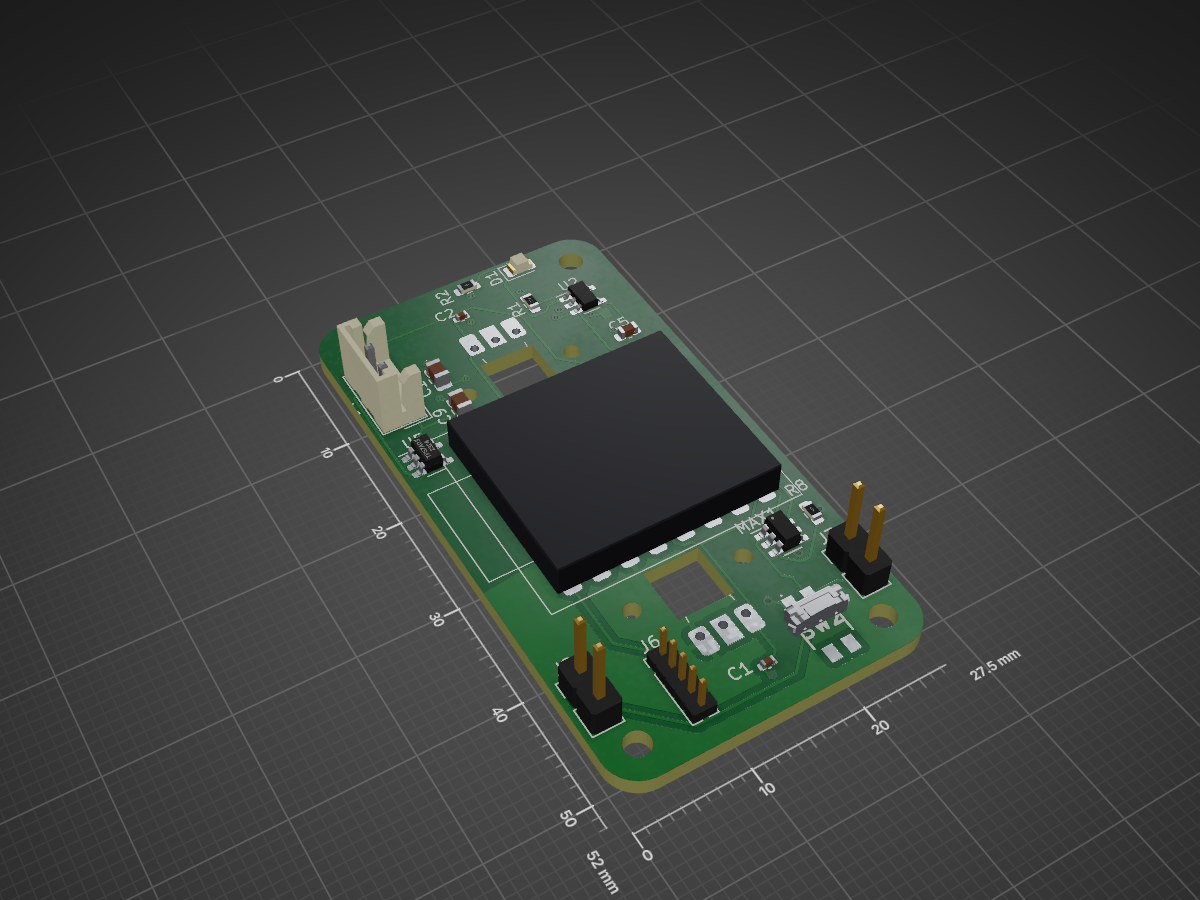
OM EPSC3-Micro is an open-source printed circuit board by Open-Muscle, from the Open-Muscle/OpenMuscle-Band repository on GitHub, published under the CERN-OHL-S-2.0 licence. It is a 2-layer board of 27.5 × 52 mm with 22 parts on 25 nets, routed with 157 tracks and 17 vias.
It is built around the LTC4054ES5-4.2#PBF and TPS7A03DQN. Its parts include 5 capacitors, 4 connectors, 3 resistors, 3 ICs and 1 diode. It belongs with the wearables and sensors and measurement boards of this library.
Status: Archived (Legacy Hardware)
License: CERN-OHL-S v2.0
The OpenMuscle-Band is the original prototype of the OpenMuscle project—a wearable forearm band equipped with 12 pressure sensors designed to detect muscle contractions and predict finger movements. This open-source hardware was developed to provide biometric data for machine learning applications in prosthetics and human-computer interaction.
BOM/: Bill of Materials detailing all components usedKiCad/: PCB design files for the sensor arraySTLs/: 3D-printable files for enclosures and mountsSchematics/: Electrical schematics of the systemThis repository serves as an archive for the original OpenMuscle-Band design. Active development has moved to the OpenMuscle GitHub Organization, where you'll find:
For historical data and machine learning scripts, refer to the legacy repository.
Electromaker:
🏆 2nd Place — Electromaker of the Month, April 2024
Electromaker Winners – March 2024
Hackaday Articles Featuring OpenMuscle:
To replicate or study the OpenMuscle-Band:
Hardware Assembly:
STLs/ directory.Firmware Installation:
boot.py and main.py scripts to handle data acquisition and transmission.Data Collection:
Machine Learning (Optional):
As this is an archived repository, we are not accepting contributions. For ongoing development and contributions, please visit the OpenMuscle GitHub Organization.
This project is licensed under the CERN Open Hardware License v2.0. See the LICENSE file for details.
| Qty | Value | Footprint | References |
|---|---|---|---|
| 2 | 100 nF | Capacitor_SMD:C_0402_1005Metric | C1, C2 |
| 2 | 4.7uF | Capacitor_SMD:C_0805_2012Metric | C9, C10 |
| 2 | A1369xUA-10 | OpenMuscleDevKit:Hall49E | H0, H1 |
| 2 | Conn_01x02_Pin | Connector_PinHeader_2.54mm:PinHeader_1x02_P2.54mm_Vertical | J2, J3 |
| 2 | SolderJumper_2_Open | Jumper:SolderJumper-2_P1.3mm_Open_TrianglePad1.0x1.5mm | JP1, JP2 |
| 1 | 150 | Resistor_SMD:R_0603_1608Metric | R2 |
| 1 | 1K | Resistor_SMD:R_0603_1608Metric | R8 |
| 1 | 2.2 uF | Capacitor_SMD:C_0603_1608Metric | C5 |
| 1 | 2.7k | Resistor_SMD:R_0603_1608Metric | R1 |
| 1 | Conn_01x05_Pin | Connector_PinHeader_1.27mm:PinHeader_1x05_P1.27mm_Vertical | J6 |
| 1 | JST_02 | Connector_JST:JST_EH_B2B-EH-A_1x02_P2.50mm_Vertical | J4 |
| 1 | LED GREEN | LED_SMD:LED_0805_2012Metric | D1 |
| 1 | LTC4054ES5-4.2 | Package_TO_SOT_SMD:TSOT-23-5 | U2 |
| 1 | SW_Push | OpenMuscleDevKit:EVQP2P02M | SW2 |
| 1 | TPS7A03 | Package_TO_SOT_SMD:SOT-23-5 | U5 |
| 1 | ~ | OpenMuscleDevKit:ESP32-C3-Super Mini | U1 |
| 1 | ~ | Package_TO_SOT_SMD:SOT-23-6 | MAX1 |
Open-Muscle/OpenMuscle-LASK5
Handheld labeler wand for training ML models on gesture inputs

turfptax/OM-Dev-Kit
Open Muscle Dev Kit (V0/V1): ESP32-C3 sensor-cell hardware (KiCad PCBs + gerbers) and MicroPython firmware for the OpenMuscle pressure-sensing platform.

Open-Muscle/OpenMuscle-FlexGrid
60-sensor wearable with flexible PCB and pressure matrix

sujinshakyaut/temp_sense_e27
Dedicated thermal monitoring module designed to interface with 24 thermistors per board for high-density temperature sensing.

W0rthlessS0ul/nRF24_jammer
The nRF24 jammer is a powerful tool that requires an ESP32 and configurable numbers of NRF24 modules to assemble.


TDA-2030/E-ink-screen
An assistant to help you view text and picture calendars

Albert-IV/om-keyboard
Right now I'm iterating on a 34 key split that uses MX spacing horiontally and choc spacing vertically. Uses the splay from the Absolem keyboard and the lowered thumb keys of the Draculad.
It measures 27.5 × 52 mm and has 2 copper layers, 1.6 mm thick.
22 parts, built around the LTC4054ES5-4.2#PBF and TPS7A03DQN. The full list of its parts is on this page, with links to each part's symbol and footprint where PCBKit's library has them.
From the Open-Muscle/OpenMuscle-Band repository on GitHub, at the commit this page was made from: the board is KiCad/OM-EPSC3-Micro.kicad_pcb and its schematic KiCad/OM-60-Stat/OM-60-Flex/OM-60-Flex.kicad_sch. PCBKit opens the board in the browser, with nothing to install.
Its repository publishes it under the CERN-OHL-S-2.0 licence: you may reuse it on that licence's terms (keep the author's notice, and for a copyleft licence share your changes alike).