2 layers88.6 × 30 mm
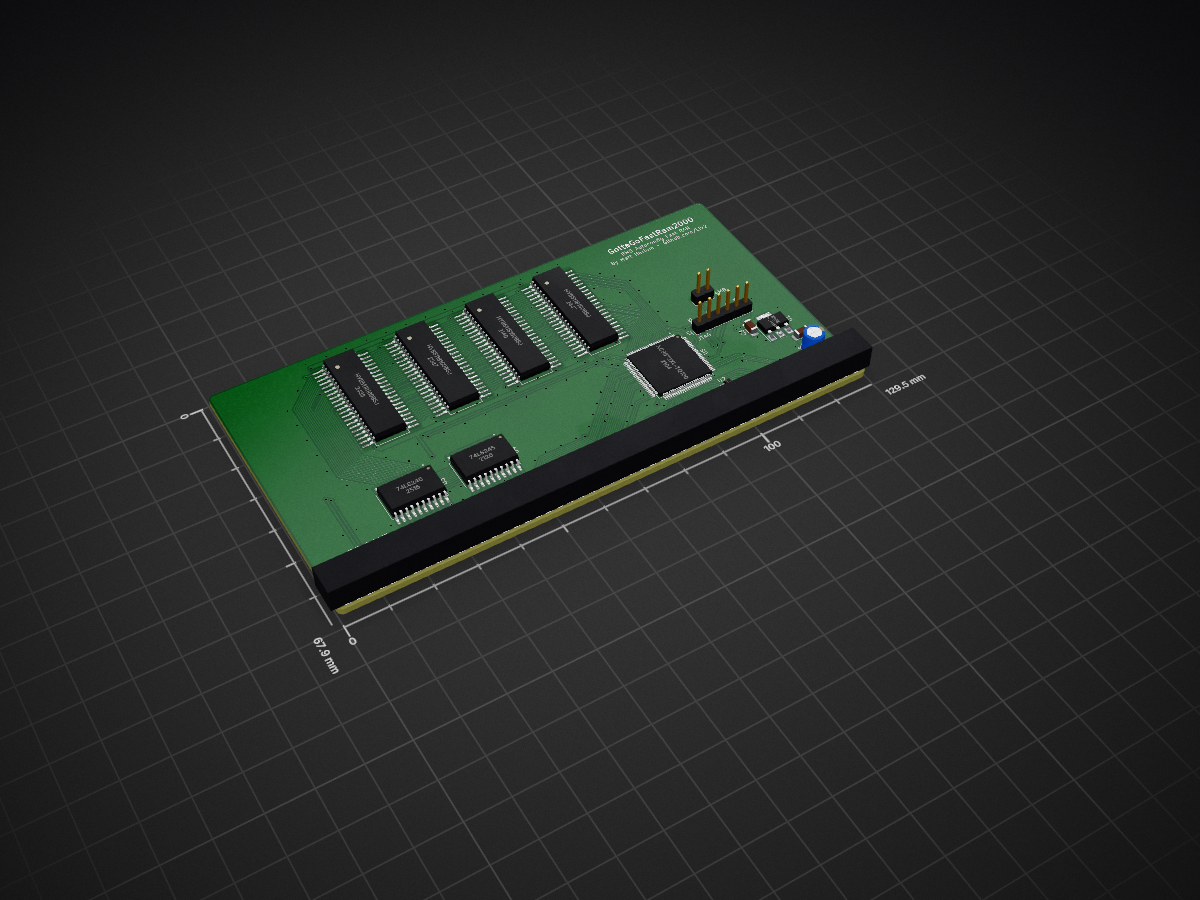
 LIV2/GottaGoFastRAM200032
8MB autoconfig fast memory for the Amiga 2000
GottaGoFastZ2 is an open-source printed circuit board by LIV2, from the LIV2/GottaGoFastRAM2000 repository on GitHub. It is a 2-layer board of 129.5 × 67.9 mm with 38 parts on 164 nets, routed with 1,440 tracks and 239 vias.
It is built around the 74LS245SC, 74LVC2G07GV and LM1117-3.3. Its parts include 25 capacitors, 9 ICs, 3 connectors and 1 resistor. It belongs with the retro computing and games boards and the FPGA and CPLD boards of this library.


This is an 8MB Autoconfig Fast RAM for the Amiga 2000
Special thanks to GadgetUK164 and sparxUK for their help testing this.
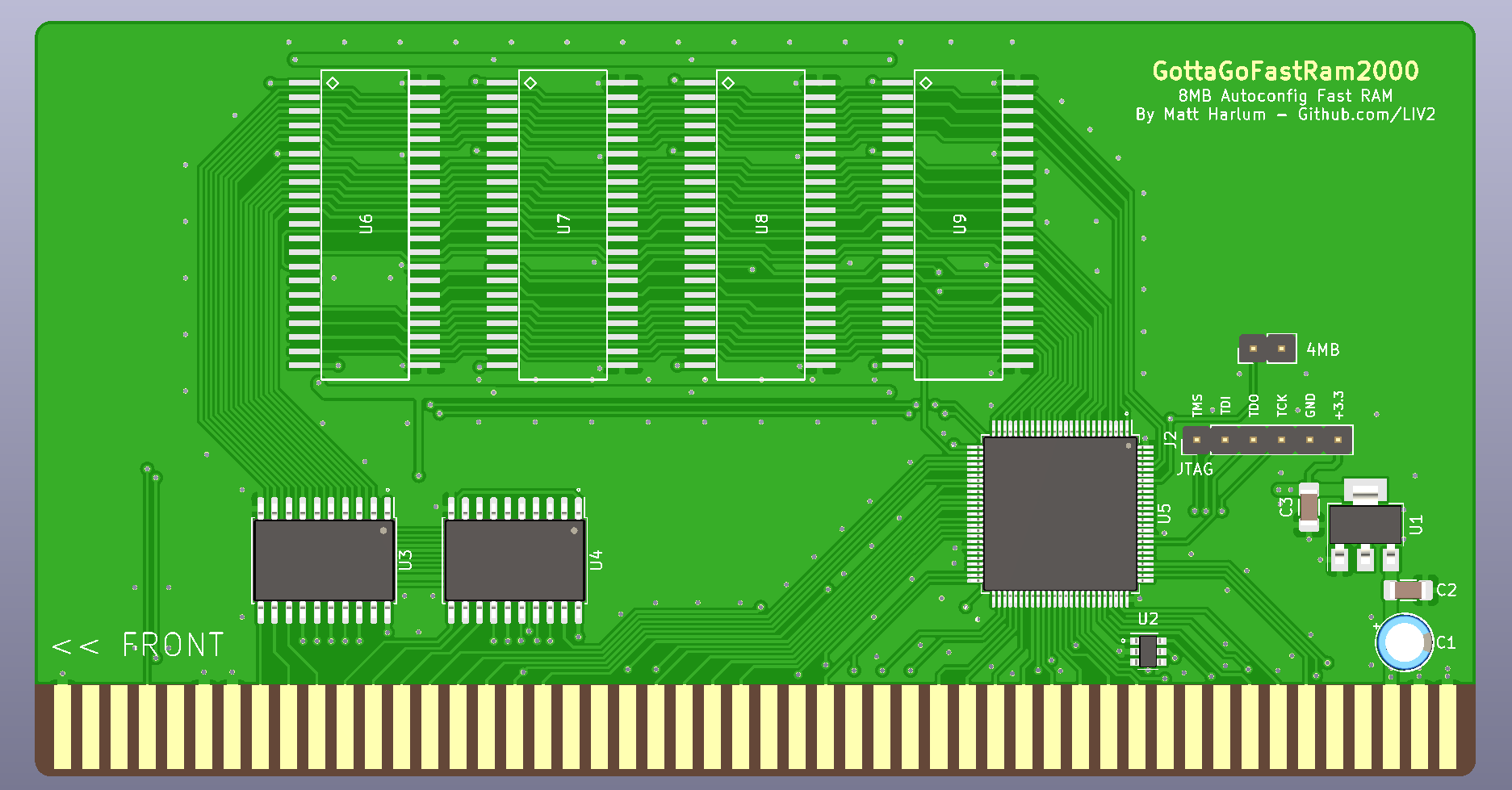
This is tested and working
There are two different firmwares available for this card.
For best results the boards should be manufactured with the "Gold Fingers" option so that the edge connector will survive many insertion/removal cycles
4MB: Forces the board to appear as a 4MB board rather than 8MB
| Component | Location | QTY | Link | Note |
|---|---|---|---|---|
| LM1117-3.3 SOT-223 | U1 | 1 | Mouser | |
| XC9572XL-10TQ100C | U5 | 1 | Mouser | Can be substituted with XC95144XL-10-TQ100 |
| 74LS245 SOIC | U3,U4 | 2 | Mouser | |
| 74LVC2G07 | U2 | 1 | Mouser | *Optional - See below |
| 5v 1MBx16 DRAM, SOJ-42 i.e K4E151611 K4F151611 MT4C1M16E5 GM71C18163C AS4C1M16E5 etc. | U6,U7,U8,U9 | 4 | Aliexpress, Ebay etc | Other parts may be compatible so long as they meet these specs: 5V, SOJ-42, 1K Refresh, 1024 row x 1024 column x 16 bits |
| 0.1uF Ceramic capacitor, 0805 | C4-25 | 22 | Mouser | |
| 10uF Ceramic capacitor, 1206 | C2,C3 | 2 | Mouser | |
| 100uF Electrolytic Capacitor | C1 | 1 | Mouser | |
| 10K Resistor, 0805 | R1 | 1 | Mouser |
* U2 buffers the cards generated DTACK and OVR signals - In a pinch this can be left out but you will run into problems with the A2091 and some other devices so it is best to fit this and save yourself the headache
Problem: System does not boot, the power LED does not change brightness
Solution: Possible incorrect orientation/faulty ic in U2 - check orientation and/or remove this IC and try again
Problem: My bridgeboard doesn't work when this card is installed
Solution: The bridgeboard needs 512K of the 8MB expansion space for its own use, you will need to move the ram board to the leftmost slot and I recommend flashing the 6MB Firmware to maximise the amount of memory offered when used with the bridgeboard
Problem: My system is unstable / graphical corruption when using this board but it passes a memory test in ATK/DiagROM etc
Solution: Check that your Amiga 2000 has the correct buffers installed in U600-605. U600,601,603,604 must be 74LS245 and U602/605 should be 74ALS245 but might be 74LS245 in some A2000 revisions.
If you have used anything else (like 74HCT245) for these you will run into issues with this board and many others.
Problem: When used with a bridgeboard/other cards I get a gray screen telling me the card has been "SHUT"
Solution: Some other board is using some of the 8MB space, so the card will be told to shutup and will reappear offering 4MB then 2, 1 etc.
On Kick 1.3-3.1 the system will not alert you to this happening and will continue to boot (this is used to do the autosizing) but newer versions "helpfully" tell you about this condition.
If using one of these newer kickstart versions with a Bridgeboard I'd recommend flashing the 6MB Firmware
Another option would be to write the firmware to offer multiple 2MB blocks until it is shut up which unfortunately doesn't work, because Kickstart 1.3-3.1 will throw a yellow screen if the last board in the chain was shut up, and newer versions will throw the gray screen telling us the board has been shut-up.
Problem: With the board installed I get a red screen saying that this board is defective
Solution: This usually means that one of the RAM chips are faulty or there could be bad soldering.
Remove all other Zorro cards, boot up ATK or Diagrom and do a manual memory test with the individual ranges listed in the memory map below.
Consult the memory map below to figure out which RAM chip is being reported faulty.
If the same bits are reported as faulty across multiple of the address ranges check for bad soldering around the RAM chips and the buffers at U3&U4.
| Address range | Chip |
|---|---|
| 200000-3FFFFF | U6 |
| 400000-5FFFFF | U7 |
| 600000-7FFFFF | U8 |
| 800000-9FFFFF | U9 |
| Qty | Value | Footprint | References |
|---|---|---|---|
| 22 | 0.1u | Capacitor_SMD:C_0805_2012Metric_Pad1.18x1.45mm_HandSolder | C10, C11, C12, C13, C14, C15, C16, C17, C18, C19, C20, C21, C22, C23, C24, C25 +6 |
| 4 | HYB5118160BSJ | GottaGoFastZ2:SOJ-42-LongPads | U6, U7, U8, U9 |
| 2 | 10u | Capacitor_SMD:C_1206_3216Metric_Pad1.33x1.80mm_HandSolder | C2, C3 |
| 2 | 74LS245 | Package_SO:SOIC-20W_7.5x12.8mm_P1.27mm | U3, U4 |
| 1 | 100u | Capacitor_THT:CP_Radial_D5.0mm_P2.50mm | C1 |
| 1 | 10K | Resistor_SMD:R_0805_2012Metric_Pad1.20x1.40mm_HandSolder | R1 |
| 1 | 4MB | Connector_PinHeader_2.54mm:PinHeader_1x02_P2.54mm_Vertical | J1 |
| 1 | 74LVC2G07 | Package_TO_SOT_SMD:SOT-23-6 | U2 |
| 1 | Conn_01x06_Male | Connector_PinHeader_2.54mm:PinHeader_1x06_P2.54mm_Vertical | J2 |
| 1 | LM1117-3.3 | Package_TO_SOT_SMD:SOT-223-3_TabPin2 | U1 |
| 1 | XC9572XL-TQ100 | Package_QFP:TQFP-100_14x14mm_P0.5mm | U5 |
| 1 | Zorro2 | GottaGoFastZ2:Zorro2-CardEdge | CON1 |

MelkhiorVintageComputing/SBusFPGA
Stuff to put a FPGA in a SBus system (SPARCstation)

Wren6991/Snowflake-FPGA
A cheap iCE40 development board, designed on and for Raspberry Pi


lrrosa/tia-fpga
FPGA replacement for the Atari 2600 TIA (C010444) video/sound chip, targeting a Sipeed Tang Nano 9K. Open hardware, CERN-OHL-S-2.0.

abstractfoundry/lumicube-boards
PCB and firmware design files for some of the LumiCube components

It measures 129.5 × 67.9 mm and has 2 copper layers, 1.6 mm thick.
38 parts, built around the 74LS245SC, 74LVC2G07GV and LM1117-3.3. The full list of its parts is on this page, with links to each part's symbol and footprint where PCBKit's library has them.
From the LIV2/GottaGoFastRAM2000 repository on GitHub, at the commit this page was made from: the board is Kicad/GottaGoFastZ2.kicad_pcb. PCBKit opens the board in the browser, with nothing to install.
Its repository states no licence, so its author keeps all rights: ask LIV2 before reusing the design.