Skip to the content
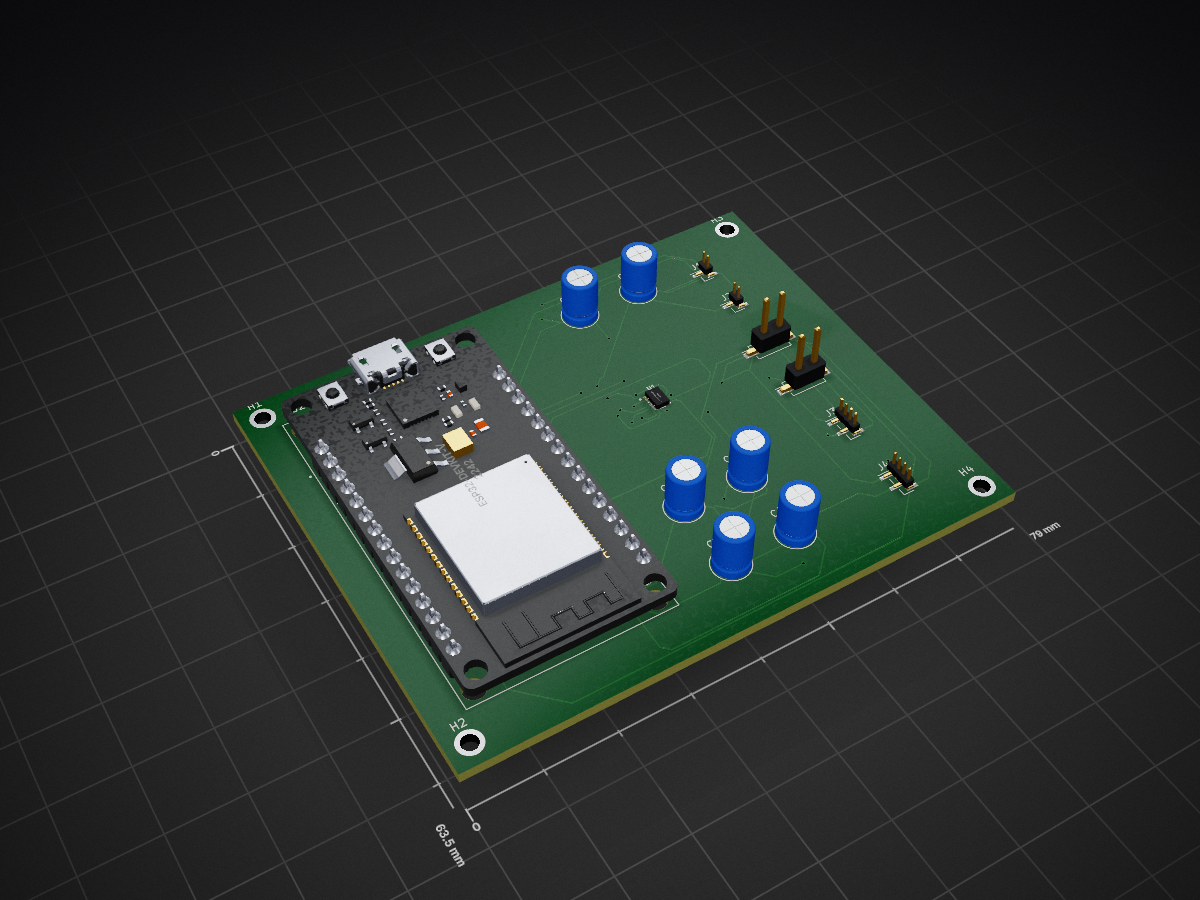
2 layers79 × 63.5 mmUpdated pcb, the printed circuit board in 3D

An intelligent autonomous rover designed for real-time warehouse inventory auditing and management, developed for Inter IIT Tech Meet 14.0.

Size
79 × 63.5 mm
Copper layers
2
Thickness
1.6 mm
Parts
18
Nets
38
Pads
90
Tracks, vias
255, 31
Routed
Yes
KiCad
KiCad 9.0 (file 20241229)
Created
13 Mar 2026
Updated
1 Apr 2026

Overview

Updated pcb is an open-source printed circuit board by Kkkbansal, from the Kkkbansal/Autonomous-Rover-for-Warehouse-Management repository on GitHub. It is a 2-layer board of 79 × 63.5 mm with 18 parts on 38 nets, routed with 255 tracks and 31 vias.

Its parts include 6 capacitors, 4 connectors and 2 ICs. It belongs with the ESP32 boards of this library.

README

README.md

Autonomous Rover for Warehouse Rack Inventory Management System

An intelligent autonomous rover designed for real-time warehouse inventory auditing and management, developed for Inter IIT Tech Meet 14.0.

The system performs autonomous navigation, vertical rack scanning, QR-code detection, and real-time inventory reporting, reducing manual audit cycles from 1–2 weeks to just 1 day with <1% discrepancy.


Project Overview

Warehouse inventory auditing is traditionally slow, labor-intensive, and error-prone.

This project introduces an end-to-end autonomous scanning rover capable of:

  • Autonomous warehouse navigation
  • Rack-level vertical scanning
  • High-accuracy QR/barcode detection
  • Real-time inventory status updates
  • Low discrepancy stock verification

Key Performance Targets

MetricTarget
Horizontal Position Accuracy±10 cm
Vertical Position Accuracy±2 cm
Image Resolution1080p
QR Detection Reliability>95%
Audit Cycle Time1 Day
Inventory Discrepancy<1%

System Architecture

The rover consists of the following major subsystems:

  • Chassis System
  • Differential Drive Mechanism
  • Vertical Scissor Lift
  • Power Management System
  • Control System
  • Path Planning Module
  • QR Code Scanning Module
  • Human Machine Interface (HMI)

Hardware Specifications

Rover Specifications

  • Dimensions: 600 × 355 mm
  • Weight: ~20 kg
  • Rack Coverage: 5 shelf levels
  • Vision Height Range: 0.14 m – 1.75 m
  • Drive: 2-wheel differential drive
  • Support: Front and rear casters
  • Lift Mechanism: 4-stage scissor lift
  • Battery: 18V rechargeable battery
  • Backup Capacity: 22000 mAh
  • Operational Time: Up to 4 hours

Sensors & Computing

  • Intel RealSense D455 for depth sensing and navigation
  • 1080p Camera for QR-code scanning
  • Jetson AGX Xavier for high-level control and processing
  • ESP32 for real-time low-level motor control

Mechanical Design

Chassis

  • Modular T-slot architecture
  • High structural rigidity
  • Controlled flexibility for uneven floors
  • Optimized load distribution

Drive System

  • Differential drive configuration
  • Zero-radius turning
  • High traction wheel placement
  • Robust caster-based stability

Vertical System

A 4-stage pantograph scissor lift is used for vertical scanning.

Why Scissor Lift?

  • Fully collapsible
  • Compact design
  • High vertical precision
  • Safe for narrow aisle movement
  • Easy field maintenance

Control Architecture

The control system follows a two-tier hierarchical structure:

High-Level Control

  • Jetson AGX Xavier
  • ROS2 (Cyclone DDS)
  • Path planning
  • Object detection
  • QR scanning
  • System supervision

Low-Level Control

  • ESP32
  • PID-based motor control
  • Encoder feedback processing
  • Real-time closed-loop control

Software Stack

  • ROS2
  • Python
  • C++
  • OpenCV
  • ESP32 Firmware
  • MATLAB PID tuning
  • Jetson SDK

Features

  • Autonomous navigation
  • Real-time mapping
  • QR code scanning
  • Inventory mismatch detection
  • Rack height scanning
  • Live bot telemetry
  • Battery diagnostics
  • Wi-Fi quality monitoring
  • Remote start / pause / restart controls

Human Machine Interface (HMI)

The HMI dashboard provides:

  • Bot live status
  • Battery health
  • Wi-Fi status
  • Live camera feed
  • Sensor telemetry
  • Start / stop scan controls
  • Inventory alerts
  • Success / caution notifications

Future Improvements

1. Multi-Robot Swarm Coordination

Enable multiple autonomous rovers with centralized planning and distributed execution.

2. Enhanced Sensor Suite

Integrate:

  • LiDAR
  • Ultrasonic sensors
  • Radar
  • Thermal imaging

3. Robotic Arm Integration

Add manipulation capabilities for:

  • pick and place
  • object repositioning
  • multi-angle scanning

Applications

  • Smart warehouses
  • Inventory automation
  • Industrial logistics
  • E-commerce fulfillment centers
  • Manufacturing storage systems

Team

Inter IIT Tech Meet 14.0

Project: Autonomous Rover for Warehouse Rack Inventory Management System


Acknowledgments

Special thanks to the Inter IIT Tech Meet organizers, mentors, and team members for their support in the development of this project.

Parts

18
QtyValueFootprintReferences
4100nFCapacitor_THT:C_Radial_D5.0mm_H7.0mm_P2.00mmC3, C4, C5, C6
4MountingHole_PadMountingHole:MountingHole_2.2mm_M2_ISO7380_Pad_TopBottomH1, H2, H3, H4
2Conn_01x02_PinConnector_PinHeader_1.00mm:PinHeader_1x02_P1.00mm_Vertical_SMD_Pin1LeftJ1, J2
2Conn_01x04_PinConnector_PinHeader_1.00mm:PinHeader_1x04_P1.00mm_Vertical_SMD_Pin1LeftJ3, J4
2Motor_DCConnector_PinHeader_2.54mm:PinHeader_2x01_P2.54mm_Vertical_SMDM1, M2
1470uFCapacitor_THT:C_Radial_D5.0mm_H7.0mm_P2.00mmC2
147uFCapacitor_THT:C_Radial_D5.0mm_H7.0mm_P2.00mmC1
1DRV8835DSSRDRV8835:SON50P300X200X80-13NU1
1ESP32-DEVKIT-V1ESP32-DEVKIT-V1[1]:MODULE_ESP32_DEVKIT_V1U2

Similar boards

  • 2 layers27.9 × 16.5 mmPowerSSO-24 breakout, the printed circuit board in 3D

    PowerSSO-24 breakout

    rusefi/rusefi

    rusefi - GPL internal combustion engine control unit

    18 parts1.2k
  • 2 layers42.7 × 13.7 mmStm32-mini12864, the printed circuit board in 3D

    Stm32-mini12864

    VoronDesign/Voron-Hardware

    Cool Hardware designed by the Voron Design group

    18 parts1.1kGPL-3.0
  • 2 layers41.2 × 46.6 mmThumb cluster left, the printed circuit board in 3D

    Thumb cluster left

    JesusFreke/lalboard

    A 3D-printed keyboard inspired by the DataHand

    18 parts993
  • 2 layers44 × 51.3 mm4272MAVcoder R4, the printed circuit board in 3D

    4272MAVcoder R4

    hackclub/OnBoard

    💡 Join 1,000 teenagers and make your first PCB with a $100 grant!

    18 parts915
  • 2 layers28.3 × 14.3 mmTap Photosensor PCB, the printed circuit board in 3D

    Tap Photosensor PCB

    VoronDesign/Voron-Tap

    Tap is a nozzle-based z-probe for the V2 and Trident printer designs. The entire toolhead moves to trigger an optical switch. Tap offers many advantages:

    18 parts716GPL-3.0
  • 2 layers20.3 × 15.2 mmL0 stepper driver, the printed circuit board in 3D

    L0 stepper driver

    Luos-io/luos_engine

    Open-source and real-time orchestrator for cyber-physical-systems, to easily design, test and deploy embedded applications and digital twins.

    18 parts546MIT
  • 2 layersMooltipass, the printed circuit board in 3D

    Mooltipass

    limpkin/mooltipass

    Github repository dedicated to the mooltipass project

    18 parts531
  • 2 layers42.5 × 28.8 mmC5VRX JACK DIY V2, the printed circuit board in 3D

    C5VRX JACK DIY V2

    Twotoz/C5VRX

    Ultra-minimal, zero-CPU 5.8 GHz analog FPV video receiver using ESP32-C5 Wi-Fi 6 PHY MODEM_DIAG, BitScrambler WBFM demodulation & resistor DAC CVBS

    18 parts515GPL-3.0

Questions

How big is the Updated pcb PCB?

It measures 79 × 63.5 mm and has 2 copper layers, 1.6 mm thick.

What parts does the Updated pcb use?

18 parts. The full list of its parts is on this page, with links to each part's symbol and footprint where PCBKit's library has them.

Where can I download the Updated pcb KiCad files?

From the Kkkbansal/Autonomous-Rover-for-Warehouse-Management repository on GitHub, at the commit this page was made from: the board is Updated_pcb.kicad_pcb and its schematic Updated_pcb.kicad_sch. PCBKit opens the board in the browser, with nothing to install.

Can I use the Updated pcb design in my own project?

Its repository states no licence, so its author keeps all rights: ask Kkkbansal before reusing the design.