
4 layers96 × 258.2 mm
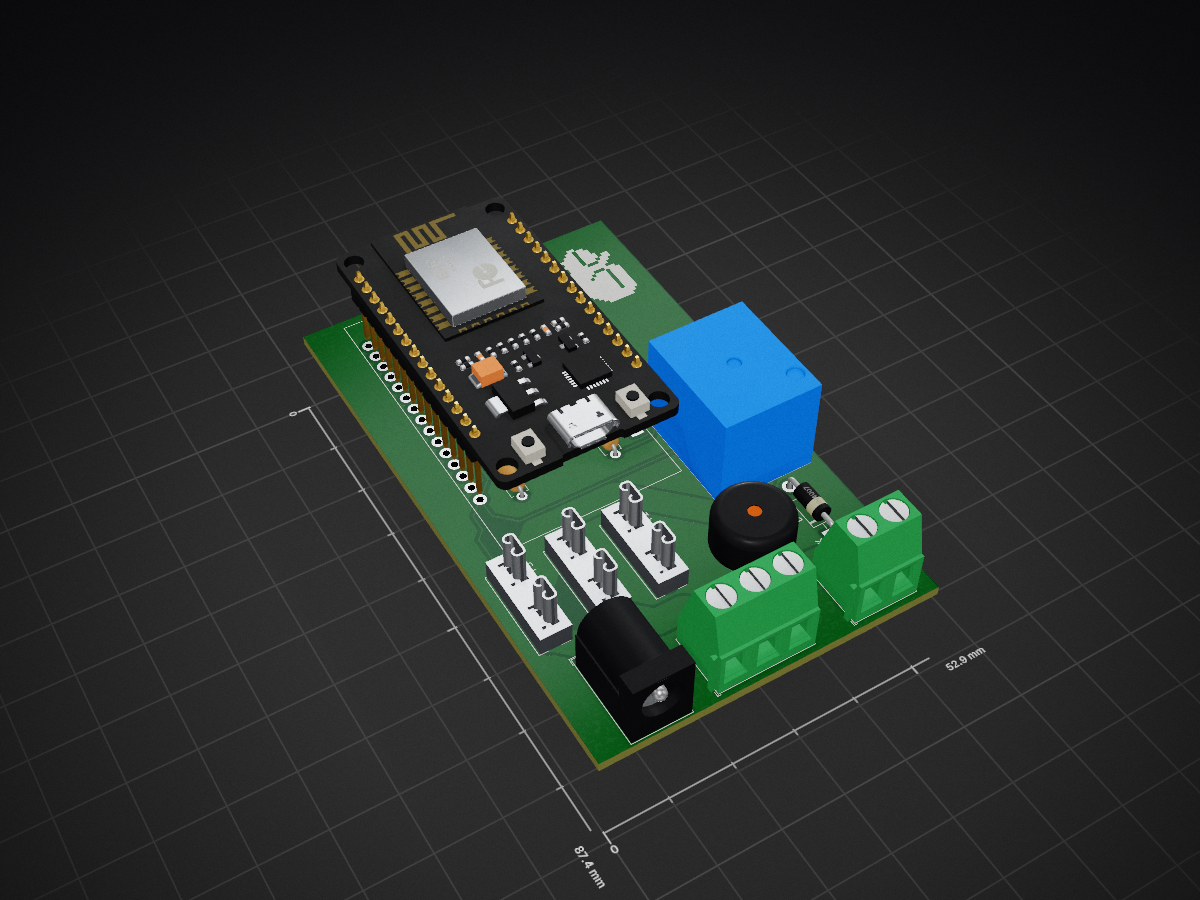
My first designed pcb board to control some LEDs.
Wled is an open-source printed circuit board by KamilJurczenko, from the KamilJurczenko/WLED_Controller repository on GitHub, published under the MIT licence. It is a 2-layer board of 52.9 × 87.4 mm with 15 parts on 41 nets, routed with 92 tracks and 0 vias.
It is built around the SN74AHCT125PW, S8050 and SRD-05VDC-SL-C. Its parts include 3 connectors, 3 fuses, 2 capacitors, 2 resistors and 2 ICs. It belongs with the ESP32 boards of this library.


My first designed pcb board to control some LEDs with a ESP-WROOM-32.
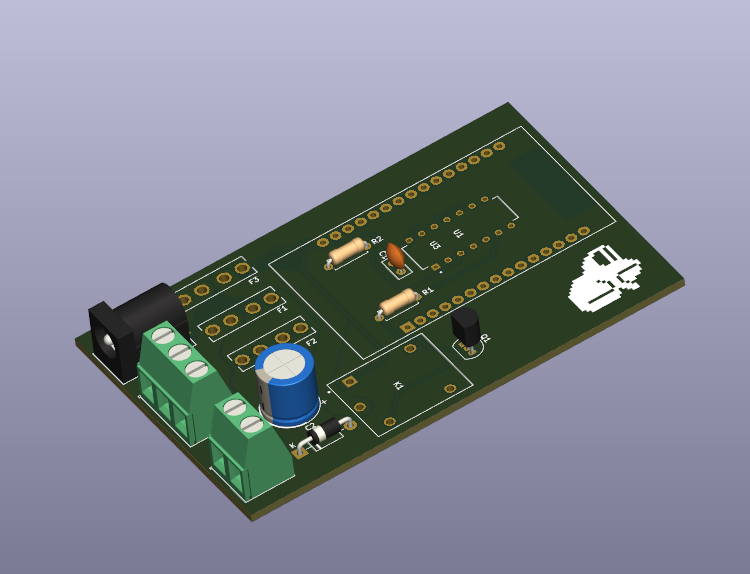
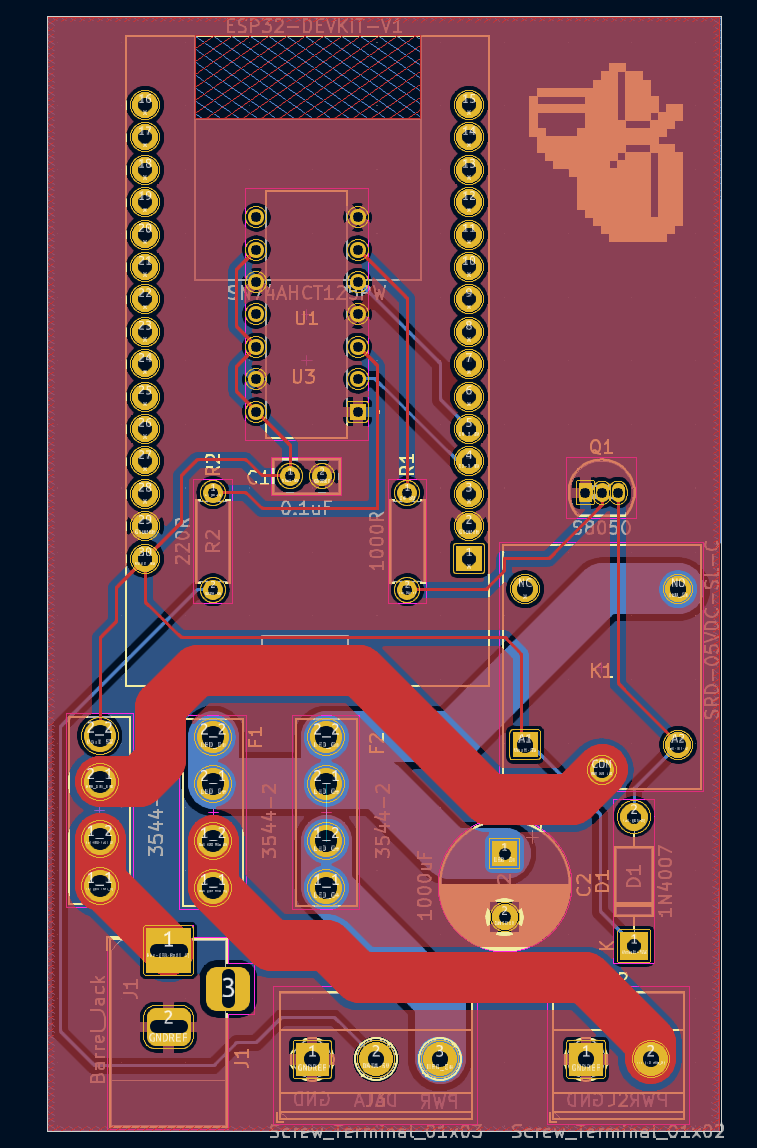
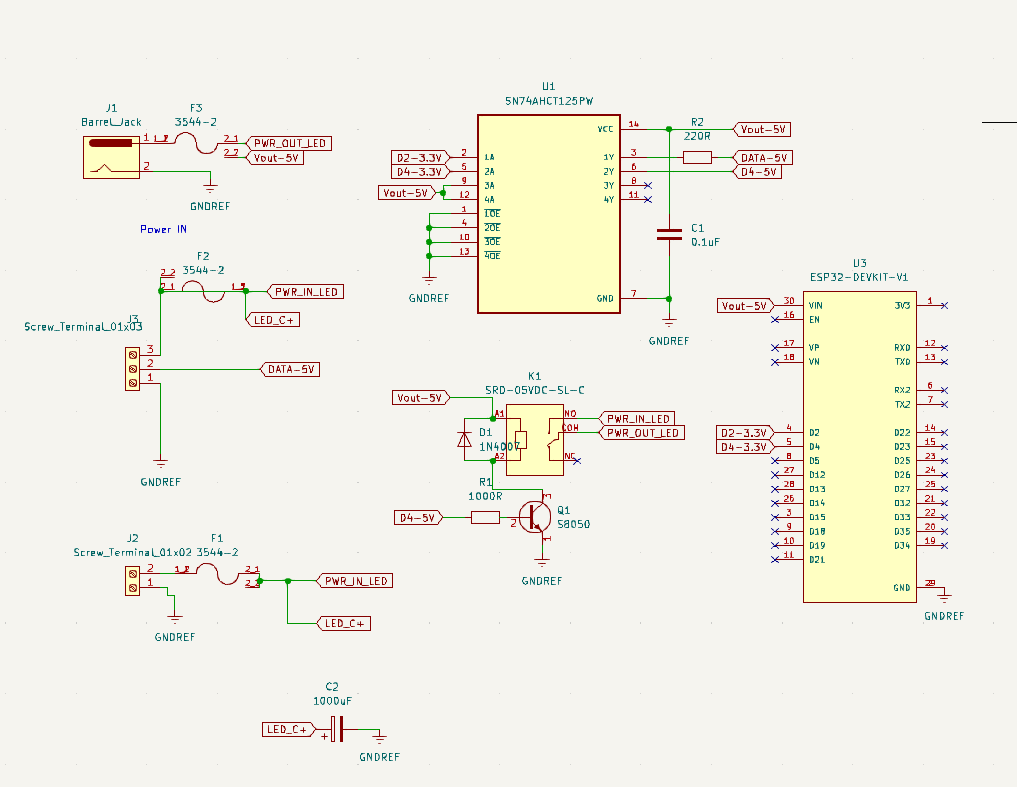
| Qty | Value | Footprint | References |
|---|---|---|---|
| 3 | 3544-2 | Footprints & Symbols:FUSE_3544-2 | F1, F2, F3 |
| 1 | 0.1uF | Capacitor_THT:C_Disc_D5.0mm_W2.5mm_P2.50mm | C1 |
| 1 | 1000R | Resistor_THT:R_Axial_DIN0207_L6.3mm_D2.5mm_P7.62mm_Horizontal | R1 |
| 1 | 1000uF | Capacitor_THT:CP_Radial_D10.0mm_P5.00mm | C2 |
| 1 | 1N4007 | Diode_THT:D_DO-41_SOD81_P10.16mm_Horizontal | D1 |
| 1 | 220R | Resistor_THT:R_Axial_DIN0207_L6.3mm_D2.5mm_P7.62mm_Horizontal | R2 |
| 1 | Barrel_Jack | Connector_BarrelJack:BarrelJack_Horizontal | J1 |
| 1 | ESP32-DEVKIT-V1 | Footprints & Symbols:MODULE_ESP32_DEVKIT_V1 | U3 |
| 1 | S8050 | Package_TO_SOT_THT:TO-92_Inline | Q1 |
| 1 | SN74AHCT125PW | Footprints & Symbols:DIP794W45P254L1930H508Q14 | U1 |
| 1 | SRD-05VDC-SL-C | Footprints & Symbols:RELAY_SRD-05VDC-SL-C | K1 |
| 1 | Screw_Terminal_01x02 | TerminalBlock_Phoenix:TerminalBlock_Phoenix_MKDS-1,5-2-5.08_1x02_P5.08mm_Horizontal | J2 |
| 1 | Screw_Terminal_01x03 | TerminalBlock_Phoenix:TerminalBlock_Phoenix_MKDS-1,5-3_1x03_P5.00mm_Horizontal | J3 |

root670/dance-pad
Dance pad using FSRs and RGB LEDs in an extruded aluminum frame.

mikenorgate/3d-printer-power-hat
A Raspberry PI HAT for controlling power to your 3D printer


rigidus/rigidus.ru
Contacts: email: i.am.rigidus טּ gmail.com jabber: rigidus@jabber.ru

IdahoLabResearch/AcCCS
A collection of tools and scripts used to communicate and emulate Electric Vehicle Communication Controllers (EVCC) and Supply Equipment Communication Controllers (SECC).
It measures 52.9 × 87.4 mm and has 2 copper layers, 1.6 mm thick.
15 parts, built around the SN74AHCT125PW, S8050 and SRD-05VDC-SL-C. The full list of its parts is on this page, with links to each part's symbol and footprint where PCBKit's library has them.
From the KamilJurczenko/WLED_Controller repository on GitHub, at the commit this page was made from: the board is wled.kicad_pcb and its schematic wled.kicad_sch. PCBKit opens the board in the browser, with nothing to install.
Its repository publishes it under the MIT licence: you may reuse it on that licence's terms (keep the author's notice, and for a copyleft licence share your changes alike).