2 layers86 × 54 mm

 JulioxTito/ESP32_Micromouse_PCB_KICAD1
Custom 2-layer PCB designed in KiCad for an autonomous Micromouse robot. Integrates an ESP32-S3 microcontroller, USB-C 5V to 3.3V power regulation, dual I2C distance sensor breakouts, and a motor driver interface.
Esp32 micromouse controller is an open-source printed circuit board by JulioxTito, from the JulioxTito/ESP32_Micromouse_PCB_KICAD repository on GitHub. It is a 2-layer board of 50 × 80 mm with 22 parts on 44 nets, routed with 230 tracks and 24 vias.
It is built around the ESP32-S3-WROOM-1-N8 and AMS1117-3.3. Its parts include 6 resistors, 4 capacitors, 4 connectors, 2 ICs and 2 switches. It belongs with the robots and motor control and interfaces and adapters boards and the ESP32 boards of this library.







A compact robotics breakout and control PCB designed for an autonomous maze-solving Micromouse robot. The board integrates power regulation, dual distance sensor interfaces, and motor driver breakouts around an ESP32-S3 system.
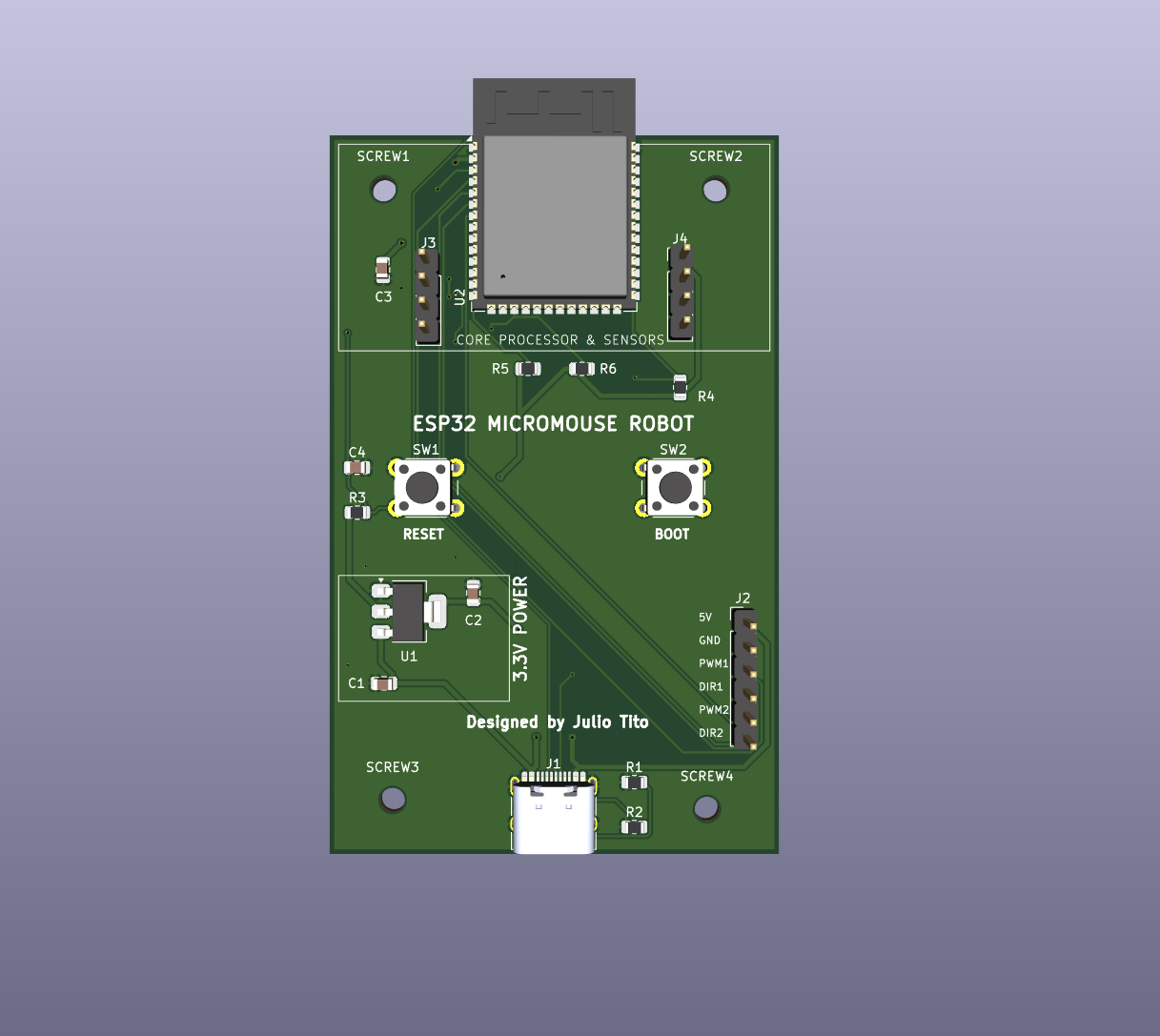
ESP32-S3 Core Module
Dual I2C Distance Sensor Breakouts
Dual DC Motor Driver Interface
USB-C Power Input & 3.3V Regulation
Hardware Control Switches
Chassis Mounting
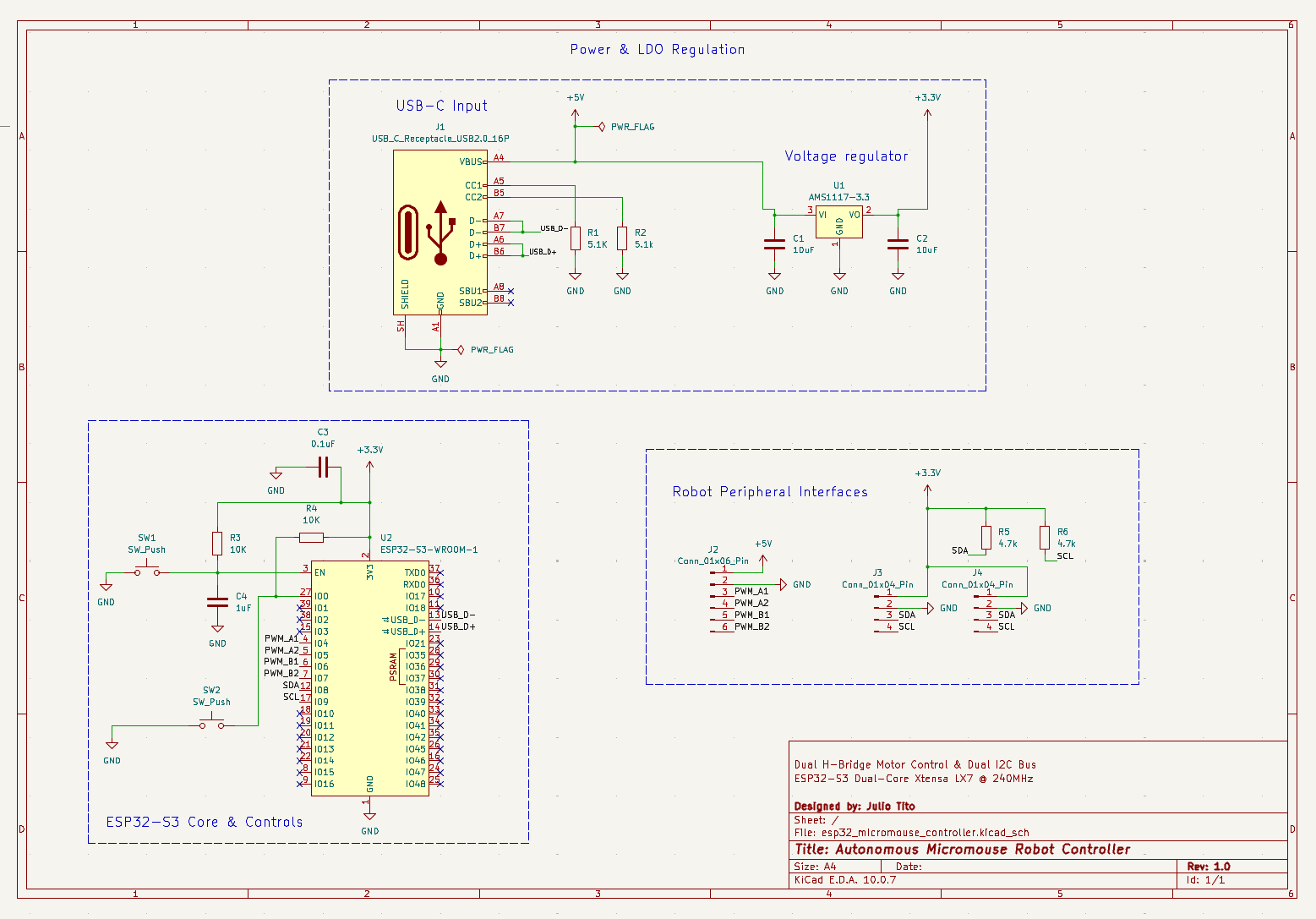
Schematic:
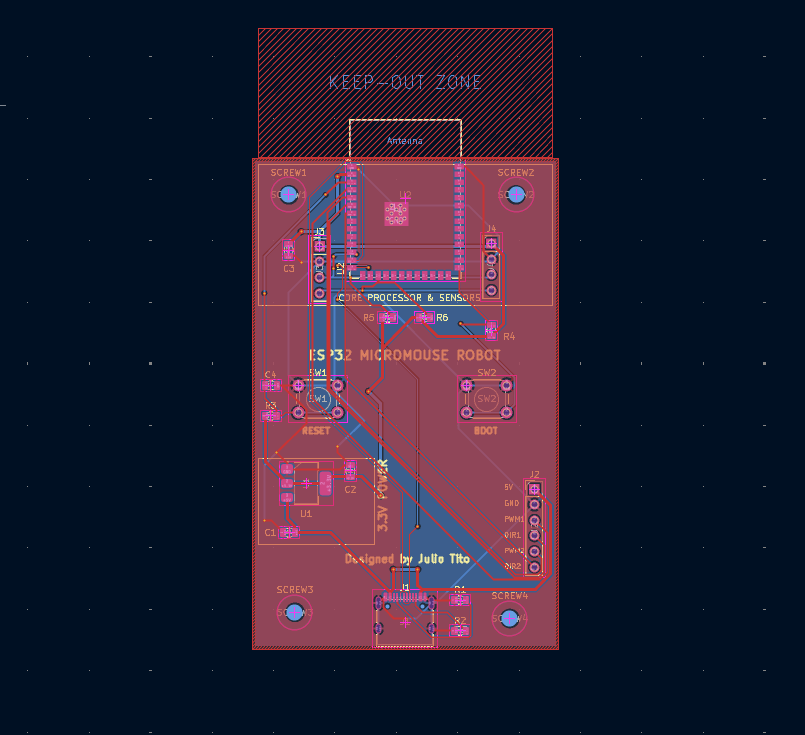
PCB Layout:
| Designator | Component | Footprint / Package | Function |
|---|---|---|---|
| U1 | AMS1117-3.3 | SOT-223 | 5V to 3.3V LDO regulator |
| U2 | ESP32-S3-WROOM-1 | SMD Module | Main system microcontroller |
| J1 | USB-C Receptacle | 16-Pin SMD | 5V power and USB data |
| J2 | Pin Header 1x06 | 2.54 mm Pitch TH | Motor driver interface |
| J3, J4 | Pin Header 1x04 | 2.54 mm Pitch TH | Left and right I2C distance sensors |
| SW1, SW2 | Tactile Switch | 6x6 mm Pushbutton | RESET and BOOT triggers |
| R1, R2 | 5.1k Resistor | 0805 SMD | USB-C CC line pull-downs |
| R3, R4 | 10k Resistor | 0805 SMD | EN and BOOT pull-up network |
| R5, R6 | 4.7k Resistor | 0805 SMD | I2C SDA and SCL bus pull-ups |
| C1, C2 | 10uF Capacitor | 0805 SMD | LDO input and output decoupling |
| C3, C4 | 0.1uF / 1uF Capacitor | 0805 SMD | Power rail filtering and reset debounce |
Julio Tito
Rutgers University – New Brunswick
B.S. in Electrical and Computer Engineering
| Qty | Value | Footprint | References |
|---|---|---|---|
| 4 | MountingHole_2.7mm_M2.5 | MountingHole:MountingHole_2.7mm_M2.5 | SCREW1, SCREW2, SCREW3, SCREW4 |
| 2 | 10K | Resistor_SMD:R_0805_2012Metric | R3, R4 |
| 2 | 10uF | Capacitor_SMD:C_0805_2012Metric | C1, C2 |
| 2 | 4.7k | Resistor_SMD:R_0805_2012Metric | R5, R6 |
| 2 | Conn_01x04_Pin | Connector_PinHeader_2.54mm:PinHeader_1x04_P2.54mm_Vertical | J3, J4 |
| 2 | SW_Push | Button_Switch_THT:SW_PUSH_6mm | SW1, SW2 |
| 1 | 0.1uF | Capacitor_SMD:C_0805_2012Metric | C3 |
| 1 | 1uF | Capacitor_SMD:C_0805_2012Metric | C4 |
| 1 | 5.1K | Resistor_SMD:R_0805_2012Metric | R1 |
| 1 | 5.1k | Resistor_SMD:R_0805_2012Metric | R2 |
| 1 | AMS1117-3.3 | Package_TO_SOT_SMD:SOT-223-3_TabPin2 | U1 |
| 1 | Conn_01x06_Pin | Connector_PinHeader_2.54mm:PinHeader_1x06_P2.54mm_Vertical | J2 |
| 1 | ESP32-S3-WROOM-1 | RF_Module:ESP32-S3-WROOM-1 | U2 |
| 1 | USB_C_Receptacle_USB2.0_16P | Connector_USB:USB_C_Receptacle_HRO_TYPE-C-31-M-12 | J1 |


DevMubarak1/PidginTranslator
Handheld translator for Nigerian languages. No internet needed for common phrases, YarnGPT for everything else.


Tomas-Kuchta-FPV/Open-ESPilot
An open-source project to develop a custom ESP32-based flight controller designed primarily for use with ArduPilot. Focused on affordability, flexibility, and ease of integration with various robotic and UAV platforms.

RoboticsBrno/Robutek
Robůtek je robotická platforma založená na čipu ESP32-S3. Je velice rozšitiřelný, ale ze základu umí jezdit, kreslit fixou, jezdit po čáře, pohybovat se bludištěm. Programování je přes Jaculus.

romioRN/Dash6.8-hardware
wifi name "service", password 12345678, connect to 192.167.4.1

It measures 50 × 80 mm and has 2 copper layers, 1.6 mm thick.
22 parts, built around the ESP32-S3-WROOM-1-N8 and AMS1117-3.3. The full list of its parts is on this page, with links to each part's symbol and footprint where PCBKit's library has them.
From the JulioxTito/ESP32_Micromouse_PCB_KICAD repository on GitHub, at the commit this page was made from: the board is Hardware_Files/esp32_micromouse_controller.kicad_pcb and its schematic Hardware_Files/esp32_micromouse_controller.kicad_sch. PCBKit opens the board in the browser, with nothing to install.
Its repository states no licence, so its author keeps all rights: ask JulioxTito before reusing the design.