2 layers126 × 108 mm
Mixerli
stahlnow/mixerli
Battery powered 10 channel (4x2 + 1x2) stereo mixer featuring stereo input level control slider and stereo rotary aux send level control.
166 parts13CERN-OHL-S-2.0
 IRNAS/bGeigieIntegrated6
Integrated version of Safecast bGeigie device
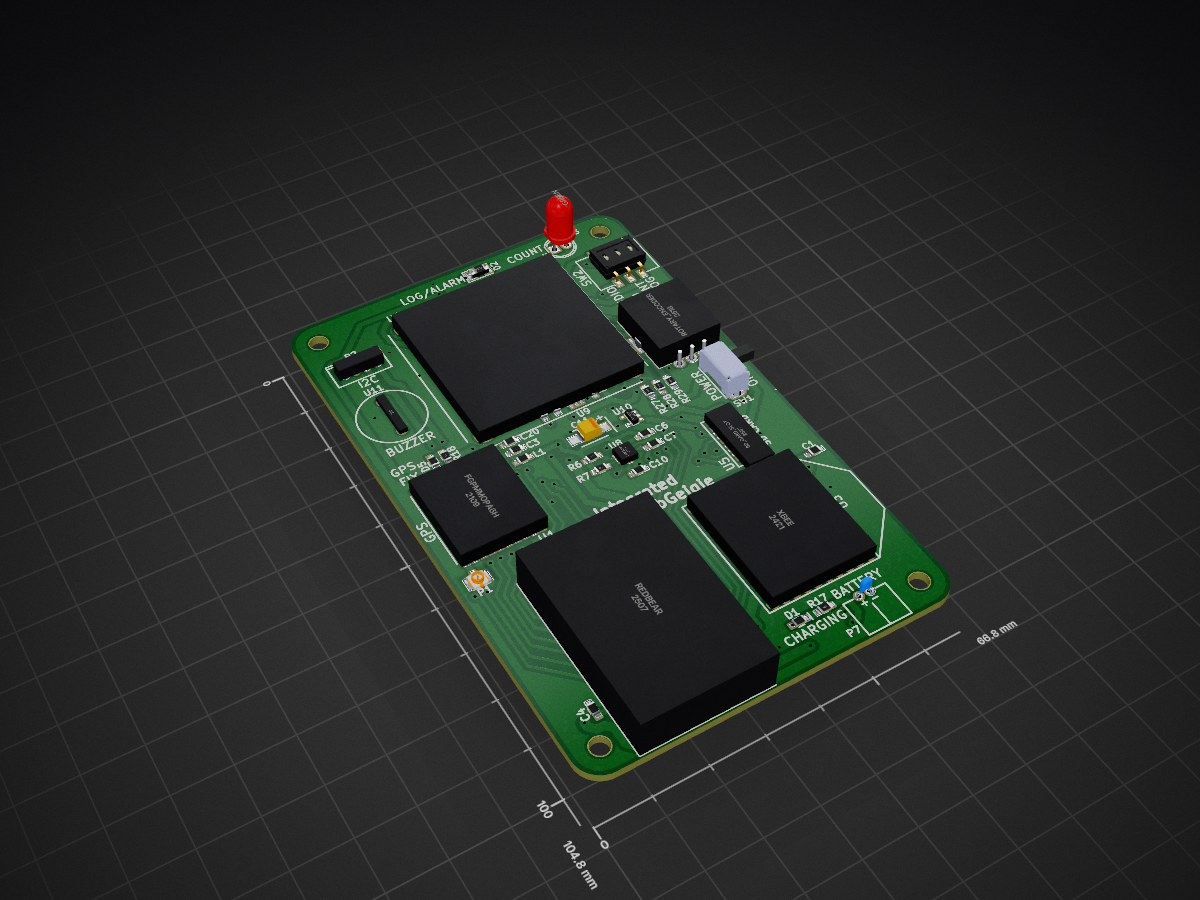
Kicad project geiger is an open-source printed circuit board by IRNAS, from the IRNAS/bGeigieIntegrated repository on GitHub. It is a 2-layer board of 66.8 × 104.8 mm with 93 parts on 58 nets, routed with 1,126 tracks and 106 vias.
It is built around the LSM303C, LM3880-1AC and MIC5205YM5, with the SI1967DH, RSR010N10FHATL and ZXMP6A13FTA among its other parts. Its parts include 31 resistors, 20 capacitors, 15 ICs, 7 transistors and 6 diodes. It belongs with the sensors and measurement and power boards of this library.


We created an integrated version of the bGeigie device, a mobile survey Geiger counter. Our PCB is based on orginal design by Safecast. We removed various breakout boards and instead placed most of the components directly on the PCB. Our design uses RedBear Duo as a central processing unit, instead of Arduino Fio. The entire circuit can be powered through USB connector on RedBear, or from a 3.7V LiPo battery. The circuit also includes a battery charger. For control of the Geiger gas tube the iRover is being used, just like in the original design. A LED and a piezo buzzer signalyze the incoming pulses. FGPMMOPA6H GPS receiver from Adafruit retrieves the current position of the device and an accelerometer/magnetometer (LSM303C form ST Microelectronics) measures acceleration and orientation of it. Data are being logged on a micro SD card. A socket for the XBee module is also included, which enables connection to an external logger. A monochrome, 128x32 pixels wide OLED graphical display from Adafruit displays a simple user interface. Accelerometer/magnetometer uses an I2C interface. SD card and OLED display communicate via SPI. XBee and GPS module are using an UART interface.
All our projects are as usefully open-source as possible.
Hardware including documentation is licensed under CERN OHL v.1.2. license
Firmware and software originating from the project is licensed under GNU GENERAL PUBLIC LICENSE v3.
Open data generated by our projects is licensed under CC0.
All our websites and additional documentation are licensed under [Creative Commons Attribution-ShareAlike 4 .0 Unported License] (https://creativecommons.org/licenses/by-sa/4.0/legalcode).
What this means is that you can use hardware, firmware, software and documentation without paying a royalty and knowing that you'll be able to use your version forever. You are also free to make changes but if you share these changes then you have to do so on the same conditions that you enjoy.
Koruza, GoodEnoughCNC and IRNAS are all names and marks of Institut IRNAS Rače. You may use these names and terms only to attribute the appropriate entity as required by the Open Licences referred to above. You may not use them in any other way and in particular you may not use them to imply endorsement or authorization of any hardware that you design, make or sell.
| Qty | Value | Footprint | References |
|---|---|---|---|
| 12 | 10K | RedBear:R_0603_HandSoldering | R4, R5, R6, R7, R19, R27, R28, R29, R30, R31, R32, R33 |
| 11 | 100nF | RedBear:R_0603_HandSoldering | C1, C3, C4, C6, C7, C8, C9, C10, C12, C15, C17 |
| 5 | 1K | RedBear:R_0603_HandSoldering | R1, R10, R13, R17, R18 |
| 5 | 470K | RedBear:R_0603_HandSoldering | R8, R12, R15, R16, R21 |
| 4 | 10uF | RedBear:TantalC_SizeB_EIA-3528_HandSoldering | C2, C5, C11, C19 |
| 4 | MountingHole_3.2mm_M3 | Mounting_Holes:MountingHole_3.2mm_M3 | , , , |
| 4 | RSR010N10FHATL | sot_32_standard:SOT-23 | Q2, Q3, Q6, Q7 |
| 2 | 0K | RedBear:R_0603_HandSoldering | R24, R25 |
| 2 | 10nF | RedBear:R_0603_HandSoldering | C16, C18 |
| 2 | 1uF | RedBear:TantalC_SizeB_EIA-3528_HandSoldering | C13, C14 |
| 2 | 9.1K | RedBear:R_0603_HandSoldering | R2, R9 |
| 2 | LOGO | opensource_hardware:LOGO | G***, G*** |
| 2 | ZXMP6A13F | sot_32_standard:SOT-23 | Q1, Q4 |
| 1 | 0R | RedBear:R_0603_HandSoldering | R26 |
| 1 | 100K | RedBear:R_0603_HandSoldering | R3 |
| 1 | 1N4148 | SOD-323_standard:SOD-323 | D4 |
| 1 | 1uF | RedBear:R_0603_HandSoldering | C20 |
| 1 | 51K | RedBear:R_0603_HandSoldering | R14 |
| 1 | 51R | RedBear:R_0603_HandSoldering | R11 |
| 1 | 68R | RedBear:R_0603_HandSoldering | R20 |
| 1 | BAT20J | SOD-323_standard:SOD-323 | D6 |
| 1 | BATTERY | B2B-PH-SM4-TB_Battery_Connector:B2B-PH-SM4-TB_Battery_Connector | P7 |
| 1 | BC847C | sot_32_standard:SOT-23 | Q5 |
| 1 | FGPMMOPA6H | FGPMMOPA6H_GPS:FGPMMOPA6H_GPS | U1 |
| 1 | Ferrite | RedBear:R_0603_HandSoldering | L1 |
| 1 | GREEN | MCL053SGC:MCL053SGC | D3 |
| 1 | GREEN | RedBear:LED_0603_HandSoldering | D1 |
| 1 | I ROVER | B3B-PH-SM4-TB_IROVER_CONNECTOR:B3B-PH-SM4-TB_IROVER_CONNECTOR | P4 |
| 1 | I2C_connector | DIP Grove 4P-2.0:DIP_Grove_4P-2_0 | P2 |
| 1 | LM3880 | LM3880:LM3880 | U9 |
| 1 | LOGO | safecast_logo:LABEL | G*** |
| 1 | LSM303C | LSM303C:LSM303C | U8 |
| 1 | LTC4412 | LTC4412:LTC4412 | U14 |
| 1 | MAX1555 | RedBear:SOT-23-5 | U2 |
| 1 | MCP1826S | MCP1826S:MCP1826S_SOT223 | U6 |
| 1 | MIC5205 | MIC5205:MIC5205 | U10 |
| 1 | OLED-PCB | Adafruit-1_3inch-128x64-Mono-OLED-PCB-master:Adafruit-1_3inch-128x64-Mono-OLED-PCB-master | U4 |
| 1 | RED | KPD-3224SURCK:KPD-3224SURCK | D2 |
| 1 | RED | RedBear:LED_0603_HandSoldering | D5 |
| 1 | RedBear | RedBear:RedBear | U7 |
| 1 | SD_CARD_SLOT | MOLEX_47309-2651_CONNECTOR_MICRO_SD:MOLEX_47309-2651_CONNECTOR_MICRO_SD | U5 |
| 1 | SWITCH_INV | OS102011MA1QN1_slide_switch:OS102011MA1QN1_slide_switch | SW1 |
| 1 | SW_DIP_3 | OMRON_ELECTRONIC_COMPONENTS_A6S-3102-H_DIP_Switch:OMRON_ELECTRONIC_COMPONENTS_A6S-3102-H_DIP_Switch | SW2 |
| 1 | Si1967DH | Si1967DH:Si1967DH | U15 |
| 1 | XBee | xbee:xbee | U3 |
| 1 | buzzer | LD-BZEG-1205:LD-BZEG-1205 | U11 |
| 1 | rotary_encoder | rotary_enc_bourns_EC12R-4215F-S0024:rotary_enc_bourns_EC12R-4215F-S0024 | U12 |
| 1 | small_i2c_oled | Small_I2C_OLED:Small_I2C_OLED | U13 |
| 1 | uFL_conn | UFL-R-SMT:U.FL-R-SMT | P1 |
stahlnow/mixerli
Battery powered 10 channel (4x2 + 1x2) stereo mixer featuring stereo input level control slider and stereo rotary aux send level control.

wolfgangfriedrich/AnalogShield-01
Arduino Schield Pixi Analog I/O 20channel KiCAD design files

andrzejkasica/CO-sensor
Project based on ME2-CO gas sensor with current loop and 2 relays output.


It measures 66.8 × 104.8 mm and has 2 copper layers, 1.6 mm thick.
93 parts, built around the LSM303C, LM3880-1AC, MIC5205YM5 and SI1967DH. The full list of its parts is on this page, with links to each part's symbol and footprint where PCBKit's library has them.
From the IRNAS/bGeigieIntegrated repository on GitHub, at the commit this page was made from: the board is KiCAD project/kicad_project_geiger.kicad_pcb. PCBKit opens the board in the browser, with nothing to install.
Its repository states no licence, so its author keeps all rights: ask IRNAS before reusing the design.