4 layers77 × 48.6 mm
NX ISD v1p4
Ghost3379/NX-ISD
A more sophisticated version of the Artemis Watch by Circuitmess.
116 parts2GPL-3.0

 Ghost3379/NX-ISD2
A more sophisticated version of the Artemis Watch by Circuitmess.
NX ISD is an open-source printed circuit board by Ghost3379, from the Ghost3379/NX-ISD repository on GitHub, published under the GPL-3.0 licence. It is a 4-layer board of 77 × 48.6 mm with 116 parts on 122 nets, routed with 1,088 tracks and 275 vias.
It is built around the ESP32-S3-WROOM-1-N16R8, BME690 and MAX30102, with the OPT3001DNPR, TLV62568DBV and ZDSD02GLGEAG among its other parts. Its parts include 31 capacitors, 29 resistors, 16 ICs, 4 transistors and 3 diodes. It belongs with the ESP32 boards of this library.


The NX-ISD is a custom, highly integrated wearable and embedded development board inspired by the Artemis Watch. It serves as the hardware foundation for the ISD-Core operating system.
[!TIP] Active Production Milestone — Hardware Revision v1.4 (Current & Recommended):
Revision v1.4 is the active, production-ready hardware milestone featuring an integrated rechargeable supercapacitor for continuous RTC timekeeping, high-speed 4-bit SDMMC MicroSD storage, a direct 40 MHz 3.3V SPI display bus (TXB0106 level shifter eliminated), tactile BOOT/RST buttons, enhanced copper heatsinking, and a cyberpunk industrial silkscreen aesthetic.
📦 Fabrication Package (Gerbers & Drill):ISD-PCB/NX-ISD_v1p4/production/NX-ISD_v1p4.zip
📜 Complete 5-Page Circuit Diagram:docs/circuit diagrams/NX-ISD_v1p4.pdf
🏭 Fabrication & Ordering Guide:ISD-PCB/PRODUCTION-GUIDE.md
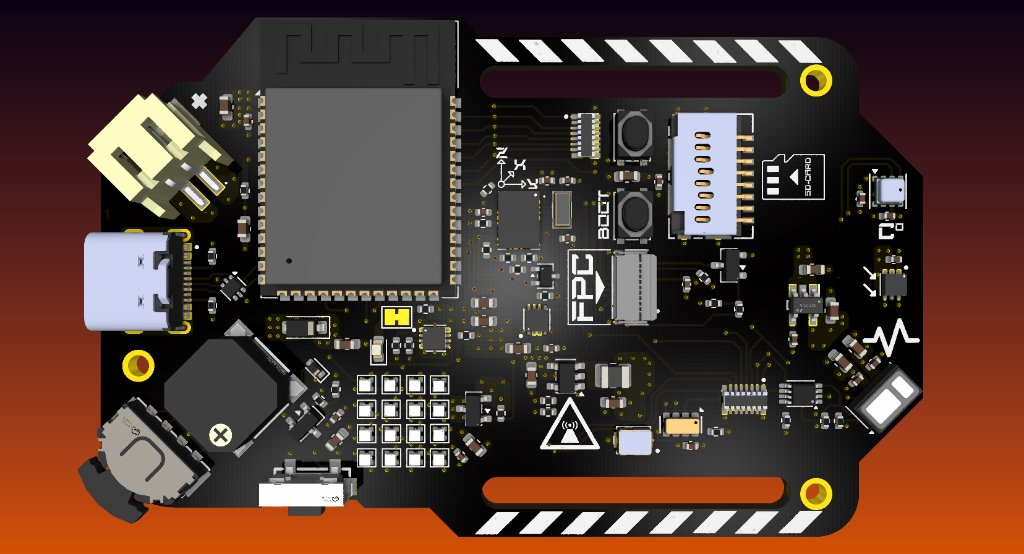
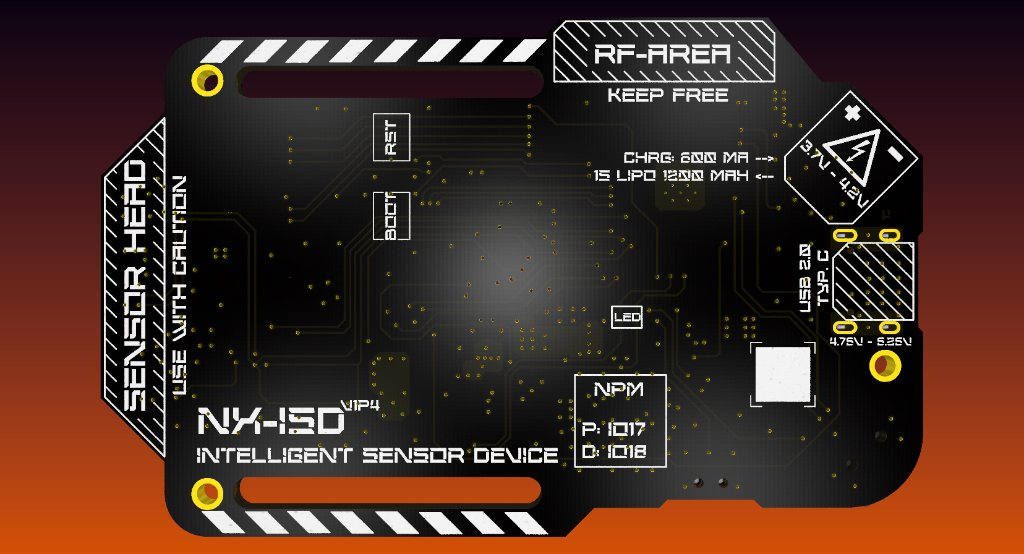
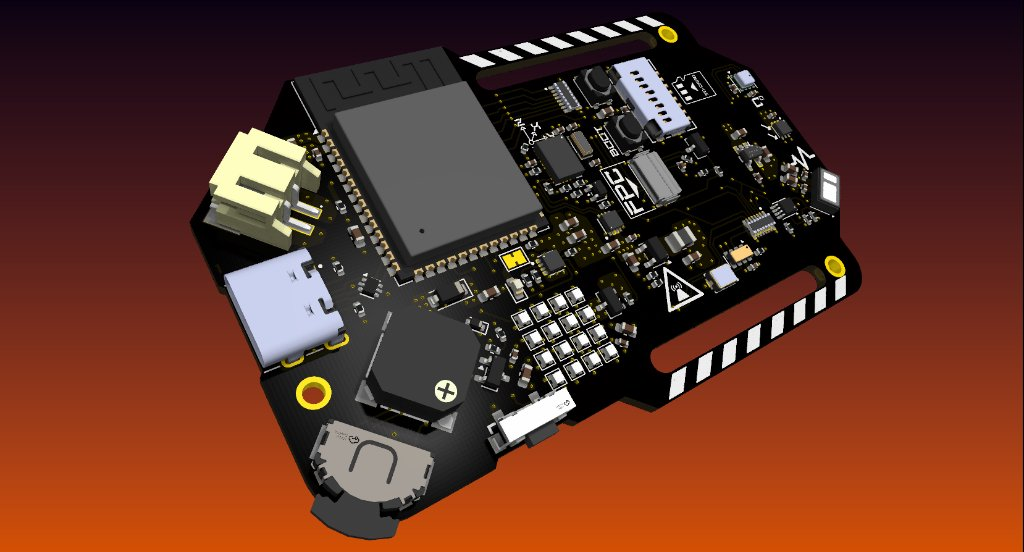
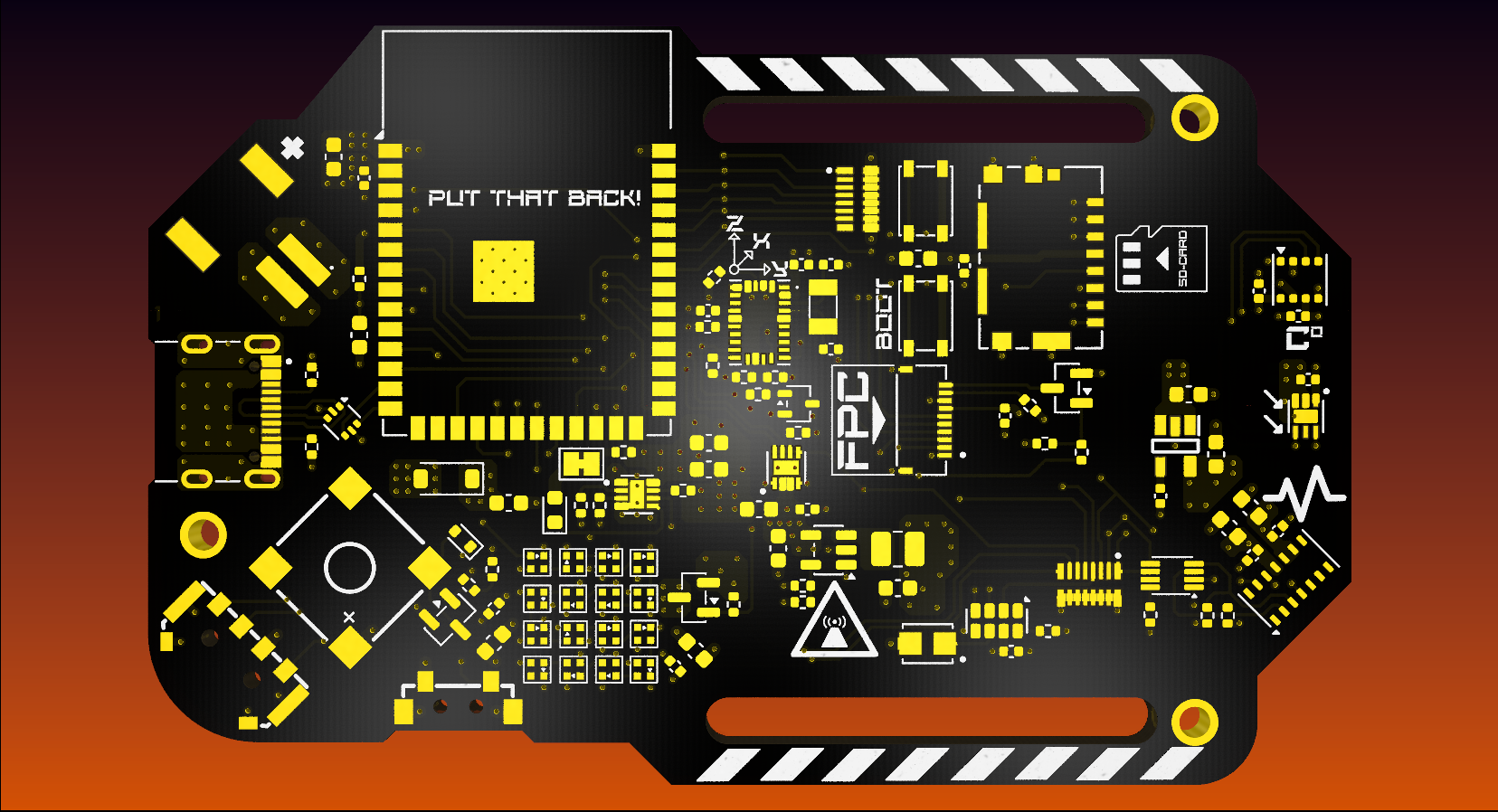
NX-ISD Hardware Revision v1p4 (KiCad Raytraced 3D Renders) — Populated Top View, Bottom Silkscreen, Perspective Isometric Angle, and Bare ENIG Finish.
N X - I S D
│     │
│     └─► Intelligent Sensor Device (Hardware Foundation)
│           │
│           ▼
│       ISD-Core
│           │
│           ├─► Custom Operating System (Dual-Core FreeRTOS based)
│           ├─► Built on PlatformIO / Arduino Framework
│           │
│           ├──► NX-MSF: Mathematical Sensor Fusion (Physics Models & Kalman Filters)
│           ├──► NX-AIS: Advanced Information System (Contextual Advisory Engine)
│           └──► NX-SDS: Self-Diagnostic System (Hardware Integrity & Proof-Testing)
│
└─► Prototyping Series (Continuous Development Environment)ISD-PCB/NX-ISD_v1p4/ISD-PCB/NX-ISD_v1p3/ISD-PCB/NX-ISD_v1p0/J4, Molex 105162-0001) operating in 4-bit SDMMC bus mode via the ESP32-S3 GPIO Matrix (SD_CLK IO41, SD_CMD IO43, SD_DAT0 IO44, SD_DAT1 IO42, SD_DAT2 IO1, SD_DAT3 IO2)Y1)U9)CPH3225A rechargeable supercapacitor (C5) charged via internal silicon trickle charger (~6.2 days continuous autonomous timekeeping)!ALERT interrupt line)DMP3130L-7 P-MOSFETs for USB/Battery power-path management and NeoPixel sleep cutoff; ZXMN3B14FTA 30V N-MOSFETs for acoustic buzzer and display backlight controlJ3). Operates natively on a direct 3.3V SPI bus at 40 MHz (TXB0106 level shifter eliminated for rock-solid signal integrity)IO17 enable, IO18 data) and local decoupling capacitorsSMD-8503-3627-16Ω) with flyback diode protectionTM-2025A 5-way navigation: Up, Down, Left, Right, Center Push)SW2) and RST (SW1) Micro Push-Buttons for effortless flashing and recoveryThe board is programmed via PlatformIO (Arduino Framework) and is optimized to run the custom ISD-Core operating system. The software stack is composed of core modular subsystems:
SensorState telemetry, 3D Cover Flow launcher, 360° radial dials, and smoothstep backlight transitions. See ISD-Core/README.md for the software architecture and ISD-Core/MANUAL.md for the complete user manual.StorageManager): Manages non-volatile configuration storage, sensor logs, and system data on high-speed MicroSD storage (4-bit SDMMC mode on v1.4 hardware; SPI NAND on legacy v1.3 prototype). Stores a 64-byte packed binary struct (/sys/config.bin) with CRC-16 validation and a zero-wear save policy (writes occur only on user confirmation/exit, never while dialing).tools/isd_cli.py / isd-cli): Standalone PC terminal tool providing blind navigation control, live sensor monitoring, BLE Uplink Bridge triggering, and offline /sys/config.bin binary inspection, verification, and JSON conversion.ISD-PCB/PRODUCTION-GUIDE.md — Complete JLCPCB ordering parameters, mechanical drawings/dimensions, stencil specs, and hand assembly workflow.ISD-PCB/NX-ISD_v1p4/production/NX-ISD_v1p4.zip — Ready-to-order RS-274X Gerbers and drill files for revision v1.4.ISD-PCB/NX-ISD_v1p4/bom/NX-ISD_v1p4_IBOM.html — Interactive visual assembly BOM highlighting components and pads.ISD-Core/MANUAL.md — Comprehensive guide covering physical controls, screen layouts, the 6 core application decks, 360° radial dials, and storage persistence.ISD-Core/README.md — Technical operating system internals, pin maps, and PlatformIO build instructions.ISD-PCB/README.md — Hardware schematics, power budgets, layer stackup, and BOM.FEATURE_LIST.md — Technical specifications, mathematical formulas, and implementation roadmap.ISD-Core/SW-TODO.md — Core application deck progress and feature checklist.In the spirit of full open-source transparency:
The software/firmware in the [ISD-Core] directory is licensed under the GNU General Public License v3.0 (GPLv3).
The hardware design files in the [ISD-PCB] directory are licensed under the CERN Open Hardware Licence Version 2 - Strongly Reciprocal (CERN-OHL-S).
| Qty | Value | Footprint | References |
|---|---|---|---|
| 16 | XL-1010RGBC-WS2812B | Global Footprints:LED-SMD_4P-L1.0-W1.0-TL_XL-1010RGBC-WS2812B | G1, G2, G3, G4, G5, G6, G7, G8, G9, G10, G11, G12, G13, G14, G15, G16 |
| 13 | 100n | Capacitor_SMD:C_0402_1005Metric | C12, C13, C17, C18, C19, C20, C21, C25, C27, C28, C29, C30, C31 |
| 11 | 10k | Resistor_SMD:R_0402_1005Metric | R8, R13, R14, R16, R17, R18, R19, R24, R26, R28, R29 |
| 8 | 1u | Capacitor_SMD:C_0603_1608Metric | C1, C4, C5, C8, C9, C10, C16, C26 |
| 4 | 10u | Capacitor_SMD:C_0603_1608Metric | C6, C11, C24, C33 |
| 3 | 51.1k | Resistor_SMD:R_0402_1005Metric | R20, R21, R22 |
| 2 | 10n | Capacitor_SMD:C_0402_1005Metric | C3, C7 |
| 2 | 1k | Resistor_SMD:R_0402_1005Metric | R7, R9 |
| 2 | 220 | Resistor_SMD:R_0402_1005Metric | R23, R25 |
| 2 | 22p | Capacitor_SMD:C_0402_1005Metric | C22, C23 |
| 2 | 4.7k | Resistor_SMD:R_0402_1005Metric | R11, R12 |
| 2 | 4.7u | Capacitor_SMD:C_0603_1608Metric | C2, C32 |
| 2 | 5.1k | Resistor_SMD:R_0402_1005Metric | R1, R2 |
| 2 | AO3400A | Package_TO_SOT_SMD:SOT-23 | Q3, Q4 |
| 1 | |||
| 1 | 1-2328702-0 | NX-AW-footprints:TE_1-2328702-0 | J2 |
| 1 | 10 | Resistor_SMD:R_0402_1005Metric | R27 |
| 1 | 100K | Resistor_SMD:R_0402_1005Metric | R10 |
| 1 | 100k | Resistor_SMD:R_0402_1005Metric | R4 |
| 1 | 10k NTC | Resistor_SMD:R_0402_1005Metric | TH1 |
| 1 | 1N4148WT | Diode_SMD:D_SOD-523 | D3 |
| 1 | 2.2u | Inductor_SMD:L_1008_2520Metric | L1 |
| 1 | 200k | Resistor_SMD:R_0402_1005Metric | R15 |
| 1 | 27k | Resistor_SMD:R_0402_1005Metric | R5 |
| 1 | 32.768 kHz | Crystal:Crystal_SMD_3215-2Pin_3.2x1.5mm | Y1 |
| 1 | 453k | Resistor_SMD:R_0402_1005Metric | R3 |
| 1 | 499 | Resistor_SMD:R_0402_1005Metric | R6 |
| 1 | AO3401A | Package_TO_SOT_SMD:SOT-23 | Q2 |
| 1 | BC847W | Package_TO_SOT_SMD:SOT-323_SC-70 | Q1 |
| 1 | BME690 | Package_LGA:Bosch_LGA-8_3x3mm_P0.8mm_ClockwisePinNumbering | U7 |
| 1 | BNO085 | Global Footprints:IC_BNO085 | U11 |
| 1 | BOOT | Jumper:SolderJumper-2_P1.3mm_Open_TrianglePad1.0x1.5mm | JP3 |
| 1 | BQ25170DSGR | Global Footprints:SON50P200X200X80-9N | U5 |
| 1 | CUT2DISABLE | Jumper:SolderJumper-2_P1.3mm_Bridged_Pad1.0x1.5mm | JP1 |
| 1 | ESP32-S3-WROOM-1-N16R8 | RF_Module:ESP32-S3-WROOM-1 | U13 |
| 1 | LOGO | graphics:power-warning | G*** |
| 1 | LOGO | graphics:heart-rate | G*** |
| 1 | MAX17048G_T10 | Global Footprints:SON50P200X200X80-9N | U6 |
| 1 | MAX30102 | OptoDevice:Maxim_OLGA-14_3.3x5.6mm_P0.8mm | U8 |
| 1 | NRVB230LSFT1G | Diode_SMD:D_SOD-123 | D1 |
| 1 | OPT3001DNPR | Global Footprints:SON65P200X200X65-7N | U10 |
| 1 | ORANGE | LED_SMD:LED_0603_1608Metric | D2 |
| 1 | PCA9306 | Package_SO:VSSOP-8_2.3x2mm_P0.5mm | U9 |
| 1 | RESET | Jumper:SolderJumper-2_P1.3mm_Open_TrianglePad1.0x1.5mm | JP2 |
| 1 | RT9193-18GB | NX-AW-footprints:SOT23-5 | U1 |
| 1 | RT9193-28GB | Global Footprints:SOT23-5 | U4 |
| 1 | RV-3028-C7 | Package_SON:MicroCrystal_C7_SON-8_1.5x3.2mm_P0.9mm | U12 |
| 1 | S2B-PH-SM4-TB | Global Footprints:JST_S2B-PH-SM4-TB | P1 |
| 1 | SMD-8503-3627-16Ω | Global Footprints:BUZ-SMD_4P-L8.5-W8.5-BR-1 | B1 |
| 1 | TLV62568DBV | Package_TO_SOT_SMD:SOT-23-5 | U3 |
| 1 | TM-2025A | Global Footprints:SW-SMD_TM-2025A | U16 |
| 1 | TS-1101VS-C-A-A | Global Footprints:KEY-SMD_TS-1101VS-C-A-A | S1 |
| 1 | TXB0106RGY | Package_DFN_QFN:Texas_RGY_R-PVQFN-N16_EP2.05x2.55mm | U15 |
| 1 | UJ20-C-H-G-SMT-1-P16-TR | Global Footprints:SAMESKY_UJ20-C-H-G-SMT-1-P16-TR | J1 |
| 1 | USBLC6-2P6 | Package_TO_SOT_SMD:SOT-666 | U2 |
| 1 | YC248-JR-074K7L | NX-AW-footprints:RESCAXS50P400X160X55-16N | RN1 |
| 1 | ZDSD02GLGEAG | NX-AW-footprints:LGA-8_L8.0-W6.0-P1.27-TL_ZDSD02GLGEAG | U14 |
The 114 most common of 116 parts.
Ghost3379/NX-ISD
A more sophisticated version of the Artemis Watch by Circuitmess.

Ghost3379/NX-ISD
A more sophisticated version of the Artemis Watch by Circuitmess.

CopperPilot/CM5-AI-Cam-CopperPilot
A Raspberry Pi Compute Module 5 carrier for edge AI vision, in the CM5's own 55 × 40 mm footprint. 100 Ω MIPI and HDMI pairs, 90 Ω USB.

Tom-Michiels/TiltBox
A handheld retro game console with tilt controls, featuring 9 games on an 8x8 LED matrix. Designed at maakleerplek


PicoballoonLabs/Debug-Boards
Hardware designs for the integrated debug probe, debug adapter, flex debug cables and RF VNA calibrator

ProyectoSoberana/Placa-Madre
Proyectos KiCad originados en el proyecto Basilisk de ETH Zürich, adaptados para el Proyecto Soberana. Contienen los archivos de diseño (esquemáticos, layout PCB y Gerbers) de los dos PCBs que componen el sistema de…

KiCad/kicad-source-mirror
This is an active mirror of the KiCad development branch, which is hosted at GitLab (updated every time something is pushed). Pull requests on GitHub are not accepted or watched.


CapnRon/gnw-zelda-microsd-kicad
Castellated-edge microSD interposer for the Game & Watch: The Legend of Zelda console mod scene — original KiCad artwork, CERN-OHL-S v2
It measures 77 × 48.6 mm and has 4 copper layers, 1.6 mm thick.
116 parts, built around the ESP32-S3-WROOM-1-N16R8, BME690, MAX30102 and OPT3001DNPR. The full list of its parts is on this page, with links to each part's symbol and footprint where PCBKit's library has them.
From the Ghost3379/NX-ISD repository on GitHub, at the commit this page was made from: the board is ISD-PCB/NX-ISD_v1p3/NX-ISD.kicad_pcb and its schematic ISD-PCB/NX-ISD_v1p0/NX-ISD.kicad_sch. PCBKit opens the board in the browser, with nothing to install.
Its repository publishes it under the GPL-3.0 licence: you may reuse it on that licence's terms (keep the author's notice, and for a copyleft licence share your changes alike).