
2 layers144 × 80 mm
DVDLaserScanner
GaudiLabs/OpenLaserScanningMicroscope
Open Source Laser Scanning Microscope
83 parts345GPL-3.0
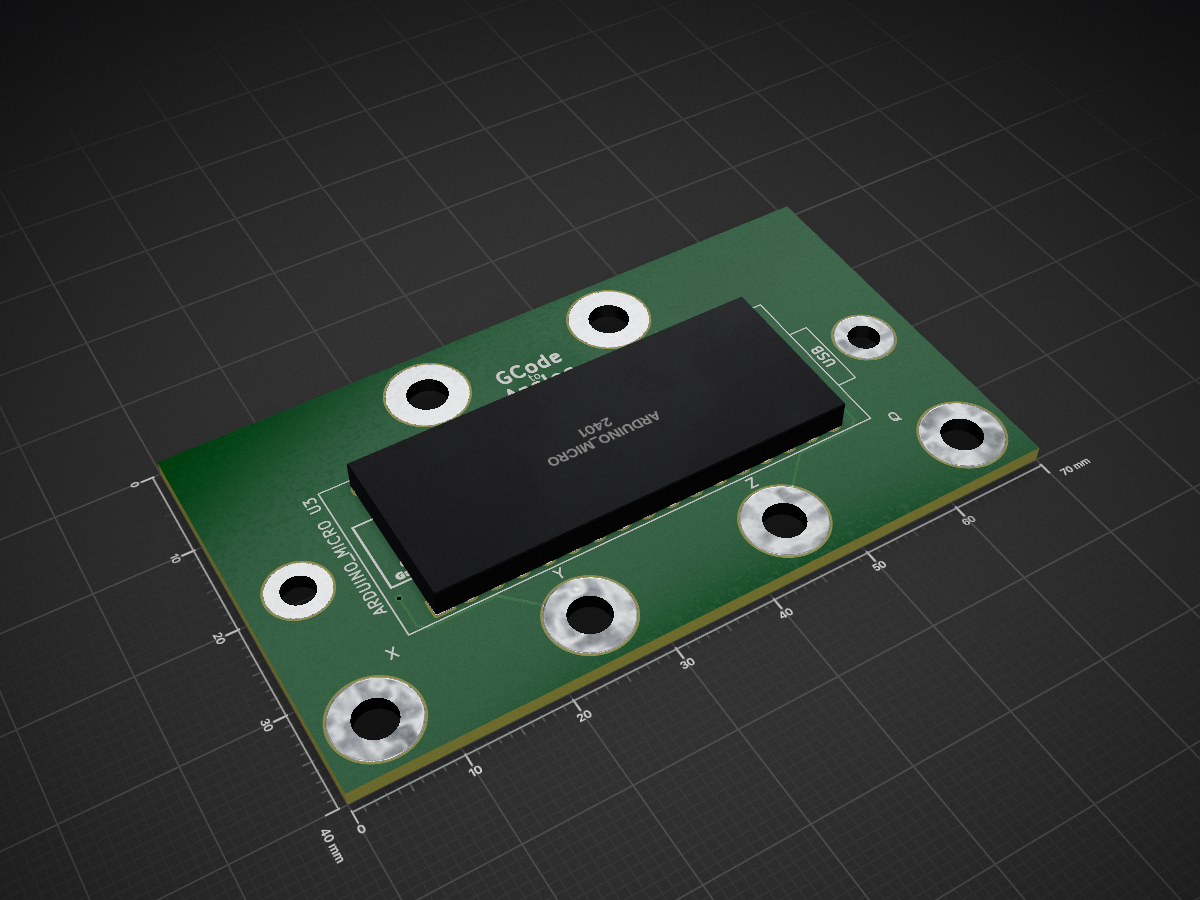
 GaudiLabs/GCodeToAnalog7
grbl-arduino_micro based Gcode to Analog converter circuit and code
GCodeToAnalog is an open-source printed circuit board by GaudiLabs, from the GaudiLabs/GCodeToAnalog repository on GitHub, published under the LGPL-3.0 licence. It is a 2-layer board of 70 × 40 mm with 16 parts on 46 nets, routed with 133 tracks and 16 vias.
It is built around the MCP4922-E/SL. Its parts include 8 crystals, 3 ICs, 1 capacitor and 1 resistor.
grbl-arduino_micro based Gcode to Analog converter circuit and code
Modified the code and added analog out commands for circuit with digital to analog converter (DAC) MCP4922-E. Can be used to control analog pen printers by sending gcode.
Based on: https://github.com/rdpowers/grbl/blob/atmega32u4-support-8c/COPYING
| Qty | Value | Footprint | References |
|---|---|---|---|
| 2 | GND | GaudiLabsFootPrints:Pad4x8 | X5, X6 |
| 2 | MCP4922-E/SL | GaudiLabsFootPrints:SOIC-14_N | U1, U2 |
| 2 | MountPad3 | GaudiLabsFootPrints:MountingHoleM3 | X7, X8 |
| 1 | 100k | GaudiLabsFootPrints:0805G | R11 |
| 1 | 100nF | GaudiLabsFootPrints:0805G | C3 |
| 1 | ARDUINO_MICRO | GaudiLabsFootPrints:Arduino_Micro_Throughole | U3 |
| 1 | LOGO | GaudiLabsLogos:GaudiLabs_8 | G*** |
| 1 | LOGO | GaudiLabsLogos:DigitalToAnalog | G*** |
| 1 | LOGO | GaudiLabsLogos:DigitalToAnalogueTongue | G*** |
| 1 | Q | GaudiLabsFootPrints:Pad4x8 | X4 |
| 1 | X | GaudiLabsFootPrints:Pad4x8 | X1 |
| 1 | Y | GaudiLabsFootPrints:Pad4x8 | X2 |
| 1 | Z | GaudiLabsFootPrints:Pad4x8 | X3 |
GaudiLabs/OpenLaserScanningMicroscope
Open Source Laser Scanning Microscope


OpenSourceNeuro/Spikeling
A hardware implementation of spiking neurons for neuroscience teaching and outreach

maurer-lbb/inkube_hardware
Open-source hardware (CAD + PCB) for inkudock, a modular incubator and closed-loop electrophysiology, and a water compartment lid preventing evaporation from cell cultures.

adeboni/eurorack
This repository stores various eurorack module designs I've made

kocer/direct-sampling-sdr
Direct-sampling SDR transceiver with four phase-coherent channels, and a class-A power amplifier for 1.8 to 54 MHz.

google/mozc-devices
Circuit diagrams and firmware source code for Gboard DIY keyboards

conorpp/u2f-zero
U2F USB token optimized for physical security, affordability, and style
It measures 70 × 40 mm and has 2 copper layers, 1.6 mm thick.
16 parts, built around the MCP4922-E/SL. The full list of its parts is on this page, with links to each part's symbol and footprint where PCBKit's library has them.
From the GaudiLabs/GCodeToAnalog repository on GitHub, at the commit this page was made from: the board is GCodeToAnalog_PCB/GCodeToAnalog.kicad_pcb. PCBKit opens the board in the browser, with nothing to install.
Its repository publishes it under the LGPL-3.0 licence: you may reuse it on that licence's terms (keep the author's notice, and for a copyleft licence share your changes alike).