2 layers85.6 × 54 mm
Name card
Nicholas1023/name-card
My PCB name card with a microcontroller, LEDs and RFID tag.
16 partsMIT

 Cosmin2106/xmas-pcb1
Christmas Tree-shaped PCB Driven by ATtiny25V-10SU and Powered by a CR2032
Xmas board is an open-source printed circuit board by Cosmin2106, from the Cosmin2106/xmas-pcb repository on GitHub, published under the Apache-2.0 licence. It is a 2-layer board of 48.3 × 59.2 mm with 36 parts on 17 nets, routed with 336 tracks and 63 vias.
It is built around the ATTINY25V-10SU, CR2032 and KMR421NGLFS. Its parts include 12 diodes, 4 resistors, 2 capacitors, 2 switches and 1 IC. It belongs with the AVR (ATmega, ATtiny) boards of this library.


The goal of this project was to create a Christmas decoration that houses a secret puzzle. The implementation is based around the Microchip ATtiny25V at 1 MHz, which offers 5 GPIO pins with pin change interrupts. The board is driven by a single CR2032 battery and features a button for user input.
The MCU can be either programmed using the exposed connectors of the "tree trunk", or with an SOIC-8 clip. In my case, I opted for the latter. Details regarding the programmer can be found in this repository.
When we turn on the board, we can perform a quick check to see if the button is already being held down or not. If we encounter a normal power cycle, we enter christmas decoration mode. The button is now dedicated to cycling through different prebuilt light shows. If the button is being pressed at boot, we enter game mode instead. The game idea is inspired by Pop The Lock and Stop Me. To optimize flash usage, we emulate randomness by using a linear congruential generator as PRNG. At the end of each game, the board displays the total number of points using the "branch" LEDs: one left blink means +10, one right blink, +1. Using EEPROM flags, we can remember if the user surpassed a hard-coded points threshold in order to unlock secret light shows in the other mode.
| Designator | Footprint | Quantity | Details |
|---|---|---|---|
| BT1 | Renata_HU2032LF | 1 | Renata 701106 holder for CR2032 |
| C1 | 402 | 1 | Ceramic 100 nF |
| C2 | 402 | 1 | Ceramic 10 uF |
| D1, D11, D3, D5, D7, D9 | 603 | 6 | Osram LO L29K-J2L1-24-0-2-R18-Z |
| D10, D12, D2, D4, D6, D8 | 603 | 6 | Osram LY L29K-H1K2-26-0-2-R18-Z |
| R1, R2, R3, R4 | 402 | 4 | 150 Ω |
| SW1 | SW_Push_1P1T_NO_CK_KMR2 | 1 | C&K KMR421NGLFS |
| SW3 | SW_DPDT_CK_JS202011JCQN | 1 | C&K JS202011JCQN |
| U1 | SOIC-8_5.3x5.3mm_P1.27mm | 1 | ATtiny25V-10SU |
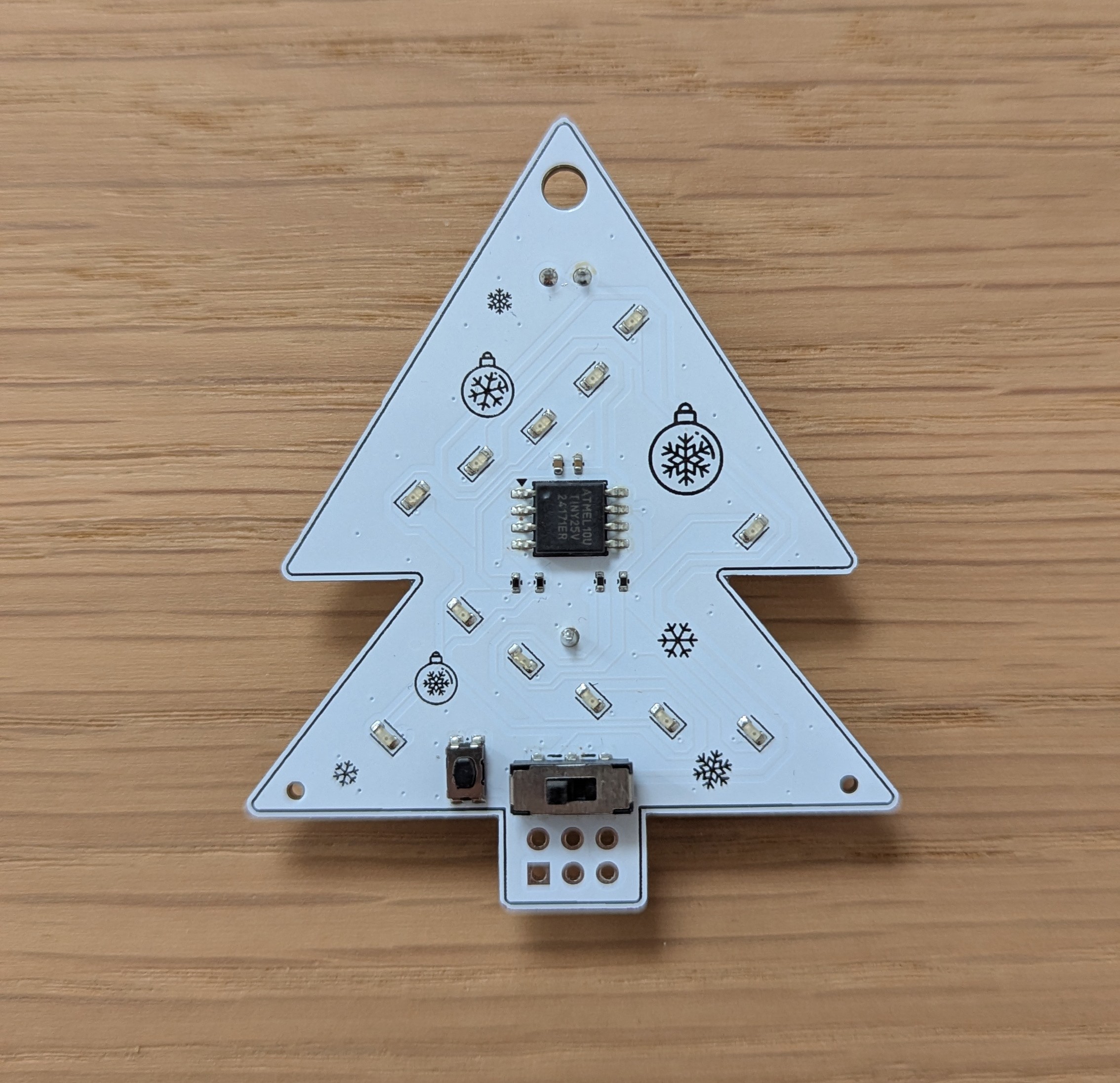
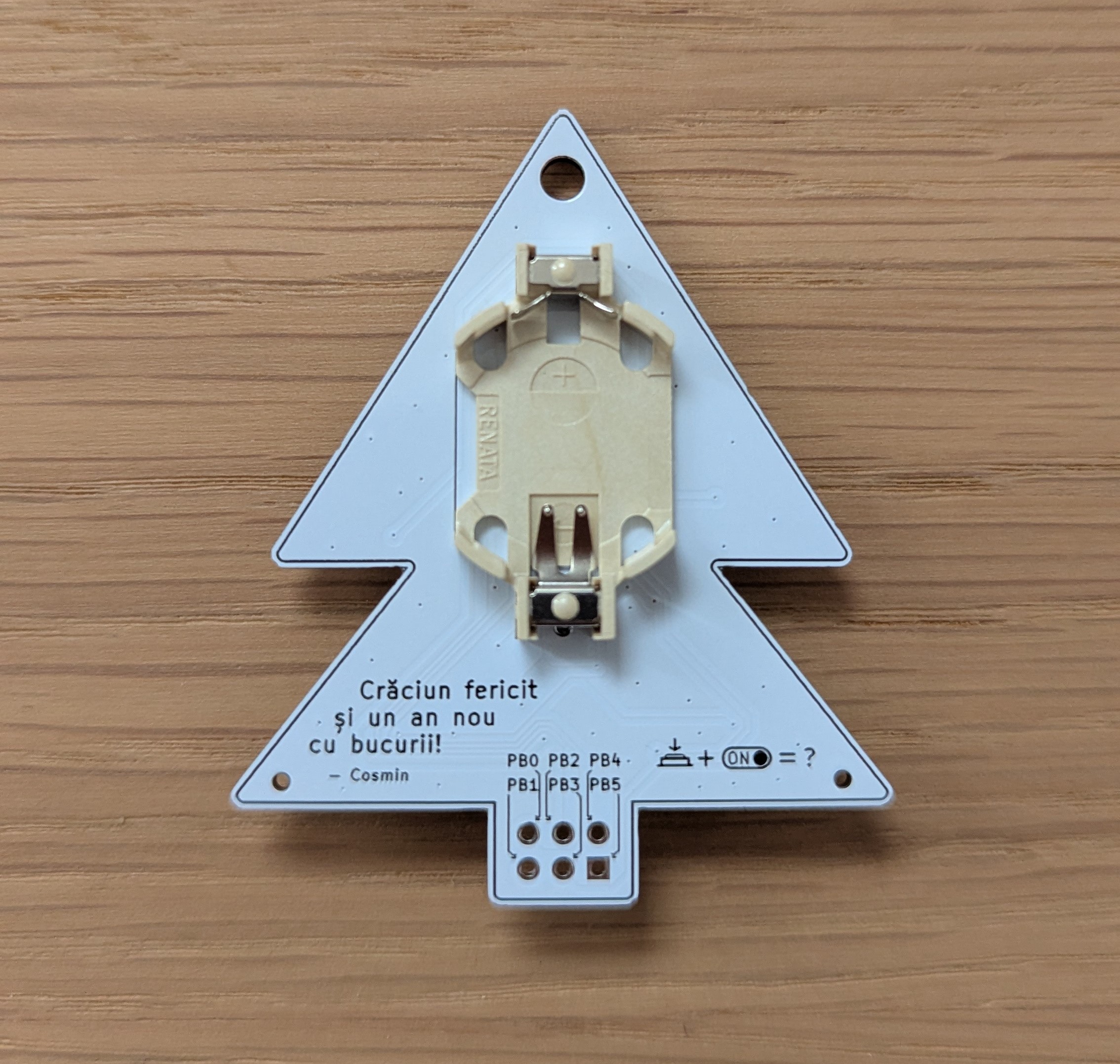
If you have ideas for improvements, please don't hesitate to reach out! Since this is my first custom PCB project, advice would be highly appreciated! :D
| Qty | Value | Footprint | References |
|---|---|---|---|
| 10 | LOGO | LOGO | G***, G***, G***, G***, G***, G***, G***, G***, G***, G*** |
| 6 | LO L29K-J2L1-24-0-2-R18-Z | LED_SMD:LED_0603_1608Metric | D1, D3, D5, D7, D9, D11 |
| 6 | LY L29K-H1K2-26-0-2-R18-Z | LED_SMD:LED_0603_1608Metric | D2, D4, D6, D8, D10, D12 |
| 4 | 150Ω | Resistor_SMD:R_0402_1005Metric | R1, R2, R3, R4 |
| 2 | Tooling Hole | MountingHole:ToolingHole_1.152mm | H2, H3 |
| 1 | ATtiny25V-10S | Package_SO:SOIC-8_5.3x5.3mm_P1.27mm | U1 |
| 1 | CR2032 | Imports:Renata_HU2032LF | BT1 |
| 1 | Ceramic 100nF | Capacitor_SMD:C_0402_1005Metric | C1 |
| 1 | Ceramic 10uF | Capacitor_SMD:C_0402_1005Metric | C2 |
| 1 | KMR421NGLFS | Button_Switch_SMD:SW_Push_1P1T_NO_CK_KMR2 | SW1 |
| 1 | Mounting Hole | MountingHole:MountingHole_3.2mm_M3_DIN965 | H1 |
| 1 | On/Off Switch JS202011JCQN | Button_Switch_SMD:SW_DPDT_CK_JS202011JCQN | SW3 |
| 1 | Pin Headers | Connector_PinHeader_2.54mm:PinHeader_2x03_P2.54mm_Vertical | J2 |
Nicholas1023/name-card
My PCB name card with a microcontroller, LEDs and RFID tag.

PublicDomainProject/strobe-torch
Little flashlight (or torch in UK) to generate 50, 60 and 300 Hz strobe light to calibrate turntables with a strobe discs

timbalicious/netrunner_paragon_pcb
Possibly functional PCB alt-art Paragon for the Netrunner LCG


It measures 48.3 × 59.2 mm and has 2 copper layers, 1.6 mm thick.
36 parts, built around the ATTINY25V-10SU, CR2032 and KMR421NGLFS. The full list of its parts is on this page, with links to each part's symbol and footprint where PCBKit's library has them.
From the Cosmin2106/xmas-pcb repository on GitHub, at the commit this page was made from: the board is cad/xmas-board/xmas-board.kicad_pcb and its schematic cad/xmas-board/xmas-board.kicad_sch. PCBKit opens the board in the browser, with nothing to install.
Its repository publishes it under the Apache-2.0 licence: you may reuse it on that licence's terms (keep the author's notice, and for a copyleft licence share your changes alike).