
4 layers113.4 × 29.3 mm
PCB Mere V1
CaptainDJMax/2627_Projet3AMSC_Index_Stellaire
Ceci est notre projet sur l'index stellaire
80 partsMIT

Ceci est notre projet sur l'index stellaire
PCB Pere V1 is an open-source printed circuit board by CaptainDJMax, from the CaptainDJMax/2627_Projet3AMSC_Index_Stellaire repository on GitHub, published under the MIT licence. It is a 4-layer board of 52.9 × 79.6 mm with 93 parts on 67 nets, routed with 587 tracks and 381 vias.
It is built around the TMC2209-LA-T, 8132H-10.000NL33DTL and CC0603KRX7R9BB104, with the TCC1206X7R225K500FT, 0603B471K500NT and 25121WF120LT4E among its other parts. Its parts include 45 capacitors, 23 resistors, 6 ICs, 4 diodes and 3 connectors.


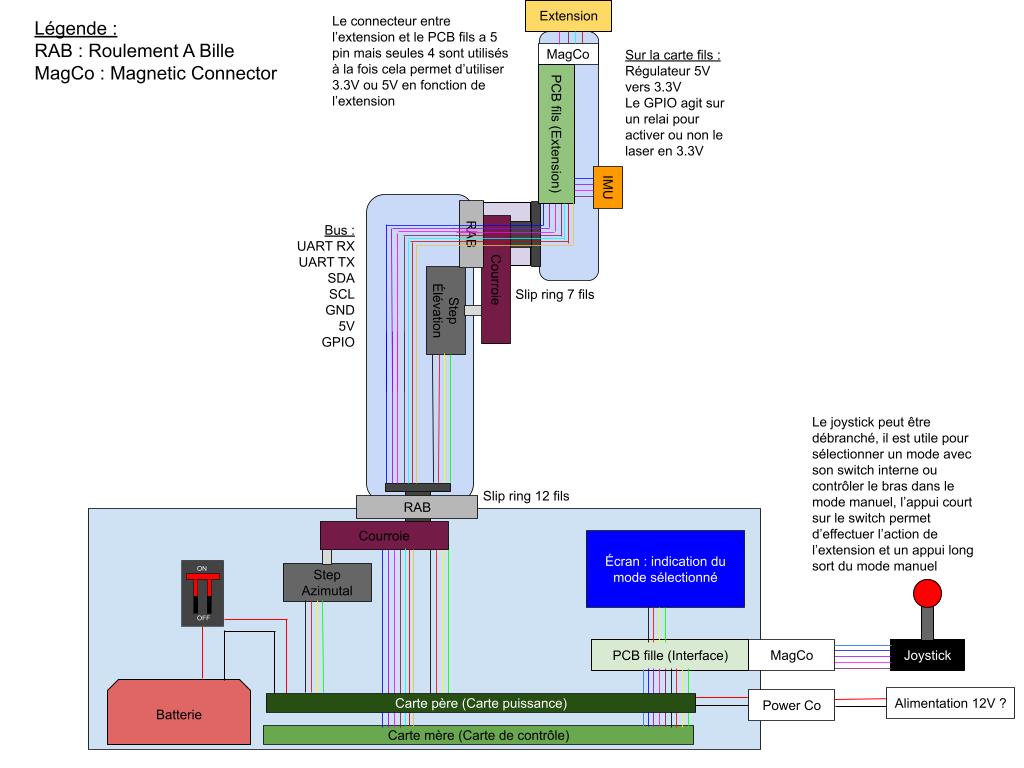
The "Stellar Index" is an autonomous and aesthetic mechanical arm, designed to point in real time at a specific celestial object selected via a mobile or web app. Whether it's a planet, a star, the International Space Station (ISS), or a galaxy, the arm tracks the object continuously.
If the object goes below the horizon, the arm will point toward the ground. Designed with premium materials, it serves as both an educational science tool and an indoor kinetic art piece.
Here is the list of project requirements, along with recommended hardware choices and the technical challenges to anticipate.
Description: The arm must dynamically target a celestial object and compensate for Earth's rotation in real time, with no limits on its rotation.
Description: The user sets the object down, turns it on, and the system automatically determines its location, exact time, and spatial orientation (North, level) without manual input.
Description: The arm must fold down to fit into a custom carrying case.
Description: A high-end finish so it blends in as premium home decor.
Description: The arm's movements must be virtually inaudible.
Description: Dual operation, featuring a custom built-in battery.
Description: A premium physical ON/OFF switch. The main control interface is a connected app via an API.
Description: The arm must be able to track a target for 72 hours without an internet connection.
Description: The end of the arm can hold different attachments, like a "mechanical finger" or a laser pointer.
Description: The system automatically corrects its own position errors (like if it gets bumped or misses a step).
| Qty | Value | Footprint | References |
|---|---|---|---|
| 18 | 100nF | EasyEDA:C0603 | C10, C12, C15, C16, C19, C20, C24, C25, C26, C30, C36, C37, C38, C42, C44, C45 +2 |
| 9 | 2.2uF | EasyEDA:C1206 | C2, C3, C4, C7, C8, C35, C40, C41, C43 |
| 8 | 490pF | EasyEDA:C0603 | C5, C6, C23, C29, C31, C32, C33, C34 |
| 4 | 100kΩ | EasyEDA:R0603 | R3, R4, R8, R19 |
| 4 | 120mΩ | EasyEDA:R2512 | R1, R2, R20, R21 |
| 4 | 1KΩ | EasyEDA:R0603 | R10, R13, R18, R22 |
| 4 | C4532X7R1C336MT000N | EasyEDA:C1812 | C1, C13, C14, C17 |
| 4 | TestPoint | TestPoint:TestPoint_Pad_D1.5mm | TP1, TP2, TP3, TP4 |
| 3 | TestPoint | TestPoint:TestPoint_Pad_1.5x1.5mm | TP5, TP6, TP7 |
| 2 | 10k | EasyEDA:R0603 | R15, R17 |
| 2 | 1kΩ | EasyEDA:R0603 | R5, R12 |
| 2 | 22nF | EasyEDA:C0805 | C11, C39 |
| 2 | 330uF | EasyEDA:CAP-SMD_BD10.0-L10.3-W10.3-LS11.0-FD | C27, C28 |
| 2 | 47k | EasyEDA:R0603 | R6, R11 |
| 2 | 8132H-10.000NL33DTL | EasyEDA:OSC-SMD_4P-L3.2-W2.5-BL | U4, U6 |
| 2 | B4B-PH-K-S | EasyEDA:CONN-TH_B4B-PH-K-S | CN3, CN4 |
| 2 | Buck LMR51625 | EasyEDA:SOT-23-6_L2.9-W1.6-P0.95-LS2.9-BL | U3, U5 |
| 2 | Rouge | EasyEDA:LED-SMD_L1.6-W0.8-R-RD | LED5, LED6 |
| 2 | TC33X-2-103E | EasyEDA:RES-ADJ-SMD_3P-L3.0-W3.8-P1.75-BR | R14, R16 |
| 2 | TMC2209-LA-T | EasyEDA:QFN-28_L5.0-W5.0-P0.50-BL-EP | U2, U7 |
| 2 | Yellow | EasyEDA:LED0805-R-RD | LED2, LED3 |
| 1 | 10uH | EasyEDA:IND-SMD_L5.4-W5.2_FAUL0530-100MT | L1 |
| 1 | 15k | EasyEDA:R0603 | R9 |
| 1 | 15uF | EasyEDA:IND-SMD_L7.0-W6.6_MCW-0650-220 | L4 |
| 1 | 22pF | EasyEDA:C0603 | C21 |
| 1 | 680 | EasyEDA:R0603 | R23 |
| 1 | 9.1k | EasyEDA:R0603 | R7 |
| 1 | B2B-PH-K-S-GW | EasyEDA:CONN-TH_B2B-PH-K-S | CN1 |
| 1 | CL10C220JB8NNNC | EasyEDA:C0603 | C18 |
| 1 | LOGO | EasyEDA:Logo_astrolab | G*** |
| 1 | PZ254-1-10-Z-8.5 | EasyEDA:HDR-TH_10P-P2.54-V-M | H2 |
| 1 | PZ254-1-20-Z-8.5 | EasyEDA:HDR-TH_20P-P2.54-V-M | H1 |
CaptainDJMax/2627_Projet3AMSC_Index_Stellaire
Ceci est notre projet sur l'index stellaire

CaptainDJMax/2627_Projet3AMSC_Index_Stellaire
Ceci est notre projet sur l'index stellaire

CaptainDJMax/2627_Projet3AMSC_Index_Stellaire
Ceci est notre projet sur l'index stellaire


wvianna/mcp-kicad-vscode
Workspace que combina um servidor MCP para automação de design de PCB com KiCad e o projeto de hardware (placa de circuito impresso) desenvolvido com ele.

AJXD2/carplay-project
One board that turns the Pi 4 + 7" screen into a complete car radio replacement. It bolts onto the Pi like a HAT, plugs into the truck's radio harness, and does everything the factory radio did plus what the Pi needs:

Omern187/lite-wing-drone
This repository contains the current KiCad-based LiteWing prototype package: source PCB files, manufacturing outputs, assembly data, 3D reference models, firmware binaries, datasheets, and design-review records.

griffotron/MotionModuleSTM32R8
PCB design and code for the STM32 powered Motion Module that controls 14 stepper motors

gallicchio/motor-pid
The motor-position feedback loop of Learning the Art of Electronics (Hayes & Horowitz), Lab 10L, as a 170 x 120 mm printed circuit board whose silkscreen is the schematic.


NCSU-High-Powered-Rocketry-Club/FIRM-KiCad
Full and open hardware design for FIRM
It measures 52.9 × 79.6 mm and has 4 copper layers, 1.6 mm thick.
93 parts, built around the TMC2209-LA-T, 8132H-10.000NL33DTL, CC0603KRX7R9BB104 and TCC1206X7R225K500FT. The full list of its parts is on this page, with links to each part's symbol and footprint where PCBKit's library has them.
From the CaptainDJMax/2627_Projet3AMSC_Index_Stellaire repository on GitHub, at the commit this page was made from: the board is Hardware/PCB/PCB_Pere/KiCad_Pere/PCB_Pere_V1/PCB_Pere_V1.kicad_pcb and its schematic Hardware/PCB/PCB_Fils/PCB_Fils.kicad_sch. PCBKit opens the board in the browser, with nothing to install.
Its repository publishes it under the MIT licence: you may reuse it on that licence's terms (keep the author's notice, and for a copyleft licence share your changes alike).