4 layers38 × 39 mm
CLN17-V1.5
creapunk/CLN-ClosedLoopNemaDriver
Compact closed-loop stepper motor driver designed for NEMA motors
103 parts1.1k

 BoltzRnD/NYSM2_Open_Stepper_Standard9
An M.2 Key B Based Open Modular Stasndard for 3D Printer Stepper Driver Modules.
NYSM.2 TMC2209 Stepper driver is an open-source printed circuit board by BoltzRnD, from the BoltzRnD/NYSM2_Open_Stepper_Standard repository on GitHub, published under the GPL-3.0 licence. It is a 2-layer board of 22 × 28.5 mm with 19 parts on 31 nets, routed with 290 tracks and 96 vias.
It is built around the TMC2209. Its parts include 7 capacitors, 7 resistors and 2 ICs. It belongs with the robots and motor control boards of this library.

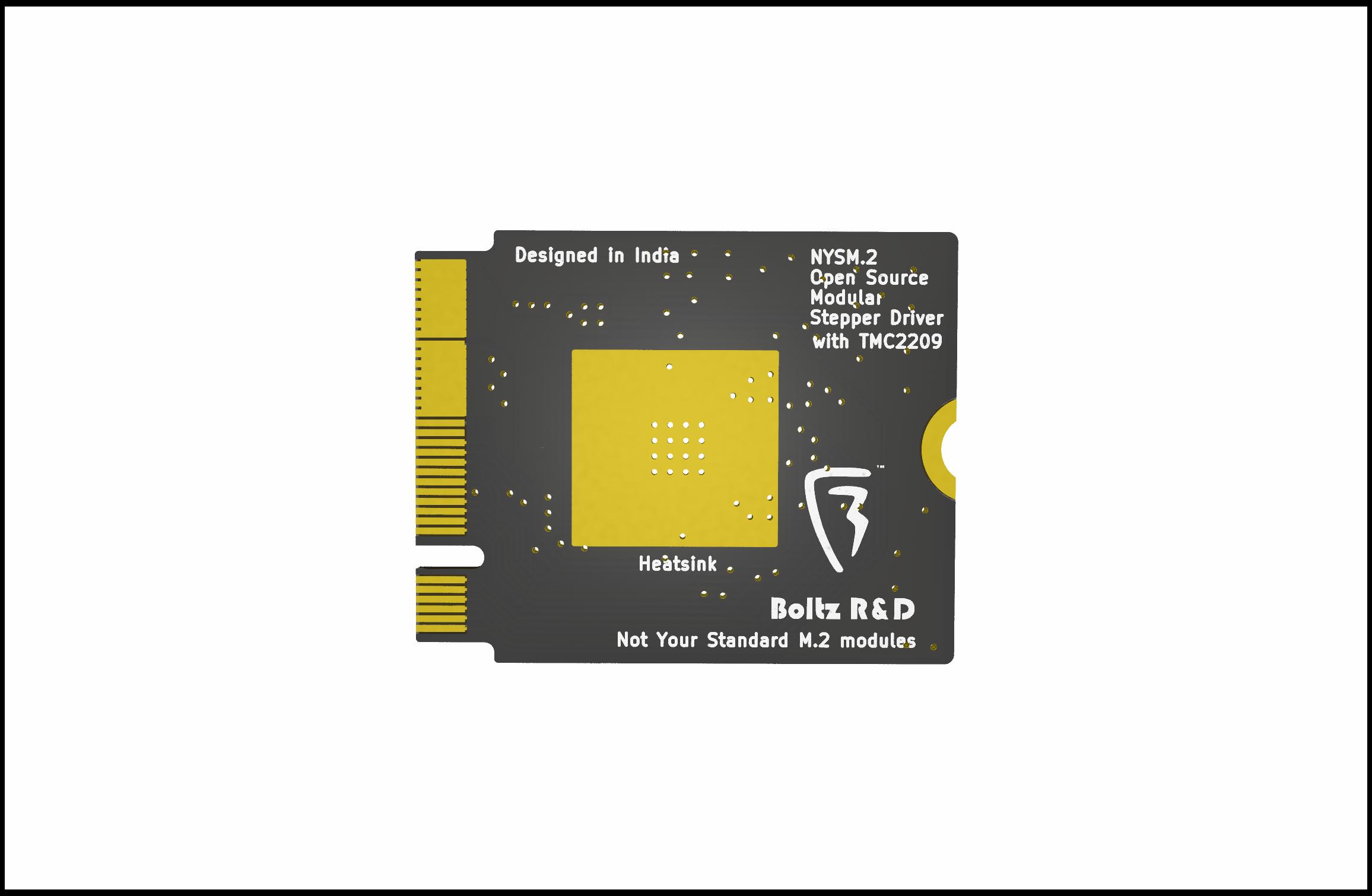
Modular stepper drivers are far superior than traditional pololu footprints as it has
apart from this NYSM.2 extends beyond these to provide more features as below:
physical locking mechanisms: to make sure drivers are locked in when In operation.
Horizontal installation: instead of vertical mounting, to not only save space in Z axis, but to also make the system less fragile to accidental damage if stuck by a physical shock.
Top and Bottom Installations: since NYSM.2 utilizes SMD and single layer mounted connectors, it means that it is possible to add by design 2 NYSM.2 modules in the same footprint area, drastically reducing the required footprint for more drivers - i.e - 20 drivers in 10 drivers area by installing 10 on top layer and 10 on bottom.
highly cost effective: since M.2 is a widely available standard with high MOQs already flooding the industry, the M.2 connectors can be integrated at very low costs into your design, where the stepper card doesn't even need a connector as it uses an edge connector built into the PCB only. in comparison to other modular standards that uses custom repurposed obsolete connector that has low manufacturing volumes. With NYSM.2 we can adopt a modular standard at almost same cost of a traditional pololu stepper drivers.
Powerful in terms of power: NYSM.2 utilizes 8 contacts(0.5A per pin) per power connection to deliver a whopping 4A to the motors, that too at 24V, that totals to 96W per driver. moreover it is theoretically possible to get more power out of it by increasing the voltages.
But that is not the best thing about NYSM.2 standard, the only best thing about it is only and only it's open source nature and GPL V3 license, that allows creators, hobbyist and manufacturers worldwide to move to a new and open modular stepper driver interface standard. unlike other modular stepper interfaces, this interface is open inside out, and is not designed to lock you into single specific manufacturer's ecosystem. and is made for the world to use.
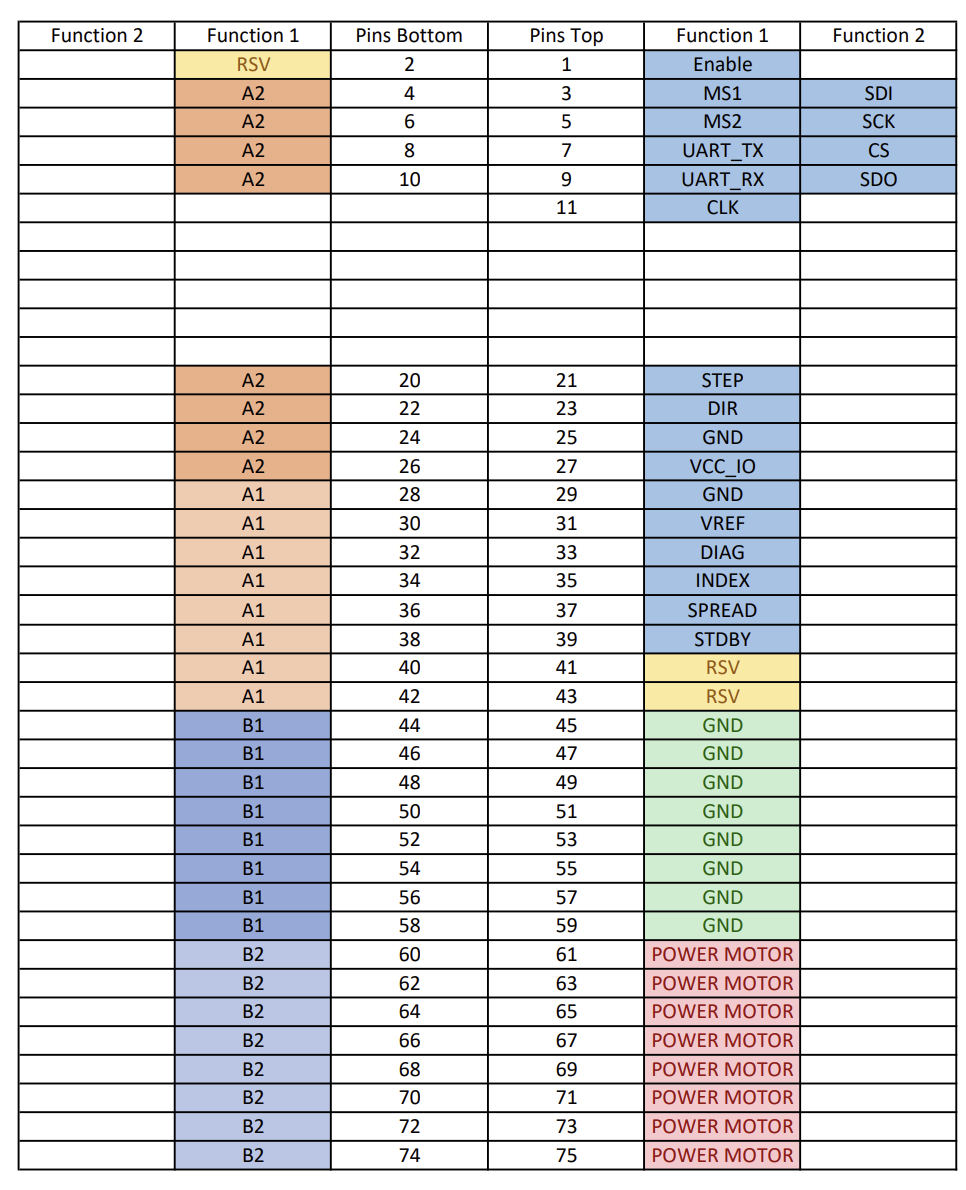
| Pin Name | Pin Number | Description |
|---|---|---|
| EN | 1 | Enable/Disable Stepper Driver |
| MS1 | 3 | Microstep Selection Pin 1 / CFG1 / SDI |
| MS2 | 5 | Microstep Selection Pin 2 / CFG2 / SCK |
| UART_TX | 7 | UART Transmission (Communication) / CFG 3 / CS |
| UART_RX | 9 | UART Receive (Communication) / CFG0 / SDO |
| CLK | 11 | CLK input |
| STEP | 21 | STEP input |
| DIR | 23 | DIR input |
| GND | 25 | Ground |
| VCC_IO | 27 | 3.3V to 5V IO supply voltage for all digital pins (does not supply IC logic part). |
| GND | 29 | Ground |
| VREF | 31 | Analog reference voltage for current scaling or reference current for use of internal sense resistors |
| DIAG | 33 | Diagnostic and StallGuard output |
| INDEX | 35 | Configurable index output. Provides index pulse. |
| SPREAD | 37 | Chopper mode selection: Low=StealthChop, High=SpreadCycle (may be left unconnected) |
| STDBY | 39 | STANDBY input |
| GND | 45, 47, 49, 51, 53, 55, 57, 59 | Ground/PSU Negative (0.5A per pin, 4A Total) |
| POW_MOT | 61, 63, 65, 67, 69, 71, 73, 75 | Motor supply voltage (0.5A per pin, 4A Total) |
| A2 | 4, 6, 8, 10, 20, 22, 24, 26 | Motor coil A output 2 (0.5A per pin, 4A Total) |
| A1 | 28, 30, 32, 34, 36, 38, 40, 42 | Motor coil A output 1 (0.5A per pin, 4A Total) |
| B1 | 44, 46, 48, 50, 52, 54, 56, 58 | Motor coil B output 1 (0.5A per pin, 4A Total) |
| B2 | 60, 62, 64, 66, 68, 70, 72, 74 | Motor coil B output 2 (0.5A per pin, 4A Total) |
Please take special care to follow these points when manufacturing the NYSM2 Boards
 This Version of the board omits the use of current limit series phase resistors, in case it is a necessity for your design, Please use the design from Branch alt_sense
NYSM.2 standard pinout and NYSM.2 TMC2209 Board contributed by Boltz R&D is licensed under GPL V3 license, and is owned by the community and everyone. Also while the standard is open(i.e - The standard pinout sequence on M.2 Key B and it's derivatives only, that means proprietary manufacturers needs to be compliant to GPLV3 for only the pinout.), you can integrate it into your proprietary designs as long as the NYSM.2 section of your design respects the license. We invite all creators, hobbyist, and manufacturers to utilize the standard and the design.
1.In klipper change set step_pulse_duration to 0.000000400 or more, in case you face print misallignment or continous layer shifting.
Clone the repository:
git clone https://github.com/BoltzRnD/NYSM2_Open_Stepper_Standard
We are actively looking for contributors to help us enhance this project. You can join our community to discuss ideas, report bugs, or request features:
The NYSM.2 standard and NYSM.2 board is provided as-is without any warranties. Boltz R&D is not responsible for any damages or issues that may arise from the use of this board.
NYSM.2 standard
Copyright (C) 2024 Boltz R&D

This Project/Open Standard is free: you can redistribute it and/or modify
it under the terms of the GNU General Public License as published by
the Free Software Foundation, either version 3 of the License, or
(at your option) any later version.

This is distributed in the hope that it will be useful,
but WITHOUT ANY WARRANTY; without even the implied warranty of
MERCHANTABILITY or FITNESS FOR A PARTICULAR PURPOSE.  See the
GNU General Public License for more details.

You should have received a copy of the GNU General Public License
along with this program.  If not, see <https://www.gnu.org/licenses/>.
Contact : info@boltzrnd.com
| Qty | Value | Footprint | References |
|---|---|---|---|
| 4 | 100nF/50V | Capacitor_SMD:C_0402_1005Metric | C2, C6, C9, C10 |
| 3 | 20K | Resistor_SMD:R_0402_1005Metric | R1, R2, R6 |
| 2 | NC | Resistor_SMD:R_0402_1005Metric | R8, R9 |
| 1 | 100K | Resistor_SMD:R_0402_1005Metric | R7 |
| 1 | 1K | Resistor_SMD:R_0402_1005Metric | R3 |
| 1 | 1uF/50V | Capacitor_SMD:C_0402_1005Metric | C8 |
| 1 | 20K | Potentiometer_SMD:Potentiometer_Bourns_TC33X_Vertical | RV1 |
| 1 | 22nF/50V | Capacitor_SMD:C_0402_1005Metric | C1 |
| 1 | 4.7uF 10V | Capacitor_SMD:C_0402_1005Metric | C7 |
| 1 | LOGO | Logo:BoltzRndLogo10mm | G*** |
| 1 | M.2-B-KEY | NYSM2-Card-B-Key:NYSM2-Card-B-Key | U2 |
| 1 | TMC2209 | TMC2209:QFN28_5X5_TRI | U1 |
| 1 | ~ | Jumper:SolderJumper-2_P1.3mm_Open_Pad1.0x1.5mm | JP1 |
creapunk/CLN-ClosedLoopNemaDriver
Compact closed-loop stepper motor driver designed for NEMA motors


wntrblm/jellyfish-and-starfish
Jellyfish and Starfish are control boards designed for use with the LumenPnP. Starfish controls the base of the machine including X & Y axes and pneumatics.

NikodemBartnik/StarTrckr
Open source star tracker for deep sky astrophotography

RParkerE/OpenSilicon
OpenSilicon enables DIY semiconductor fabrication with open-source guides for building IC equipment at home. The project includes BOMs, 3D files, firmware, and PDKs, supporting makers and researchers in chip fabrication.

AdamTuraj/PicoMMU
A Klipper expansion board intended to run a MMU unit to control a stepper motor and servo.

TheContrappostoShop/Apollo
Control Board for the Prometheus mSLA Printer.

Duet3D/Duet3-Mini5plus
This repository also contains information in the Mini 2+ : a two driver expansion board for the Duet 3 mini 5+
It measures 22 × 28.5 mm and has 2 copper layers, 0.89 mm thick.
19 parts, built around the TMC2209. The full list of its parts is on this page, with links to each part's symbol and footprint where PCBKit's library has them.
From the BoltzRnD/NYSM2_Open_Stepper_Standard repository on GitHub, at the commit this page was made from: the board is NYSM.2_TMC2209_Stepper_driver/NYSM.2_TMC2209_Stepper_driver.kicad_pcb and its schematic NYSM.2_TMC2209_Stepper_driver/NYSM.2_TMC2209_Stepper_driver.kicad_sch. PCBKit opens the board in the browser, with nothing to install.
Its repository publishes it under the GPL-3.0 licence: you may reuse it on that licence's terms (keep the author's notice, and for a copyleft licence share your changes alike).