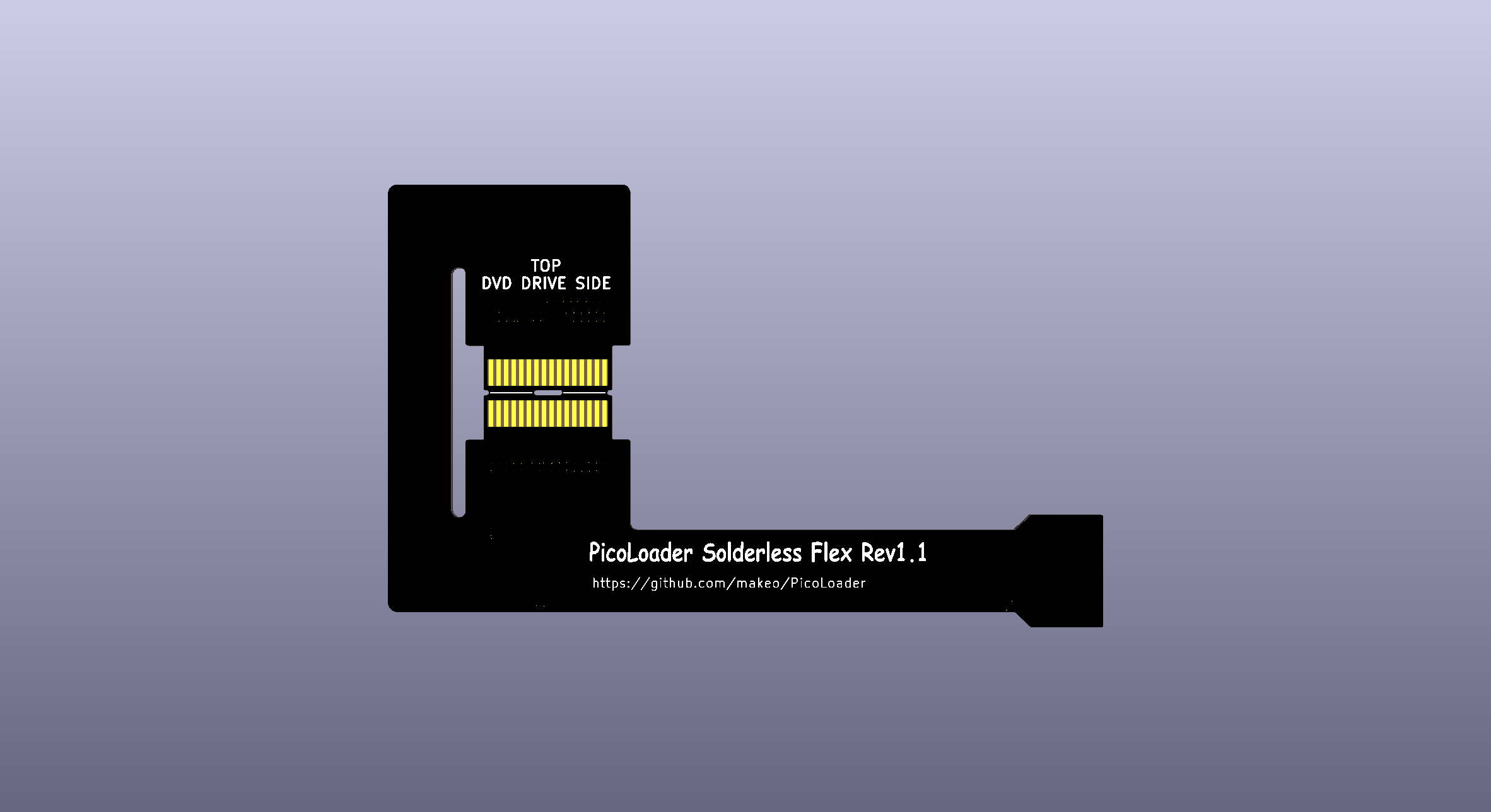
Flex
Auroxin/picoloader-hw
Open-hardware PicoLoader for the Nintendo GameCube: a solderless RP2040 modchip. KiCad 10 sources for the v1.1A (2 MB) and v1.2A (16 MB) boards, the 30-pin flex PCB and the 3D-printed mounting parts. GPL-2.0.

Open-hardware PicoLoader for the Nintendo GameCube: a solderless RP2040 modchip. KiCad 10 sources for the v1.1A (2 MB) and v1.2A (16 MB) boards, the 30-pin flex PCB and the 3D-printed mounting parts. GPL-2.0.
Picoloader is an open-source printed circuit board by Auroxin, from the Auroxin/picoloader-hw repository on GitHub, published under the GPL-2.0 licence. It is a 2-layer board of 27.2 × 36 mm with 37 parts on 58 nets, routed with 738 tracks and 159 vias.
It is built around the RP2040, ZD25WQ16CEIGR and AP2112K-3.3TRG1, with the 1N5819WS, TSA343G00-250J2 and TYPE-C-31-M-12 among its other parts. Its parts include 15 capacitors, 8 resistors, 3 diodes, 3 connectors and 2 ICs. It belongs with the retro computing and games boards and the RP2040 boards of this library.

The 30-pin flex that connects the main board to the console. It taps the DVD-drive flex
connector with DVDCN_FLEX_PADS, so the install needs no soldering.
Library:DVDCN_FLEX_PADS on the DVD-drive side, Library:Hirose_FH12-30S-0.5SH_1x30-1MP_P0.50mm_pad
for the FFC to the main boardGamecubeConnectors.kicad_sym and both project footprints ship with the project, so the
schematic opens without missing-library warningsThe flex is shared by every board revision; the silkscreen still reads Rev1.1 because the
outline has not changed since. See ../../3d-print/ for the
Fold_KeyV1.2.stl part that creases the cable at the right position.
Open Flex.kicad_pro with KiCad 10 or newer.
| Qty | Value | Footprint | References |
|---|---|---|---|
| 9 | 100nf | Library:C_0402_1005Metric | C5, C6, C7, C8, C11, C13, C15, C16, C18 |
| 3 | TestPoint | Library:TestPoint_Pad_D1.0mm | TP3, TP4, TP5 |
| 2 | 1K | Library:R_0402_1005Metric | R1, R11 |
| 2 | 1N5819WS | Library:D_SOD-323 | D1, D3 |
| 2 | 1uF | Library:C_0603_1608Metric | C14, C17 |
| 2 | 1uf | Library:C_0603_1608Metric | C3, C10 |
| 2 | 27r | Library:R_0402_1005Metric | R3, R4 |
| 2 | 5.1K | Library:R_0402_1005Metric | R9, R10 |
| 2 | 5pf | Library:C_0402_1005Metric | C2, C19 |
| 2 | TSA343G00-250J2 | Library:SW_Push_SPST_NO_Alps_SKRK | J2, RSW1 |
| 1 | 10K | Library:R_0402_1005Metric | R2 |
| 1 | 12MHz | Library:Crystal_SMD_3225-4Pin_3.2x2.5mm | Y1 |
| 1 | 470r | Library:R_0402_1005Metric | R13 |
| 1 | AP2112K-3.3TRG1 | Library:SOT-23-5 | U1 |
| 1 | Conn_01x30 | Library:Hirose_FH12-30S-0.5SH_1x30-1MP_P0.50mm_Horizontal | J1 |
| 1 | LED | Library:LED_0603_1608Metric | D2 |
| 1 | RP2040 | Library:RP2040-QFN-56 | U3 |
| 1 | TYPE-C-31-M-12 | Library:HRO-TYPE-C-31-M-12 | USB2 |
| 1 | ZD25WQ16CEIGR | Library:Winbond_USON-8-1EP_3x2mm_P0.5mm_EP0.2x1.6mm | FLASH1 |

Auroxin/picoloader-hw
Open-hardware PicoLoader for the Nintendo GameCube: a solderless RP2040 modchip. KiCad 10 sources for the v1.1A (2 MB) and v1.2A (16 MB) boards, the 30-pin flex PCB and the 3D-printed mounting parts. GPL-2.0.

Chisfamily/GB-Link-USB-Hardware
An open-source USB adapter for the Game Boy Link Cable.

RetroScaler/RP2040-PICO-BOOT
Raspberry PI RP2040 PICOBOOT for the Game cube console


opencorp2030-ctrl/cartouche-usb4
Tiny USB4 (40 Gb/s) NVMe 2230 drive board (22 x 34 mm) for CARTOUCHE, a local AI you carry in your pocket. KiCad 9, Gerbers, BOM, STEP.

punkfab/pcb-corpus
235 real KiCad boards from open-source hardware repositories, prepared as a placement and routing benchmark


u1f992/qingpi
Qingpi aka NeoCtrlMod is a project for externally controlling the Nintendo 3DS.
It measures 27.2 × 36 mm and has 2 copper layers, 1.2 mm thick.
37 parts, built around the RP2040, ZD25WQ16CEIGR, AP2112K-3.3TRG1 and 1N5819WS. The full list of its parts is on this page, with links to each part's symbol and footprint where PCBKit's library has them.
From the Auroxin/picoloader-hw repository on GitHub, at the commit this page was made from: the board is hw/v1.1/picoloader.kicad_pcb and its schematic hw/flex/Flex.kicad_sch. PCBKit opens the board in the browser, with nothing to install.
Its repository publishes it under the GPL-2.0 licence: you may reuse it on that licence's terms (keep the author's notice, and for a copyleft licence share your changes alike).