
2 layers65 × 56.5 mm
SuperPower RPi KiCAD
SensorsIot/SuperPower
Here you should find the best power supplies for your low-power projects
122 parts600

 AnaviTechnology/anavi-macro-pad-210
Open source, programmable, two-key keypad with backlighting
Anavi macro pad-2 is an open-source printed circuit board by AnaviTechnology, from the AnaviTechnology/anavi-macro-pad-2 repository on GitHub. It is a 2-layer board of 40.6 × 38 mm with 22 parts on 15 nets, routed with 116 tracks and 2 vias.
It is built around the ATTINY85-20SU. Its parts include 6 resistors, 2 capacitors, 2 diodes, 2 inductors and 1 IC. It belongs with the keyboards and input boards and the AVR (ATmega, ATtiny) boards of this library.
Open source, programmable, two-key keypad with backlighting
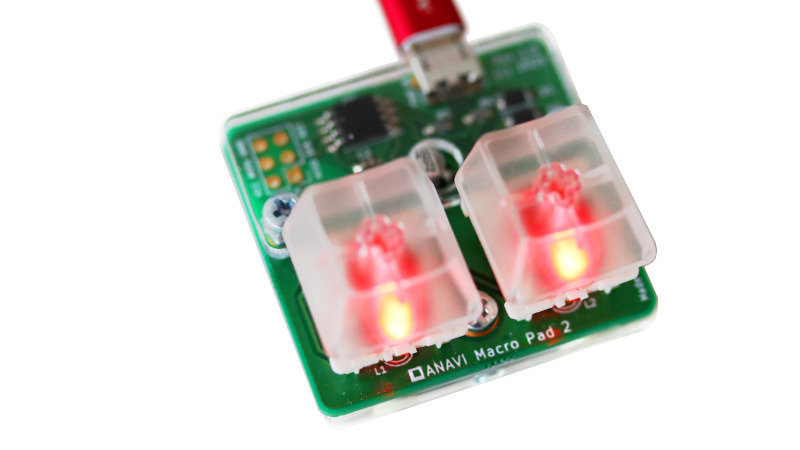
ANAVI Macro Pad 2 is an open source, custom-programmable, mini 2-key keyboard/keypad. Each key can be reprogrammed to activate a macro or even a dedicated shortcut - all without any coding experience! Powered by the advanced, but easy-to-use Quantum Mechanical Keyboard (QMK) open source firmware.
ANAVI Macro Pad 2 has been designed with the cross platform and open source electronics design automation suite KiCad. The acrylic enclosure has been designed with OpenSCAD.
For more details please visit https://anavi.technology/
The project is released under the Creative Commons Attribution-ShareAlike 4.0 International (CC BY-SA 4.0).
Note: This is a human-readable summary of (and not a substitute for) the license.
You are free to:
Share — copy and redistribute the material in any medium or format Adapt — remix, transform, and build upon the material for any purpose, even commercially. The licensor cannot revoke these freedoms as long as you follow the license terms. Under the following terms:
Attribution — You must give appropriate credit, provide a link to the license, and indicate if changes were made. You may do so in any reasonable manner, but not in any way that suggests the licensor endorses you or your use. ShareAlike — If you remix, transform, or build upon the material, you must distribute your contributions under the same license as the original. No additional restrictions — You may not apply legal terms or technological measures that legally restrict others from doing anything the license permits. Notices:
You do not have to comply with the license for elements of the material in the public domain or where your use is permitted by an applicable exception or limitation. No warranties are given. The license may not give you all of the permissions necessary for your intended use. For example, other rights such as publicity, privacy, or moral rights may limit how you use the material.
You will have to provide a link to the original creator of the project http://www.anavi.technology on any documentation or website.
Credit can be attributed through a link to the creator website: http://www.anavi.technology
| Qty | Value | Footprint | References |
|---|---|---|---|
| 2 | 1N4148 | Diode_SMD:D_SOD-123 | D1, D2 |
| 2 | 22R | Resistors_SMD:R_0603_HandSoldering | R3, R4 |
| 2 | 68R | Resistors_SMD:R_0603_HandSoldering | R5, R6 |
| 2 | LED | LED_THT:LED_D3.0mm | L1, L2 |
| 2 | SW_DIP_x01 | Button_Switch_Keyboard:SW_Cherry_MX_1.00u_PCB | KEY 1, KEY 2 |
| 1 | 1.5K | Resistors_SMD:R_0603_HandSoldering | R1 |
| 1 | 100nF | Capacitor_SMD:C_0805_2012Metric | C2 |
| 1 | 10k | Resistors_SMD:R_0603_HandSoldering | R2 |
| 1 | 10uF | Capacitor_SMD:CP_Elec_4x5.4 | C1 |
| 1 | ATtiny85-20SU | Package_SO:SOIJ-8_5.3x5.3mm_P1.27mm | U1 |
| 1 | AVR-ISP-6 | Connector_PinHeader_2.54mm:PinHeader_2x03_P2.54mm_Vertical | ISP |
| 1 | LOGO | logo:anavi-logo | G*** |
| 1 | Q_NPN_BEC | TO_SOT_Packages_SMD:SOT-23 | Q1 |
| 1 | USB_B_Micro | Connector_USB:USB_Micro-B_Molex-105017-0001 | J1 |
The 19 most common of 22 parts.
SensorsIot/SuperPower
Here you should find the best power supplies for your low-power projects

KivApple/dell-charger-emulator
Emulator of original Dell charger using ATTINY85


bwack/C64-Saver-bwack
C64 Saver v1 and v2 - Overvoltage protection for the C64 and its power brick.


valerionew/very-good-uc-doggos
A special graduation present for a special friend. Six microcontrollers in one devboard


spielhuus/LoRa-Environmental-Sensors
ATtiny85 based LoRa atmospheric sensor board with BME280
It measures 40.6 × 38 mm and has 2 copper layers, 1.6 mm thick.
22 parts, built around the ATTINY85-20SU. The full list of its parts is on this page, with links to each part's symbol and footprint where PCBKit's library has them.
From the AnaviTechnology/anavi-macro-pad-2 repository on GitHub, at the commit this page was made from: the board is anavi-macro-pad-2.kicad_pcb. PCBKit opens the board in the browser, with nothing to install.
Its repository states no licence, so its author keeps all rights: ask AnaviTechnology before reusing the design.