4 layers
LED Ring
Aharoni-Lab/MiniCAM
Using the Miniscope Software, multiple Miniscopes and MiniCAMs can be connected, streamed, and time-sync'ed recording simultaniously.
28 parts15
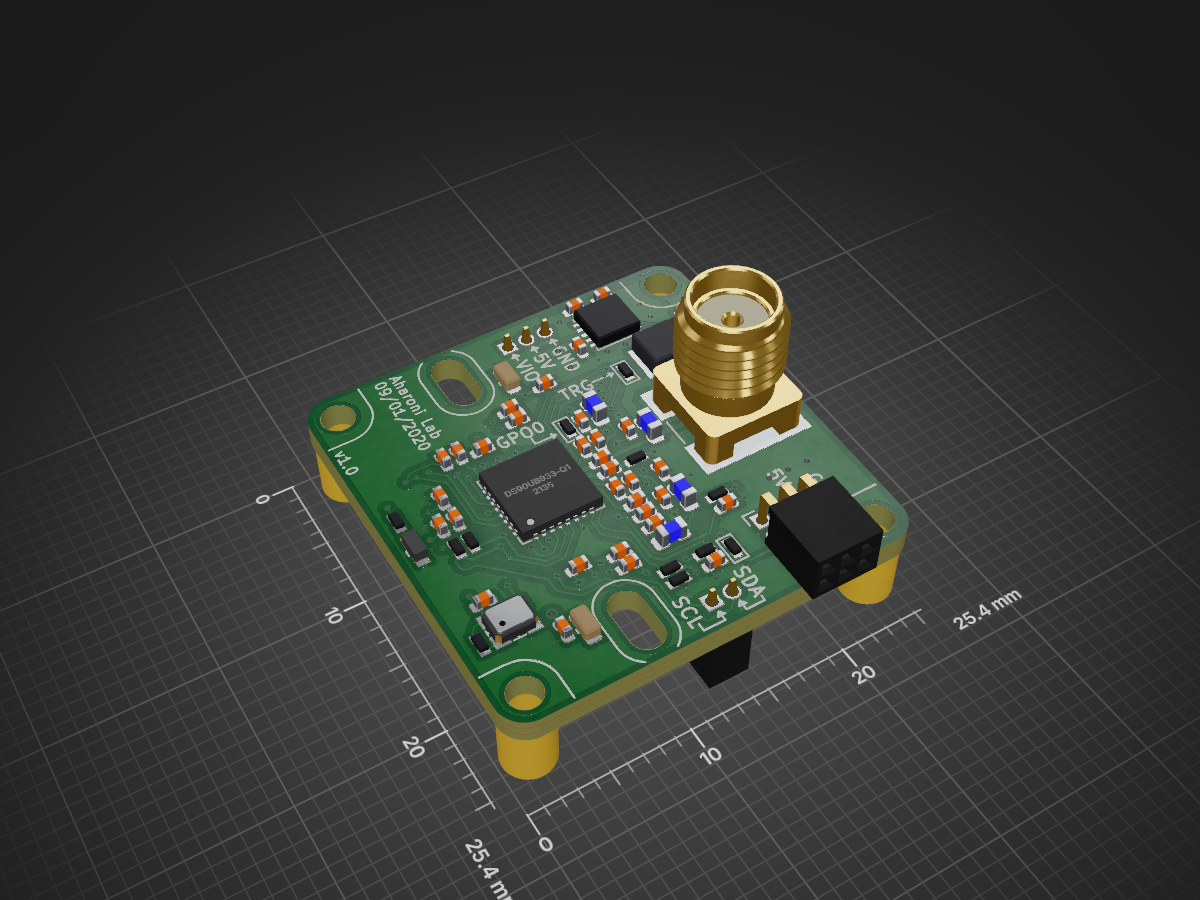
 Aharoni-Lab/MiniCAM15
Using the Miniscope Software, multiple Miniscopes and MiniCAMs can be connected, streamed, and time-sync'ed recording simultaniously.
MiniCAM is an open-source printed circuit board by Aharoni-Lab, from the Aharoni-Lab/MiniCAM repository on GitHub. It is a 4-layer board of 25.4 × 25.4 mm with 69 parts on 45 nets, routed with 583 tracks and 91 vias.
It is built around the DS90UB933-Q1, ADL3225V-470MT-TL000 and SMA-J-P-H-RA-TH1. Its parts include 36 capacitors, 13 resistors, 5 inductors, 4 ICs and 4 connectors.


The MiniCAM is an open-source behaviroal camera for imaging freely behaving animals in behavioral and neuroscience experiments. The goal of the MiniCAM project is to provide an open-source, customizable, high-quality, and affordable alternative to using webcams or scientific USB cameras for behavioral imaging. The MiniCAM is powered and communicates over any commercial 50ohm coaxial cable minimizing the cabling that needs to run into the experimental environment. The coaxial cable connects the MiniDAQ to any version of UCLA Miniscope DAQs or MiniDAQs which then connects over USB3 to a host computer.
Using the Miniscope Software, multiple Miniscopes and MiniCAMs can be connected, streamed, and time-sync'ed recording simultaniously.

The MiniCAM consists of a custom printed circuit board (PCB), a 3D printed housing, an off the shelf M12 lens mount, a M12 camera lens, and an optional LED illumination ring. The PCB contains a 5MP CMOS image sensor, support electronics to power and serialize the imaging data, and an SMA coax connector. The image sensor can be configured through the Miniscope software and the optional LED illumination ring intensity can also be controlled through software. The MiniCAM runs at 50fps with 1024X768 resolution as the default configuration. Higher frame rate can be achieved by choosing smaller resolutions and higher resolution comes with lower frame rate.

The MiniCAM requires a UCLA Miniscope Data Acquisition (DAQ) board (connected over a 50ohm coaxial cable) and a host computer (connected over USB3) running the Miniscope Software (or other third-party application that can stream UVC cameras and can communicate through a Miniscope DAQ). You can use any generation of Miniscope DAQ but you must update it with the newest firmware. You can also use the cheaper and smaller version of the Miniscope DAQ called the MiniDAQ (open-source link coming soon). Once updated to the newest firmware, any Miniscope DAQ device will work with all Miniscope and MiniCAM devices.

Just like Miniscopes, the MiniCAM uses a 50Ohm coaxial cable for power, communication, and data. Any 50Ohm coax cable should work with the system.
M12 lenses and M12 Mount Lens Holders are avaiable in Amazon (can be purchased at other places too). It can be handy to buy a M12 Lens Kit that comes with a range of M12 lenses for different view angles. We have been happy with the Arducam lens set which can be found on Amazon. If you are using the optional LED illumination ring or other nIR light source make sure to remove any IR filter located in the lens if applicable.
Any 50Ohm coaxial cable should be compatible with this system. It is not necessary to use the expensive, thin, flexible coax cables generally used with Miniscopes. The thicker the cable the longer length you can run (maxing out at around 10 to 15 meters). It generally is most convinient to get a coax cable with male SMA connectors on both ends to connect between the MiniCAM and MiniDAQ (or standard Miniscope DAQ).
| Qty | Value | Footprint | References |
|---|---|---|---|
| 15 | 0.1uF | .Capacitor:C_0402_1005Metric_L | C4, C5, C6, C7, C8, C9, C10, C14, C15, C19, C22, C24, C27, C30, C32 |
| 7 | 1uF | .Capacitor:C_0402_1005Metric_L | C1, C2, C3, C11, C16, C33, C35 |
| 6 | 10nF | .Capacitor:C_0402_1005Metric_L | C18, C21, C26, C29, C31, C34 |
| 6 | MountingHole | .Connector:Conn_1x1_700_Circular_Pad | H1, H2, H3, H4, H5, H6 |
| 4 | 10uF | .Capacitor:C_0603_1608Metric_L | C12, C13, C17, C36 |
| 4 | BLM18PG471SN1D | .Inductor:L_0603_1608Metric_L | L1, L3, L4, L5 |
| 3 | 0 | .Resistor:R_0402_1005Metric_ERJ_L | R11, R12, R13 |
| 3 | 2K | .Resistor:R_0402_1005Metric_ERJ_L | R1, R5, R6 |
| 3 | 4.7uF | .Capacitor:C_0402_1005Metric_L | C20, C23, C28 |
| 2 | 10K | .Resistor:R_0402_1005Metric_ERJ_L | R7, R8 |
| 1 | 100K | .Resistor:R_0402_1005Metric_ERJ_L | R9 |
| 1 | 1K | .Resistor:R_0402_1005Metric_ERJ_L | R4 |
| 1 | 47nF | .Capacitor:C_0402_1005Metric_L | C25 |
| 1 | 50 | .Resistor:R_0402_1005Metric_ERJ_L | R3 |
| 1 | 500 | .Resistor:R_0402_1005Metric_ERJ_L | R2 |
| 1 | ADL3225V-470MT-TL000 | .Inductor:L_1210_3225Metric_L | L2 |
| 1 | Conn_01x02 | Connector_PinSocket_1.27mm:PinSocket_1x02_P1.27mm_Vertical | J2 |
| 1 | Conn_01x03 | Connector_PinSocket_1.27mm:PinSocket_1x03_P1.27mm_Vertical | J3 |
| 1 | Conn_02x03_Odd_Even | Connector_PinSocket_1.27mm:PinSocket_2x03_P1.27mm_Horizontal | J4 |
| 1 | DNL | .Resistor:R_0402_1005Metric_ERJ_L | R10 |
| 1 | DS90UB933-Q1 | .Package_QFN:QFN_33_P50_500X500X80L40X24T310L | U2 |
| 1 | LED_Small_ALT | .LED:LED_SC80X160X65L40L | D1 |
| 1 | MT9P031 | .Package_LCC:iLCC48P70_1000X1000X135L80X40N | U3 |
| 1 | NCV8154MW180280TBG | .Package_QFN:DFN10_3x3_11P50_300X300X100L40X24T250X180N | U1 |
| 1 | SMA-J-P-H-RA-TH1 | Connector_Coaxial:SMA_Amphenol_132134-10_Vertical | J1 |
| 1 | SiT_2.5mmx2mm | .Oscillator:OSC_CC250X200X80L70X75L | U4 |
Aharoni-Lab/MiniCAM
Using the Miniscope Software, multiple Miniscopes and MiniCAMs can be connected, streamed, and time-sync'ed recording simultaniously.


Aharoni-Lab/Miniscope-Wire-Free-DAQ
All information, guides, and tutorials can be found on the Miniscope-Wire-Free-DAQ Wiki Page .


jlab-sensing/RF-Backscatter-PCB-V1
This repo consists of the backscatter tag PCBs used with the WaDAR sensing system. This repo is a submodule of WaDAR. This is our first version of the tag used in WaDAR's sensing system.


timothy-joseph/timotelemetry_timounu
Formula Student Telemetry system I've developed in my first year of University at UPB Drive

Aharoni-Lab/Miniscope-LFOV
Large field-of-view miniature microscope for rats and larger animals.
It measures 25.4 × 25.4 mm and has 4 copper layers, 1.6 mm thick.
69 parts, built around the DS90UB933-Q1, ADL3225V-470MT-TL000 and SMA-J-P-H-RA-TH1. The full list of its parts is on this page, with links to each part's symbol and footprint where PCBKit's library has them.
From the Aharoni-Lab/MiniCAM repository on GitHub, at the commit this page was made from: the board is KiCad/MiniCAM/MiniCAM.kicad_pcb. PCBKit opens the board in the browser, with nothing to install.
Its repository states no licence, so its author keeps all rights: ask Aharoni-Lab before reusing the design.