
8 layers150 × 90 mm

 ALeggeUp/power-wheel-ubuck
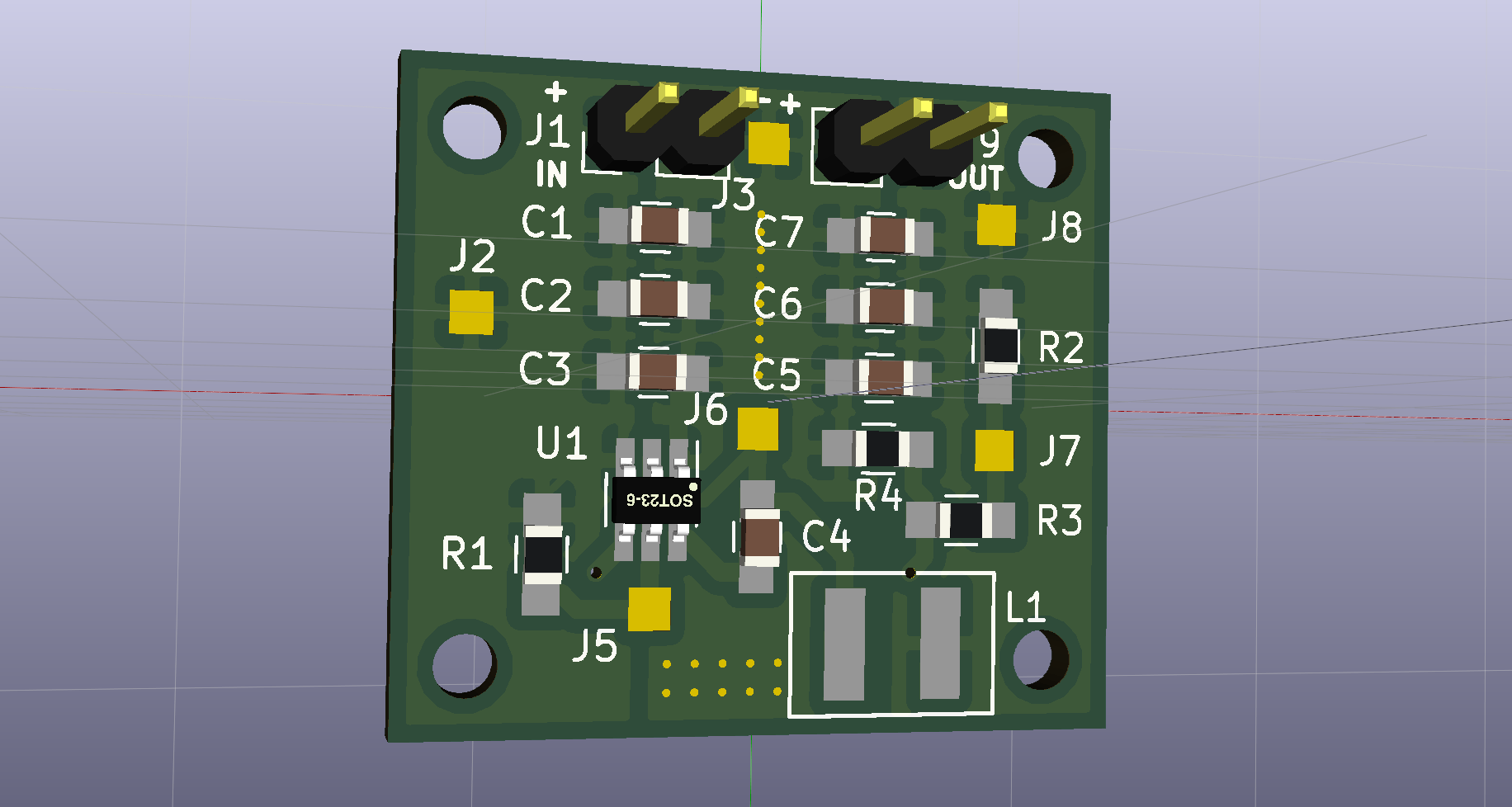
This project is a synchronous buck converter providing 5V at 3A from 4.5-V to 17-V input.
Power wheel ubuck is an open-source printed circuit board by ALeggeUp, from the ALeggeUp/power-wheel-ubuck repository on GitHub, published under the CC-BY-SA-4.0 licence. It is a 2-layer board of 26 × 23.5 mm with 45 parts on 8 nets, routed with 37 tracks and 2 vias.
It is built around the TPS563200DDCR. Its parts include 8 connectors, 7 capacitors, 4 resistors, 1 IC and 1 inductor. It belongs with the power boards of this library.
This project is a synchronous buck converter providing 5V at 3A from 4.5-V to 17-V input.
This work is licensed under the Creative Commons Attribution 4.0 International License. To view a copy of this license, visit http://creativecommons.org/licenses/by/4.0/ or send a letter to Creative Commons, PO Box 1866, Mountain View, CA 94042, USA.
| Qty | Value | Footprint | References |
|---|---|---|---|
| 6 | TEST_1P | Measurement_Points:Measurement_Point_Square-SMD-Pad_Small | J2, J3, J5, J6, J7, J8 |
| 3 | 22u | Capacitors_SMD:C_0805_HandSoldering | C5, C6, C7 |
| 2 | 0.1u | Capacitors_SMD:C_0805_HandSoldering | C1, C4 |
| 2 | 10K | Resistors_SMD:R_0805_HandSoldering | R1, R4 |
| 2 | 10u | Capacitors_SMD:C_0805_HandSoldering | C2, C3 |
| 2 | CONN_01X02_MALE | Pin_Headers:Pin_Header_Straight_1x02_Pitch2.54mm | J1, J9 |
| 1 | 0 | Resistors_SMD:R_0805_HandSoldering | R2 |
| 1 | 3.3u | power-wheel-ubuck-passives:VLS5045EX | L1 |
| 1 | 54.9K | Resistors_SMD:R_0805_HandSoldering | R3 |
| 1 | TPS563200DDCR | TO_SOT_Packages_SMD:SOT-23-6_Handsoldering | U1 |
The 21 most common of 45 parts.

Cheesylorry/Quantum-Demonstrator-Lite
A Repository for the Quantum Demonstrator Lite, a Plug and play Quantum Algorythm for Students. Integrates into SpinDrops, a software for simmulating up to three Qubits.

clover-clever/NuBiHo_Quad_Drone
Microprocessor Quad Drone System, based on SPRacing R3 w/Arduino PPM Control Signal


noahcroit/access_control_rp2zk
Firmware for Fail-secure door controller of access control room. Activate when power outage is occured.

punkfab/pcb-corpus
235 real KiCad boards from open-source hardware repositories, prepared as a placement and routing benchmark


imchipwood/dumbpad
Simple 4x4 numpad with rotary encoder. Powered by QMK via ATmega32u4 Pro Micro
It measures 26 × 23.5 mm and has 2 copper layers, 1.6 mm thick.
45 parts, built around the TPS563200DDCR. The full list of its parts is on this page, with links to each part's symbol and footprint where PCBKit's library has them.
From the ALeggeUp/power-wheel-ubuck repository on GitHub, at the commit this page was made from: the board is power-wheel-ubuck.kicad_pcb. PCBKit opens the board in the browser, with nothing to install.
Its repository publishes it under the CC-BY-SA-4.0 licence: you may reuse it on that licence's terms (keep the author's notice, and for a copyleft licence share your changes alike).