2 layers117 × 51 mm
.kicad_pcb
zehome/autoaudioswitcher
OSHW: Automatic audio input switcher based on audio activity
63 parts10BSD-3-Clause

 zehome/autoaudioswitcher10
OSHW: Automatic audio input switcher based on audio activity
Audioswitch is an open-source printed circuit board by zehome, from the zehome/autoaudioswitcher repository on GitHub, published under the BSD-3-Clause licence. It is a 2-layer board of 120 × 50 mm with 80 parts on 53 nets, routed with 412 tracks and 4 vias.
It is built around the LM358, TC1044SCOA and ADG409BRZ, with the LM317 among its other parts. Its parts include 35 resistors, 17 capacitors, 7 ICs, 5 diodes and 4 connectors. It belongs with the audio and music boards of this library.


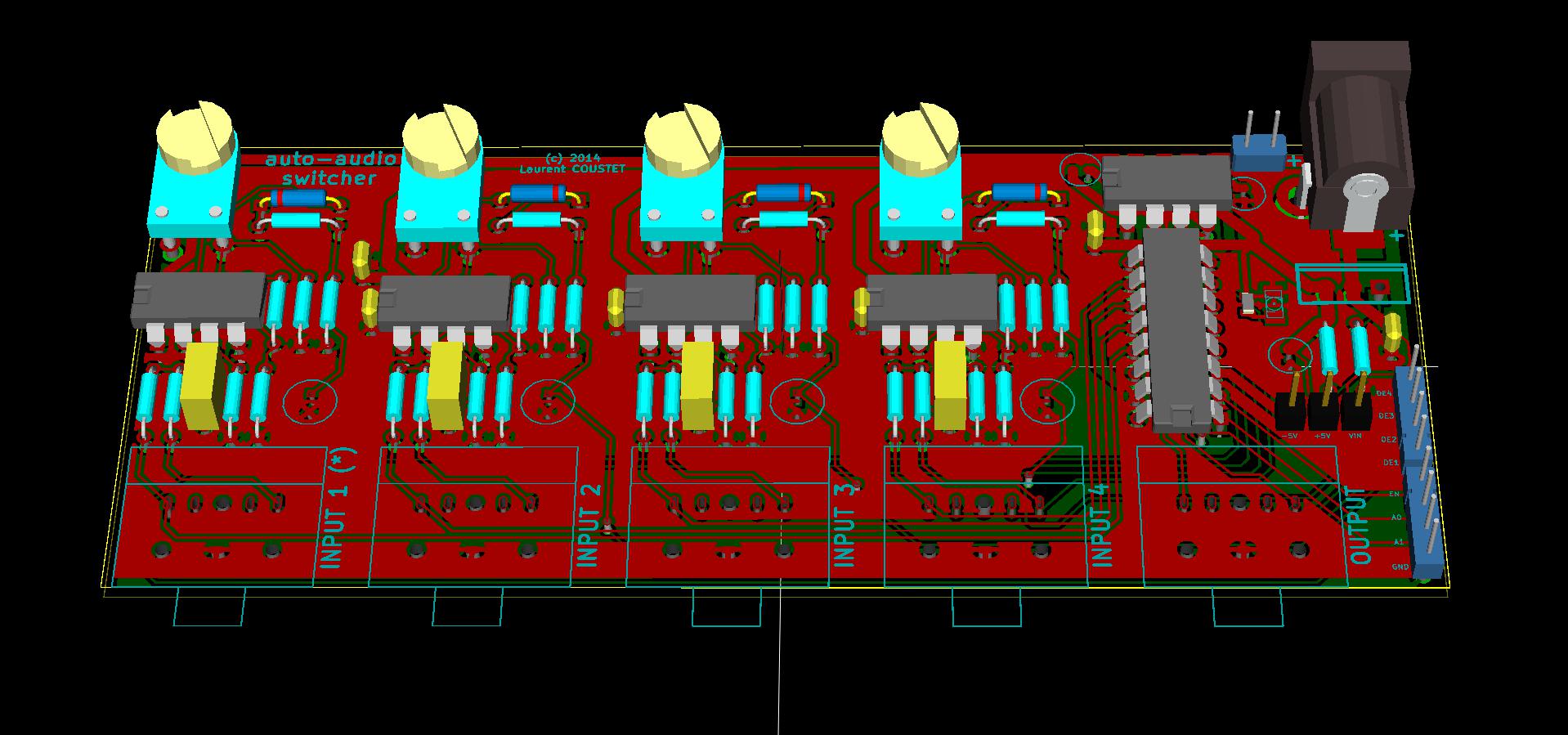
With vintage amplifiers, you have limited input switching capabilities. And they are all manual. This projects aims to solve this problem.
I have an old kenwood KA-4002 (http://www.hifivintage.eu/product.php?id_product=476) which I love.

So, my solution to this problem, automatic audio input switcher. Basically, the system will detect which audio input has a signal, and switch to it using a solid state MUX.
The project is in early state. Prototype circuit works on a breadbord. First test PCB done and sent to the factory.
Stereo input is muxed using 10k resistors and AC coupled into an amplifier (saturated). Then, the signal is compared to a reference voltage using a comparator which charges a CAP. A MCU will then poll the charge of the CAP and trigger the MUX (ADG409) to switch on the output if needed. (Programmed in the MCU)
Early design stage.
Breadboard prototype working.
Testing PCB done and sent to the factory. Gerbers available in GERBERS_REV0/.
KiCAD 20140622 + bzr4027 (r4027)
http://hackaday.io/project/2282-automatic-audio-input-switcher
OSHW: Automatic audio input switcher based on audio activity
| Qty | Value | Footprint | References |
|---|---|---|---|
| 12 | 10K | R3 | R1, R2, R3, R7, R10, R11, R12, R13, R14, R15, R16, R17 |
| 8 | 100K | R3 | R5, R8, R21, R22, R23, R30, R31, R32 |
| 8 | 1K | R3 | R4, R9, R18, R19, R20, R27, R28, R29 |
| 5 | 10nF | C1 | C13, C14, C15, C16, C17 |
| 4 | 100K | RV2X4 | RV1, RV2, RV3, RV4 |
| 4 | 100uF | C1V5 | C7, C8, C9, C10 |
| 4 | 10nF | C2 | C1, C2, C3, C4 |
| 4 | 15K | R3 | R6, R24, R25, R26 |
| 4 | DIODE | D3 | D1, D2, D3, D4 |
| 4 | LM358 | DIP-8__300 | U1, U2, U3, U4 |
| 3 | 10uF | C1.5V4 | C5, C6, C12 |
| 1 | 0.1uF | C1 | C11 |
| 1 | 1K | SM0805 | R35 |
| 1 | 240 | R3 | R34 |
| 1 | 720 | R3 | R33 |
| 1 | ADG409 | DIP-16__300 | U5 |
| 1 | CTRL CONN | PIN_ARRAY_4x1 | P5 |
| 1 | DETECT CONN | PIN_ARRAY_4x1 | P3 |
| 1 | INPUT1 | 3.5MMJACK | JACK1 |
| 1 | INPUT2 | 3.5MMJACK | JACK2 |
| 1 | INPUT3 | 3.5MMJACK | JACK3 |
| 1 | INPUT4 | 3.5MMJACK | JACK4 |
| 1 | LM317 | TO220_VERT | U7 |
| 1 | OUTPUT1 | 3.5MMJACK | JACKOUT1 |
| 1 | POWER | JACK_ALIM | P1 |
| 1 | PWR LED | LED-1206 | D5 |
| 1 | TC1044S | DIP-8__300 | U6 |
| 1 | TESTPWR | PIN_ARRAY_2X1 | P2 |
| 1 | TP -5V | PIN_ARRAY_1 | TP1 |
| 1 | TP_VCC | PIN_ARRAY_1 | TP3 |
| 1 | TP_VIN | PIN_ARRAY_1 | TP2 |
zehome/autoaudioswitcher
OSHW: Automatic audio input switcher based on audio activity

chukhanhhoang/SoftRoboticSetupFesto
Code for Raspberry Pi and Matlab/Simulink


kevinisabelle/litdlm01
AVR C Drum Lighting module using XMEGA microcontroller (Includes KiCad PCB)

cellularmitosis/ProgrammableLM317
A TTL-serial programmable LM317 voltage voltage supply circuit board design.

its-villada/ZFireAlarm
Sistema de sensores inalámbricos a ser distribuidos sobre el edificio de la institución educativa

Windfisch/analog-synth
A low-cost semimodular analog synthesizer


GBert/railroad
git clone https://github.com/arendst/Tasmota.git cd Tasmota git tag pio run
It measures 120 × 50 mm and has 2 copper layers, 1.6 mm thick.
80 parts, built around the LM358, TC1044SCOA, ADG409BRZ and LM317. The full list of its parts is on this page, with links to each part's symbol and footprint where PCBKit's library has them.
From the zehome/autoaudioswitcher repository on GitHub, at the commit this page was made from: the board is audioswitch.kicad_pcb. PCBKit opens the board in the browser, with nothing to install.
Its repository publishes it under the BSD-3-Clause licence: you may reuse it on that licence's terms (keep the author's notice, and for a copyleft licence share your changes alike).