2 layers
@home
z0b1/weather-station
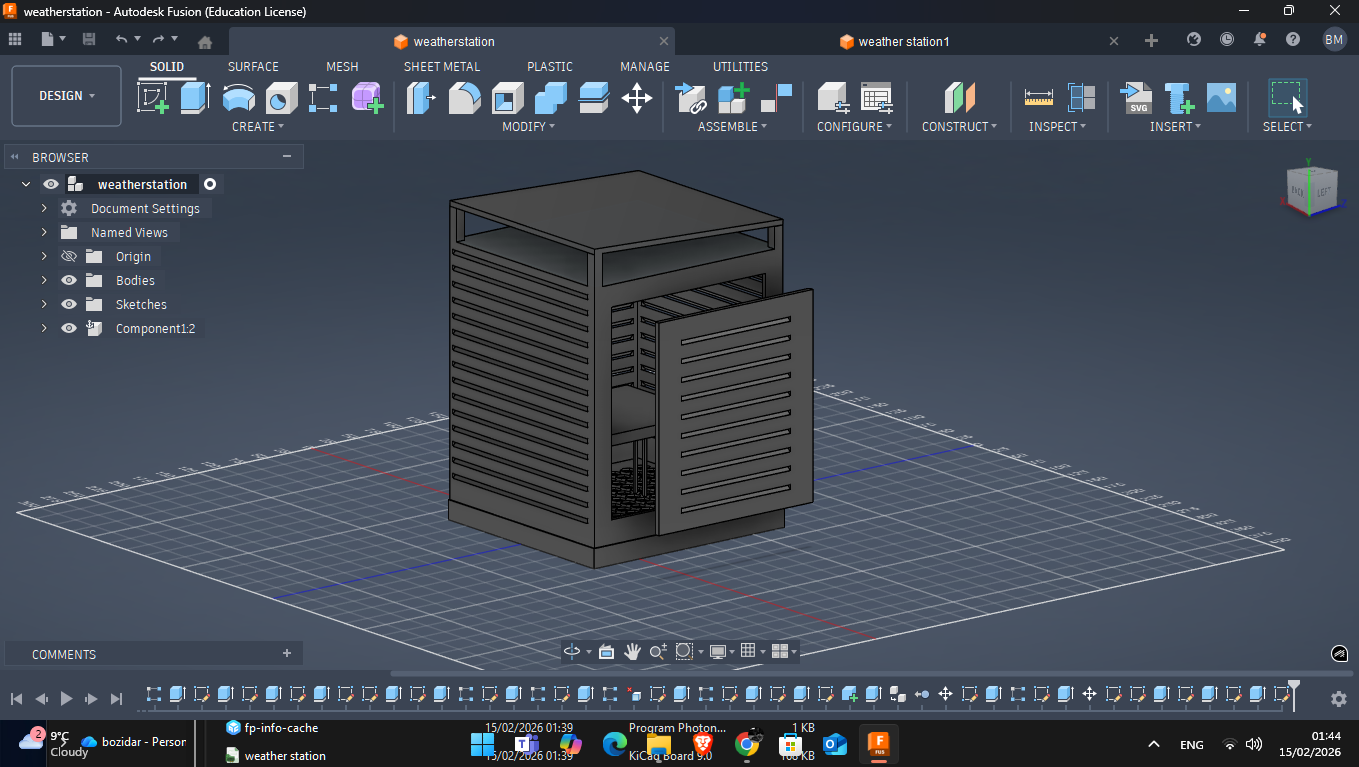
I'm presenting my project of a Field Weather Station containing anemometers and wind direction sensors, also ambient temp. and humidity sensors with a UHF transmitter in the field and an at home reciever.
2 parts2

 z0b1/weather-station2
I'm presenting my project of a Field Weather Station containing anemometers and wind direction sensors, also ambient temp. and humidity sensors with a UHF transmitter in the field and an at home reciever. This also includes an RPi4 B that is recieving satellite images and displaying them in a mobile phone app.
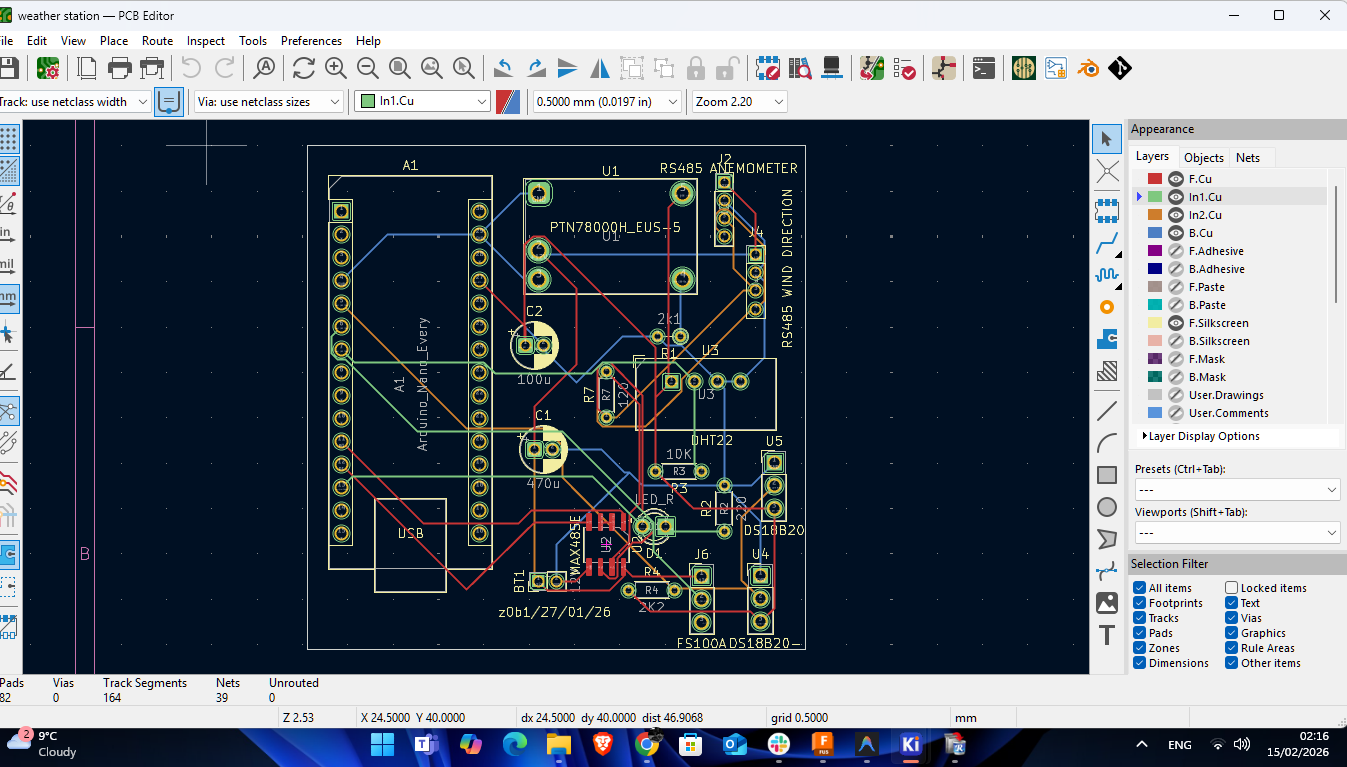
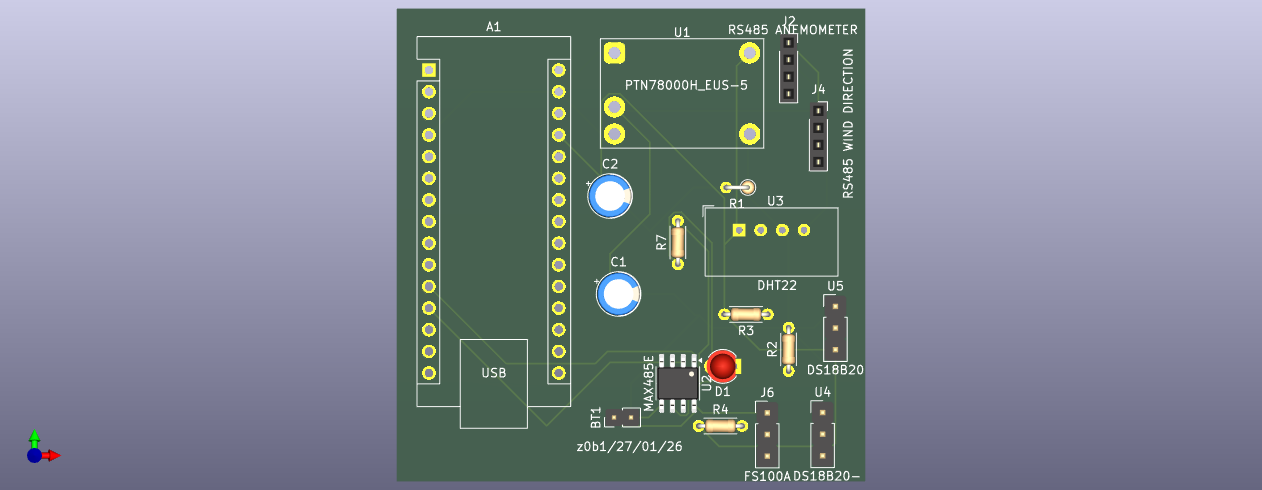
Weather station is an open-source printed circuit board by z0b1, from the z0b1/weather-station repository on GitHub. It is a 4-layer board with 11 parts on 36 nets, routed with 168 tracks and 12 vias.
It is built around the MAX485ED, DS18B20 and BME280. Its parts include 4 ICs, 3 connectors, 2 resistors and 1 capacitor. It belongs with the home automation and IoT boards and the AVR (ATmega, ATtiny) boards of this library.


I'm presenting my project of a Field Weather Station containing anemometers and wind direction sensors, also ambient temp., humidity and pressure sensors with LoRa transmission from the field to a home ESP32 receiver that uploads data to ThingSpeak cloud.
I live in the countryside and my family has large fruit plantations. By the microclimate of my area strong frosts in the spring time are common, that quite often hurts the fruits. We solve this issue by turning on our watering systems(the ground water keeps around 12 degrees Celsius at all times), but also by using air heaters to warm the area. So instead of waking up every 30 minutes to check the temps and having to go outside this idea was born. Main goal is that the weather station sends me phone notifications via ThingSpeak alerts. The weather station is located atleast 500m away from the house so the trick was getting reliable power, which I solved using a solar panel and a Lead Acid battery.
Using an Arduino Nano I read the data from the sensors (BME280 for temp/humidity/pressure, DS18B20 for soil/surface temps, RS485 anemometers) and log to SD card locally. The data is transmitted via SX1278 LoRa module at 433MHz to the home receiver. At home, an ESP32 with another SX1278 LoRa module receives the data and uploads it to ThingSpeak cloud for visualization and alerts.
[Field Station - Arduino Nano]
  ├── BME280 (temperature, humidity, pressure)
  ├── DS18B20 x2 (soil/surface temperature)
  ├── RS485 Anemometer + Wind Direction
  ├── SD Card (local logging backup)
  └── SX1278 LoRa TX (433MHz)
           │
           └──── 500m+ range ────┐
                                 │
[Home Receiver - ESP32]          │
  ├── SX1278 LoRa RX ◄───────────┘
  ├── WiFi
└── ThingSpeak Cloud UploadUsing ThingSpeak's MATLAB analysis to recognize patterns and predict frost conditions.
| Reference | Qty | Value | Price | Link | Info | Datasheet |
|---|---|---|---|---|---|---|
| A1 | 1 | Arduino Nano | € 5.16 | Link | Field Controller | Link |
| A2 | 1 | ESP32 DevKit V1 | € 4.50 | Link | Home Receiver + WiFi | ~ |
| BT1 | 1 | 12V 5Ah Lead Acid | € 11.84 | Link | Alternative capacity | ~ |
| C1 | 1 | 470uF | € 0.00 | Link | I already have | ~ |
| C2 | 1 | 100uF | € 0.00 | Link | I already have | ~ |
| C3 | 1 | 2pF | - | ~ | ||
| C4 | 1 | 2.2pF | - | ~ | ||
| C5 | 1 | 10pF | - | ~ | ||
| C6 | 1 | 470pF | - | ~ | ||
| D1 | 1 | LED_R | € 0.00 | Link | I already have | ~ |
| J1, J2 | 1 | RS485 ANEMOMETER | € 26.53 | Link | RS485 type | ~ |
| J4 | 1 | RS485 WIND DIRECTION | € 23.82 | Link | RS485 type | ~ |
| U4 | 1 | SDLA12TA | € 6.86 | Link | Link | |
| R1 | 1 | 2k1 | € 0.00 | Link | I already have | ~ |
| R2 | 1 | 220 | - | ~ | ||
| R3, R6 | 2 | 10K | - | ~ | ||
| R5 | 1 | 47K | - | ~ | ||
| R7 | 1 | 120 | - | ~ | ||
| SC1 | 1 | Solar cell | € 23.00 | Link | 15W 12V | ~ |
| U1 | 1 | DC-DC Buck Converter PTN78000HAZ | € 3.02 | Link | Voltage Regulator | ~ |
| U2 | 1 | MAX485E | € 4.39 | Link | RS485 Translate | Link |
| U3 | 1 | BME280 | € 2.50 | Link | Temp/Humidity/Pressure | Link |
| RF1 | 2 | SX1278 LoRa 433MHz | € 6.00 | Link | LoRa Transceiver Modules | ~ |
| SD1 | 1 | Micro SD Card Module | € 1.00 | Link | SPI SD Card Reader | ~ |
| U5 | 2 | DS18B20 | € 5.59 | Link | Waterproof Temp Sensor | Link |
| PCB | 1 | JLCPCB PCB Manufacturing | € 19.61 | Link | $20.75 | ~ |
| Grand Total | € 143.82 ($152.45) | Priced items subtotal | ||||
| Grand Total (Including shipping/VAT) | € 148.82 ($157.75) | +€ 5.00 shipping/VAT |
NOTE: Significant cost savings vs previous design by removing RPi + RTL-SDR setup
| Field | Data |
|---|---|
| 1 | Temperature (°C) |
| 2 | Humidity (%) |
| 3 | Pressure (hPa) |
| 4 | Wind Speed (m/s) |
| 5 | Wind Direction (°) |
| 6 | Soil Temp (°C) |
| 7 | Surface Temp (°C) |
| 8 | LoRa RSSI (dBm) |
| Qty | Value | Footprint | References |
|---|---|---|---|
| 2 | DS18B20 | Connector_PinHeader_2.54mm:PinHeader_1x03_P2.54mm_Vertical | U4, U5 |
| 1 | 100u | Capacitor_THT:CP_Radial_D5.0mm_P2.00mm | C2 |
| 1 | 120 | Resistor_THT:R_Axial_DIN0204_L3.6mm_D1.6mm_P5.08mm_Horizontal | R7 |
| 1 | 2K2 | Resistor_THT:R_Axial_DIN0204_L3.6mm_D1.6mm_P5.08mm_Horizontal | R4 |
| 1 | Arduino_Nano_Every | Module:Arduino_Nano | A1 |
| 1 | BME280 | Package_LGA:Bosch_LGA-8_2.5x2.5mm_P0.65mm_ClockwisePinNumbering | U3 |
| 1 | LoRa module SX1278 | Connector_PinHeader_2.54mm:PinHeader_1x12_P2.54mm_Vertical | J7 |
| 1 | MAX485E | Package_SO:SOIC-8_3.9x4.9mm_P1.27mm | U2 |
| 1 | RS485 ANEMOMETER | Connector_PinHeader_2.00mm:PinHeader_1x04_P2.00mm_Vertical | J1 |
| 1 | RS485 WIND DIRECTION | Connector_PinSocket_2.00mm:PinSocket_1x04_P2.00mm_Vertical | J4 |
z0b1/weather-station
I'm presenting my project of a Field Weather Station containing anemometers and wind direction sensors, also ambient temp. and humidity sensors with a UHF transmitter in the field and an at home reciever.


akladnig/CamperVan
- CamperVan Design and Arduino Circuit Design - Campervan Design Overview - Dashboard App - Electrical System - Sensors - Circuit Design - Battery and voltage monitoring - Voltage Divider Design - Low Pass Filter - TODO


Sidbit08/ABEX_PCB_v1
A custom ESP32-S3-based PCB designed in KiCad for automated soil sample analysis, featuring drivers and interfaces for environmental sensors, peristaltic pumps, and auger drilling actuators.


klinkon-electronics/WeatherIOT-Hardware
The WeatherIOT Board is a simple, economical but effective ESP32 board that can be use as datalogger for enviromental monitoring with integrations for smart applications such as greenhouses, beehives, smart sprinklers…

Sebastian-S-Posada/balloon-data-logger-shield
An Arduino Uno shield, designed in KiCad, that logs temperature, humidity, barometric pressure, and acceleration to a microSD card. It's built as a lightweight, low-power payload for a high-altitude balloon flight.
11 parts, built around the MAX485ED, DS18B20 and BME280. The full list of its parts is on this page, with links to each part's symbol and footprint where PCBKit's library has them.
From the z0b1/weather-station repository on GitHub, at the commit this page was made from: the board is KiCAD/weather station/weather station.kicad_pcb and its schematic KiCAD/@home/@home.kicad_sch. PCBKit opens the board in the browser, with nothing to install.
Its repository states no licence, so its author keeps all rights: ask z0b1 before reusing the design.