
2 layers73.9 × 42.4 mm

The code for Li Feng Yin and Daniel Zhang's sumo robot, for TEJ3MI
Sumo is an open-source printed circuit board by Yourself1011, from the Yourself1011/sumo-bot repository on GitHub. It is a 2-layer board of 76.2 × 94 mm with 57 parts on 55 nets, routed with 252 tracks and 0 vias.
It is built around the L293D, 74HC04D and L7805. Its parts include 19 resistors, 8 capacitors, 8 diodes, 6 ICs and 5 switches. It belongs with the PIC boards of this library.


The code for Li Feng Yin and Daniel Zhang's sumo robot, for TEJ3MI
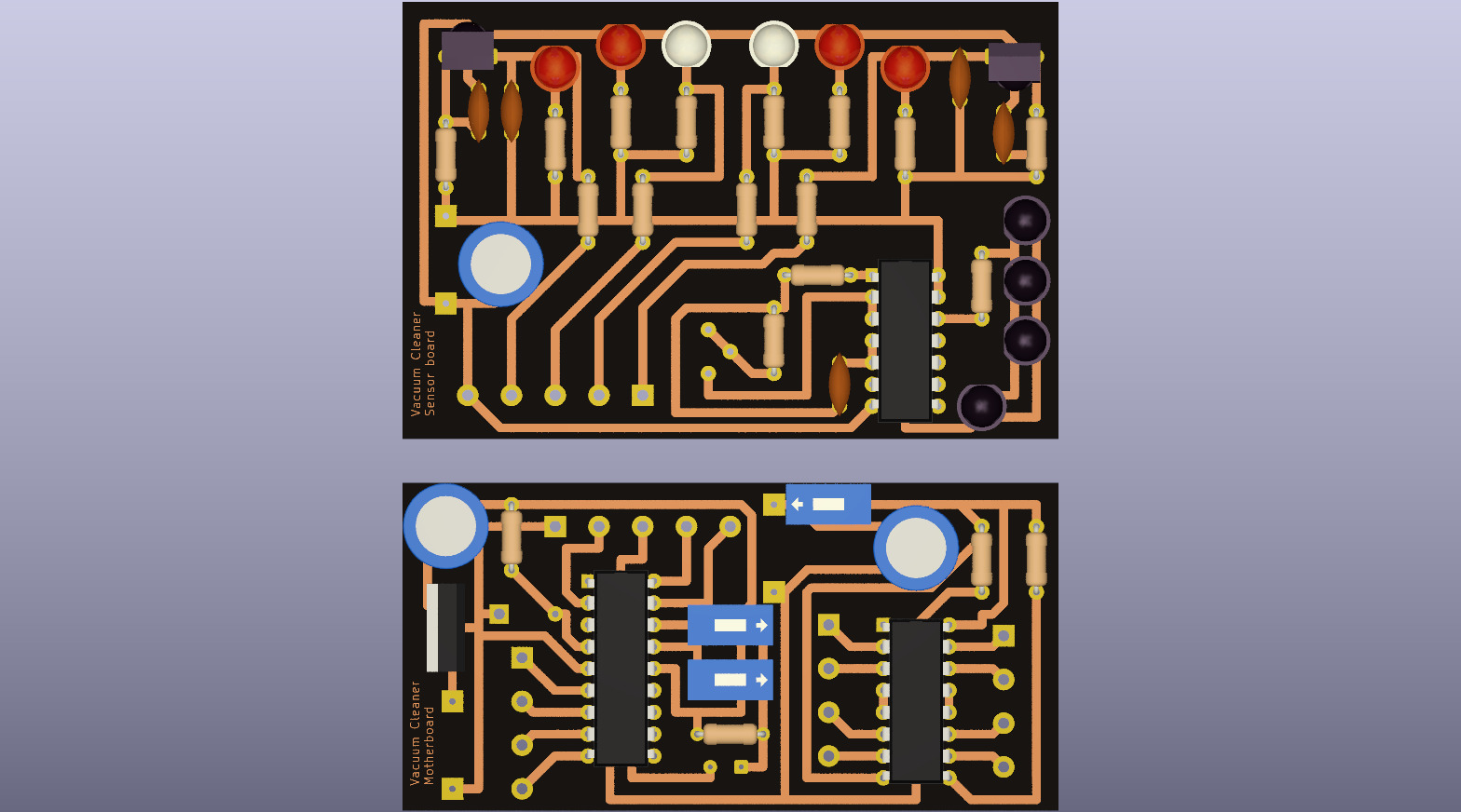
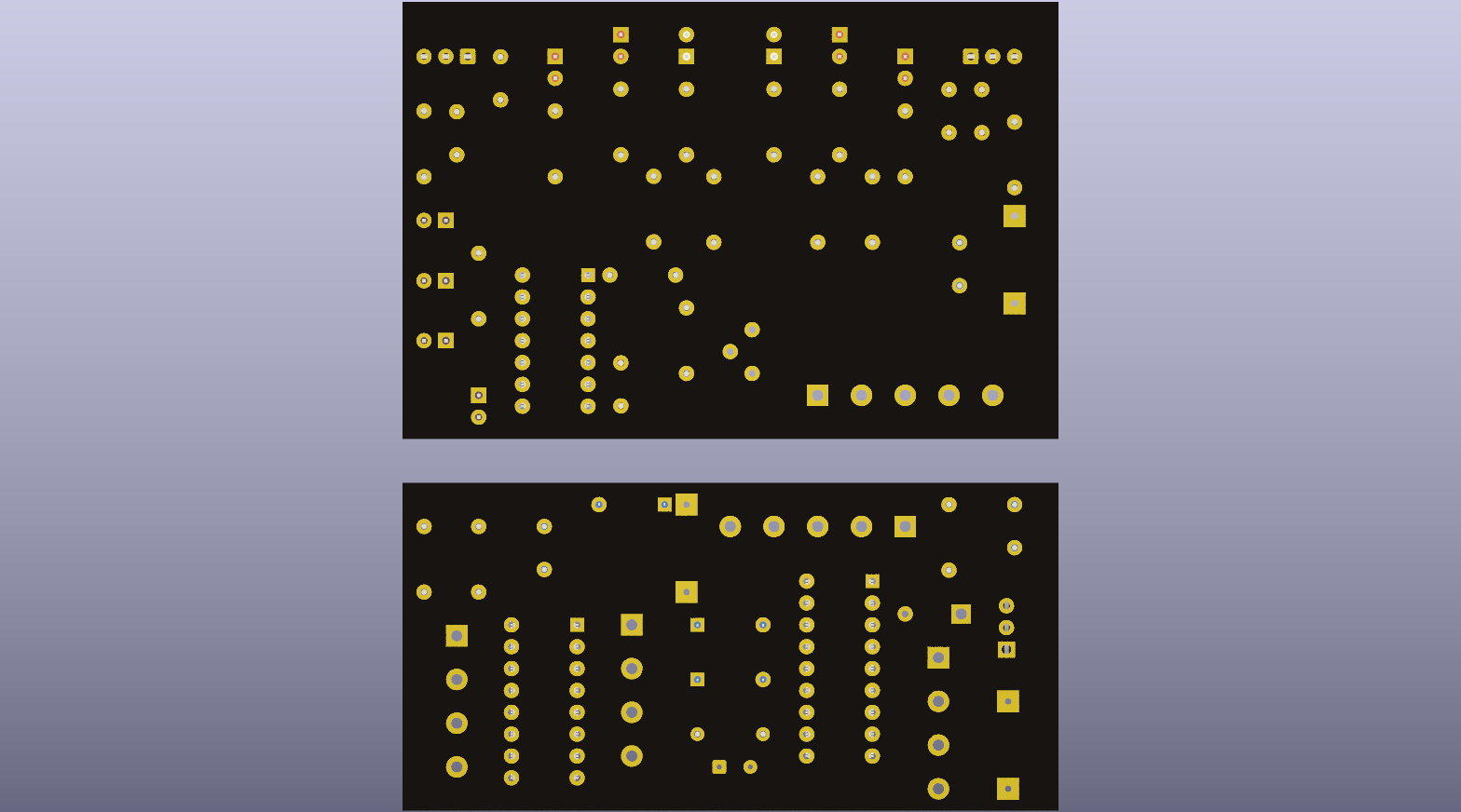
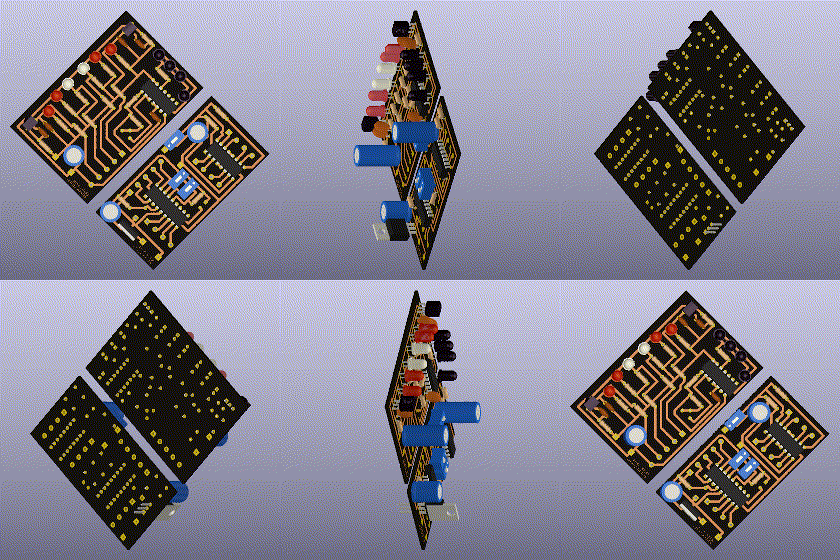
| Qty | Value | Footprint | References |
|---|---|---|---|
| 7 | 220 | Resistor_THT:R_Axial_DIN0207_L6.3mm_D2.5mm_P7.62mm_Horizontal | R4, R8, R11, R12, R13, R16, R17 |
| 4 | 100 | Resistor_THT:R_Axial_DIN0207_L6.3mm_D2.5mm_P7.62mm_Horizontal | R6, R10, R15, R18 |
| 4 | IR LED | LED_THT:LED_D5.0mm_IRBlack | D3, D4, D7, D8 |
| 3 | SW_DIP_x01 | Button_Switch_THT:SW_DIP_SPSTx01_Slide_9.78x4.72mm_W7.62mm_P2.54mm | SW2, SW3, SW4 |
| 3 | Screw_Terminal_01x04 | TerminalBlock_MetzConnect:TerminalBlock_MetzConnect_Type101_RT01604HBWC_1x04_P5.08mm_Horizontal | T1, T3, T4 |
| 2 | 0.1uF | Capacitor_THT:C_Disc_D7.5mm_W2.5mm_P5.00mm | C5, C8 |
| 2 | 1000uF | Capacitor_THT:C_Radial_D10.0mm_H20.0mm_P5.00mm | C2, C3 |
| 2 | 10k | Resistor_THT:R_Axial_DIN0207_L6.3mm_D2.5mm_P7.62mm_Horizontal | R2, R3 |
| 2 | 1uF | Capacitor_THT:C_Disc_D7.5mm_W2.5mm_P5.00mm | C6, C7 |
| 2 | 47k | Resistor_THT:R_Axial_DIN0207_L6.3mm_D2.5mm_P7.62mm_Horizontal | R5, R14 |
| 2 | BPW40 | LED_THT:LED_D5.0mm_Clear | Q1, Q2 |
| 2 | LED | LED_THT:LED_D5.0mm | D2, D6 |
| 2 | Screw_Terminal_01x05 | TerminalBlock_MetzConnect:TerminalBlock_MetzConnect_Type101_RT01605HBWC_1x05_P5.08mm_Horizontal | T2, T5 |
| 2 | Super LED | LED_THT:LED_D5.0mm | D1, D5 |
| 2 | TSOP4038 | OptoDevice:Vishay_MOLD-3Pin | U5, U6 |
| 1 | 1000uF | Capacitor_THT:C_Radial_D10.0mm_H12.5mm_P5.00mm | C1 |
| 1 | 100k | Resistor_THT:R_Axial_DIN0207_L6.3mm_D2.5mm_P7.62mm_Horizontal | R7 |
| 1 | 10k | Potentiometer_THT:Potentiometer_Bourns_3386P_Vertical | VR1 |
| 1 | 1k | Resistor_THT:R_Axial_DIN0207_L6.3mm_D2.5mm_P7.62mm_Horizontal | R19 |
| 1 | 1nF | Capacitor_THT:C_Disc_D7.5mm_W2.5mm_P5.00mm | C4 |
| 1 | 3.3k | Resistor_THT:R_Axial_DIN0207_L6.3mm_D2.5mm_P7.62mm_Horizontal | R9 |
| 1 | 4.7k | Resistor_THT:R_Axial_DIN0207_L6.3mm_D2.5mm_P7.62mm_Horizontal | R1 |
| 1 | 4xAA | Battery:Battery_Pads | BT1 |
| 1 | 6xAA | Battery:Battery_Pads | BT3 |
| 1 | 74HC04 | Package_DIP:DIP-14_W7.62mm | U4 |
| 1 | 9V | Battery:Battery_Pads | BT2 |
| 1 | L293D | Package_DIP:DIP-16_W7.62mm | U3 |
| 1 | L7805 | Package_TO_SOT_THT:TO-220-3_Vertical | U2 |
| 1 | PIC16F628A-IP | Package_DIP:DIP-18_W7.62mm | U1 |
| 1 | SW_DIP_x01 | Connector_Wire:SolderWire-0.1sqmm_1x02_P3.6mm_D0.4mm_OD1mm | SW5 |
| 1 | SW_Push | Button_Switch_THT:SW_PUSH_1P1T_6x3.5mm_H5.0_APEM_MJTP1250 | SW1 |
It measures 76.2 × 94 mm and has 2 copper layers, 1.6 mm thick.
57 parts, built around the L293D, 74HC04D and L7805. The full list of its parts is on this page, with links to each part's symbol and footprint where PCBKit's library has them.
From the Yourself1011/sumo-bot repository on GitHub, at the commit this page was made from: the board is sumo.kicad_pcb and its schematic sumo.kicad_sch. PCBKit opens the board in the browser, with nothing to install.
Its repository states no licence, so its author keeps all rights: ask Yourself1011 before reusing the design.

comakingspace/FlipDotDisplay
They were bought at the Makerfaire Hannover 2016.


mrpossoms/openturret
Opensource designs and software for autonomously aiming gimble

abdelrauf-44/Self-Balancing-Robot
ESP32-based self-balancing robot using MPU6050 IMU and PID control, with wireless monitoring and tuning via Blynk.