2 layers82 × 81 mm
 comakingspace/FlipDotDisplay3
They were bought at the Makerfaire Hannover 2016.
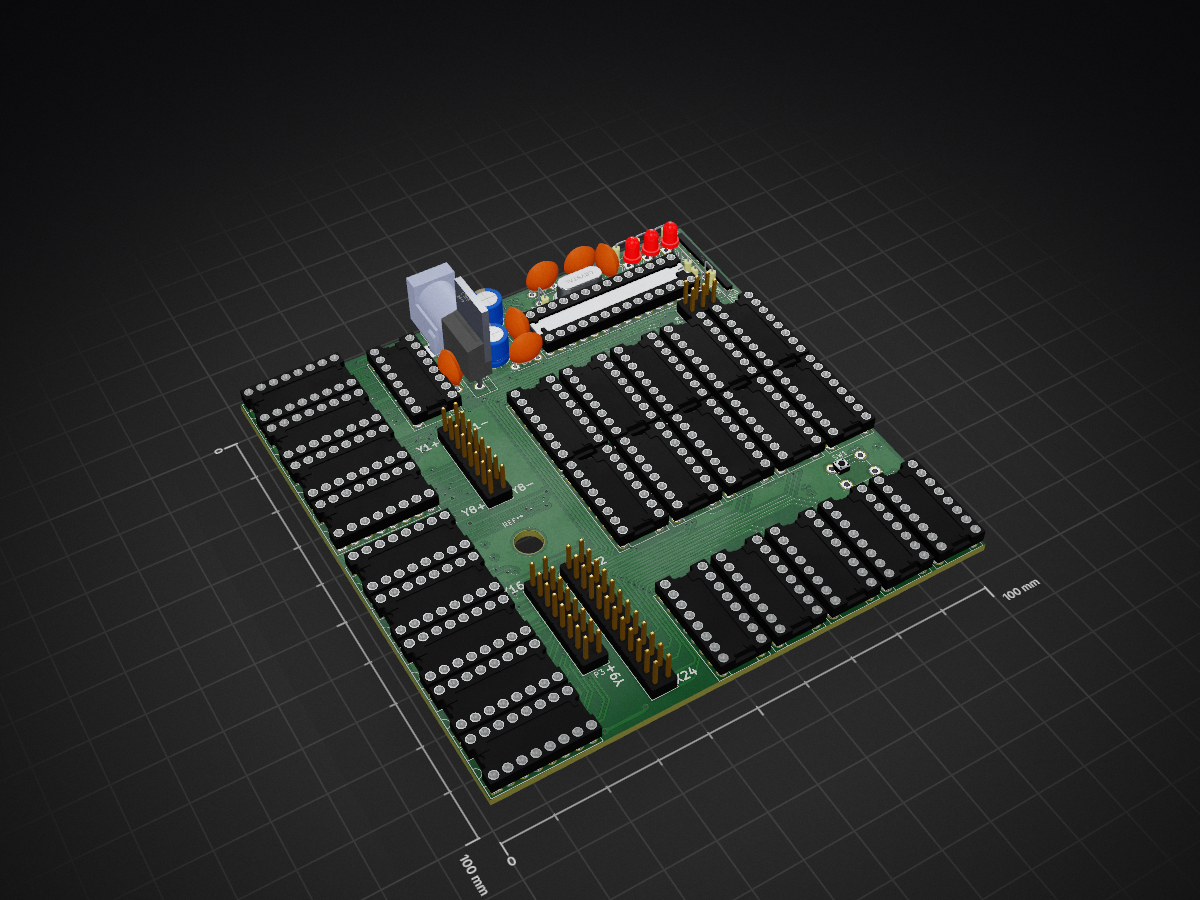
Flipdot H Bridge is an open-source printed circuit board by comakingspace, from the comakingspace/FlipDotDisplay repository on GitHub. It is a 2-layer board of 100 × 100 mm with 76 parts on 160 nets, routed with 1,432 tracks and 315 vias.
It is built around the ATMEGA328P-PU, L293D and 74HC595, with the L7805 among its other parts. Its parts include 28 ICs, 8 capacitors, 7 resistors, 5 connectors and 3 diodes. It belongs with the interfaces and adapters boards and the ESP8266 and AVR (ATmega, ATtiny) boards of this library.


3 old flip dot displays which need some work to get up and running.
They were bought at the Makerfaire Hannover 2016.
Hardware design is made in KiCAD 4.
A dot on the display is switched by magnetising an inductor, which causes the colored dot (with a small magnet embedded) to change the orientation. Because the core of the inductor stays magnetized the state of the dot is stable even without being powered.
The inductors of the pixels are hooked up in an array with 24x16. Each column is connected to a single pin of the connector and each row has two inputs; one for positive voltage and one for negative (see FlipDotSchematic). By applying a voltage to a row and a column the corresponding pixel is flipped depending on the current flow direction. The original driver probably used two different power rails and sets of transistors to change the direction of the dot.
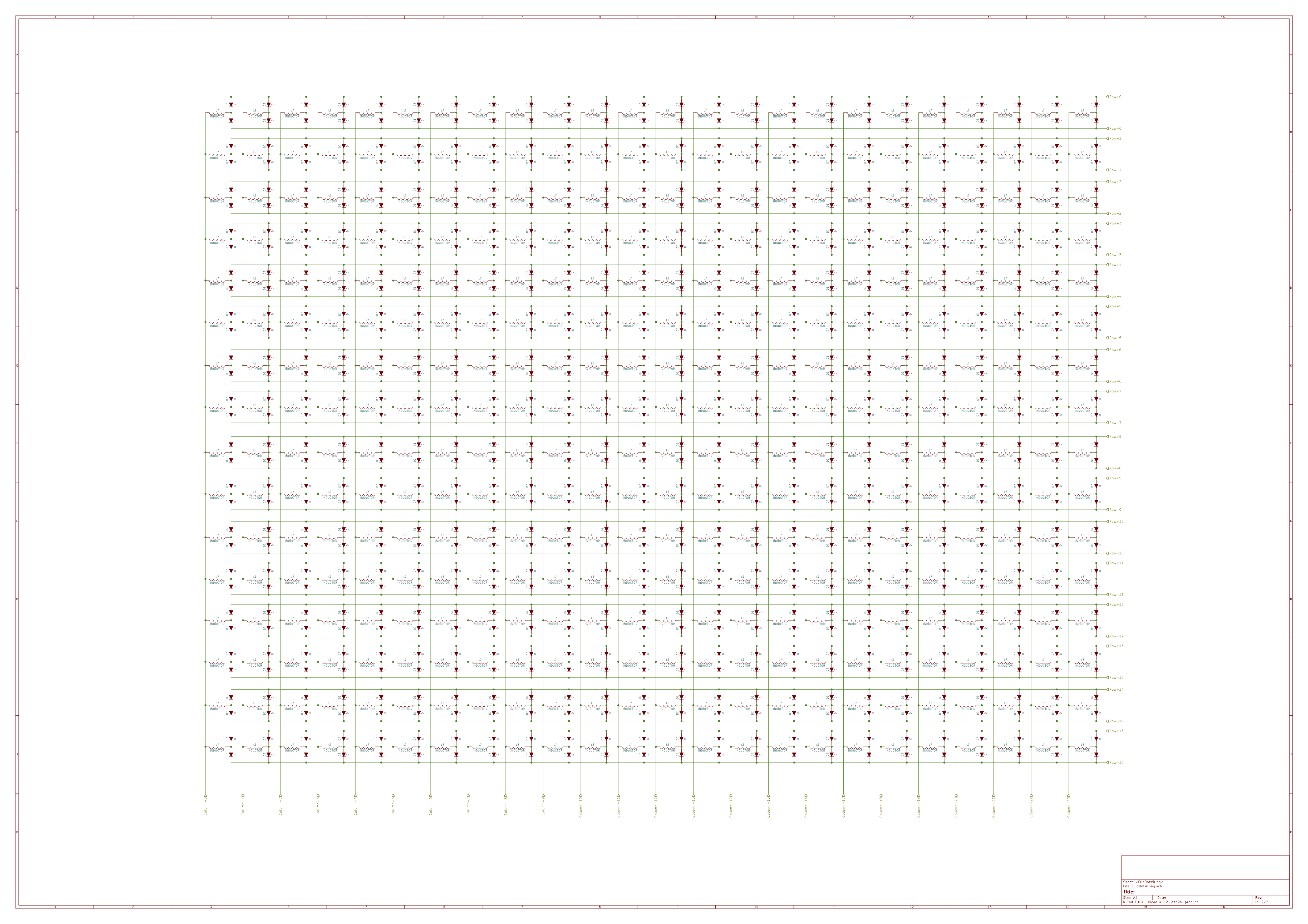
The new driver will use a half-bridge configuration on each input to select the current flow direction.
| Qty | Value | Footprint | References |
|---|---|---|---|
| 20 | L293D | Housings_DIP:DIP-16_W7.62mm_Socket | U3, U10, U11, U12, U14, U15, U16, U17, U18, U19, U21, U22, U23, U24, U25, U26 +4 |
| 5 | 74HC595 | Housings_DIP:DIP-16_W7.62mm_Socket | U1, U2, U7, U8, U13 |
| 3 | 1.5K | Resistors_THT:R_Axial_DIN0204_L3.6mm_D1.6mm_P2.54mm_Vertical | R3, R4, R5 |
| 3 | 100nF | Capacitors_THT:C_Disc_D4.7mm_W2.5mm_P5.00mm | C1, C5, C8 |
| 2 | 22p | Capacitors_THT:C_Disc_D4.7mm_W2.5mm_P5.00mm | C6, C7 |
| 2 | CONN_02X08 | Pin_Headers:Pin_Header_Straight_2x08_Pitch2.54mm | P2, P3 |
| 1 | 0.33uF | Capacitors_THT:C_Disc_D4.7mm_W2.5mm_P5.00mm | C3 |
| 1 | 10k | Resistors_THT:R_Axial_DIN0204_L3.6mm_D1.6mm_P2.54mm_Vertical | R6 |
| 1 | 10uF | Capacitors_THT:CP_Radial_D6.3mm_P2.50mm | C2 |
| 1 | 1M | Resistors_THT:R_Axial_DIN0204_L3.6mm_D1.6mm_P2.54mm_Vertical | R7 |
| 1 | 1k | Resistors_THT:R_Axial_DIN0204_L3.6mm_D1.6mm_P2.54mm_Vertical | R1 |
| 1 | 1uF | Capacitors_THT:CP_Radial_D6.3mm_P2.50mm | C4 |
| 1 | 2k | Resistors_THT:R_Axial_DIN0204_L3.6mm_D1.6mm_P2.54mm_Vertical | R2 |
| 1 | ATMEGA328P-PU | Housings_DIP:DIP-28_W7.62mm_Socket | U28 |
| 1 | Barrel_Jack | Connectors:BARREL_JACK | J1 |
| 1 | CONN_02X03 | Pin_Headers:Pin_Header_Straight_2x03_Pitch2.54mm | P4 |
| 1 | CONN_02X13 | Pin_Headers:Pin_Header_Straight_2x12_Pitch2.54mm | P1 |
| 1 | Crystal | Crystals:Crystal_HC49-4H_Vertical | Y1 |
| 1 | ESP8266_D1_Mini | FDD_footprint:ESP8266_D1_Mini_cropped | U20 |
| 1 | L7805 | TO_SOT_Packages_THT:TO-220_Vertical | U27 |
| 1 | LOGO | FDD_footprint:FDD_Icon | G*** |
| 1 | Led_Green | LEDs:LED_D3.0mm | D1 |
| 1 | Led_Red | LEDs:LED_D3.0mm | D3 |
| 1 | Led_Yellow | LEDs:LED_D3.0mm | D2 |
| 1 | SW_Push | Buttons_Switches_THT:SW_PUSH_6mm | SW1 |
The 54 most common of 76 parts.
It measures 100 × 100 mm and has 2 copper layers, 1.6 mm thick.
76 parts, built around the ATMEGA328P-PU, L293D, 74HC595 and L7805. The full list of its parts is on this page, with links to each part's symbol and footprint where PCBKit's library has them.
From the comakingspace/FlipDotDisplay repository on GitHub, at the commit this page was made from: the board is Schematics_H-Bridge/Flipdot_H-Bridge.kicad_pcb. PCBKit opens the board in the browser, with nothing to install.
Its repository states no licence, so its author keeps all rights: ask comakingspace before reusing the design.




EthanSousaProjects/CBR_Custom_Cluster
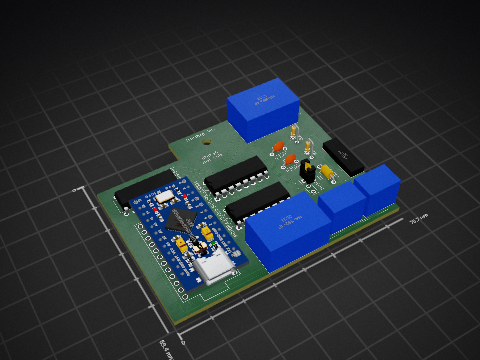
A custom cluster design for my CBR 125RW6 (2006 carb model) to replace the old large mechanical cluster with a smaller simpler design.


kr4fty/DCMotorController
Closed Loop Position Control for DC Servo Motors. STEP / DIR compatible Driver