4 layers75.5 × 82.7 mm
IoT Edge Device V1
AfriOrbit/SDR-IOT-project
This project includes all work materials for the SDR and IOT communication systems.
99 parts
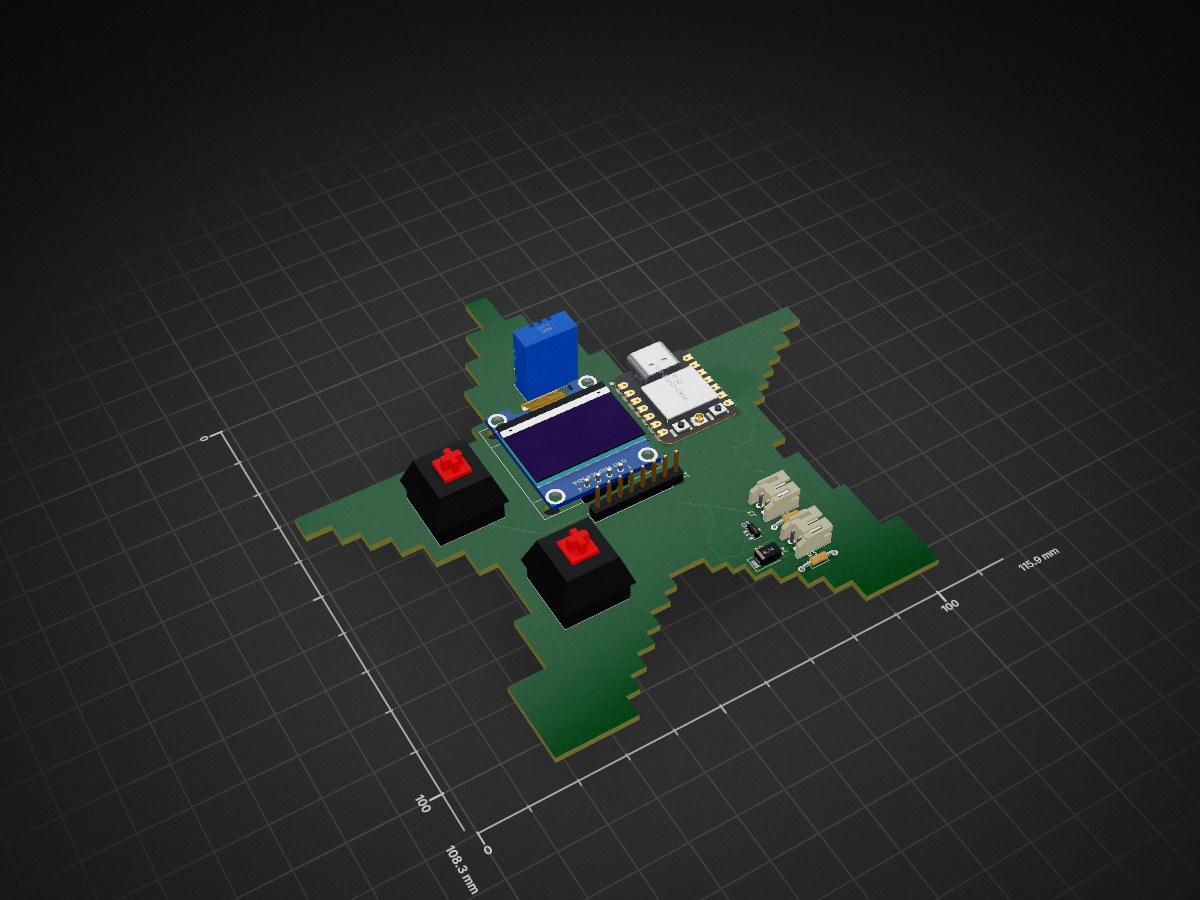
 young1dev/Starbie
Starbie is a tiny motion-controlled digital pet — essentially a desktop Tamagotchi with minimal gameplay buttons. Instead of relying entirely on button presses, you interact with the pet by moving the device.
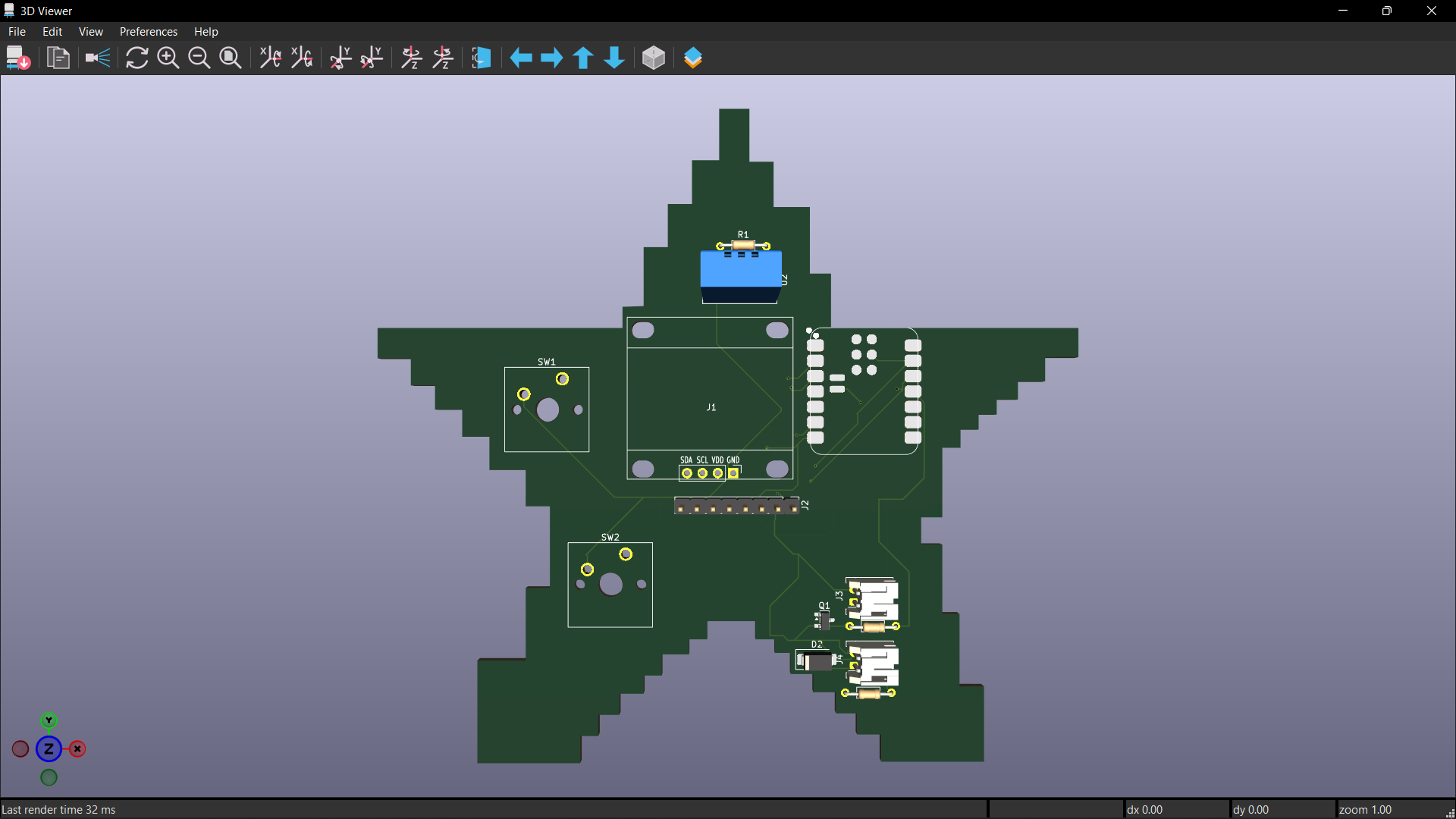
Starbie is an open-source printed circuit board by young1dev, from the young1dev/Starbie repository on GitHub. It is a 2-layer board of 115.9 × 108.3 mm with 13 parts on 29 nets, routed with 153 tracks and 11 vias.
It is built around the DHT11, AO3400A and SS14. Its parts include 4 connectors, 3 resistors, 2 ICs, 2 switches and 1 diode. It belongs with the ESP32 and RISC-V boards of this library.


Starbie is a tiny motion-controlled digital pet — essentially a desktop Tamagotchi with minimal gameplay buttons. Instead of relying entirely on button presses, you interact with the pet by moving the device.
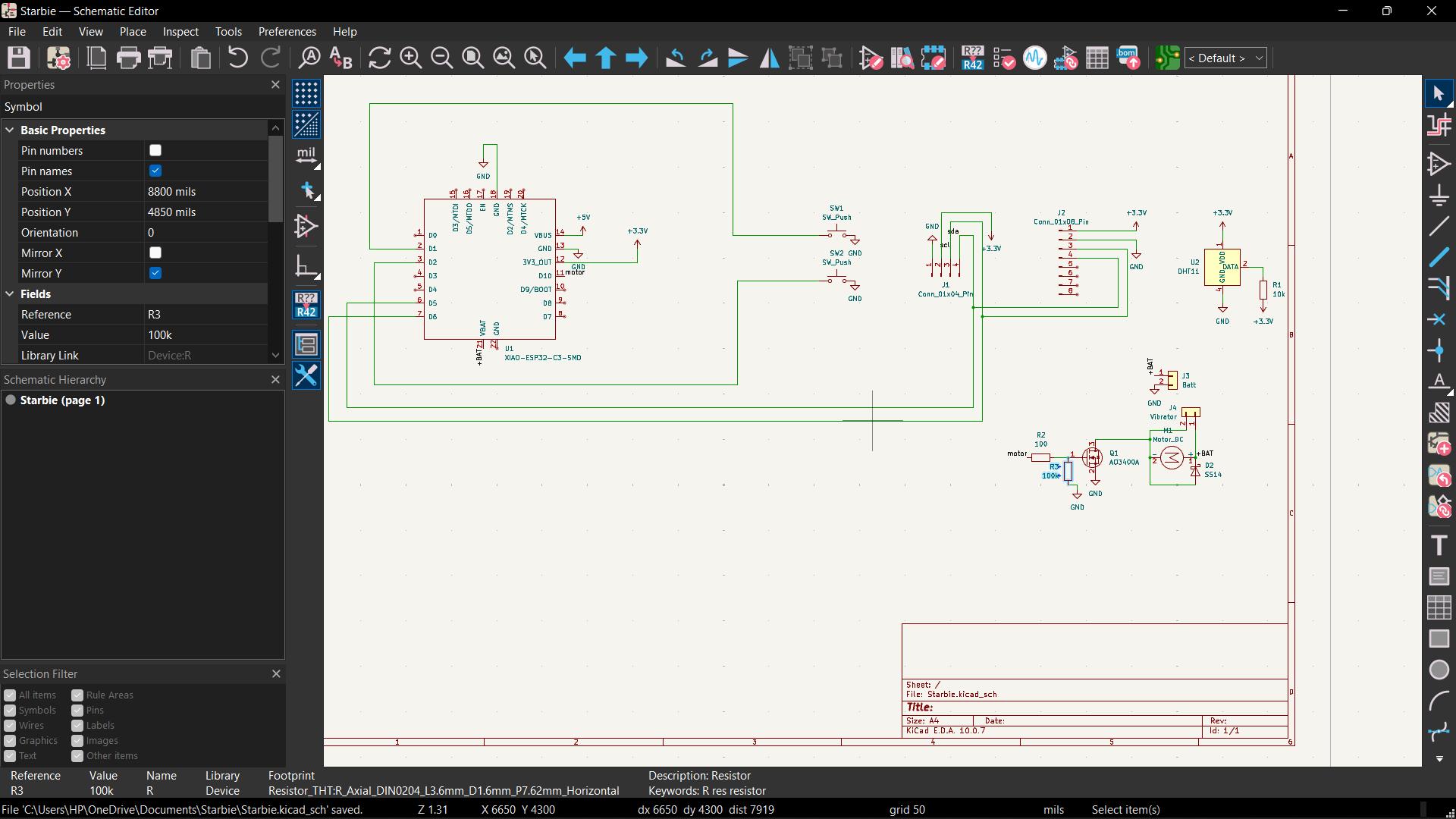
Built around the Seeed XIAO ESP32-C3, Starbie uses an OLED display to bring the pet to life and motion input to respond to interactions. My version adds a vibration motor for physical feedback and a custom PCB designed to integrate the electronics used.
The PCB design and firmware are complete, but the PCB has not yet been tested.
Starbie is designed to sit on your desk, display its personality on a small screen, and react to how you handle it. Its interface combines a tilt-controlled radial menu, pet animations, and a stats screen.
The custom PCB integrates the microcontroller, display connections, buttons, sensors, and additional circuitry for vibration feedback. The design incorporates both through-hole and surface-mount components.
This project was created as my Week 1 project for Half Life, a 10 weeks hardware-building program powered by hackclub.
My goal was to adapt the original design and add a physical response to the pet's interactions through a vibration motor and its driver circuit.
The KiCad design files, PCB renders, and firmware are included in this repository.
The firmware targets the Seeed XIAO ESP32-C3 and uses PlatformIO with the Arduino framework. It includes the virtual pet interface, tilt-controlled radial menu, stats screen, and shake interaction, with vibration feedback added as my custom feature.
Current status: The PCB design and firmware are complete. The physical PCB has not yet been assembled and tested, so the operation of the complete hardware remains unverified.
The design includes the following main components:
See the Hardware/ directory for the KiCad schematic and PCB design files. Consult the component list and schematic for the circuit connections and power requirements before assembling the board.
| Item | Qty | Supplier | Cost/item | Total Cost | Link |
|---|---|---|---|---|---|
| Seeed XIAO ESP32-C3 | 1 | AliExpress | $7.91 | $7.91 | AliExpress |
| OLED | 1 | AliExpress | $1.19 | $1.19 | AliExpress |
| JST PH 2.0 | 1 | AliExpress | $3.37 | $3.37 | AliExpress |
| DHT11 | 1 | AliExpress | $1.76 | $1.76 | AliExpress |
| MPU6050 | 1 | AliExpress | $0.99 | $0.99 | AliExpress |
| AO3400A N-channel MOSFET | 1 | AliExpress | $0.99 | $0.99 | AliExpress |
| SS14 Schottky diode | 1 | AliExpress | $1.91 | $1.91 | AliExpress |
| Vibrator motor | 1 | AliExpress | $1.19 | $1.19 | AliExpress |
| Cherry MX push-button switch | 1 | AliExpress | $4.78 | $4.78 | AliExpress |
| Battery 3.7V 500mAh | 1 | AliExpress | $3.79 | $3.79 | AliExpress |
| Resistors | 1 | AliExpress | $1.99 | $1.99 | AliExpress |
| PCB Printing | 1 | JLCPCB | $4.00 | $4.00 | JLCPCB |
| Estimated total shipping | 1 | — | — | $2.00 | — |
| Grand Total | $31.88 |
Note: Shipping is estimated and may change at checkout.
The firmware is maintained as a separate PlatformIO project in Firmware/.
See Firmware/README.md for the development environment, build and upload instructions, controls, and sprite customization guide.
Hardware/ — KiCad schematic and PCB source files.Images/ — PCB renders and design screenshots.Firmware/ — PlatformIO firmware project.Fabrication/ — PCB fabrication files (Gerber, gbrjob and drl files)Starbie builds on the original project documented in the Starbie Week 1 Guide.
| Qty | Value | Footprint | References |
|---|---|---|---|
| 2 | SW_Push | Button_Switch_Keyboard:SW_Cherry_MX_1.00u_PCB | SW1, SW2 |
| 1 | 100 | Resistor_THT:R_Axial_DIN0204_L3.6mm_D1.6mm_P7.62mm_Horizontal | R2 |
| 1 | 100k | Resistor_THT:R_Axial_DIN0204_L3.6mm_D1.6mm_P7.62mm_Horizontal | R3 |
| 1 | 10k | Resistor_THT:R_Axial_DIN0204_L3.6mm_D1.6mm_P7.62mm_Horizontal | R1 |
| 1 | AO3400A | Package_TO_SOT_SMD:SOT-23 | Q1 |
| 1 | Batt | Connector_JST:JST_PH_S2B-PH-K_1x02_P2.00mm_Horizontal | J3 |
| 1 | Conn_01x04_Pin | Imported Parts:Display_128x64_096_I2C | J1 |
| 1 | Conn_01x08_Pin | Connector_PinHeader_2.54mm:PinHeader_1x08_P2.54mm_Vertical | J2 |
| 1 | DHT11 | Imported Parts:Aosong_DHT11_5.5x12.0_P2.54mm | U2 |
| 1 | SS14 | Diode_SMD:D_SMA | D2 |
| 1 | Vibrator | Connector_JST:JST_PH_S2B-PH-K_1x02_P2.00mm_Horizontal | J4 |
| 1 | XIAO-ESP32-C3-SMD | Imported Parts:XIAO-ESP32-C3-SMD | U1 |
It measures 115.9 × 108.3 mm and has 2 copper layers, 1.6 mm thick.
13 parts, built around the DHT11, AO3400A and SS14. The full list of its parts is on this page, with links to each part's symbol and footprint where PCBKit's library has them.
From the young1dev/Starbie repository on GitHub, at the commit this page was made from: the board is Hardware/Starbie.kicad_pcb and its schematic Hardware/Starbie.kicad_sch. PCBKit opens the board in the browser, with nothing to install.
Its repository states no licence, so its author keeps all rights: ask young1dev before reusing the design.
AfriOrbit/SDR-IOT-project
This project includes all work materials for the SDR and IOT communication systems.


National-Association-of-Rocketry-UCD/2025_NAR_CanSat
PCB and schematic files can be accesed by downloading KiCADCamsatPCB as a zip file and then opening the KiCAD project file.

theaparnaprabhu/Applied-Projects
Applied, hands-on projects that go beyond quick learning exercises — real builds combining hardware, firmware, and design.

vishalbodkhe/ESP32-Smart-Temperature-Fan-Controller
KiCad PCB design of an ESP32 based smart temperature and fan controller.

doabayomi/iot-plant-monitor
PCB design for an ESP32-based plant control monitor


BoltzRnD/SmartPrintCoreH7x
STM32H7 based Robust and Open Source 3D Printer Mainboard