
2 layers117.3 × 54.5 mm

k34 keyboard design
K34 is an open-source printed circuit board by wongjingping, from the wongjingping/k34 repository on GitHub, published under the CC0-1.0 licence. It is a 2-layer board of 253.7 × 118.7 mm with 69 parts on 61 nets, routed with 264 tracks and 40 vias.
Its parts include 34 diodes and 1 IC. It belongs with the keyboards and input boards and the nRF52 and nRF5x boards of this library.
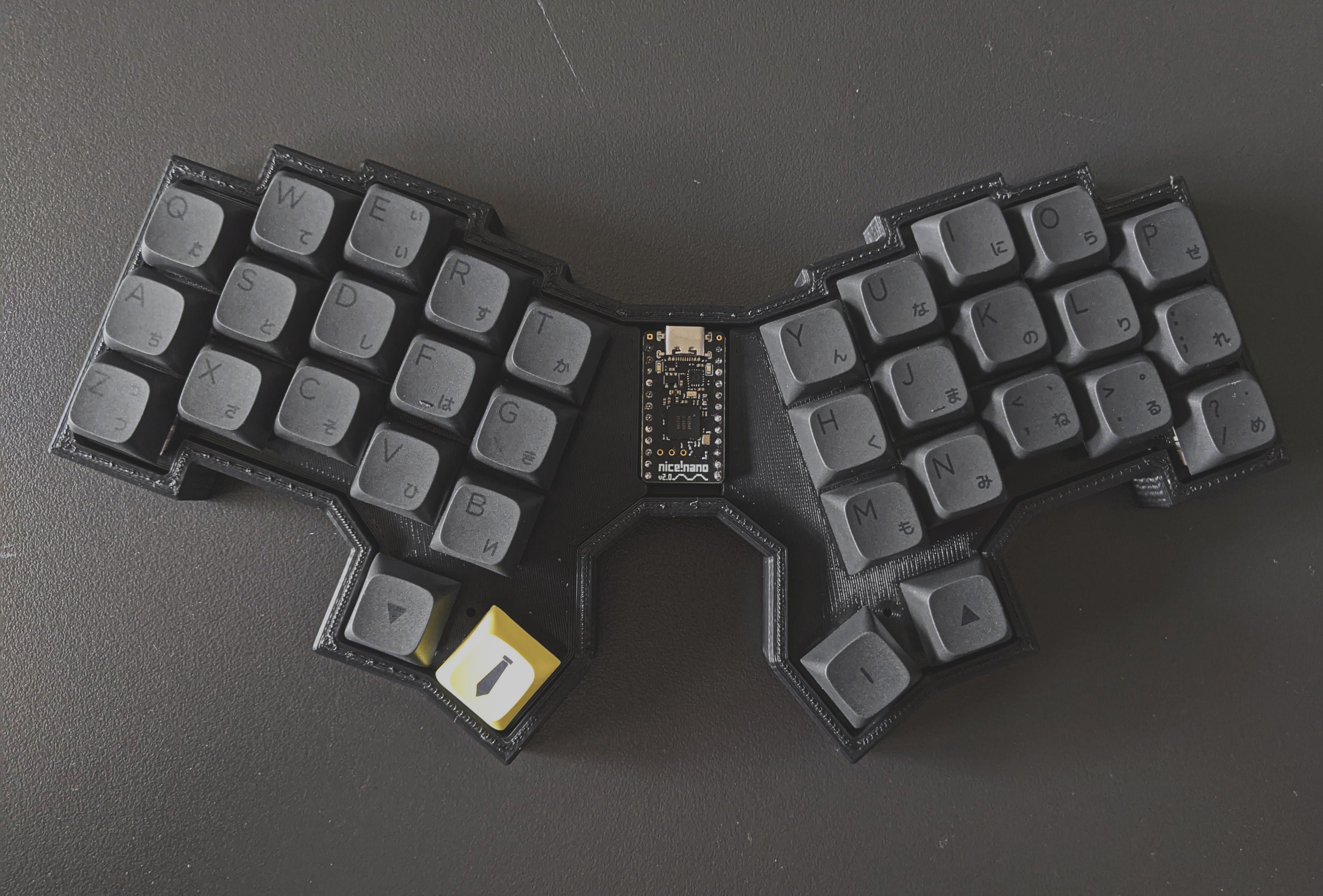
This project contains the pcb designs for the k34 keyboard. The k34 is a unibody, column-staggered, high-profile, 3d-printed, tray-mount keyboard with 34 keys.
orient.py contains a python script I used to programmatically arrange the switch and diode footprints. Traces were hand-connected.
k34/plate and case reference contains the exported svg's that I imported into fusion360 for modeling the case and plate files.
case contains the stl files I used for the plate and case. The case supports the sides/outline of the pcb and fits well but isn't secured (ie would be fine if you're not planning to transport/move it around a lot). Note that the plate is non-symmetric and is adapted directly from the pcb's edge cut layer.
| Qty | Value | Footprint | References |
|---|---|---|---|
| 34 | D_Small | Diode_SMD:D_SOD-128 | D1, D2, D10, D11, D12, D13, D14, D15, D16, D17, D18, D19, D20, D21, D22, D23 +18 |
| 34 | MX-NoLED | MX_Alps_Hybrid:MXOnly-1U-Hotswap | MX1, MX2, MX10, MX11, MX12, MX13, MX14, MX15, MX16, MX17, MX18, MX19, MX20, MX21, MX22, MX23 +18 |
| 1 | nice_nano | nice-nano-kicad:nice_nano | U1 |

jackw01/scanlight
A better light source for scanning color negative film

Biacco42/Ergo42
7x4 ortho linear split keyboard - The Answer to the Ultimate Question of Life, the Universe, and at least Keyboards

eigenco/frankenpi
This is an experimental project to connect Raspberry Pi with the help of cheap Cyclone IV FPGA board to 8-bit ISA bus to act as multiple different devices.

mattybrad/drumkid
Version 4 was the first successful working design, with full code, schematics, Gerbers, etc available on GitHub.

KaiPereira/Overglade-Badges
NFC hackathon badges for the Overglade game jam in Singapore!

BerkeleyHCI/PolymorphicBlocks
A Python-based hardware description language for PCBs for higher-level (block-diagram / system-architecture level) PCB design through libraries of directly reusable subcircuit generators.

It measures 253.7 × 118.7 mm and has 2 copper layers, 1.6 mm thick.
69 parts. The full list of its parts is on this page, with links to each part's symbol and footprint where PCBKit's library has them.
From the wongjingping/k34 repository on GitHub, at the commit this page was made from: the board is k34/k34.kicad_pcb. PCBKit opens the board in the browser, with nothing to install.
Its repository publishes it under the CC0-1.0 licence: you may reuse it on that licence's terms (keep the author's notice, and for a copyleft licence share your changes alike).