2 layers319 × 95.6 mm

 willwaush/Cenere-Mouse22
Open Source tri-Mode Mouse
Cenere Mouse is an open-source printed circuit board by willwaush, from the willwaush/Cenere-Mouse repository on GitHub. It is a 4-layer board of 47.8 × 89 mm with 114 parts on 112 nets, routed with 1,112 tracks and 674 vias.
It is built around the TPS62840YBGR, BQ24075RGT and SN74LVC1T45DCK, with the SRV05-4, CMI627301D07 and AO3401A among its other parts. Its parts include 50 capacitors, 27 resistors, 9 ICs, 7 diodes and 6 switches. It belongs with the nRF52 and nRF5x boards of this library.


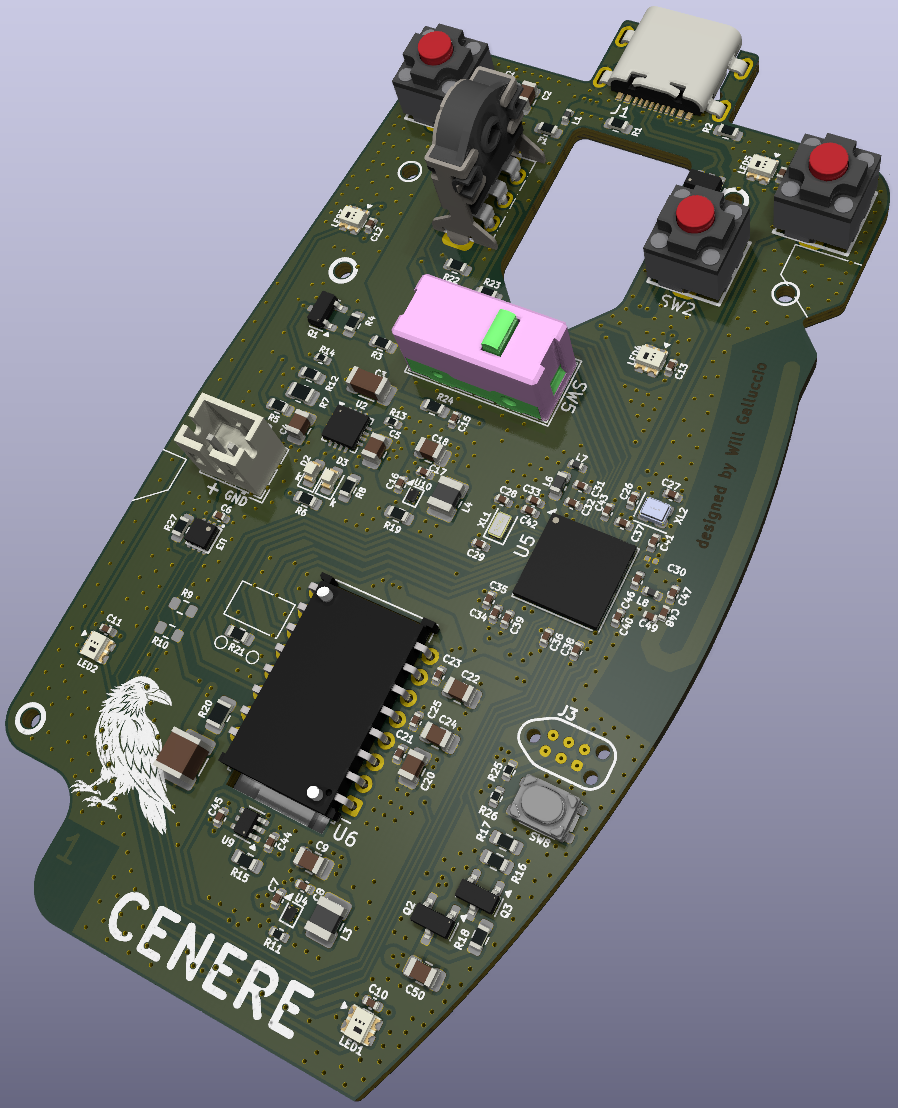
This project is an open-source tri-mode connectivity gaming mouse, designed around the Nordic nRF52840 SoC.
It supports three connectivity modes:
The design is a 4-layer PCB, manufactured by JLCPCB, chosen for their reliable stackup and cost-effective prototyping services.
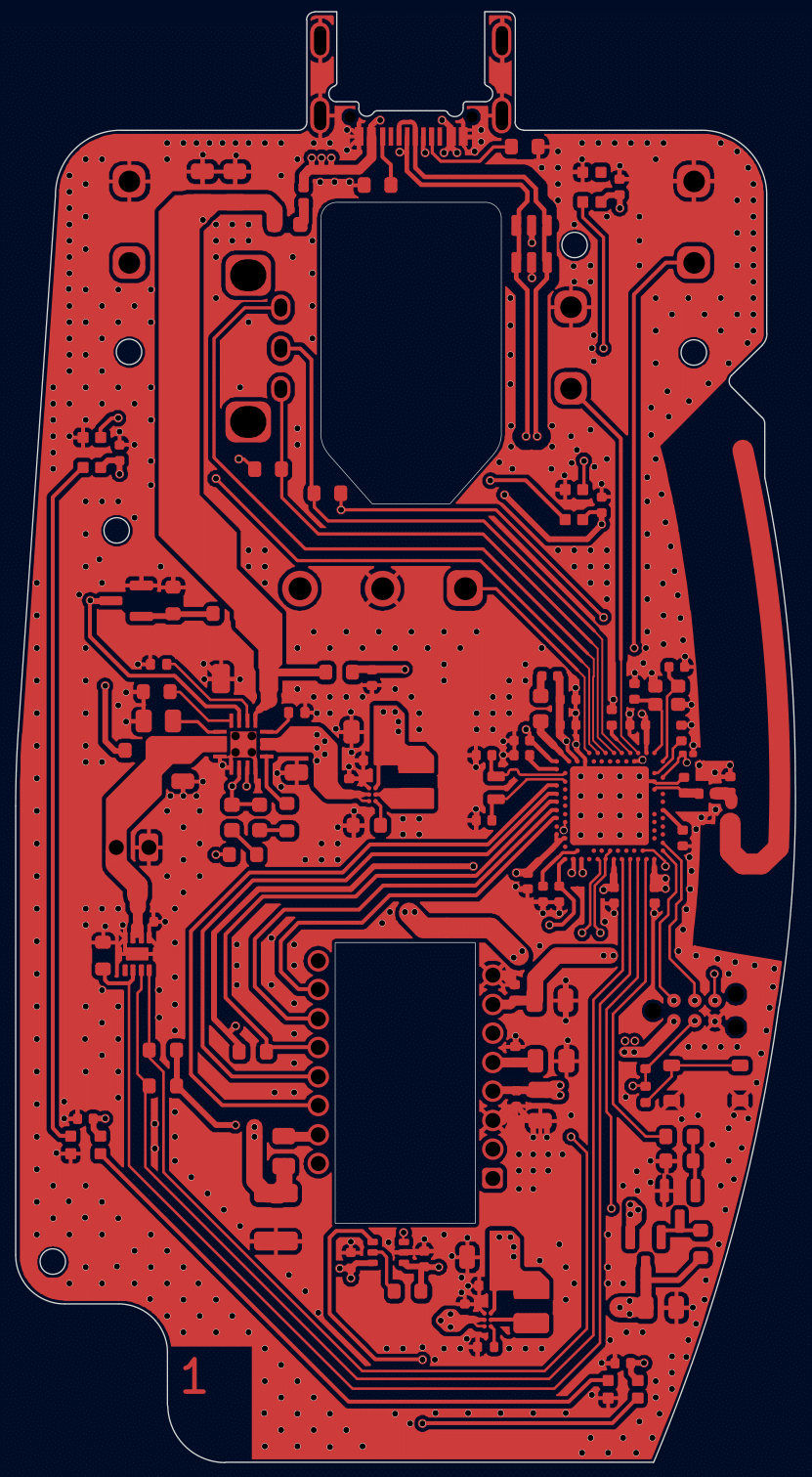
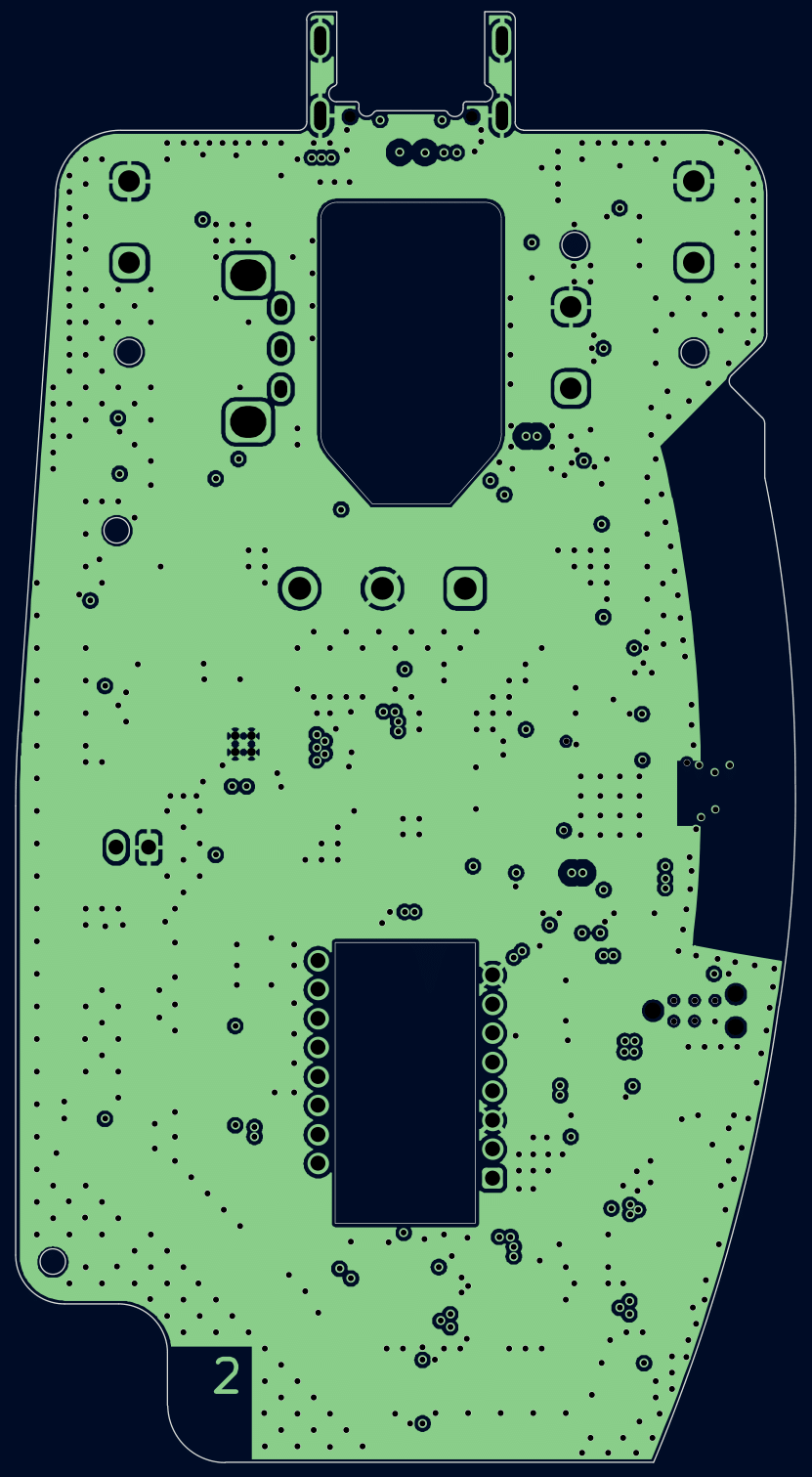
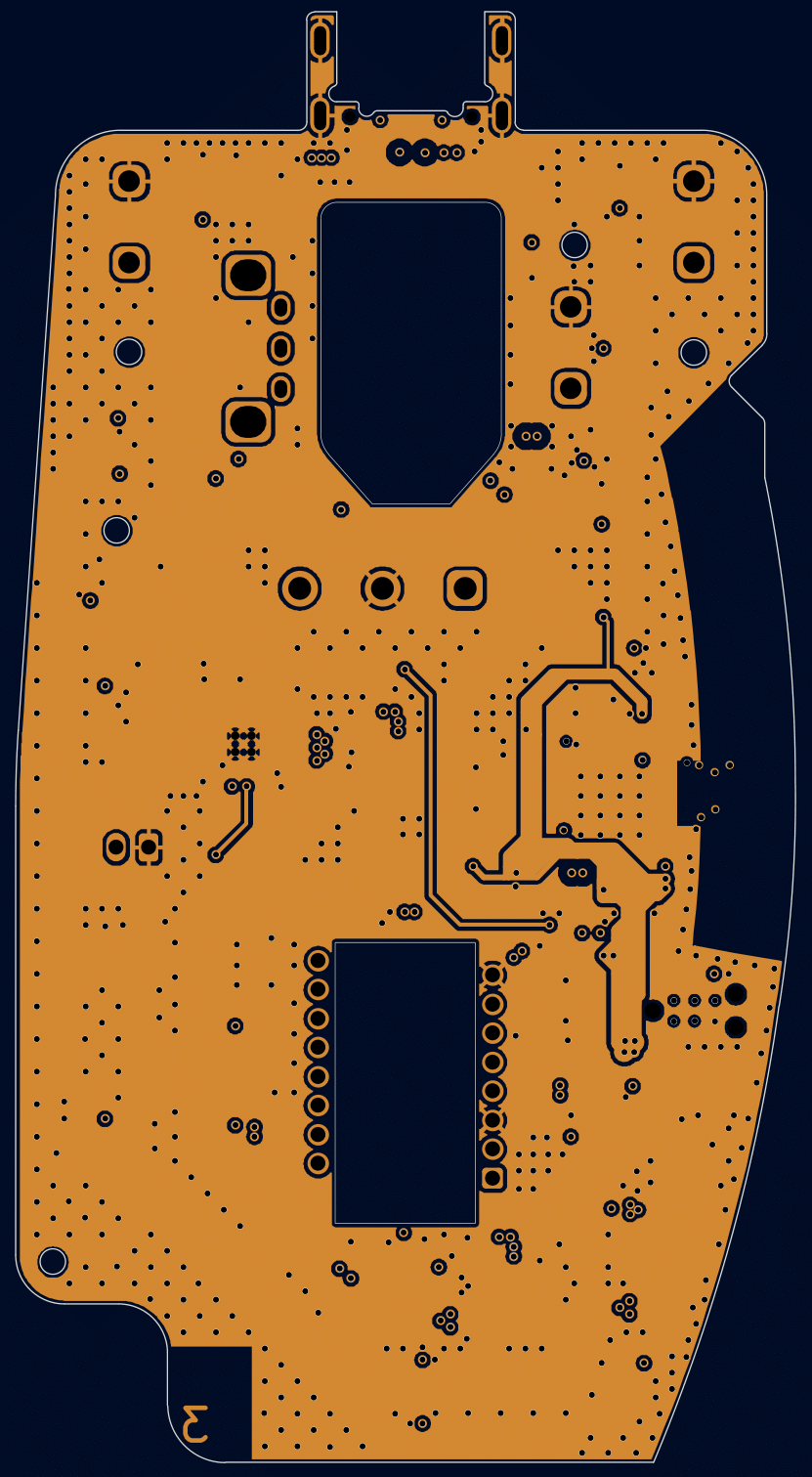
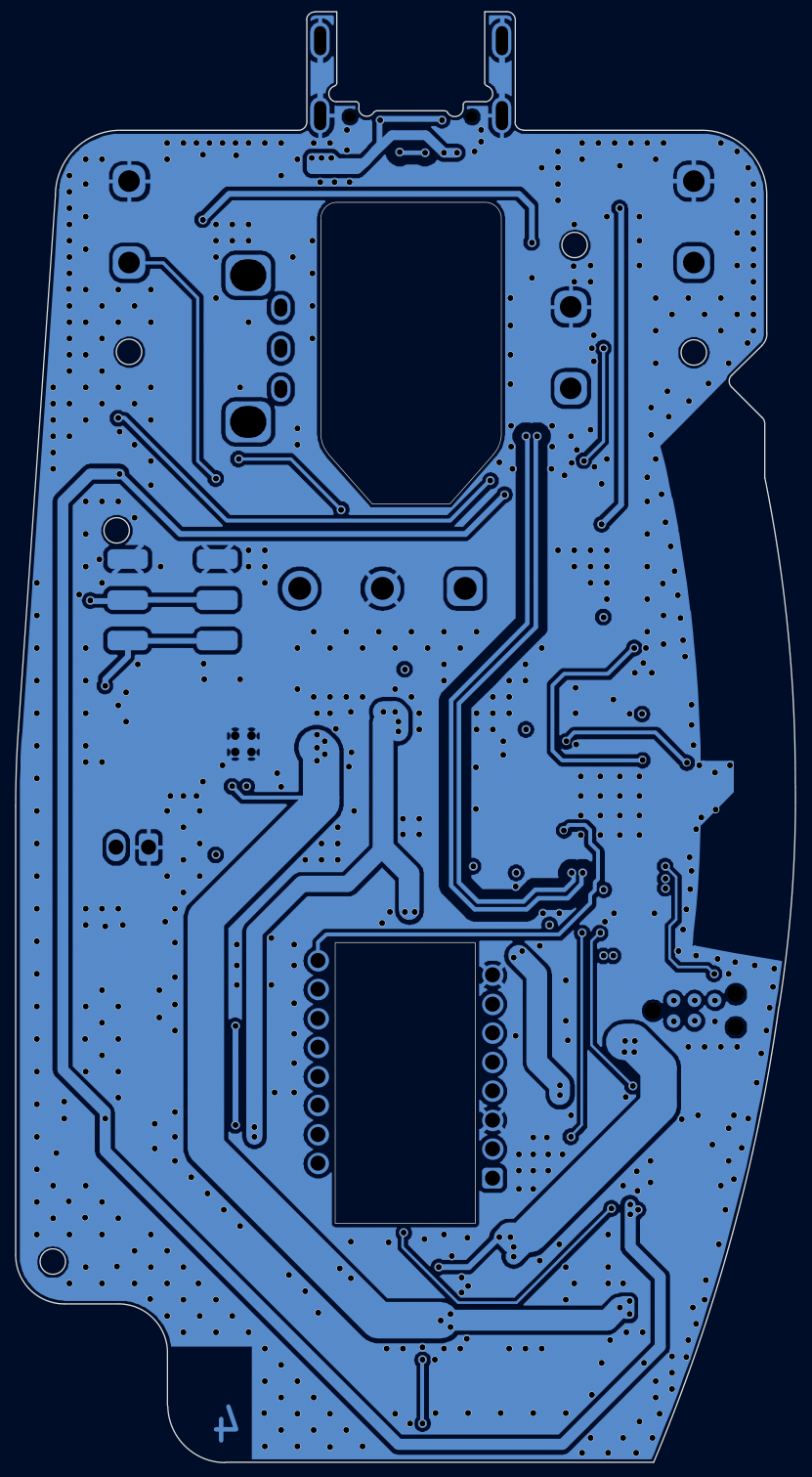
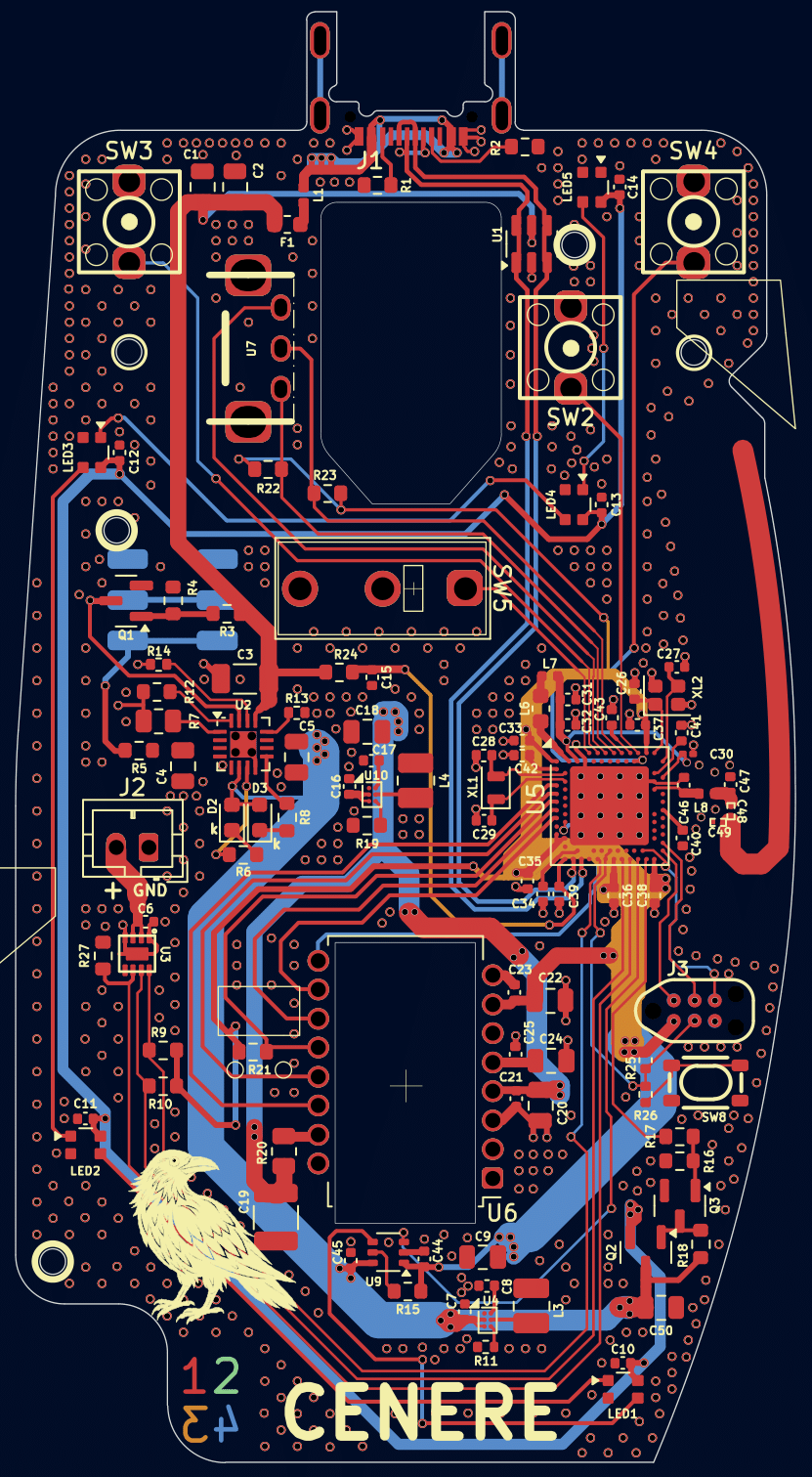
The board will be fabricated at JLCPCB with the following stackup:
This configuration provides an easy to work with controlled impedance environment for the high speed signals as well as the RF Section.
/Kicad Files → KiCad design files /Electronics Docs → Documentation, layer renders, diagrams
Work in progress..
This project uses a dual-license model:
Software (Code) → GNU GPL v3.0 with a Non-Commercial Use Exception
Hardware (Schematics, PCB Layouts, Documentation) → CC BY-NC 4.0
If you use this project (code or hardware) in your own work, you must credit:
© [Your Name or Handle] – [Year]
Repo: [GitHub Repository URL]
Example attribution:
“Based on the open-source design/code by [Your Name], available at [GitHub Repo URL].”
For commercial licensing, please contact the author.
| Qty | Value | Footprint | References |
|---|---|---|---|
| 15 | 100nF | Capacitor_SMD:C_0402_1005Metric | C6, C10, C11, C12, C13, C14, C21, C23, C25, C36, C37, C38, C42, C44, C45 |
| 7 | 10K | Resistor_SMD:R_0603_1608Metric | R4, R9, R10, R16, R18, R21, R27 |
| 6 | 10uF | Capacitor_SMD:C_0805_2012Metric | C1, C9, C18, C20, C22, C50 |
| 5 | 4.7uF | Capacitor_SMD:C_0402_1005Metric | C7, C16, C34, C35, C39 |
| 5 | WS2812_2020 | PCM_marbastlib-various:LED_WS2812_2020 | LED1, LED2, LED3, LED4, LED5 |
| 3 | 12pF | Capacitor_SMD:C_0402_1005Metric | C26, C27, C43 |
| 3 | 1uF | Capacitor_SMD:C_0402_1005Metric | C15, C31, C33 |
| 3 | 4.7uF | Capacitor_SMD:C_0805_2012Metric | C4, C5, C24 |
| 3 | 5.1K | Resistor_SMD:R_0603_1608Metric | R1, R2, R15 |
| 3 | CMI627301D07 | Cenere_Mouse:SW_Tactile_SPST_ Kailh_6x6x7.3mm_Mute_Silent | SW2, SW3, SW4 |
| 2 | 1.5K | Resistor_SMD:R_0603_1608Metric | R6, R8 |
| 2 | 100R | Resistor_SMD:R_0603_1608Metric | R3, R17 |
| 2 | 10uF | Capacitor_SMD:C_0402_1005Metric | C8, C17 |
| 2 | 15pF | Capacitor_SMD:C_0402_1005Metric | C28, C29 |
| 2 | 1M | Resistor_SMD:R_0603_1608Metric | R22, R23 |
| 2 | 2.2uH | Inductor_SMD:L_1008_2520Metric | L3, L4 |
| 2 | 2N7002 | Package_TO_SOT_SMD:SOT-23 | Q1, Q3 |
| 2 | TPS62840YBG | Cenere_Mouse:Texas_DSBGA-6_0.76x1.16mm_Layout2x3_P0.4mm | U4, U10 |
| 1 | 0.4pF | Cenere_Mouse:Z0201 RF Antenna Path | C48 |
| 1 | 0.5pF | Capacitor_SMD:C_0402_1005Metric | C47 |
| 1 | 0.8pF | Capacitor_SMD:C_0402_1005Metric | C46 |
| 1 | 1 A | Fuse:Fuse_0603_1608Metric | F1 |
| 1 | 1.5K | Resistor_SMD:R_0402_1005Metric | R26 |
| 1 | 100K | Resistor_SMD:R_0402_1005Metric | R25 |
| 1 | 100K | Resistor_SMD:R_0603_1608Metric | R5 |
| 1 | 100nF | Capacitor_SMD:C_0201_0603Metric | C30 |
| 1 | 100nF | Capacitor_SMD:C_0805_2012Metric | C2 |
| 1 | 100pF | Capacitor_SMD:C_0402_1005Metric | C41 |
| 1 | 10K | Resistor_SMD:R_0805_2012Metric | R7 |
| 1 | 10uH | Inductor_SMD:L_0603_1608Metric | L6 |
| 1 | 15nH | Inductor_SMD:L_0402_1005Metric | L7 |
| 1 | 2.2K | Resistor_SMD:R_0402_1005Metric | R13 |
| 1 | 267K | Resistor_SMD:R_0402_1005Metric | R11 |
| 1 | 3.9K | Resistor_SMD:R_0603_1608Metric | R12 |
| 1 | 32.768kHz | Crystal:Crystal_SMD_2012-2Pin_2.0x1.2mm | XL1 |
| 1 | 32MHz | Crystal:Crystal_SMD_2016-4Pin_2.0x1.6mm | XL2 |
| 1 | 4.7R | Resistor_SMD:R_0603_1608Metric | R24 |
| 1 | 4.7nH | Inductor_SMD:L_0402_1005Metric | L8 |
| 1 | 4.7uF | Capacitor_SMD:C_1206_3216Metric | C3 |
| 1 | 47nF | Capacitor_SMD:C_0402_1005Metric | C32 |
| 1 | 47uF | Capacitor_SMD:C_1210_3225Metric | C19 |
| 1 | 5.6R | Resistor_SMD:R_0805_2012Metric | R20 |
| 1 | 56K | Resistor_SMD:R_0402_1005Metric | R14 |
| 1 | 820pF | Capacitor_SMD:C_0402_1005Metric | C40 |
| 1 | 909R | Resistor_SMD:R_0603_1608Metric | R19 |
| 1 | AO3401A | Package_TO_SOT_SMD:SOT-23 | Q2 |
| 1 | BLM15PX121SN1D | Inductor_SMD:L_0402_1005Metric | L1 |
| 1 | BQ24075RGT | Package_DFN_QFN:VQFN-16-1EP_3x3mm_P0.5mm_EP1.6x1.6mm_ThermalVias | U2 |
| 1 | DNP | Cenere_Mouse:Z0201 RF Antenna Path | C49 |
| 1 | Emerald | LED_SMD:LED_0603_1608Metric | D3 |
| 1 | HRO_Type-C-31-M-14 | PCM_marbastlib-various:USB_C_Receptacle_HRO_TYPE-C-31-M-14 | J1 |
| 1 | MAX17048 | Cenere_Mouse:TDFN-8-EP_2x2mm_EP_0.8x1.38mm | U3 |
| 1 | Microswitch_DPI | Cenere_Mouse:SW_Tactile_SPDT_Omron_D2F | SW5 |
| 1 | Microswitch_Wheel | Cenere_Mouse:KEY-SMD_4P-L4.2-W3.2-P2.20-LS4.6 | SW8 |
| 1 | PAW3395DM | Cenere_Mouse:PixArt_PDIP-16_10.9x16.2mm_P1.78mm | U6 |
| 1 | PH-2A | Connector_JST:JST_PH_B2B-PH-K_1x02_P2.00mm_Vertical | J2 |
| 1 | Red | LED_SMD:LED_0603_1608Metric | D2 |
| 1 | SN74LVC1T45DC | Package_TO_SOT_SMD:SOT-363_SC-70-6 | U9 |
| 1 | SRV05-4 | Package_TO_SOT_SMD:SOT-23-6 | U1 |
| 1 | SW_Slide_DPDT | Cenere_Mouse:SLIDE SMD DPDT | SW1 |
| 1 | TC2030_SWD | PCM_marbastlib-various:CON_TC2030_outlined | J3 |
| 1 | TTC/Kailh Encoder E103 | Cenere_Mouse:TTC E103 - Kailh Rotary Encoder | U7 |
| 1 | nRF52840-QIXX | Package_DFN_QFN:Nordic_AQFN-73-1EP_7x7mm_P0.5mm | U5 |


maxd-out83/ESP32-S3-Small-Camera-PCB-v2.4
Engineering PCB Design Project


It measures 47.8 × 89 mm and has 4 copper layers, 1.61 mm thick.
114 parts, built around the TPS62840YBGR, BQ24075RGT, SN74LVC1T45DCK and SRV05-4. The full list of its parts is on this page, with links to each part's symbol and footprint where PCBKit's library has them.
From the willwaush/Cenere-Mouse repository on GitHub, at the commit this page was made from: the board is Kicad Files/Cenere Mouse.kicad_pcb and its schematic Kicad Files/Cenere Mouse.kicad_sch. PCBKit opens the board in the browser, with nothing to install.
Its repository states no licence, so its author keeps all rights: ask willwaush before reusing the design.