
2 layers55 × 40 mm
STPM33 Breakout
whatnick/STPM3x_Breakout
KiCad 10 breakout boards for the STPM32, STPM33, and STPM34 energy metering ICs
46 parts

 whatnick/STPM3x_Breakout
KiCad 10 breakout boards for the STPM32, STPM33, and STPM34 energy metering ICs
STPM34 Breakout is an open-source printed circuit board by whatnick, from the whatnick/STPM3x_Breakout repository on GitHub. It is a 2-layer board of 75 × 50 mm with 55 parts on 47 nets, routed with 415 tracks and 51 vias.
It is built around the STPM34. Its parts include 22 resistors, 15 capacitors, 2 connectors, 1 IC and 1 switch. It belongs with the interfaces and adapters boards of this library.
KiCad 10 open-hardware breakout for the STMicroelectronics STPM33 metering ASIC. It measures one isolated voltage channel and two current-transformer channels, making it useful for phase/neutral comparison, tamper detection, and two-current experiments sharing one voltage reference.
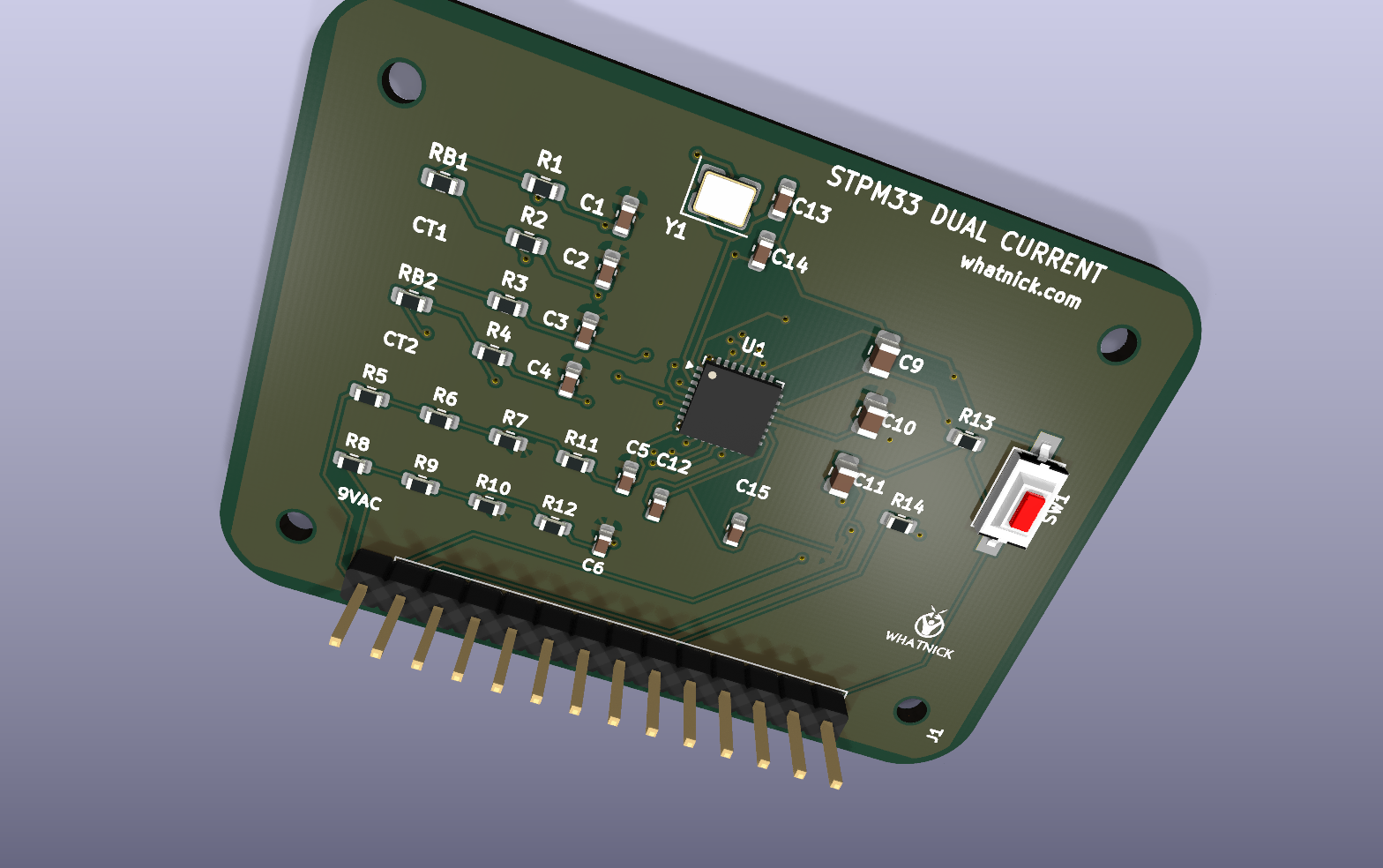
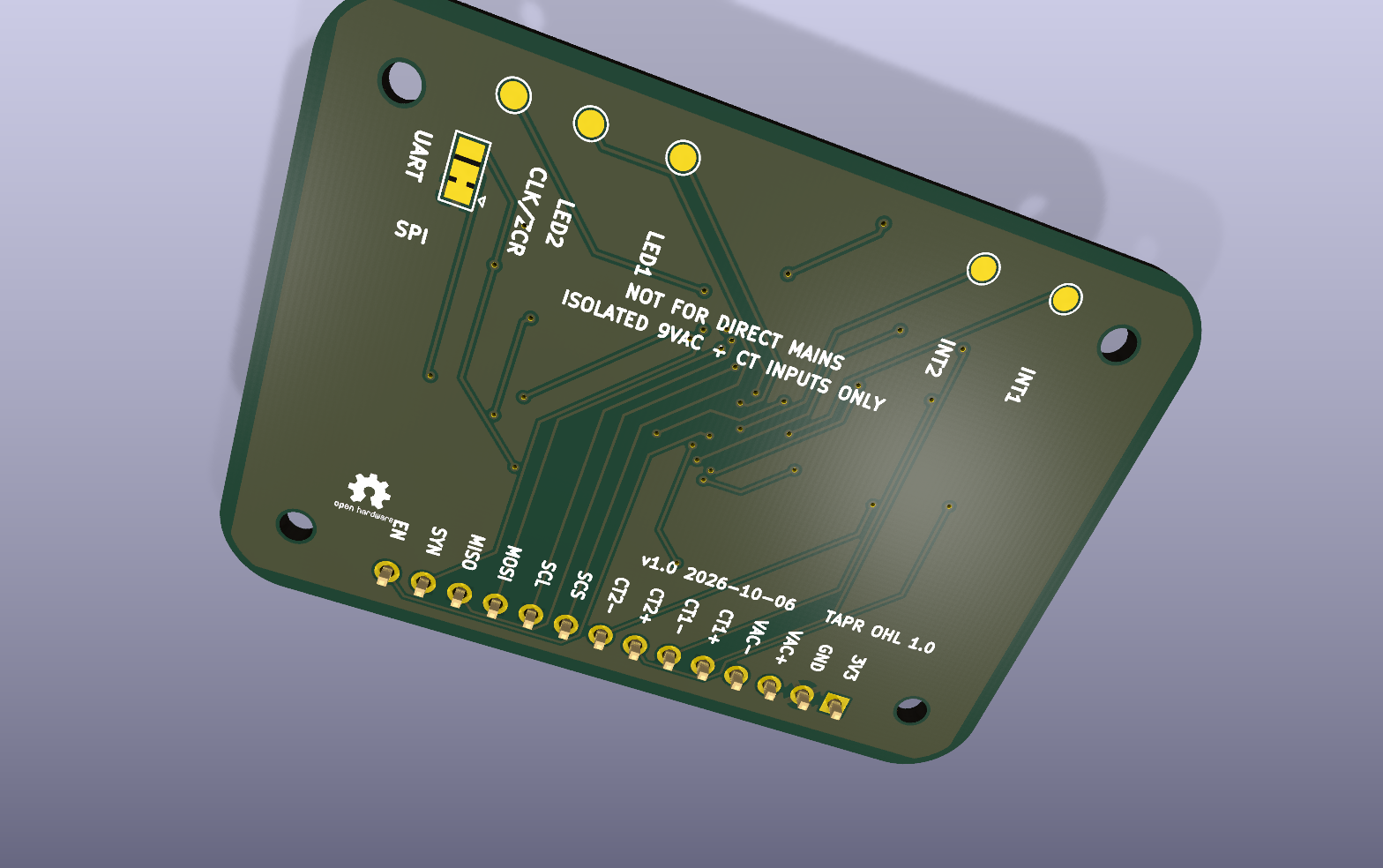
This is not an isolated mains-input board. Connect only isolated low-voltage sources and follow applicable electrical-safety practices.
| Pin | Signal | Pin | Signal |
|---|---|---|---|
| 1 | +3V3 | 8 | CT2_N |
| 2 | DGND | 9 | SCS |
| 3 | VAC_P | 10 | SCL |
| 4 | VAC_N | 11 | MOSI/RXD |
| 5 | CT1_P | 12 | MISO/TXD |
| 6 | CT1_N | 13 | SYN |
| 7 | CT2_P | 14 | EN |
Underside pads expose INT1, INT2, LED1, LED2, and CLKOUT/ZCR.
STPM33 supports SPI or UART, not I2C. SJ1 biases SCS through R14 at power-up:
Run the scripts from the repository root:
python .\scripts\build_stpm33_schematic.py
python .\scripts\apply_stpm33_bom.py
& "C:\Program Files\KiCad\10.0\bin\python.exe" .\scripts\build_stpm33_pcb.py
Routing uses Freerouting with Java 25:
$env:JAVA25 = "C:\Program Files\Eclipse Adoptium\jre-25.0.4.101-hotspot\bin\java.exe"
$env:FREEROUTING_JAR = "C:\path\to\freerouting-2.4.1.jar"
& "C:\Program Files\KiCad\10.0\bin\python.exe" .\scripts\route_stpm33.py
& "C:\Program Files\KiCad\10.0\bin\python.exe" .\scripts\finalize_stpm33_pcb.py
The checked-in routed PCB is the production source. Reconstruction scripts capture the schematic, mechanical envelope, placement, routing workflow, ground pours, markings, and project-local 3D/logo assets.
python .\scripts\apply_stpm33_bom.py
python .\scripts\render_stpm33.py
python .\scripts\generate_stpm33_gerbers.py
The Elecrow BOM is written to manufacturing. Gerbers, separate PTH/NPTH
drills, Gerber job data, front/rear position CSVs, and the upload ZIP are
written to gerber. The BOM contains 16 grouped unique parts and 33 fitted
components.
KiCad 10 ERC and DRC are mandatory before fabrication export. The Gerber generator enforces zero ERC/DRC violations and zero unconnected items before creating the package.
| Qty | Value | Footprint | References |
|---|---|---|---|
| 8 | 100k | R_0603_1608Metric | R5, R6, R8, R9, R15, R16, R18, R19 |
| 4 | 100R | R_0603_1608Metric | R1, R2, R3, R4 |
| 4 | 1k | R_0603_1608Metric | R11, R12, R21, R22 |
| 4 | 2.49k | R_0603_1608Metric | R7, R10, R17, R20 |
| 4 | 330n | C_0603_1608Metric | C1, C2, C3, C4 |
| 4 | 33n | C_0603_1608Metric | C5, C6, C7, C8 |
| 4 | MountingHole_2.2mm_M2 | MountingHole_2.2mm_M2 | H1, H2, H3, H4 |
| 2 | 100n | C_0603_1608Metric | C12, C15 |
| 2 | 10k | R_0603_1608Metric | R13, R14 |
| 2 | 15p | C_0603_1608Metric | C13, C14 |
| 2 | 1u | C_0805_2012Metric | C9, C10 |
| 2 | 2.4R | R_0603_1608Metric | RB1, RB2 |
| 1 | 16MHz | Crystal_SMD_3225-4Pin_3.2x2.5mm | Y1 |
| 1 | 4.7u | C_0805_2012Metric | C11 |
| 1 | ANALOG I/O | PinHeader_1x08_P2.54mm_Vertical | J1 |
| 1 | ANALOG/DIGITAL STAR | NetTie-3_SMD_Pad0.5mm | NT1 |
| 1 | CLKOUT_ZCR | TestPoint_Pad_D1.5mm | TP3 |
| 1 | HOST I/O | PinHeader_1x10_P2.54mm_Vertical | J2 |
| 1 | LED1 | TestPoint_Pad_D1.5mm | TP1 |
| 1 | LED2 | TestPoint_Pad_D1.5mm | TP2 |
| 1 | OSHW_Logo | OSHW_Logo | LOGO_OSHW |
| 1 | RESET | SW_SPST_CK_RS282G05A3 | SW1 |
| 1 | SPI / UART | SolderJumper-3_P1.3mm_Bridged12_Pad1.0x1.5mm | SJ1 |
| 1 | STPM34 | QFN-32-1EP_5x5mm_P0.5mm_EP3.45x3.45mm | U1 |
| 1 | Whatnick_Logo | Whatnick_Logo | LOGO_W |
whatnick/STPM3x_Breakout
KiCad 10 breakout boards for the STPM32, STPM33, and STPM34 energy metering ICs

whatnick/STPM3x_Breakout
KiCad 10 breakout boards for the STPM32, STPM33, and STPM34 energy metering ICs

davidphilipbarr/Sweep
Sweep - a small promicro based keyboard inspired by the Ferris.

VoronDesign/Voron-Hardware
Cool Hardware designed by the Voron Design group

hackclub/OnBoard
💡 Join 1,000 teenagers and make your first PCB with a $100 grant!

lever-tech/flake
An open-source, wireless, split ergonomic keyboard designed to be productive, healthy, and enjoyable. [formerly Anywhy Flake]

jes/scamp-cpu
A homebrew 16-bit CPU with a homebrew Unix-like-ish operating system.

CRImier/MyKiCad
My KiCad boards. Can't be bothered uploading individually anymore, so here you go.

rgoulter/keyboard-labs
Repo with my PCB designs and keyboard firmware

dcpedit/dissatisfaction30
To get the PCB manufactured, upload dissat-pcb.zip to JLCPCB, select your desired PCB color while keeping all the other default options, and place your order (minimum 5).
It measures 75 × 50 mm and has 2 copper layers, 1.6 mm thick.
55 parts, built around the STPM34. The full list of its parts is on this page, with links to each part's symbol and footprint where PCBKit's library has them.
From the whatnick/STPM3x_Breakout repository on GitHub, at the commit this page was made from: the board is hardware/STPM34_Breakout/STPM34_Breakout.kicad_pcb and its schematic hardware/STPM32_Breakout/STPM32_Breakout.kicad_sch. PCBKit opens the board in the browser, with nothing to install.
Its repository states no licence, so its author keeps all rights: ask whatnick before reusing the design.