

2 layers38.1 × 38.1 mm
SIM868
vul-os/sirboard
Open hardware: 107 KiCad PCB designs — SMD-to-THT breakout adapters, ATTiny/ATMega/ESP development boards, and a 39-part sensor line on a common JST-SH connector.
73 parts56Apache-2.0

 vul-os/sirboard56
Open hardware: 107 KiCad PCB designs — SMD-to-THT breakout adapters, ATTiny/ATMega/ESP development boards, and a 39-part sensor line on a common JST-SH connector.
BME680 is an open-source printed circuit board by vul-os, from the vul-os/sirboard repository on GitHub, published under the Apache-2.0 licence. It is a 2-layer board of 17.8 × 14.4 mm with 21 parts on 13 nets, routed with 119 tracks and 18 vias.
It is built around the BME680 and BSS138DW. Its parts include 9 resistors, 2 capacitors, 2 transistors, 1 IC and 1 diode. It belongs with the interfaces and adapters and sensors and measurement boards and the ESP32 and AVR (ATmega, ATtiny) boards of this library.

Open hardware for people who would rather prototype than reflow.
107 PCB designs — breakout adapters, development boards and a 39-part sensor line.
Routed in KiCad. Black soldermask, ENIG gold, 0.1″ pitch.
The mark in brand/ is the source of truth. Every icon this repo
ships — favicon, PWA and app icons, the mark in the README and on the site — is
rendered from brand/logo.svg rather than redrawn, so there is one approved
drawing and no second copy to drift.
Copy it outward, never edit a derived copy, and never edit brand/ to match
something downstream.
vulos.org/projects/sirboard · Docs · MIT OR Apache-2.0

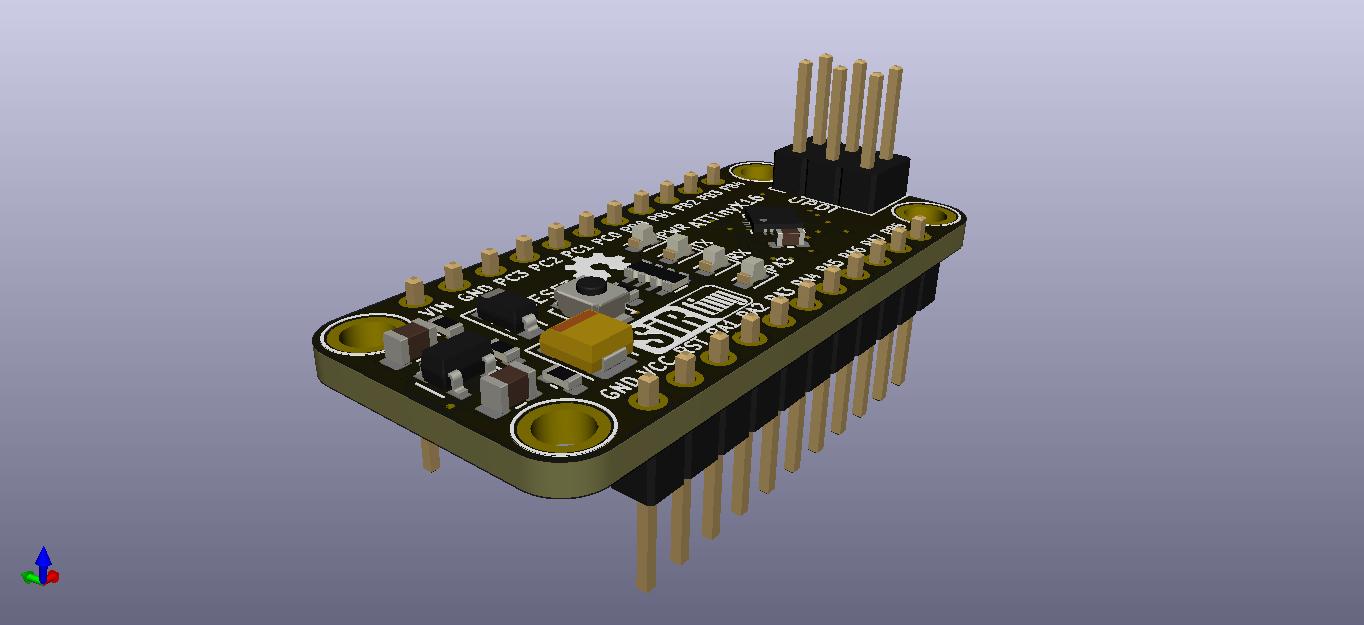
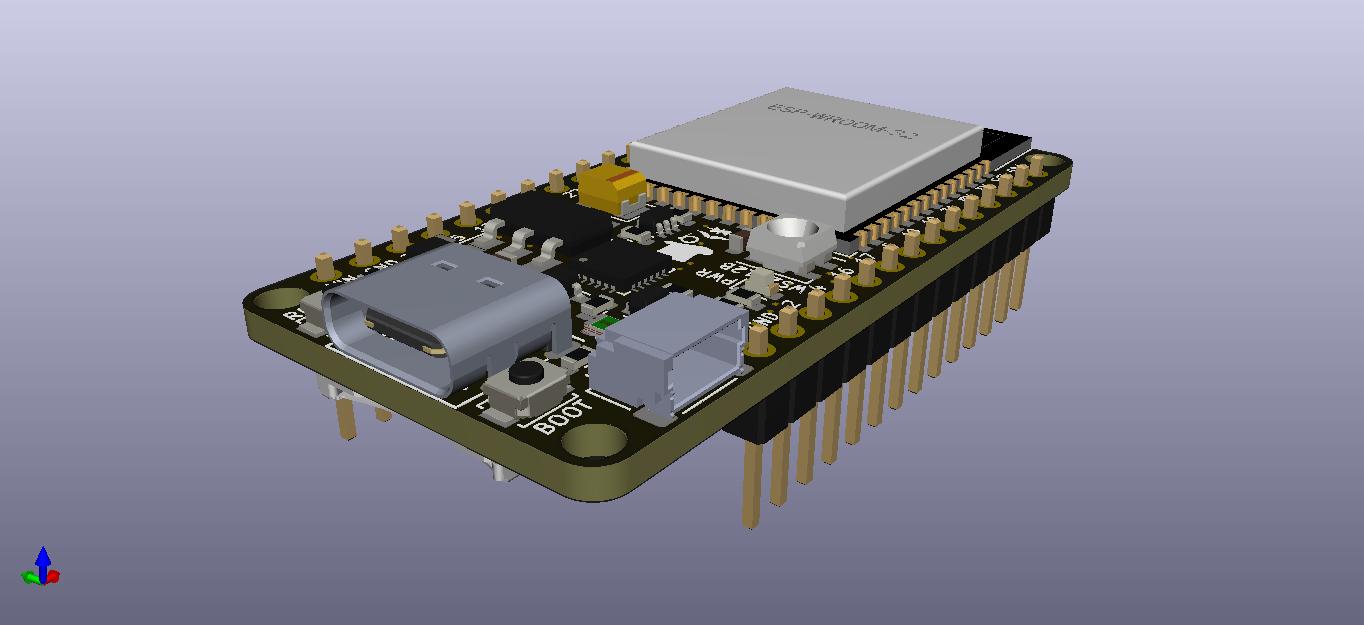
Most interesting silicon ships in a package that will not sit on a breadboard. SirBoard answers that in three layers: bare adapters you solder the part onto yourself, modules with the part already placed and supported, and development boards with a microcontroller, regulator, USB and headers.
| Directory | Contents |
|---|---|
Boards/Breakout/ | 21 adapters — QFN, TQFP, SOIC, SOT, USB, MicroSD, coin cells, ESP module carriers |
Boards/Microcontrollers/ | ATTiny, ATMega328PB/32U4/1284P, ESP32/ESP8266 and SIMCom GNSS carriers |
Boards/Interface/ | USB-to-UART bridges, level shifters, port expanders, a USBASP programmer |
Boards/Sensors/ | SirBlue — 39 digital sensors on one 4-pin JST-SH connector, plus two earlier collections (DigitalSensors 12, AnalogueSensors 2) |
Boards/Modules/ | EEPROM, FRAM, real-time clocks — 5 designs |
Fritzing/ | 60 hand-drawn breadboard SVGs |
git clone git@github.com:vul-os/sirboard.git
cd sirboard

# most designs ship a plotted PDF and renders — no tools needed to read one
open Boards/Microcontrollers/SirTiny/ATTinyX16/ATTinyX16.pdf

# or open the project itself
kicad Boards/Microcontrollers/SirTiny/ATTinyX16/ATTinyX16.pro
These are KiCad 5 files (board format 20171130). KiCad 6 through 9 open
them and offer to convert on save.
Hardware repositories rot by ambiguity, so here it is plainly.
Can you get these made? Yes. Every one of the 107 designs is fully routed
2-layer copper with a board outline, and plots to gerbers from source with
kicad-cli or File → Plot. Nothing here needs a blind via, a buried via,
controlled impedance or a non-standard stack-up, and every outline fits inside a
100 × 100 mm panel. Seven of the fine-pitch breakouts need a 5 mil process
rather than 6 mil — they are named in
Manufacturing.
What is not claimed. No DRC or ERC report is committed for any board, and
no fabrication or bring-up log exists in this repository. The _Front/_Back/
_Iso images are KiCad 3D-viewer renders, not photographs of assembled boards —
so do not read them as proof that a given design was built and worked. Treat
every design as prototype-grade: run DRC yourself and read the schematic
before you spend money on a panel. The catalogue has shipped at least one
unconnected trace in the past (commit 28e6714, on the TQFP48 breakout), which
is exactly the class of defect a DRC run catches and a render does not.
Is it maintained? The designs are stable rather than actively developed. Two
directories under Boards/ hold a README and no design —
Sensors/SirRed (an analogue line on a 3-pin JST-SH)
and Modules/SirReference (voltage references) —
and they are stated intent, not work in progress; neither is counted in the 107.
What is maintained is the repository's honesty:
CI gates the counts, coverage tables and fab
figures in these docs against the actual .kicad_pcb files on every push, so a
claim here cannot quietly drift away from the copper. Fixes to existing designs
are the most welcome kind of change.
Every SirBlue board carries the same 4-pin 1.00 mm JST-SH
connector — GND · VCC · SDA · SCL — and the same outline. One cable fits all
39 parts, so swapping an accelerometer for a time-of-flight ranger is a
connector move rather than a rewire. A
TCA9548A multiplexer handles the address
collisions when you want eight of the same part.
Every part here is a standard part with a maintained driver already in the
wild, and docs/LIBRARIES.md names the one to install for
each — Adafruit, Pololu, SparkFun, MCUdude's cores, TinyGSM, RTClib.
SirBoard used to fork them. Those forks accumulated no functional changes and drifted up to 384 commits behind upstream, so they were retired. A stale driver shipped under our name is worse than no driver at all.
| Overview | What SirBoard is and how the repository is laid out |
| Getting started | Open a design, wire a sensor, install a driver |
| Breakout adapters | The 21 footprints, and how to pick one |
| Development boards | Nine families, with the core to install for each |
| Sensors | The full SirBlue line |
| Modules | Storage, timekeeping, reference |
| Fritzing parts | The breadboard artwork |
| Driver libraries | Part → upstream library, verified |
| Manufacturing | Stack-up, gerber export, assembly notes |
Every product line lives in this repository, with its full history intact —
git log -- Boards/Microcontrollers/SirTiny returns SirTiny's own commits, and
git blame still names whoever drew the trace.
Fixes to existing designs are the most welcome kind of change — see
CONTRIBUTING.md. Commit the KiCad sources and the renders,
never the backups or fp-info-cache.
MIT OR Apache-2.0 — © VulOS. Fabricate these designs, modify them, sell the boards. SirBoard is a Vulos project; source and issues at github.com/vul-os/sirboard.
Part of Vulos — open by design.
| Qty | Value | Footprint | References |
|---|---|---|---|
| 8 | 10K | Resistor_SMD:R_0603_1608Metric | R1, R2, R3, R4, R5, R7, R8, R9 |
| 2 | 1uF | Capacitor_SMD:C_0603_1608Metric | C1, C2 |
| 2 | BSS138DW | Package_TO_SOT_SMD:SOT-363_SC-70-6 | Q1, Q2 |
| 2 | MountingHole | MountingHole:MountingHole_2.7mm_M2.5_ISO14580_Pad | H3, H4 |
| 1 | 1K | Resistor_SMD:R_0603_1608Metric | R6 |
| 1 | AP2127K-3.3 | Package_TO_SOT_SMD:SOT-23-5 | U1 |
| 1 | BME680 | Package_LGA:Bosch_LGA-8_3x3mm_P0.8mm_ClockwisePinNumbering | BME680 |
| 1 | Conn_01x07 | Connector_PinHeader_2.54mm:PinHeader_1x07_P2.54mm_Vertical | J1 |
| 1 | LED | LED_SMD:LED_0603_1608Metric | D1 |
| 1 | LOGO | logo:SirBoard79x25 | G*** |
| 1 | LOGO | logo:logo63x89 | G*** |
It measures 17.8 × 14.4 mm and has 2 copper layers, 1.6 mm thick.
21 parts, built around the BME680 and BSS138DW. The full list of its parts is on this page, with links to each part's symbol and footprint where PCBKit's library has them.
From the vul-os/sirboard repository on GitHub, at the commit this page was made from: the board is Boards/Sensors/DigitalSensors/BME680/BME680.kicad_pcb. PCBKit opens the board in the browser, with nothing to install.
Its repository publishes it under the Apache-2.0 licence: you may reuse it on that licence's terms (keep the author's notice, and for a copyleft licence share your changes alike).
vul-os/sirboard
Open hardware: 107 KiCad PCB designs — SMD-to-THT breakout adapters, ATTiny/ATMega/ESP development boards, and a 39-part sensor line on a common JST-SH connector.

vul-os/sirboard
Open hardware: 107 KiCad PCB designs — SMD-to-THT breakout adapters, ATTiny/ATMega/ESP development boards, and a 39-part sensor line on a common JST-SH connector.

vul-os/sirboard
Open hardware: 107 KiCad PCB designs — SMD-to-THT breakout adapters, ATTiny/ATMega/ESP development boards, and a 39-part sensor line on a common JST-SH connector.

vul-os/sirboard
Open hardware: 107 KiCad PCB designs — SMD-to-THT breakout adapters, ATTiny/ATMega/ESP development boards, and a 39-part sensor line on a common JST-SH connector.

vul-os/sirboard
Open hardware: 107 KiCad PCB designs — SMD-to-THT breakout adapters, ATTiny/ATMega/ESP development boards, and a 39-part sensor line on a common JST-SH connector.

vul-os/sirboard
Open hardware: 107 KiCad PCB designs — SMD-to-THT breakout adapters, ATTiny/ATMega/ESP development boards, and a 39-part sensor line on a common JST-SH connector.

vul-os/sirboard
Open hardware: 107 KiCad PCB designs — SMD-to-THT breakout adapters, ATTiny/ATMega/ESP development boards, and a 39-part sensor line on a common JST-SH connector.

vul-os/sirboard
Open hardware: 107 KiCad PCB designs — SMD-to-THT breakout adapters, ATTiny/ATMega/ESP development boards, and a 39-part sensor line on a common JST-SH connector.

vul-os/sirboard
Open hardware: 107 KiCad PCB designs — SMD-to-THT breakout adapters, ATTiny/ATMega/ESP development boards, and a 39-part sensor line on a common JST-SH connector.

vul-os/sirboard
Open hardware: 107 KiCad PCB designs — SMD-to-THT breakout adapters, ATTiny/ATMega/ESP development boards, and a 39-part sensor line on a common JST-SH connector.

vul-os/sirboard
Open hardware: 107 KiCad PCB designs — SMD-to-THT breakout adapters, ATTiny/ATMega/ESP development boards, and a 39-part sensor line on a common JST-SH connector.

vul-os/sirboard
Open hardware: 107 KiCad PCB designs — SMD-to-THT breakout adapters, ATTiny/ATMega/ESP development boards, and a 39-part sensor line on a common JST-SH connector.


MaizeShark/Nikon-NMEA-Pro
low-power GNSS logger and BLE remote shutter for Nikon cameras

offgridevices/offgrid-hardware
Open hardware from OffGrid Devices. One folder per board. CERN-OHL-S.


jfm92/everAliveSensor
Solar-powered BLE environmental sensor (temp, humidity, pressure) with a 50F supercapacitor — potentially infinite lifetime, 19-day dark autonomy. ESP32 + BME680. Experimental.