
2 layers100 × 50 mm

 volw/wifiOiler3
Automatic, distance depending chain oiler for motorbikes with track recording (GPS).
WifiOiler01 is an open-source printed circuit board by volw, from the volw/wifiOiler repository on GitHub, published under the GPL-3.0 licence. It is a 2-layer board of 80 × 45 mm with 15 parts on 16 nets, routed with 88 tracks and 0 vias.
It is built around the IRLZ34N. Its parts include 3 capacitors, 3 resistors, 3 connectors, 2 diodes and 1 IC. It belongs with the ESP8266 boards of this library.
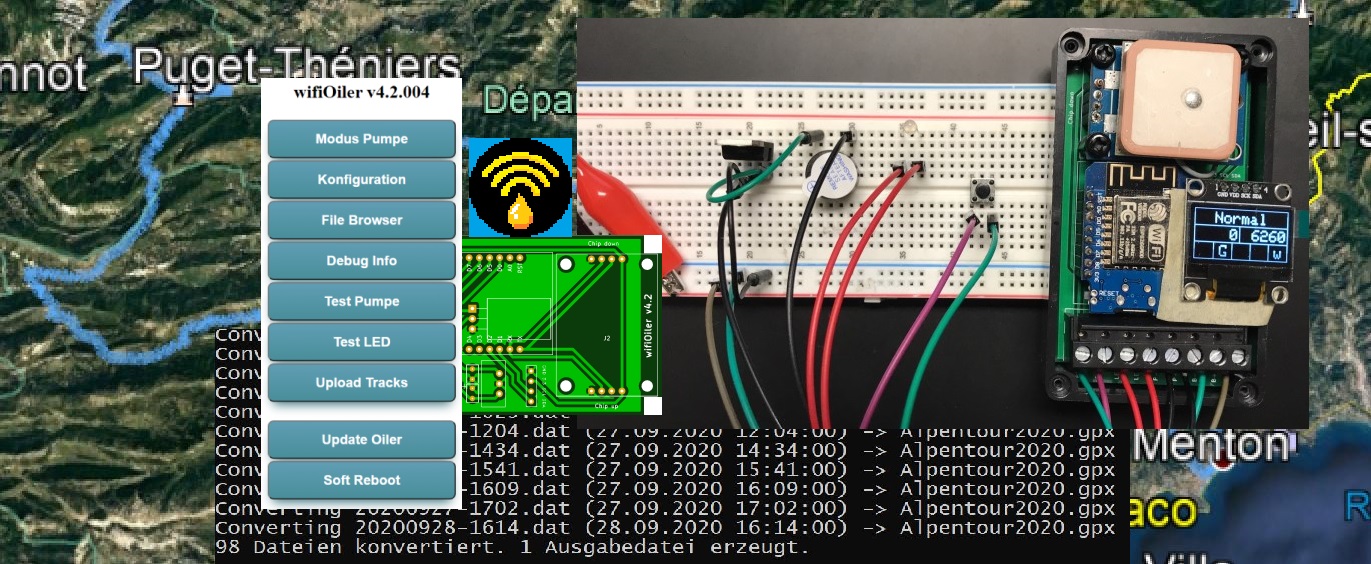
Automatischer streckenabhängiger Kettenöler für's Motorrad mit folgenden Funktionen:
In diesem Repo zu finden:
Wem das alles zuviel an Bastelei ist und Hilfe bei Erstellung der Platine, bzw. Steuereinheit benötigt, kann sich gerne melden...
Detlev Axon, creator of RehOiler
Mikal Hart, creator of TinyGPS++, an NMEA parsing library.
Hristo Gochkov for the FSBrowser example.
Maarten Lamers for his distance calculation (taken from TinyGPS++)
Patrick Gillespie for his Macro Font Generator.
And many thanks to all the others who share their knowledge
| Qty | Value | Footprint | References |
|---|---|---|---|
| 2 | 10K | _ProjectFootprints:R_Axial_DIN0207_L6.3mm_D2.5mm_P10.16mm_Horizontal | R2, R3 |
| 2 | 1N4004 | _ProjectFootprints:D_DO-41_SOD81_P7.62mm_Horizontal | D1, D2 |
| 2 | CP_Small | _ProjectFootprints:MKS02-63 100N Folienkondensator | C1, C2 |
| 1 | 10 uF | _ProjectFootprints:CP_Radial_D5.0mm_P2.00mm | C3 |
| 1 | 220 | _ProjectFootprints:R_Axial_DIN0207_L6.3mm_D2.5mm_P10.16mm_Horizontal | R1 |
| 1 | CONN_01X08 | _ProjectFootprints:Stiftleiste_1x8_5mm_D13_Box_korr | P1 |
| 1 | Conn_01x04 | _ProjectFootprints:Pin_Header_Straight_1x04_Pitch2.54mm | J1 |
| 1 | Conn_01x04 | _ProjectFootprints:NEO6M_18_ChipUp | J2 |
| 1 | D1-mini | _ProjectFootprints:D1 mini (ESP8266) | MCU1 |
| 1 | IRLZ34N | _ProjectFootprints:TO-220-3_Horizontal_NoPad | Q1 |
| 1 | LC78_05_TO220 | _ProjectFootprints:LC78_0.5 aufrecht | U1 |
| 1 | NEO6M | _ProjectFootprints:NEO6M_18_ChipDown | N1 |
It measures 80 × 45 mm and has 2 copper layers, 1.6 mm thick.
15 parts, built around the IRLZ34N. The full list of its parts is on this page, with links to each part's symbol and footprint where PCBKit's library has them.
From the volw/wifiOiler repository on GitHub, at the commit this page was made from: the board is Schaltung/wifiOiler_4.2/wifiOiler01.kicad_pcb. PCBKit opens the board in the browser, with nothing to install.
Its repository publishes it under the GPL-3.0 licence: you may reuse it on that licence's terms (keep the author's notice, and for a copyleft licence share your changes alike).

Hans-Beerman/Deurnode_ESP32-PoE
KiCad design Deurnode for the MakerSpace Leiden, based on the Olimex ESP32-PoE

3D-Printing-for-Microfluidics/3D_printer_control
2nd generation 3D printer control software

DavidJ-Saving-Time/watch-cleaner
So this is a very rough draft of code designed to run on an esp32 to control a watch cleaning machine see this YouTube video https://youtu.be/Opr75n8DbYY I'll be adding to this and making it easier for people to use.

destroyer796/3DWelder
An overbuilt 3D pen that will use a chc pro hotend and custom dc extruder powered by a power tool battery

grillbaer/solar-power-supply
Solar power harvesting for micro controller projects with li-Ion battery and highly efficient charge controller

aidtopia/spider_dropper
Mechanism to "drop" a spider (or other lightweight prop) for Halloween fun

Asterisk-Projects/CatearTronics
Soldering the components onto the pcb is pretty simple by design. I used exclusively THT components as to make it as accessible as possible to anyone who wanted to construct a working set of ears.