2 layers66.2 × 60.9 mm

 vklachkov/blackgpib6
GPIB Peripheral Emulator for GRiD Compass
Pi hat is an open-source printed circuit board by vklachkov, from the vklachkov/blackgpib repository on GitHub, published under the MIT licence. It is a 2-layer board of 75 × 65 mm with 61 parts on 75 nets, routed with 579 tracks and 38 vias.
Its parts include 40 resistors, 7 ICs and 4 capacitors.
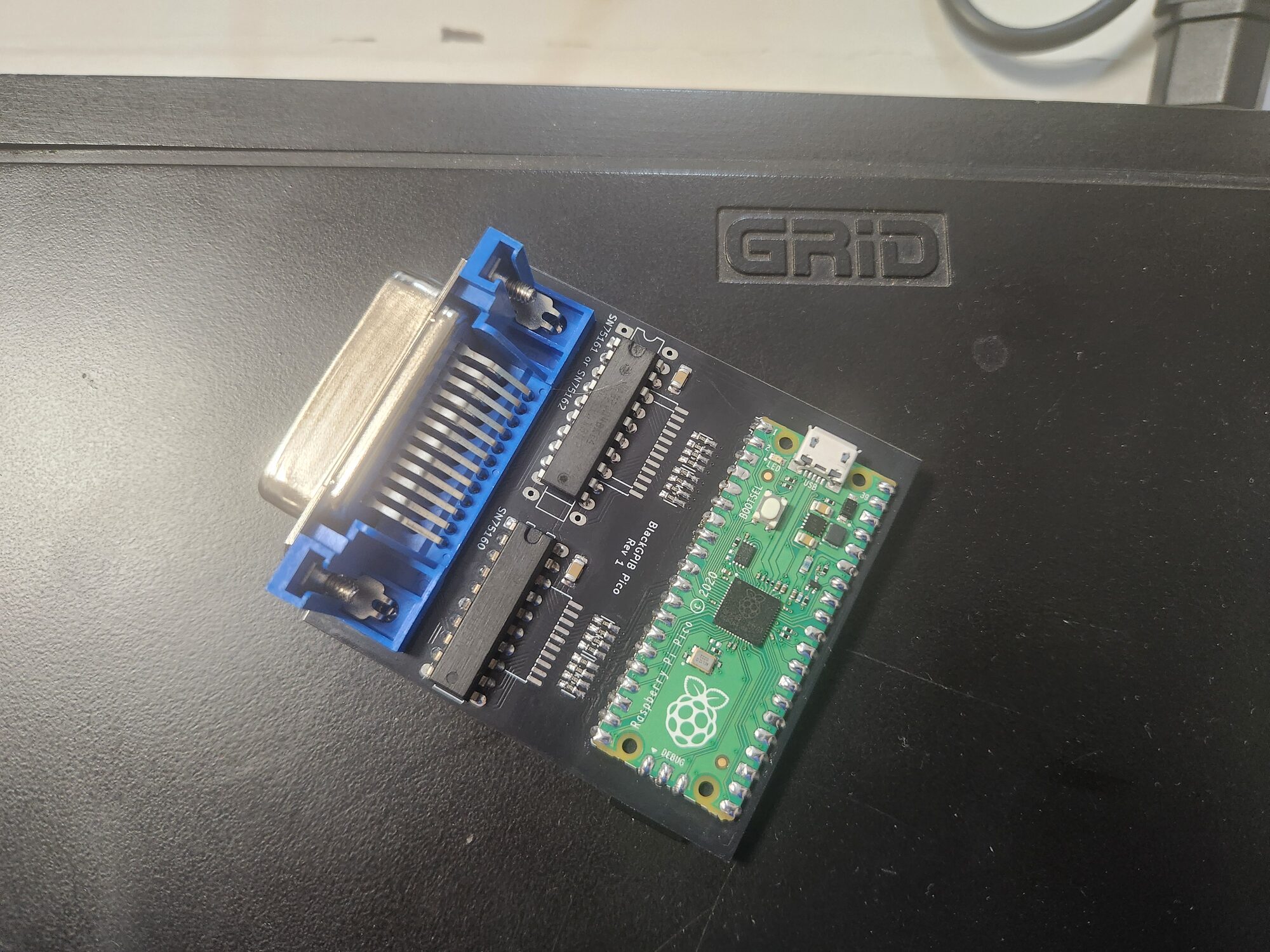
| Part | Value | Package | Quantity | Comment |
|---|---|---|---|---|
| GPIB Connector Female | - | 90 Degree | 1 | |
| SN75160 | - | SMD or DIP | 1 | |
| SN75161 / SN75162 | - | SMD or DIP | 1 | |
| Resistor Pack (4x0603) | 3.3kΩ | 1206 (4x0603) | 2 | Front side of the board |
| Resistor Pack (4x0603) | 6.8kΩ | 1206 (4x0603) | 2 | Back side of the board |
| Ceramic Capacitor | 0.1µF | 1206 | 3 | Any for 5V, I used random 10V capacitor |
| Tantalum Capacitor | 100µF | Case C (6032) | 1 | Any for 3.3V, I used random 10V capacitor |
| MicroSD Card Slot | - | SMD | 1 | LSCS |
| Pi Pico 2040 | - | SMD | 1 |
Because the Raspberry Pi Pico is positioned far from the edge of the board, not all micro-USB cables will fit.
When inserting the cable, hold it gently to prevent the SD card from popping out of the slot.
| Qty | Value | Footprint | References |
|---|---|---|---|
| 20 | 3k | 0204_7 | R21, R22, R23, R24, R25, R26, R27, R28, R29, R30, R31, R32, R33, R34, R35, R36 +4 |
| 20 | 3k | R0805 | R1, R2, R3, R4, R5, R10, R11, R12, R13, R14, R15, R16, R17, R18, R19, R20 +4 |
| 2 | C-EU050-024X044 | C050-024X044 | C3, C4 |
| 2 | C-EUC0805 | C0805 | C1, C2 |
| 2 | PINHD-1X5 | 1X05 | JP1, JP2 |
| 1 | dummyfp3 | UNK_HOLE_3 | |
| 1 | dummyfp0 | UNK_HOLE_0 | |
| 1 | dummyfp2 | UNK_HOLE_2 | |
| 1 | dummyfp1 | UNK_HOLE_1 | |
| 1 | 75160P | DIL20 | IC1 |
| 1 | 75160SO | SO20L | IC2 |
| 1 | 75161P | DIL20 | IC3 |
| 1 | 75161SO | SO20L | IC4 |
| 1 | 75162 | DIL24-3 | IC6 |
| 1 | 75162P | DIL22-3 | IC5 |
| 1 | 75162SO24 | SOIC127P1030X265-24N | IC7 |
| 1 | C24HP | 24HP | PL1 |
| 1 | GPIB-PINHD-2X12 | GPIB-PINHD-2X12 | JP3 |
| 1 | OSHW-LOGOS | OSHW-LOGO-S | LOGO2 |
| 1 | RASPBERRY-PI+HEADERONLY | RASPBERRY-PI-PLUS-HEADERONLY | U$2 |


shanteacontrols/OpenDeck
A platform for building interactive control and sensing devices using MIDI and OSC built with Zephyr RTOS.

Neumi/open_echo
Open Source echo sounder / depth sounder / SONAR for bathymetry and research. Arduino based and compatible.

StuckAtPrototype/AirCube
Works standalone out of the box. Pairs with Home Assistant in minutes. Other platforms are supported through community-contributed extensions.

TeXitoi/keyseebee
KeySeeBee is a split ergo keyboard. It is only 2 PCB (so the name) with (almost) only SMD components on it. It's only a keyboard, no LED, no display, nothing more than keys and USB.


Jeija/esp8266-smartwatch
ESP8266 DIY WiFi Smartwatch with MPU-9250, RTC, OLED, FT232, ...


It measures 75 × 65 mm and has 2 copper layers, 1.6 mm thick.
61 parts. The full list of its parts is on this page, with links to each part's symbol and footprint where PCBKit's library has them.
From the vklachkov/blackgpib repository on GitHub, at the commit this page was made from: the board is hardware/pi-hat/untitled.kicad_pcb and its schematic hardware/pi-hat/untitled.kicad_sch. PCBKit opens the board in the browser, with nothing to install.
Its repository publishes it under the MIT licence: you may reuse it on that licence's terms (keep the author's notice, and for a copyleft licence share your changes alike).