2 layers99.8 × 99.8 mm
OpenDeck r2.2.1
shanteacontrols/OpenDeck
A platform for building interactive control and sensing devices using MIDI and OSC built with Zephyr RTOS.
164 parts960Apache-2.0
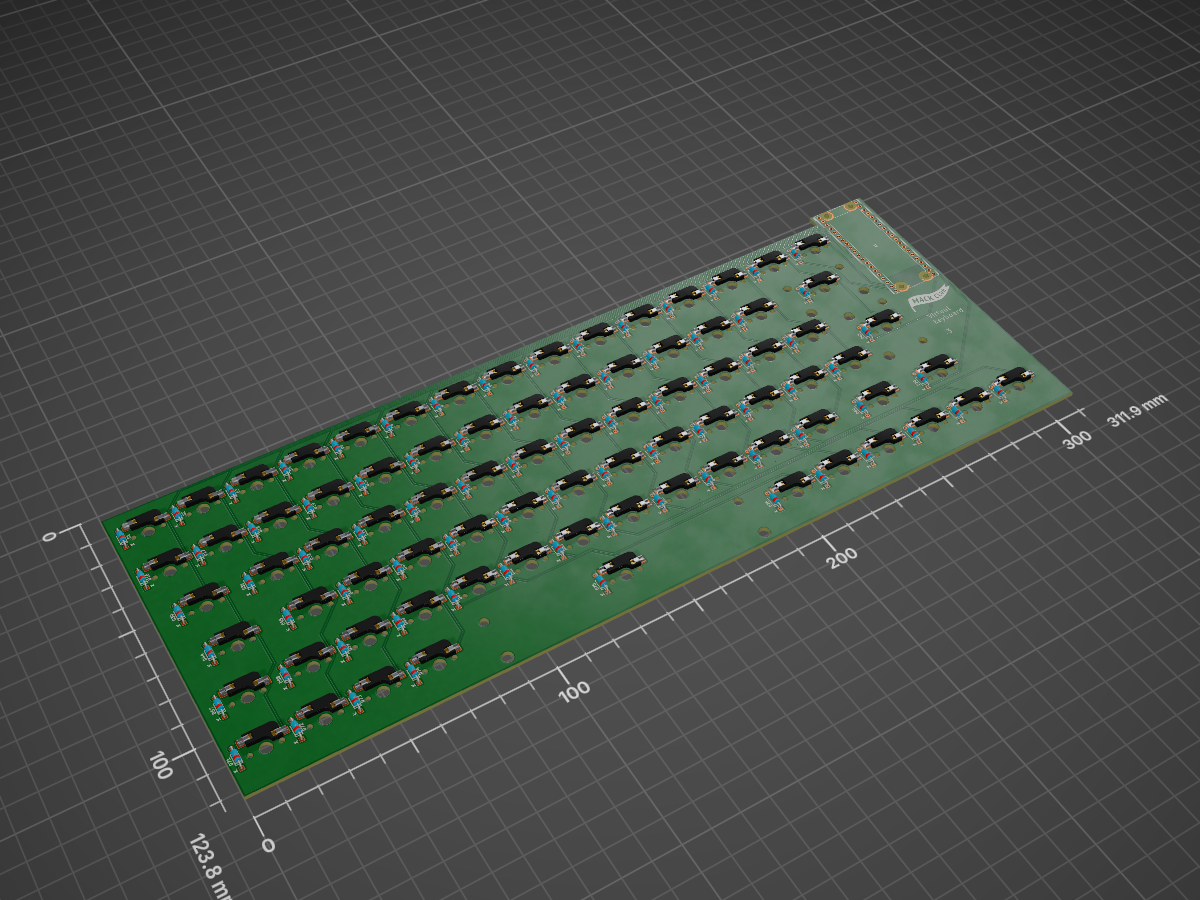
 virtualfuzz/virtual_keyboard
Mirror of https://codeberg.org/virtualfuzz/virtual_keyboard
Jayden keyboard is an open-source printed circuit board by virtualfuzz, from the virtualfuzz/virtual_keyboard repository on GitHub, published under the MIT licence. It is a 2-layer board of 311.9 × 123.8 mm with 164 parts on 115 nets, routed with 507 tracks and 9 vias.
Its parts include 81 diodes and 81 switches. It belongs with the keyboards and input boards and the RP2040 boards of this library.

Uses kmk for the firmware, maybe in the future I will switch to Rust.
The goal of this keyboard is to be one that I like, not one with a bunch of fancy features. It's as minimal as I like it to be, 65% keyboards seem good, but I still need F keys because for some games it better to have them.
For the arrow keys, I don't think it's that bad not having them thanks to WASD keys.


The case is supposed to stick together using screws, not sure if they will fit.
I think I'll use some tape or a wire to hold it together if it doesn't fit.
| QTY | Name | Part number |
|---|---|---|
| 1 | Orpheus PICO | |
| 81 | Diodes | 1N4148WL |
| 81 | Kailh Hotswap Sockets |
| QTY | Name |
|---|---|
| 1 | Bottom case |
| 1 | Top case |
| 4 | 2mm (Self-drilling?) Screws |
| 81 | DSA keycaps |
| 81 | Cherry MX Switches |
| 1 | 6u Stabilizer |
| 2 | 2u Stabilizers |
ISO layout

["Esc","F1","F2","F3","F4","F5","F6","F7","F8","F9","F10","F11","F12","Print screen","Delete"],
["#\n@","1\nà","2\né","3\nè","4\nê","5\n(","6\n)","7\n‘","8\n’","9\n«","0\n»","\"\n'","¨\n^",{w:2},"Backspace"],
[{w:1.5},"Tab","A","Z\n£","E\n€","R","T\n{","Y\n}","U","I","O","P","–\n-","±\n+",{x:0.25,w:1.25,h:2,w2:1.5,h2:1,x2:-0.25},"Enter"],
[{w:1.75},"Caps Lock","Q","S","D\n$","F","G","H","J","K","L","M","\\\n/","½\n*"],
[{w:1.25},"Shift",">\n<","W","X","C","V","B","N","?\n.","!\n,","…\n:","=\n;",{w:1.75},"Shift","↑"],
["Ctrl","Fn","Super","Alt",{a:7,w:6},"","Alt Gr","Super","Ctrl","←","↓","→"]| Qty | Value | Footprint | References |
|---|---|---|---|
| 81 | D | Diode_THT:D_DO-35_SOD27_P7.62mm_Horizontal | D1, D2, D10, D11, D12, D13, D14, D15, D16, D17, D18, D19, D20, D21, D22, D23 +65 |
| 74 | SW_Push | MX_HOTSWAP:MX-Hotswap-1U | SW1, SW2, SW10, SW11, SW12, SW13, SW14, SW15, SW16, SW17, SW18, SW19, SW20, SW21, SW22, SW23 +58 |
| 2 | SW_Push | MX_HOTSWAP:MX-Hotswap-1.75U | SW44, SW69 |
| 1 | LOGO | LOGO | G*** |
| 1 | RaspberryPi_Pico | PICO:RaspberryPi_Pico_Common_THT_MountingHoles | A1 |
| 1 | SW_Push | MX_HOTSWAP:MX-Hotswap-6U | SW75 |
| 1 | SW_Push | MX_HOTSWAP:MX-Hotswap-2U | SW29 |
| 1 | SW_Push | MX_HOTSWAP:MX-Hotswap-1.5U | SW30 |
| 1 | SW_Push | MX_HOTSWAP:MX-Hotswap-ISO | SW43 |
| 1 | SW_Push | MX_HOTSWAP:MX-Hotswap-1.25U | SW57 |
It measures 311.9 × 123.8 mm and has 2 copper layers, 1.6 mm thick.
164 parts. The full list of its parts is on this page, with links to each part's symbol and footprint where PCBKit's library has them.
From the virtualfuzz/virtual_keyboard repository on GitHub, at the commit this page was made from: the board is PCB/jayden_keyboard.kicad_pcb and its schematic PCB/jayden_keyboard.kicad_sch. PCBKit opens the board in the browser, with nothing to install.
Its repository publishes it under the MIT licence: you may reuse it on that licence's terms (keep the author's notice, and for a copyleft licence share your changes alike).
shanteacontrols/OpenDeck
A platform for building interactive control and sensing devices using MIDI and OSC built with Zephyr RTOS.


beekeeb/crkbd-glp
A variant of the Corne keyboard for GLP (Gateron Low Profile) key switches


Millisman/EG8010
Collection of designs for the EG8010 (ASIC for single-phase SPWM control H-bridge)
