
2 layers27.9 × 15.2 mm
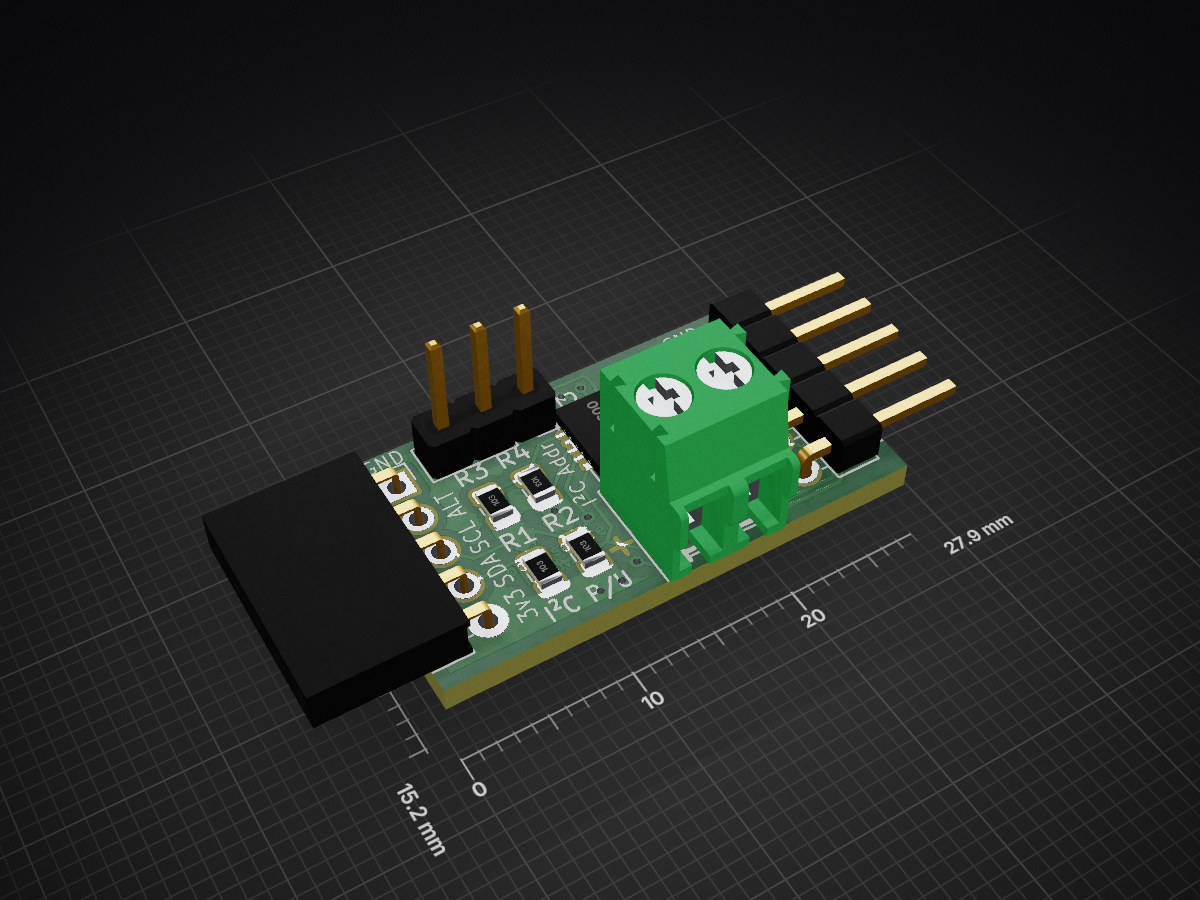
 vintlabs/MCP9600-Module1
MCP9600 I²C Module (Hardware)
I2C Thermocouple is an open-source printed circuit board by vintlabs, from the vintlabs/MCP9600-Module repository on GitHub, published under the CC-BY-SA-4.0 licence. It is a 2-layer board of 27.9 × 15.2 mm with 13 parts on 12 nets, routed with 100 tracks and 18 vias.
It is built around the MCP9600-E/MX. Its parts include 4 resistors, 4 connectors, 1 capacitor and 1 IC. It belongs with the sensors and measurement boards and the ESP32 boards of this library.
MCP9600 I²C Thermocouple to Digital Module (Hardware)

Simple module to detect temperature from a thermocouple on a Raspberry Pi (plugs in directly to the header on a Pi) or Arduino etc. Supports thermocouple types K, J, T, N, S, E, B and R, and uses simple I²C interface. Can be run on 2.7v to 5.5v. Board dimensions: 15x28mm (headers protrude beyond that)
There are headers on both sides of the board so that multiple boards can be connected together (being sure to use a different I2C address for each!), and there are footprints to add pullup resistors if they are required.
Additionally, alerts can be programmed, and when plugged directly into a Raspberry Pi GPIO4 will be ALERT1, ALERT2-4 are accessible using optional header J3.
Note that as of this date, the gerbers are the Rev A prototype and the design is a bit ahead of that. (only minor edits - the Rev A board works fine)
Designed using KiCAD 5.0.0
See pdf/ directory for images and PDF of schematic.
See https://github.com/pvint/MCP9600_Pi for C code (tested on a Raspberry Pi Zero W using a type K thermocouple)

| Qty | Value | Footprint | References |
|---|---|---|---|
| 4 | 10k | Resistor_SMD:R_0805_2012Metric | R1, R2, R3, R4 |
| 1 | 10uF | Capacitor_SMD:C_0805_2012Metric | C1 |
| 1 | Conn_01x03 | Connector_PinSocket_2.54mm:PinSocket_1x03_P2.54mm_Vertical | J3 |
| 1 | Conn_01x05 | Connector_PinSocket_2.54mm:PinSocket_1x05_P2.54mm_Horizontal | J1 |
| 1 | Conn_01x05 | Connector_PinHeader_2.54mm:PinHeader_1x05_P2.54mm_Horizontal | J4 |
| 1 | MCP9600 | I2C_Thermocouple:MCP9600_QFN-20-1EP_5x5mm_P0.65mm_EP3.35x3.35mm | U1 |
| 1 | Screw_Terminal_01x02 | TerminalBlock_Phoenix:TerminalBlock_Phoenix_PT-1,5-2-3.5-H_1x02_P3.50mm_Horizontal | J2 |
The 10 most common of 13 parts.


TAMU-RED-Avionics/TAMU-RED-Avionics
This repository is home to the code and documentation for the Avionics and Controls subteam of the Texas A&M University Rocket Engine Design ( TAMU RED ) team.


andreicito2/Physical-electronics-oven
This is my Capstone project. I am making a oven for my Physical Electonic professor.


PubInv/high-amp-controller-board
A PCB assembly for controlling up to 60 amps of power for electolysis of electroplating

wrickert/ReflowOvenController
Reflow controller for the Panasonic NB-W250S Toaster Oven.
It measures 27.9 × 15.2 mm and has 2 copper layers, 1.6 mm thick.
13 parts, built around the MCP9600-E/MX. The full list of its parts is on this page, with links to each part's symbol and footprint where PCBKit's library has them.
From the vintlabs/MCP9600-Module repository on GitHub, at the commit this page was made from: the board is I2C_Thermocouple.kicad_pcb. PCBKit opens the board in the browser, with nothing to install.
Its repository publishes it under the CC-BY-SA-4.0 licence: you may reuse it on that licence's terms (keep the author's notice, and for a copyleft licence share your changes alike).