2 layers100 × 100 mm
Explorer
anyshake/explorer
🌏 Detecting seismic wave using 3 geophones and 3-axis accelerometer, pack & send data to AnyShake Observer over RS232 / RS485 serial.
266 parts100

 vincentchen18/polyphonic-synthesizer1
a 2 octave pcb musical instrument!!! :)))
Polyphonic synthesizer is an open-source printed circuit board by vincentchen18, from the vincentchen18/polyphonic-synthesizer repository on GitHub. It is a 2-layer board of 300.1 × 90.5 mm with 76 parts on 83 nets, routed with 549 tracks and 71 vias.
It is built around the PCM5102PW and SMAJ5.0CA. Its parts include 26 diodes, 25 switches, 5 connectors, 4 resistors and 1 IC. It belongs with the audio and music boards and the RP2040 boards of this library.


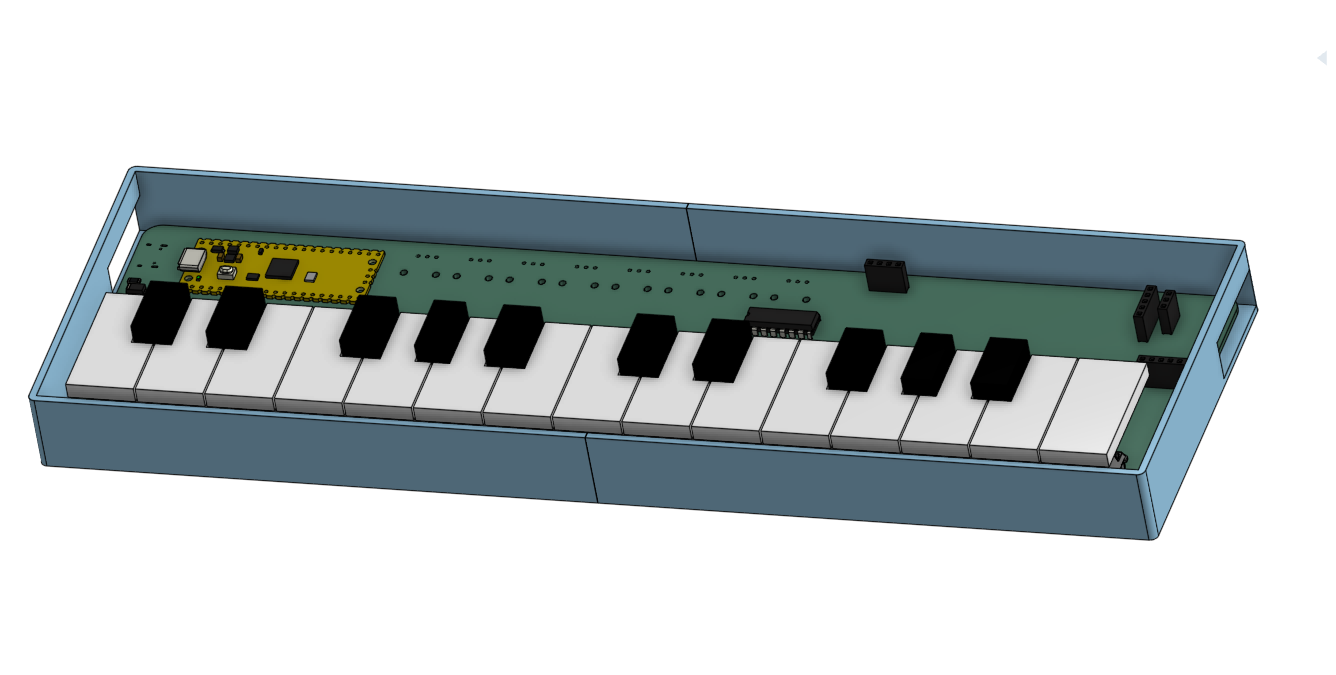
You're probably wondering why this is called a polyphonic synthesizer. Well, I thought it sounded fancier than "scrappy 2 octave piano". Anyway, this is my 2nd PCB project, made for the week 3, Instruments, of the Half Life YSWS from Hack Club.
As a former unskilled piano player (AMEB G6), I decided to make an electronic keyboard this week cos why not. :)))
Well, at least it's supposed to be an electric keyboard. I'm pretty sure the keys are a bit smaller than they actually are supposed to be, but at least their shape is recognisable, right?
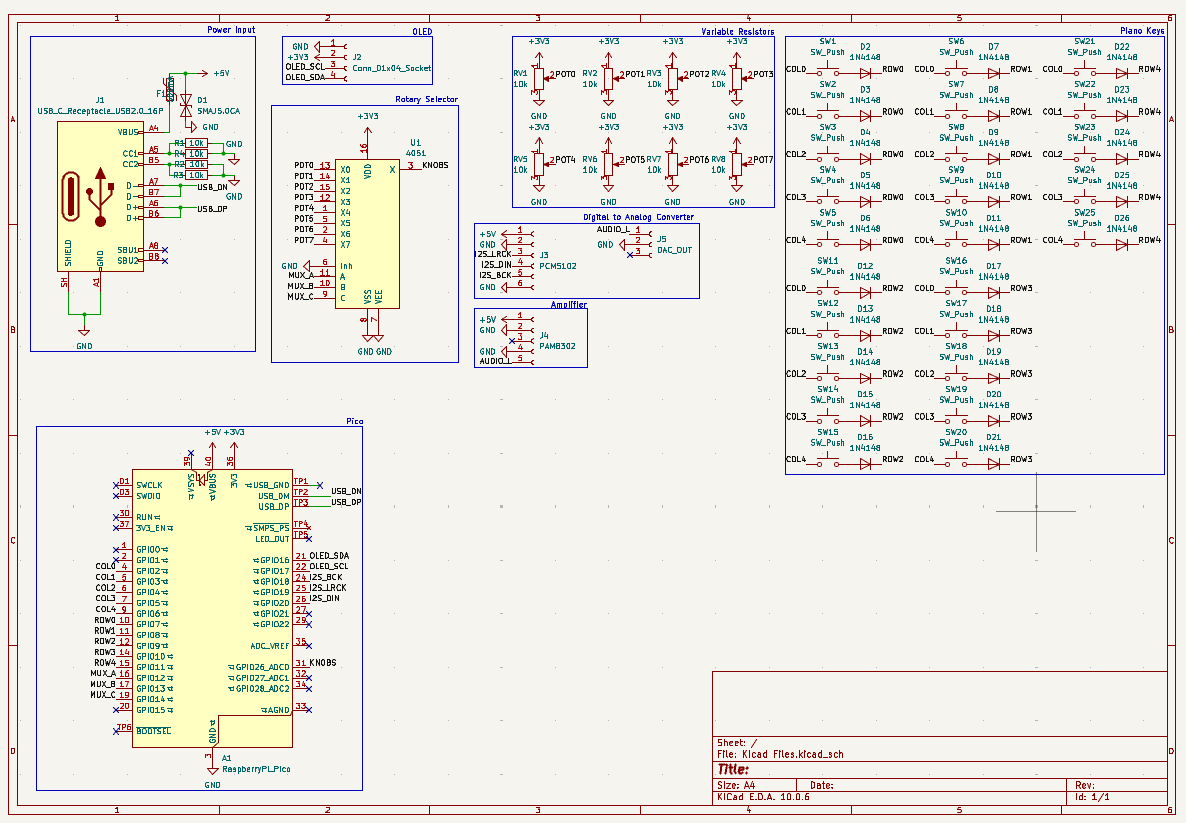
Above is my final schematic for the Synthesizer. As you can see, it contains a USB-C receptacle, Raspberry Pi Pico, some OLEDs, 25 switches (1 per key for 25 keys), and 8 knobs for customised sound settings.
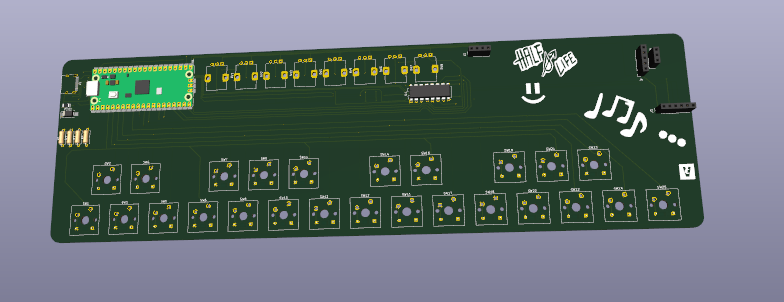
This is my PCB render of my project.
Basically, you need a bunch of Cherry MX switches that you need to stick onto the squares at the bottom.
Then, you gotta 3D print the white and black key files in here, ideally in PLA or PETG filament.
Next, you need to stick the holes of the 3D printed parts onto the stems of the switches, and there should be enough tolerance to stick it in easily.
There's also a bunch of soldering that you need to do for the electrical components, but aside from that it's pretty easy.
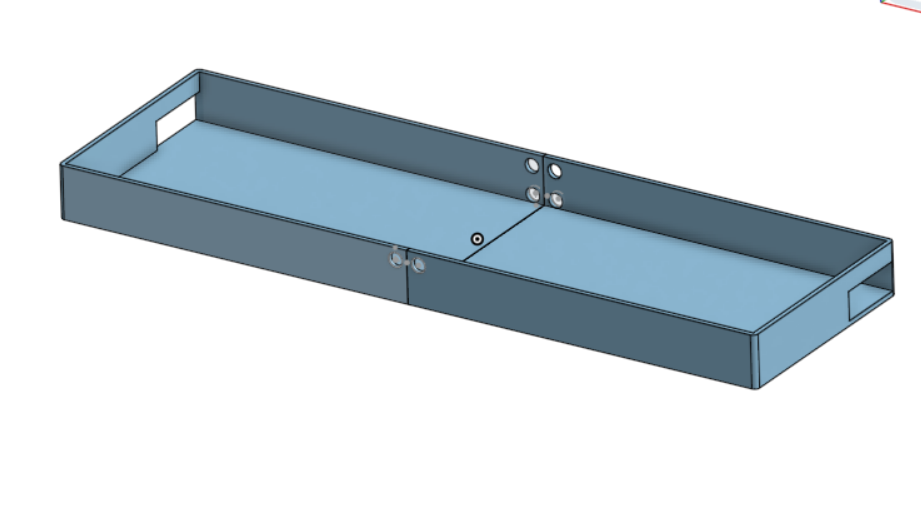
It is also important to note that the enclosure is completely optional, and exists only to hold the PCB so it doesn't slide around if you're trying to play it. It does not in any way affect the functionality of the actual piano.
If you do print the enclosure, please note that it is too large for a standard 3D printer with a buildspace of 220mm x 220mm x 220mm, so I have already halved the box in the STL model, and all you gotta do is either superglue the halves together or zip tie the 2 halves together using the provided 6mm diameter zip tie holes. (Zip ties are recommended)
The enclosure also has 2 holes for the USB cable and also the audio jack. Place the PCB inside it accordingly.
You may also notice that there is absolutely no top panel or lid for the enclosure. Please note that this is intended. so you can see my beautiful silkscreen art and also I do not have any access to hinges :CC
I dont even have much to say here, it's just a regular piano?? If you're seeing this and you're a music student then this is a sign to go back to studying music theory.
| Knob | What it does |
|---|---|
| Volume | how loud the thingy is |
| Instrument | switches between 5 sounds: Piano, Organ, Pluck, Bell and 8-bit |
| Tone | makes it darker or brighter, like turning the treble down/up |
| Attack | how fast a note fades in, turn up for a swell similar to a violin |
| Release | basically a damper pedal |
| Echo | adds repeating echoes |
| Octave | shifts the keyboard +/- 2 octaves so you can basically get the range of the entire piano |
| Transpose | shifts every note +/- 6 semitones in case you get bored of your key |
The 3d modelling was made in onshape. Find the editable model at this link: https://cad.onshape.com/documents/eaea6aaede962270a3775490/w/8b0d608019392835e9ec1b16/e/e5c3a90dd200dcba6fe43490?renderMode=0&uiState=6adddfe965922c75c7df5742
The Firmware for this project is programmed in Arduino IDE.
No AI used in this project.
| Item | Purpose | Qty | Price | Source |
|---|---|---|---|---|
| Custom PCB 300×90mm, 2-layer (incl. shipping, $5 JLCONE coupon) | Main board | 5 | US$23.25 | JLCPCB |
| USB-C receptacle HRO TYPE-C-31-M-12 | Power + USB data | 5 | US$0.87 | LCSC |
| SMAJ5.0CA TVS diode | USB ESD protection | 20 | US$0.61 | LCSC |
| SMD1206-050-16 500mA polyfuse | USB overcurrent protection | 10 | US$0.43 | LCSC |
| Raspberry Pi Pico RP2040 (micro USB) + free knob caps (incl. GST) | Microcontroller | 1 | US$3.16 | AliExpress |
| Grant total | US$28.32 |
| Item | Purpose | Qty | Price | Source |
|---|---|---|---|---|
| Gateron G Pro 3.0 MX switches (30pc) | Keys (25 needed, 8 leftover from Starbie) | 1 pack | AU$5.49 | AliExpress |
| 1N4148 DO-35 diodes (50pc) | Key matrix anti-ghosting | 1 pack | AU$2.83 | AliExpress |
| RV09 10K vertical potentiometers (5pc) | 8 control knobs | 2 packs | AU$2.78 | AliExpress |
| CD4051BE DIP-16 | Analog mux for the 8 knobs | 1 | AU$2.44 | AliExpress |
| 0.96" I2C OLED 128x64 | Display | 1 | AU$3.74 | AliExpress |
| GY-PCM5102 I2S DAC module | Audio DAC + headphone jack | 1 | AU$4.19 | AliExpress |
| PAM8302A CJMCU-832 amp module | Speaker amplifier | 1 | AU$2.50 | AliExpress |
| 8Ω 1W 28mm speaker (2pc) | Speaker | 1 pack | AU$4.60 | AliExpress |
| 10% GST | Tax | — | AU$2.86 | — |
| Out-of-pocket total | AU$31.43 (US$21.98) |
| Item | Purpose | Qty |
|---|---|---|
| 10k resistors (1/4W) | USB-C CC pull-downs | 4 |
Project total: US$50.30 (AUD converted at AU$1 = US$0.6994)
| Qty | Value | Footprint | References |
|---|---|---|---|
| 25 | 1N4148 | Diode_THT:D_DO-35_SOD27_P7.62mm_Horizontal | D2, D10, D11, D12, D13, D14, D15, D16, D17, D18, D19, D20, D21, D22, D23, D24 +9 |
| 25 | SW_Push | Button_Switch_Keyboard:SW_Cherry_MX_1.00u_PCB | SW1, SW2, SW10, SW11, SW12, SW13, SW14, SW15, SW16, SW17, SW18, SW19, SW20, SW21, SW22, SW23 +9 |
| 8 | 10k | Potentiometer_THT:Potentiometer_Alps_RK09K_Single_Vertical | RV1, RV2, RV3, RV4, RV5, RV6, RV7, RV8 |
| 4 | 10k | Resistor_THT:R_Axial_DIN0207_L6.3mm_D2.5mm_P7.62mm_Horizontal | R1, R2, R3, R4 |
| 1 | 4051 | Package_DIP:DIP-16_W7.62mm | U1 |
| 1 | 500mA | Fuse:Fuse_1206_3216Metric_Pad1.42x1.75mm_HandSolder | F1 |
| 1 | Conn_01x04_Socket | Connector_PinSocket_2.54mm:PinSocket_1x04_P2.54mm_Vertical | J2 |
| 1 | DAC_OUT | Connector_PinSocket_2.54mm:PinSocket_1x03_P2.54mm_Vertical | J5 |
| 1 | LOGO | images:halflifeimage | |
| 1 | LOGO | images:quaver | |
| 1 | LOGO | images:quaver + semiquaver | |
| 1 | LOGO | images:profilepicture | |
| 1 | LOGO | images:crotchet | |
| 1 | PAM8302 | Connector_PinSocket_2.54mm:PinSocket_1x05_P2.54mm_Vertical | J4 |
| 1 | PCM5102 | Connector_PinSocket_2.54mm:PinSocket_1x06_P2.54mm_Vertical | J3 |
| 1 | RaspberryPi_Pico | Module:RaspberryPi_Pico_SMD | A1 |
| 1 | SMAJ5.0CA | Diode_SMD:D_SMA_Handsoldering | D1 |
| 1 | USB_C_Receptacle_USB2.0_16P | Connector_USB:USB_C_Receptacle_HRO_TYPE-C-31-M-12 | J1 |
anyshake/explorer
🌏 Detecting seismic wave using 3 geophones and 3-axis accelerometer, pack & send data to AnyShake Observer over RS232 / RS485 serial.

BYU-I-eBadge/e-badge
A hackable eBadge platform for students — a customizable, programmable electronics badge designed for hands-on learning and creative exploration throughout their academic journey.


ParadigmEngineering/igvc-2023-hardware
Intelligent Ground Vehicle Competition (Spring 2023) hardware for the Paradigm Engineering Student Group

victorstoica114/UWB_Module_ESP_IDF
ESP-IDF 6.0.2 firmware for the custom UWB Module V1.0 Rev.B, based on an ESP32-S3-WROOM-1-N16R8. The same application image runs on every module; persistent identity and runtime configuration select the role and active…


It measures 300.1 × 90.5 mm and has 2 copper layers, 1.6 mm thick.
76 parts, built around the PCM5102PW and SMAJ5.0CA. The full list of its parts is on this page, with links to each part's symbol and footprint where PCBKit's library has them.
From the vincentchen18/polyphonic-synthesizer repository on GitHub, at the commit this page was made from: the board is Kicad Files/Kicad Files.kicad_pcb and its schematic Kicad Files/Kicad Files.kicad_sch. PCBKit opens the board in the browser, with nothing to install.
Its repository states no licence, so its author keeps all rights: ask vincentchen18 before reusing the design.