
2 layers52.2 × 52.2 mm
Base promicro
google/mozc-devices
Circuit diagrams and firmware source code for Gboard DIY keyboards
30 parts3kApache-2.0

Documentation and Project Repo
Hh3.0 is an open-source printed circuit board by Vik-Prabhu, from the Vik-Prabhu/Hardware-Hackathon-3.0 repository on GitHub. It is a 2-layer board of 92.2 × 52.8 mm with 30 parts on 48 nets, routed with 45 tracks and 2 vias.
Its parts include 7 connectors, 5 resistors, 3 diodes and 2 ICs. It belongs with the ESP32 and RISC-V boards of this library.
Green Node
The global agricultural sector faces a massive adoption gap in precision agriculture. Out of over 500 million small farms globally, only about 10% use digital agricultural services.
To build a low-cost, scalable, and open-source plantation monitoring system for the Hardware Hackathon 3.0. Green Node merges robust hardware edge nodes with a sophisticated AI advisory pipeline to bring state-of-the-art agricultural monitoring to farmers. Our core objective focuses on plant survival, optimal yield, and early disease prevention through high-accuracy local ground truth.
The current market is split between expensive agricultural tech and software-heavy platforms lacking local ground truth:
| Competitor | Approach | Weakness |
|---|---|---|
| Fasal | Farm-specific IoT | Very high hardware cost, vertical-specific |
| CropIn | Software-only platform | No on-ground sensors (estimations only) |
| Manual Contractors | Schedule-based inspection | Inefficient, unaccountable |
Despite the rise of precision agriculture, competitors fail due to scaling constraints and disconnected methodologies. Existing systems lack integration between cheap continuous ambient measurement and deep-learning visual diagnostics. Solutions like Fasal capture field data but demand massive capital ($200+ unit cost), while CropIn relies purely on estimates without true real-world soil/plant mapping.
Green Node bridges this gap by decoupling continuous soil telemetry from computationally heavy vision tasks—delivering a comprehensive package for under ₹2,400 per node, combined with actionable, real-time AI-guided triaging devoid of monthly LTE service drops.
The core novelty resides in our Dual-Node Architecture linked to an AI Advisory Pipeline: Instead of providing raw datasets like "humidity is 78%", Green Node features a visual capture layer. The camera node feeds leaf images into an AI model combined with live ambient data. The system generates intelligent, multi-lingual daily action priorities—e.g., "Node 3 has early signs of Late Blight — inspect row 4." Additionally, we leverage Dynamic Sentinal Polling: Sensor nodes dynamically change their reporting frequency based on internal thresholds (e.g. accelerating ping rates from 30s to 5s during severe moisture drops).
Green Node is a fully integrated ecosystem designed to deliver actionable intelligence. It incorporates:
DHT sensor library, ArduinoJson.To validate our system in a real-world edge scenario, we deployed it in a live indoor bonsai nursery:
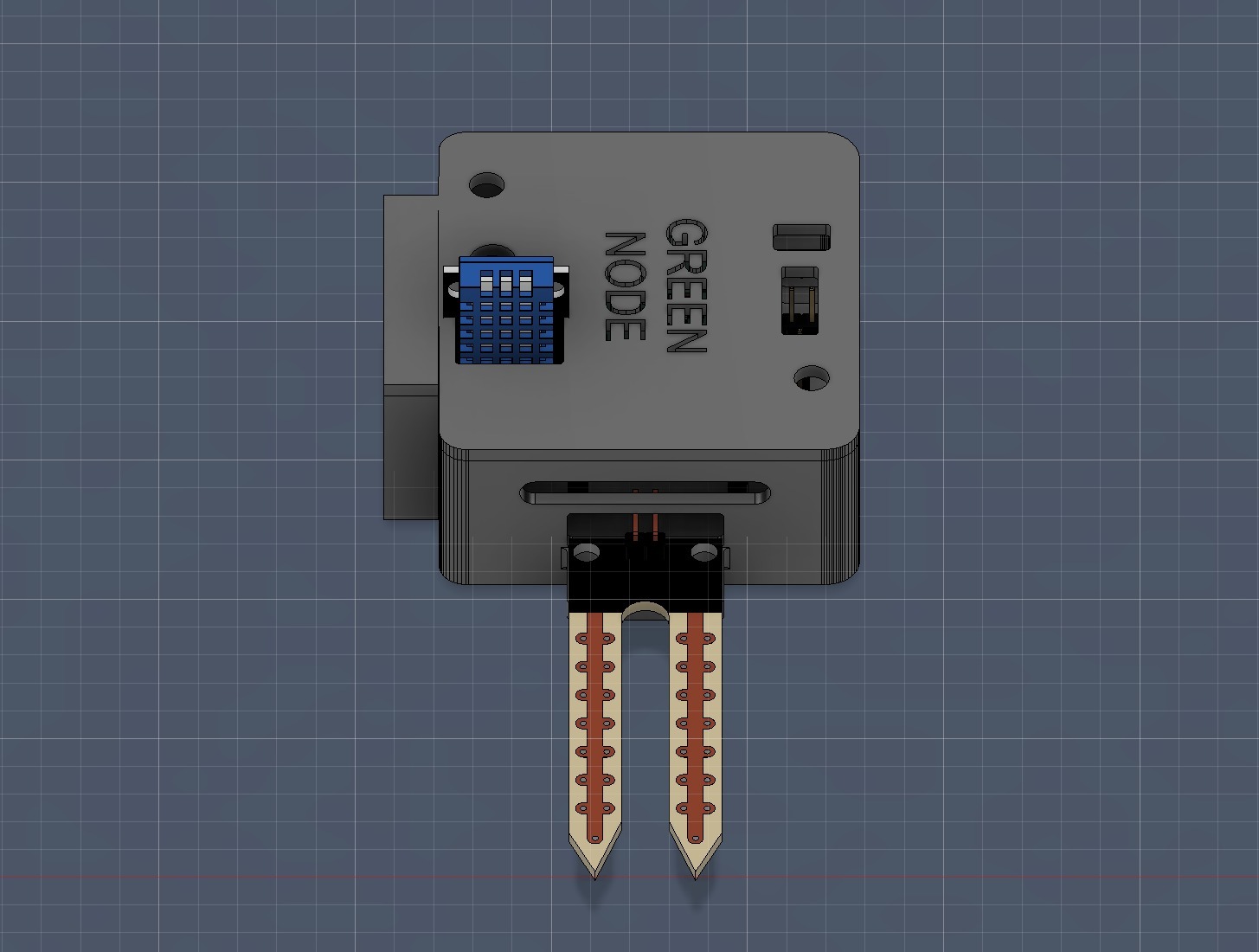
mDNS structures routing directly to a secure, localized central Python Hub—acting as a firewall from public internet threats.vikram-Vivobook-Go.local:8000/register.GET /capture. The node streams a JPEG byte packet alongside X-Moisture and X-Temperature custom headers.Daily Action Plan.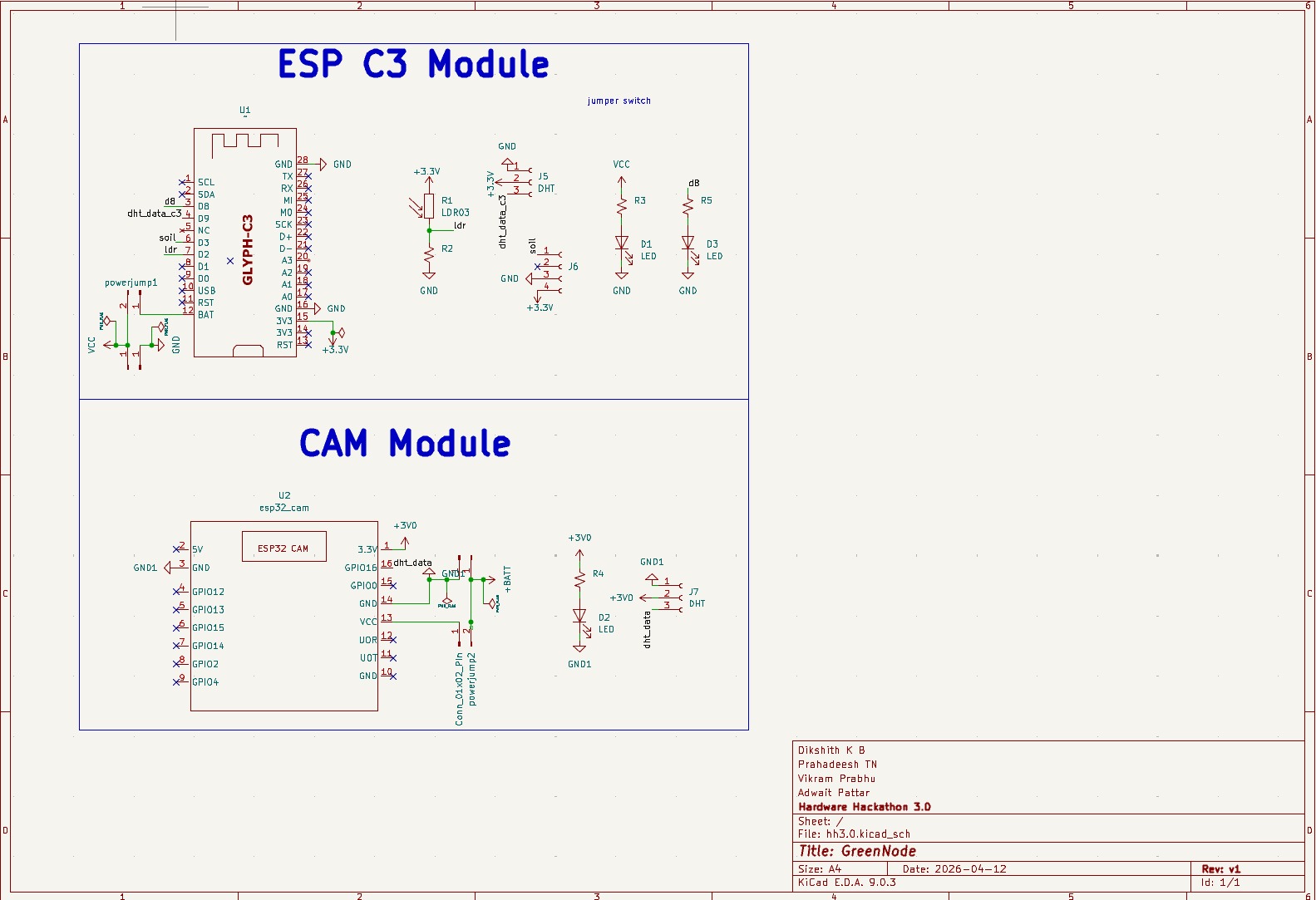
[Insert Link to Live Project Demo Video Here]
The current repository encompasses the complete documentation, firmware, server environment, and backend code designed explicitly according to the 13-point rubric constraints. Repository URL: https://github.com/Vik-Prabhu/Hardware-Hackathon-3.0
| Qty | Value | Footprint | References |
|---|---|---|---|
| 4 | Conn_01x01_Pin | Connector_Wire:SolderWirePad_1x01_SMD_1x2mm | J1, J2, J3, J4 |
| 3 | LED | LED_THT:LED_D3.0mm_Clear | D1, D2, D3 |
| 3 | R_Small_US | Resistor_THT:R_Axial_DIN0204_L3.6mm_D1.6mm_P5.08mm_Horizontal | R3, R4, R5 |
| 3 | VAL** | mouse-bite.pretty-main:mouse-bite-2mm-4mm | mouse-bite-2mm-4mm, mouse-bite-2mm-4mm, mouse-bite-2mm-4mm |
| 2 | Conn_01x02_Pin | Connector_PinHeader_2.54mm:PinHeader_1x02_P2.54mm_Vertical | powerjump1, powerjump2 |
| 2 | DHT | Connector_PinSocket_2.54mm:PinSocket_1x03_P2.54mm_Vertical | J5, J7 |
| 2 | LOGO | LOGO | G***, G*** |
| 1 | 100k | Resistor_THT:R_Axial_DIN0204_L3.6mm_D1.6mm_P5.08mm_Horizontal | R2 |
| 1 | Conn_01x04_Socket | Connector_PinHeader_2.54mm:PinHeader_1x04_P2.54mm_Vertical | J6 |
| 1 | LDR03 | OptoDevice:R_LDR_4.9x4.2mm_P2.54mm_Vertical | R1 |
| 1 | esp32_cam | pcbcupid_footprint:esp32_cam | U2 |
| 1 | ~ | pcbcupid_footprint:glyph-c3 | U1 |
The 24 most common of 30 parts.
It measures 92.2 × 52.8 mm and has 2 copper layers, 1.6 mm thick.
30 parts. The full list of its parts is on this page, with links to each part's symbol and footprint where PCBKit's library has them.
From the Vik-Prabhu/Hardware-Hackathon-3.0 repository on GitHub, at the commit this page was made from: the board is PCB/hh3.0.kicad_pcb and its schematic PCB/hh3.0.kicad_sch. PCBKit opens the board in the browser, with nothing to install.
Its repository states no licence, so its author keeps all rights: ask Vik-Prabhu before reusing the design.
google/mozc-devices
Circuit diagrams and firmware source code for Gboard DIY keyboards


VoronDesign/Voron-Hardware
Cool Hardware designed by the Voron Design group

hoglet67/RGBtoHDMI
Bare-metal Raspberry Pi project that provides pixel-perfect sampling of Retro Computer RGB/YUV video and conversion to HDMI

tenderlove/initial-v
It's a BMW shifter converted to a Bluetooth Keyboard that you use with Vim

hackclub/OnBoard
💡 Join 1,000 teenagers and make your first PCB with a $100 grant!

