4 layers36 × 34 mm
UClock ESP32C3
SirioGuy/uClock
Powered by the ESP32-C3, μClock includes an ultra-precise real-time clock that automatically corrects itself via NTP servers, ensuring it's always perfectly on time.
68 parts2MIT

 V3n0m1010011010/E-Paper-Dev-Board
Eine kompakte, selbst entwickelte ESP32-S3-Platine für portable Anwendungen mit E-Paper-Display, microSD-Karte, Navigationstaster und LiPo-Akku.
E paper esp32 is an open-source printed circuit board by V3n0m1010011010, from the V3n0m1010011010/E-Paper-Dev-Board repository on GitHub. It is a 2-layer board of 40.8 × 36.4 mm with 56 parts on 85 nets, routed with 386 tracks and 72 vias.
It is built around the ESP32-S3-WROOM-1U-N8R8, TPS628438DRL and MBR0530, with the FFC2B28-24-G and SI1308EDL among its other parts. Its parts include 11 resistors, 4 connectors, 3 ICs, 2 switches and 1 diode. It belongs with the lEDs and displays boards and the ESP32 boards of this library.


Eine kompakte, selbst entwickelte ESP32-S3-Platine für portable Anwendungen mit E-Paper-Display, microSD-Karte, Navigationstaster und LiPo-Akku.
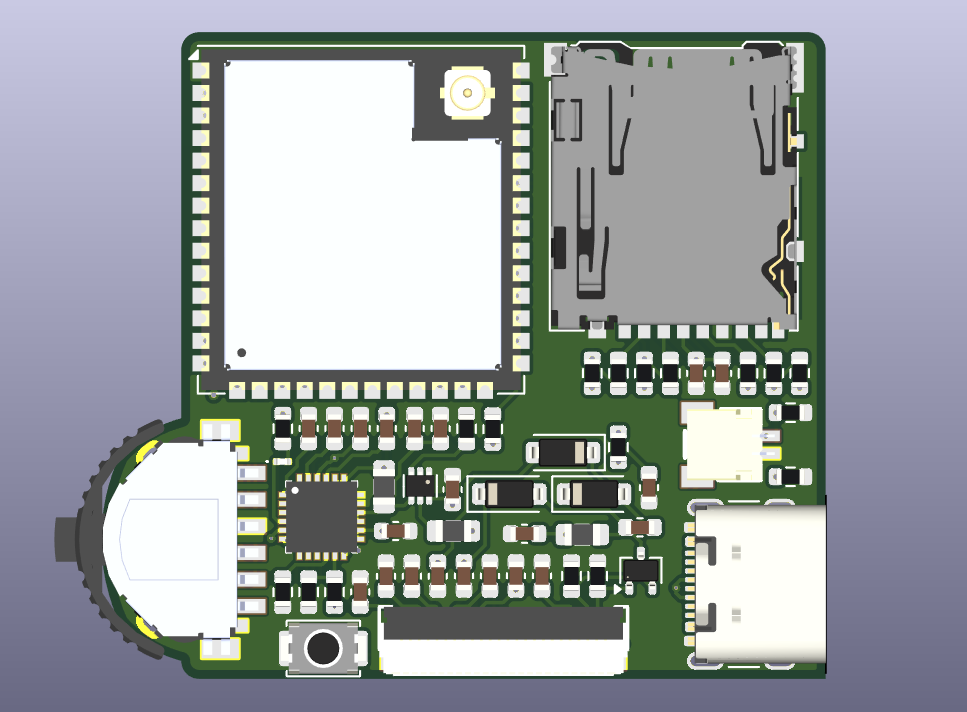
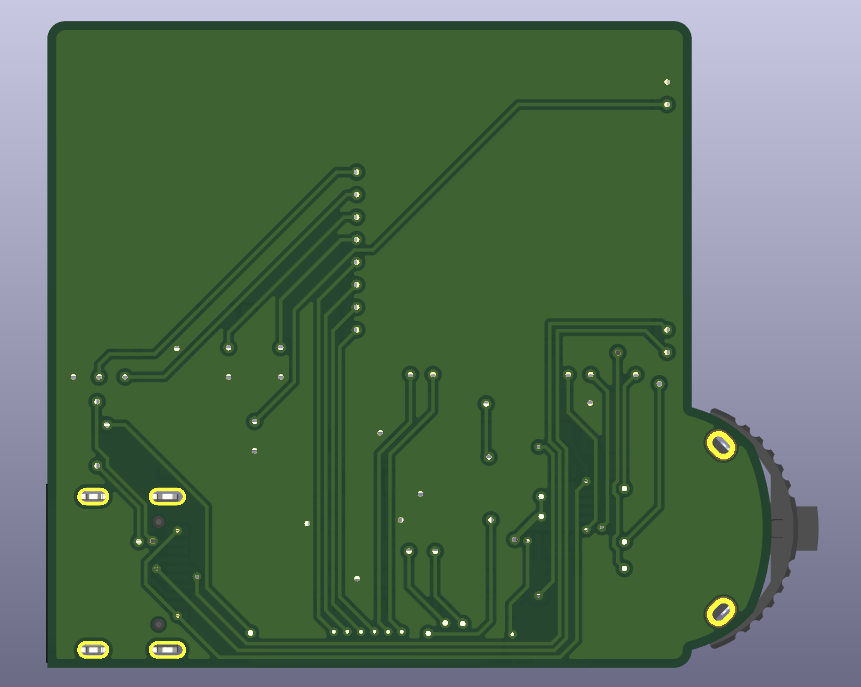
| Komponente | Beschreibung |
|---|---|
| ESP32-S3-WROOM-1U | Hauptcontroller |
| GDEY0154D67 | 1.54" E-Paper Display |
| BQ25896 | LiPo-Ladecontroller |
| TPS62843 | 3.3 V Buck-Converter |
| TS43-135255-10-BK-200-SMT-TR | Navigationstaster |
| USB4105 | USB-C Anschluss |
| SM02B-SRSS-TB(LF)(SN) | JST-Akkuanschluss |
Die verwendeten Datenblätter befinden sich im Ordner Docs.
Enthalten sind unter anderem die Datenblätter für:
Die übrigen Dateien im Docs-Ordner enthalten zusätzliche Datenblätter und Referenzinformationen für das PCB-Design.
| Qty | Value | Footprint | References |
|---|---|---|---|
| 8 | 1uF/25V | Capacitor_SMD:C_0603_1608Metric | CD3, CD4, CD5, CD6, CD7, CD8, CD9, CD10 |
| 7 | 10kΩ | Resistor_SMD:R_0603_1608Metric | R2, R5, R7, RD6, RD7, RESP1, RESP2 |
| 4 | 22Ω | Resistor_SMD:R_0603_1608Metric | R1, R3, R4, R6 |
| 3 | 10uF | Capacitor_SMD:C_0603_1608Metric | Cb7, Cb8, Cs2 |
| 3 | MBR0530 | Diode_SMD:D_SOD-123 | DD1, DD2, DD3 |
| 2 | 1uF | Capacitor_SMD:C_0603_1608Metric | Cb1, Cesp1 |
| 2 | 1uH | Inductor_SMD:L_0805_2012Metric | Lb1, Lb2 |
| 2 | 4.7uF | Capacitor_SMD:C_0603_1608Metric | Cb2, Cb5 |
| 2 | 4.7uF/25V | Capacitor_SMD:C_0603_1608Metric | CD1, CD2 |
| 2 | 5.1kΩ | Resistor_SMD:R_0603_1608Metric | Rusb1, Rusb2 |
| 1 | 100nF | Capacitor_SMD:C_0603_1608Metric | Cs1 |
| 1 | 1MΩ | Resistor_SMD:R_0603_1608Metric | RD1 |
| 1 | 2.2kΩ | Resistor_SMD:R_0603_1608Metric | RD5 |
| 1 | 2.2Ω | Resistor_SMD:R_0603_1608Metric | RD2 |
| 1 | 22uF | Capacitor_SMD:C_0603_1608Metric | Cb6 |
| 1 | 249kΩ | Resistor_SMD:R_0603_1608Metric | RD3 |
| 1 | 260Ω | Resistor_SMD:R_0603_1608Metric | RD4 |
| 1 | 47nF | Capacitor_SMD:C_0603_1608Metric | Cb4 |
| 1 | 47uH 500mA | Inductor_SMD:L_0805_2012Metric | LD1 |
| 1 | 8.2uF | Capacitor_SMD:C_0603_1608Metric | Cb3 |
| 1 | BM02B-SRSS-TB_LF__SN_ | SM02B-SRSS-TB_LF__SN:SM02B-SRSS-TB_LF__SN | J3 |
| 1 | BQ25896RTWR | bq25896:IC_BQ25896RTWR | U2 |
| 1 | ESP32-S3-WROOM-1U-N8R8 | esp32_wroom_u1:ESP32-S3-WROOM-1U | U1 |
| 1 | FFC2B28-24-G | FFC2B28-24-G:GCT_FFC2B28-24-G | J1 |
| 1 | LED | LED_SMD:LED_0201_0603Metric | D1 |
| 1 | Micro_SD_Card_Det_Hirose_DM3AT | Connector_Card:microSD_HC_Hirose_DM3AT-SF-PEJM5 | J6 |
| 1 | SW_Push | Button_Switch_SMD:SW_Push_SPST_NO_Alps_SKRK | SW1 |
| 1 | Si1308EDL | Package_TO_SOT_SMD:SOT-323_SC-70 | Q1 |
| 1 | TPS628438DRL | Package_TO_SOT_SMD:SOT-563 | U4 |
| 1 | TS43-135255-10-BK-200-SMT-TR | TS43:SW_TS43-135255-10-BK-200-SMT-TR | S1 |
| 1 | USB_C_Receptacle_USB2.0_14P | Connector_USB:USB_C_Receptacle_GCT_USB4105-xx-A_16P_TopMnt_Horizontal | J2 |
SirioGuy/uClock
Powered by the ESP32-C3, μClock includes an ultra-precise real-time clock that automatically corrects itself via NTP servers, ensuring it's always perfectly on time.


Allegra42/ZEReader-KiCad
ZEReader is an open source hardware and software E-Book Reader platform. Originally developed as a bachelor's thesis in electrical engineering, the project now evolves as a hobby initiative dedicated to further develop…

sandgum/Triangulate-ES_01-Watch
A 5mm thick smartwatch which uses an E-ink display and two OLEDs to display information while consuming very little power


CausticLime1/Debugging-Board
The purpose of this project is to develop a budget-friendly electronics debugging station that includes various PCBs (Printed Circuit Boards) that incorporate different functionalities.

PyCubed-Mini/flatsat
Base circuit board for electrically and mechanically connecting flight hardware.

hamuelbones/e-e-paper
An ESP32-C-based internet-connected decorative e-paper display
It measures 40.8 × 36.4 mm and has 2 copper layers, 1.6 mm thick.
56 parts, built around the ESP32-S3-WROOM-1U-N8R8, TPS628438DRL, MBR0530 and FFC2B28-24-G. The full list of its parts is on this page, with links to each part's symbol and footprint where PCBKit's library has them.
From the V3n0m1010011010/E-Paper-Dev-Board repository on GitHub, at the commit this page was made from: the board is esp32_epaper_board/kicad/e-paper-esp32/e-paper-esp32.kicad_pcb and its schematic esp32_epaper_board/kicad/e-paper-esp32/e-paper-esp32.kicad_sch. PCBKit opens the board in the browser, with nothing to install.
Its repository states no licence, so its author keeps all rights: ask V3n0m1010011010 before reusing the design.