
2 layers85 × 60 mm

My own Arduino-style development board built from scratch using a DIP ATmega328P and custom KiCad PCB.
ArduCore is an open-source printed circuit board by urjadoshi2024etc-creator, from the urjadoshi2024etc-creator/ArduCore-Custom-Arduino-Board repository on GitHub. It is a 2-layer board of 52 × 57.5 mm with 19 parts on 29 nets, routed with 202 tracks and 36 vias.
It is built around the ATMEGA328P-PU, AS7805AT-G1 and 470UF 25V. Its parts include 4 capacitors, 4 connectors, 1 resistor, 1 IC and 1 diode. It belongs with the microcontroller boards boards and the AVR (ATmega, ATtiny) boards of this library.


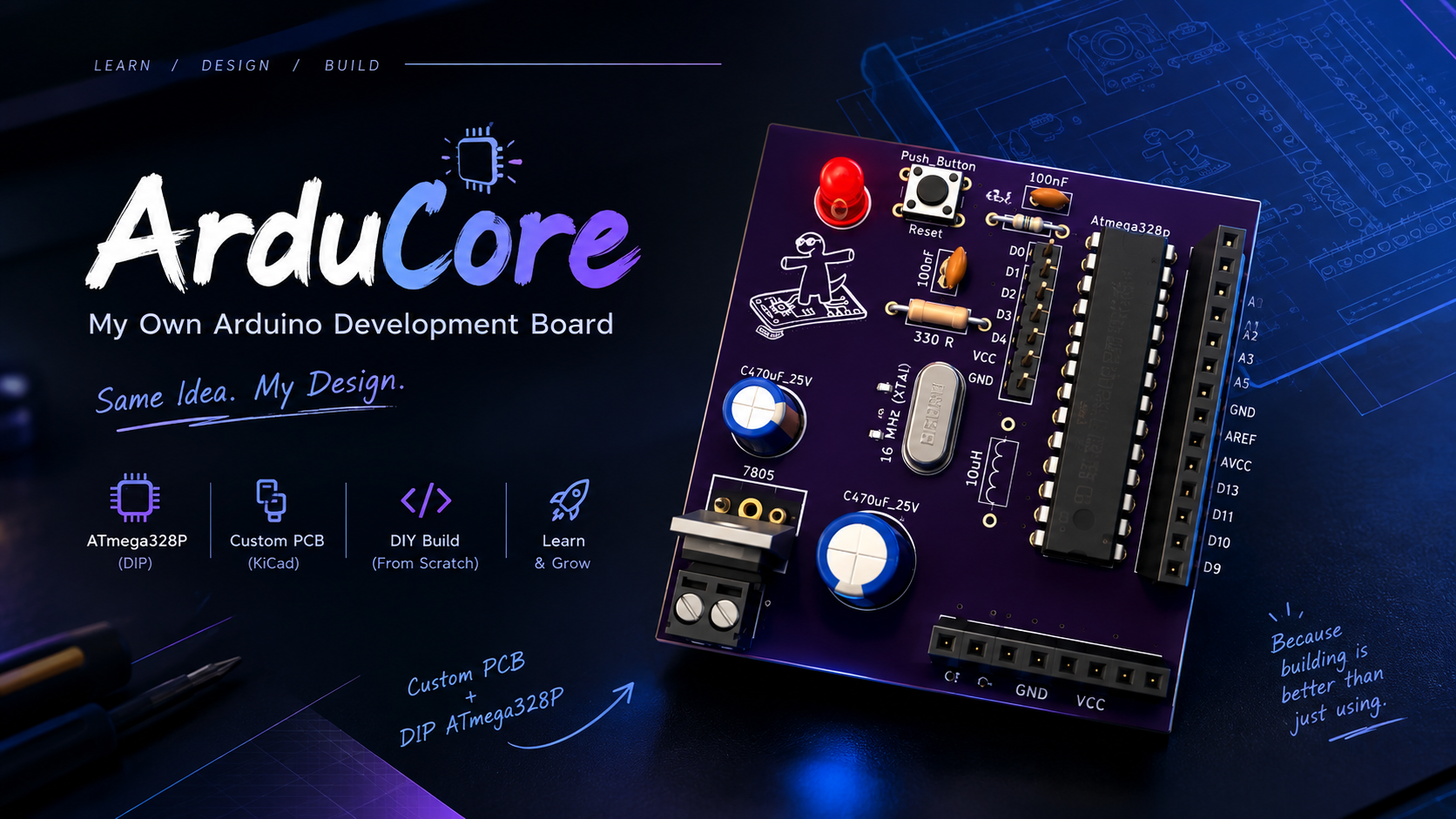
I wanted to go one step deeper.
Instead of using a ready-made Arduino board, I designed the microcontroller circuit, power section, reset circuit, clock circuit, headers, and PCB layout myself.
I wanted my own Arduino Devboard so made this project
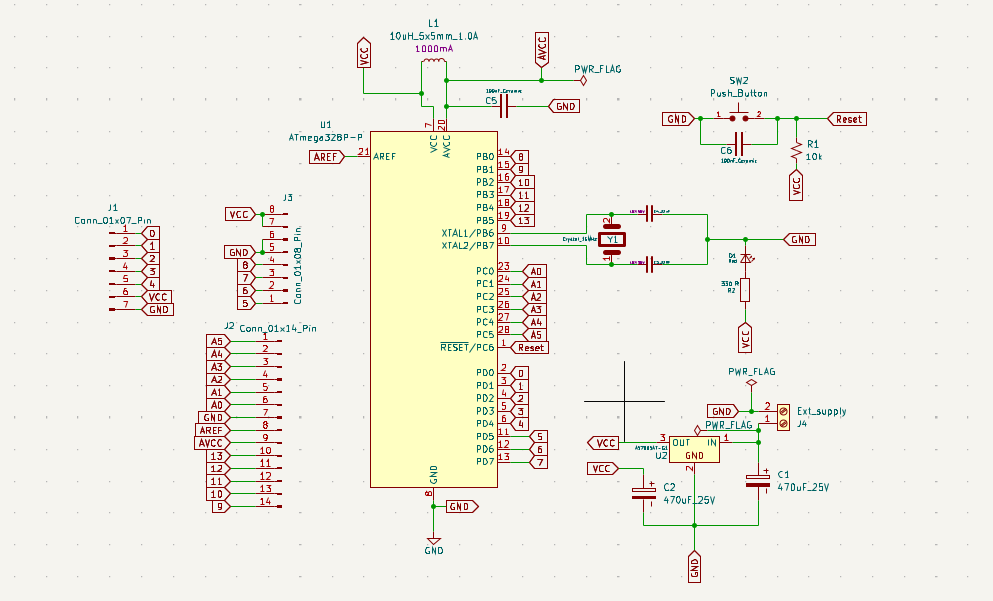
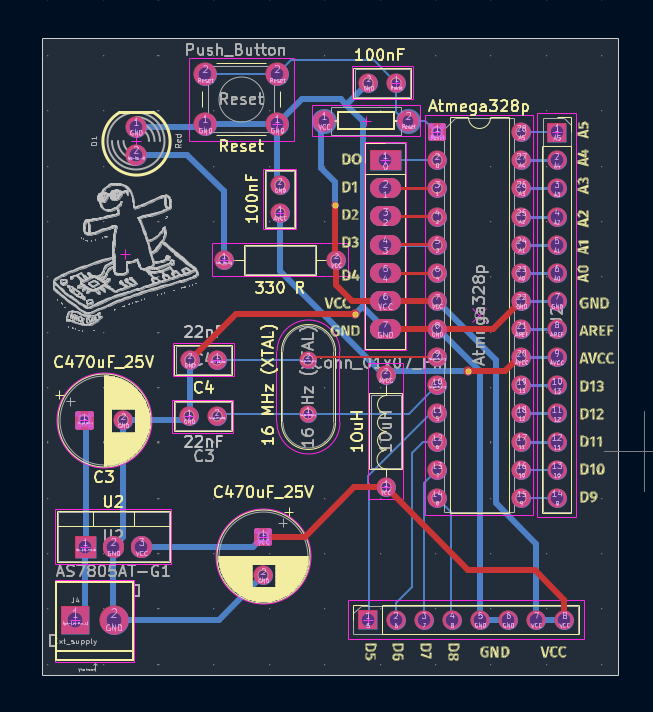
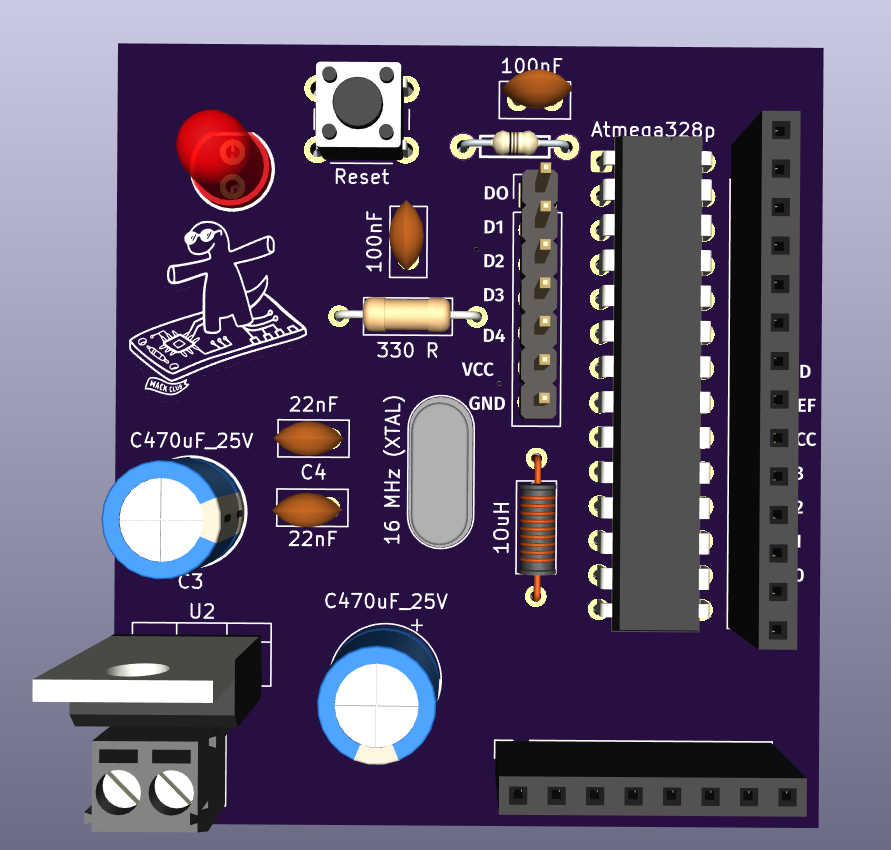 ---
## Programming
ArduCore does not contain a dedicated USB-to-Serial programmer.
Instead, another Arduino can be used as an ISP programmer.
┌───────────────────────┐
│   Arduino Programmer  │
│                       │
│     ArduinoISP        │
└───────────┬───────────┘
            │
            │ ISP
            │
            ▼
┌───────────────────────┐
│       ArduCore        │
│                       │
│     ATmega328P        │
└───────────────────────┘Programming ArduCore with Arduino ISP
Yet to be implemented
Manufacturing files are available in:
production/gerbers/The complete component list is maintained in:
production/bom/This project is submitted under the B-Tier ($25 max) hardware grant for custom development boards.
| Item | Description | Estimated Cost |
|---|---|---|
| PCB Fabrication | Custom 2-layer PCB (5 pcs) via JLCPCB | ~$2.00 |
| Shipping & Handling | Standard global shipping for manufactured PCBs | ~$10.50 |
| Component BOM | ATmega328P-PU, 16 MHz Crystal, 7805 regulator, THT passives, switches, & pin headers | ~$6.50 |
| Total Requested | $19.00 |
--- This project started with a simple question ---
"What's actually inside an Arduino?"
| Qty | Value | Footprint | References |
|---|---|---|---|
| 2 | 100nF_Ceramic | Capacitor_THT:C_Disc_D5.0mm_W2.5mm_P2.50mm | 100nF, 100nF |
| 2 | 22nF | PCM_SparkFun-Capacitor:C_0603_1608Metric | C3, C4 |
| 2 | 470uF_25V | Capacitor_THT:CP_Radial_D8.0mm_P3.50mm | C470uF_25V, C470uF_25V |
| 1 | 10k | PCM_SparkFun-Resistor:R_Axial_DIN0207_L6.3mm_D2.5mm_P7.62mm_Horizontal | R1 |
| 1 | 10uH_5x5mm_1.0A | PCM_Inductor_THT_AKL:L_Axial_L6.6mm_D2.7mm_P10.16mm_Horizontal_Vishay_IM-2 | 1OuH |
| 1 | 330 R | Resistor_THT:R_Axial_DIN0207_L6.3mm_D2.5mm_P10.16mm_Horizontal | 330 R |
| 1 | AS7805AT-G1 | Package_TO_SOT_THT:TO-220-3_Vertical | U2 |
| 1 | ATmega328P-P | Package_DIP:DIP-28_W7.62mm | Atmega328p |
| 1 | Conn_01x07_Pin | PCM_SL_Connectors:PinHeader_1x07_P2.54mm_Vertical | J1 |
| 1 | Conn_01x08_Pin | Connector_PinSocket_2.54mm:PinSocket_1x08_P2.54mm_Vertical | J3 |
| 1 | Conn_01x14_Pin | Connector_PinSocket_2.54mm:PinSocket_1x14_P2.54mm_Vertical | J2 |
| 1 | Crystal_16MHz | Crystal:Crystal_HC49-4H_Vertical | 16 MHz (XTAL) |
| 1 | Ext_supply | PCM_SparkFun-Connector:ScrewTerminal_1x02_P3.5mm_Horizontal_Black | J4 |
| 1 | LOGO | LOGO | G*** |
| 1 | Push_Button | Button_Switch_THT:SW_PUSH_6mm | Reset |
| 1 | Red | PCM_SparkFun-LED:LED_5mm_PTH_Red_Silk | D1 |

RyanHailey21/neuromorphic-retina-encoder-pcb
Hardware-accelerated neuromorphic vision encoder and closed-loop motor reflex PCB system built around the Raspberry Pi RP2040 and a 16-neuron hardware Leaky Integrate-and-Fire (LIF) analog spiking neural network.

Ace2932/Fennec
This project is a heavily modified fork of the open-source NovaSM3 quadruped, redesigned to serve as a research platform for embodied AI.


zmaker/arduino_cookbook
gli sketch del nuovo progetto Arduino Cookbook e dei video di YouTube

coseyfannitutti/discipad
17-key numpad assembled with only through hole components, including usb type-c

matthewcieplak/super-sixteen
Code and schematics for the Super Sixteen Eurorack sequencer

coseyfannitutti/romeo
Staggered 40% keyboard pcb that can be assembled with only through hole components, including USB Type-C
It measures 52 × 57.5 mm and has 2 copper layers, 1.6 mm thick.
19 parts, built around the ATMEGA328P-PU, AS7805AT-G1 and 470UF 25V. The full list of its parts is on this page, with links to each part's symbol and footprint where PCBKit's library has them.
From the urjadoshi2024etc-creator/ArduCore-Custom-Arduino-Board repository on GitHub, at the commit this page was made from: the board is pcb/ArduCore.kicad_pcb and its schematic pcb/ArduCore.kicad_sch. PCBKit opens the board in the browser, with nothing to install.
Its repository states no licence, so its author keeps all rights: ask urjadoshi2024etc-creator before reusing the design.