Skip to the content
4 layers65.4 × 53.3 mmWaterdrop esphome, the printed circuit board in 3D

Waterdrop RO system smart Wi-Fi module for Home Assistant

Size
65.4 × 53.3 mm
Copper layers
4
Thickness
1.6 mm
Parts
39
Nets
46
Pads
151
Tracks, vias
227, 30
Pours
1
Routed
Yes
KiCad
KiCad 9.0 (file 20241229)
Created
9 Jan 2026
Updated
29 Jun 2026

Overview

Waterdrop esphome is an open-source printed circuit board by twasilczyk, from the twasilczyk/waterdrop-esphome repository on GitHub, published under the MIT licence. It is a 4-layer board of 65.4 × 53.3 mm with 39 parts on 46 nets, routed with 227 tracks and 30 vias.

It is built around the 74AHCT125D, ESP32-S3-TINY and B360A, with the BC817 and SMAJ30A among its other parts. Its parts include 13 resistors, 5 connectors, 4 capacitors, 4 ICs and 3 diodes. It belongs with the home automation and IoT and radio and wireless boards and the ESP32 boards of this library.

Main components

5

README

README.md

waterdrop-esphome

Smarten Waterdrop RO systems: a plug-in Wi-Fi add-on board to integrate with Home Assistant, read hidden diagnostic parameters, and work around refrigerator line limitations.

See the story: Hacking a water filter through a 7-segment display.

[!WARNING] Use at your own risk. This is not a certified retail product, but an open-source hacking hobby project.

Features

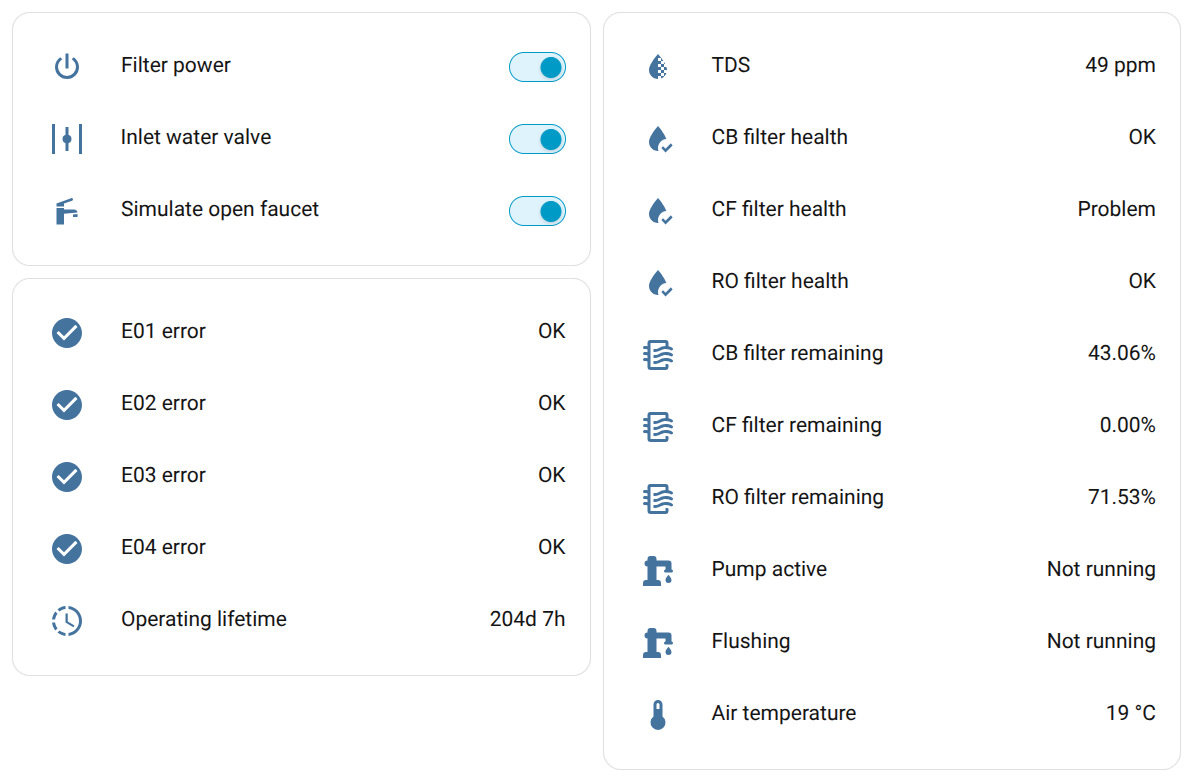
  • Reads sensors exposed by original RO unit
    • Water TDS level
    • Individual filter state: total and remaining life plus derivative sensors (life percentage, filter health warning)
    • Pump state (idle, active, flushing)
    • Error codes
    • Ambient air temperature
    • Last filter change time
    • Potentially more, as about fourteen 16-bit fields are still not reverse-engineered
  • Simulates faucet handle position (see Refrigerator line workaround)
  • Switchable power supply to the main RO unit
  • Emergency water shutoff with external latching solenoid valve

Screenshot of Home Assistant dashboard with controls and sensors

Refrigerator line workaround

Waterdrop RO water filter systems don't play particularly well with refrigerator water lines. After dispensing water from the refrigerator, the RO unit tends to switch to an erratic flush mode: briefly flushing every 5 minutes. This continues until water is dispensed from the original Waterdrop smart faucet.

The simulated faucet handle feature works around this issue. If the RO unit performs this flush attempt while the faucet is reported open, it will start a proper flush cycle and switch back to the regular 12-hour flushing interval.

Installing firmware

ESPHome Builder

Best for long-term maintenance.

  1. Define the following secrets (ESPHome Device Builder 🡒 three-dot menu 🡒 Secrets):
    • common_api_encryption_key
    • ota_password
    • wifi_ssid
    • wifi_password
  2. Create device 🡒 Advanced set up options 🡒 Empty Configuration; paste the following:
    text
    substitutions:
      branch: stable
    
    packages:
      waterdrop-esphome:
        url: https://github.com/twasilczyk/waterdrop-esphome
        ref: ${branch}
        files:
          - firmware/builder-package.yaml
  3. Install over USB at first, then you can switch to OTA
  4. If installing for the first time, don't forget to enable power to the RO system - it controlls both power supply and serial communication (with faucet as well as the main unit)

Local environment

Best for development (from terminal or VSCode).

  1. Set up ESPHome through the pip method
  2. cd path/to/repo
  3. ln -s "$HOME/path/to/your/esphome-venv" .venv
  4. Create secrets.yaml one directory up from your repo root:
    text
    wifi_ssid: "YourWiFi"
    wifi_password: "..."
    ota_password: "..."
    common_api_encryption_key: "..."

Then, you can build from terminal:

text
cd firmware
esphome run waterdrop-esphome.yaml

Or from VSCode:

  1. Ctrl+Shift+P
  2. Tasks: Run Task
  3. ESPHome: Run without debugging

Electronics

Bill of materials

RefQtyValueProductTotal cost [$]Optional
C11100µF/50V50YXJ100M8X11.50.43
C21220µF/16V25YXJ220M6.3X110.31
C3122nFCL21B223KBANFNC0.10
C41100nFCL21B104KBCNNNC0.10
D11SMAJ30ASMAJ30A0.22
D21B360AB360A-13-F0.51
D311N41481N4148W-7-F0.17Yes (relay)
F11500mA0PTF0078P + 0217.500MXP1.35
J11DC5525 mPJ-002B0.66
J21DC5525 f10-029503.17Yes (relay)
J31Waterdrop0.00
J415pin 2.54PH1RB-05-UA0.15
J512pin 2.54PH1RB-02-UA0.10Yes (valve)
K11SPDT 24VG5LE-1-E DC242.74Yes (relay)
L1133µH12RS333C1.35
L211µHMLZ2012A1R0WT0000.10
Q11BC817BC817-40-7-F0.23Yes (relay)
R113.6k08050.10
R211.2k08050.10
R3,R11210k08050.20R3 (relay)
R4147k08050.10Yes (relay)
R5,R6,R9,R134100k08050.40R13 (valve)
R7,R10,R12351k08050.30R12 (valve)
R1411Ω08050.10Yes (valve)
U11LM2596DS-ADJLM2596DSADJG2.34
U21ESP32-S3-TinyESP32-S3-Tiny-Kit11.99
U3174AHCT125SN74AHCT125QDRQ10.70
U41TB67H450ATB67H450AFNG0.85Yes (valve)
3428.8721.11 w/o

Inlet water valve

Inlet water valve is an emergency shutoff valve for inlet water in case other components of your smart home detected a leak. However, I haven't had much luck finding one exactly matching my requirements:

  • Latching/pulse/bistable, so it doesn't take constant load (if Normally Closed) or wouldn't unintentionally re-open water flow in case of power loss (if Normally Open).
  • 3/8" Push-Fit connection to match RO system tubing.
  • Ideally 24V, to directly accept RO power supply voltage.
  • Reasonably priced.

A close one is SDF-S209B-24V, priced at $3.65 - but requires two G1/2 to Push-Fit 3/8 adapters. 24V latching solenoids are the only supported type of external inlet valves.

Parts

39
QtyValueFootprintReferences
4100kResistor_SMD:R_0805_2012Metric_Pad1.20x1.40mm_HandSolderR5, R6, R9, R13
351kResistor_SMD:R_0805_2012Metric_Pad1.20x1.40mm_HandSolderR7, R10, R12
210kResistor_SMD:R_0805_2012Metric_Pad1.20x1.40mm_HandSolderR3, R11
2MountingHoleMountingHole:MountingHole_3.2mm_M3H3, H4
11.2kResistor_SMD:R_0805_2012Metric_Pad1.20x1.40mm_HandSolderR2
1100nFCapacitor_SMD:C_0805_2012Metric_Pad1.18x1.45mm_HandSolderC4
1100µF/50VCapacitor_THT:CP_Radial_D8.0mm_P3.50mmC1
11N4148Diode_SMD_extra:D_SOD-123_HandsolderingD3
11µHInductor_SMD:L_0805_2012Metric_Pad1.15x1.40mm_HandSolderL2
11ΩResistor_SMD:R_0805_2012Metric_Pad1.20x1.40mm_HandSolderR14
1220µF/16VCapacitor_THT:CP_Radial_D6.3mm_P2.50mmC2
122nFCapacitor_SMD:C_0805_2012Metric_Pad1.18x1.45mm_HandSolderC3
124V_INConnector_BarrelJack:BarrelJack_HorizontalJ1
124V_OUTConnector_Wire:SolderWire-1.5sqmm_1x02_P6mm_D1.7mm_OD3mm_ReliefJ2
124V_OUT_RELIEFMountingHole_extra:MountingHole_4.3mmH1
13.6kResistor_SMD:R_0805_2012Metric_Pad1.20x1.40mm_HandSolderR1
133µHInductor_THT_updated:L_Radial_D10.5mm_P4.00x5.00mm_Murata_1200RSL1
147kResistor_SMD:R_0805_2012Metric_Pad1.20x1.40mm_HandSolderR4
1500mAFuse:Fuseholder_Cylinder-5x20mm_Stelvio-Kontek_PTF78_Horizontal_OpenF1
15VJumper:SolderJumper-2_P1.3mm_Bridged_Pad1.0x1.5mmJP1
174AHCT125Package_SO:SOIC-14_3.9x8.7mm_P1.27mmU3
1B360ADiode_SMD:D_SMA_HandsolderingD2
1BC817Package_TO_SOT_SMD:SOT-23_HandsolderingQ1
1Comm_FaucetConnector_PinHeader_2.54mm:PinHeader_1x05_P2.54mm_HorizontalJ4
1Comm_ROConnector_Wire:SolderWire-0.25sqmm_1x04_P4.2mm_D0.65mm_OD1.7mm_ReliefJ3
1Comm_RO_RELIEFMountingHole_extra:MountingHole_4.3mmH2
1ESP32-S3-TinyRF_Module_extra:ESP32-S3-TINY-SMDU2
1G5LE-1-E DC24Relay_THT:Relay_SPDT_Omron-G5LE-1K1
1LM2596DS-ADJPackage_TO_SOT_SMD:TO-263-5_TabPin3U1
1SMAJ30ADiode_SMD:D_SMA_HandsolderingD1
1TB67H450APackage_SO:SOIC-8-1EP_3.9x4.9mm_P1.27mm_EP2.29x3mm_ThermalViasU4
1ValveConnector_PinHeader_2.54mm:PinHeader_1x02_P2.54mm_HorizontalJ5

Similar boards

  • 2 layers150 × 70 mmHydrogen - bakalarka, the printed circuit board in 3D

    Hydrogen - bakalarka

    Jed0vcela/Gas-Flow-Control-and-Logging-System

    Mass flow control and data acquisition platform based on Raspberry Pi Pico. Supports dual MFC control via RS-232, analog sensing (pressure, temperature, voltage), USB communication, and local button interface.

    77 parts
  • 2 layers43.8 × 31.8 mmCbp, the printed circuit board in 3D

    Cbp

    0x007E/cbp

    CAN-Bus Power

    34 parts
  • 2 layers92.7 × 62.2 mmMgc, the printed circuit board in 3D

    Mgc

    0x007E/mgc

    MeGARCard - Development Platform

    121 parts
  • 4 layers230 × 135 mmVancontroller, the printed circuit board in 3D

    Vancontroller

    Camperlux/vancontroller

    VanController: ESP32-S3 12 V campervan controller board (6 fused relays, 6 PWM dimmers, CAN, RS485, GPS) - KiCad 10 design, manufacturing files and enclosure. Free for non-commercial use.

    259 parts
  • 4 layers150 × 155 mmUsb console server, the printed circuit board in 3D

    Usb console server

    TheKingOfChaos/Console-Server

    48 RS-232 console ports on one Raspberry Pi: three identical boards, 16 ports each. Built from the design record of 2026-10-10. KiCad 10.0.7. This is Rev B (git tag rev-A is the first board).

    361 parts
  • 4 layers120 × 76 mmPanel, the printed circuit board in 3D

    Panel

    vbartusevicius/weather-station

    Open-source rooftop weather and air-quality station with no moving parts (Ø 96 × 235 mm, UV-stabilised ASA): ultrasonic wind, acoustic rain and hail, UV / sunlight / night-sky brightness, temperature, humidity…

    235 parts
  • 2 layers99.5 × 99.5 mmBalancer, the printed circuit board in 3D

    Balancer

    kwiecinski/BMS-and-offgrid-photovoltaic-management-system

    Project contains BMS for lead-acid batteries and ESP-based board used to pull information from EASUN offgrid inverter, energy meters and sensors.

    173 parts3MIT

Questions

How big is the Waterdrop esphome PCB?

It measures 65.4 × 53.3 mm and has 4 copper layers, 1.6 mm thick.

What parts does the Waterdrop esphome use?

39 parts, built around the 74AHCT125D, ESP32-S3-TINY, B360A and BC817. The full list of its parts is on this page, with links to each part's symbol and footprint where PCBKit's library has them.

Where can I download the Waterdrop esphome KiCad files?

From the twasilczyk/waterdrop-esphome repository on GitHub, at the commit this page was made from: the board is electronics/waterdrop-esphome/waterdrop-esphome.kicad_pcb and its schematic electronics/waterdrop-esphome/power.kicad_sch. PCBKit opens the board in the browser, with nothing to install.

Can I use the Waterdrop esphome design in my own project?

Its repository publishes it under the MIT licence: you may reuse it on that licence's terms (keep the author's notice, and for a copyleft licence share your changes alike).