2 layers174.5 × 126.3 mm
 Tsquash/AirQualityMonitor
AQM is an ESP32-C6-based, Matter compatible, indoor air-quality monitor. It measures carbon dioxide, temperature, humidity, VOC, and NOx, displays the latest readings on an e-paper display, and publishes its…
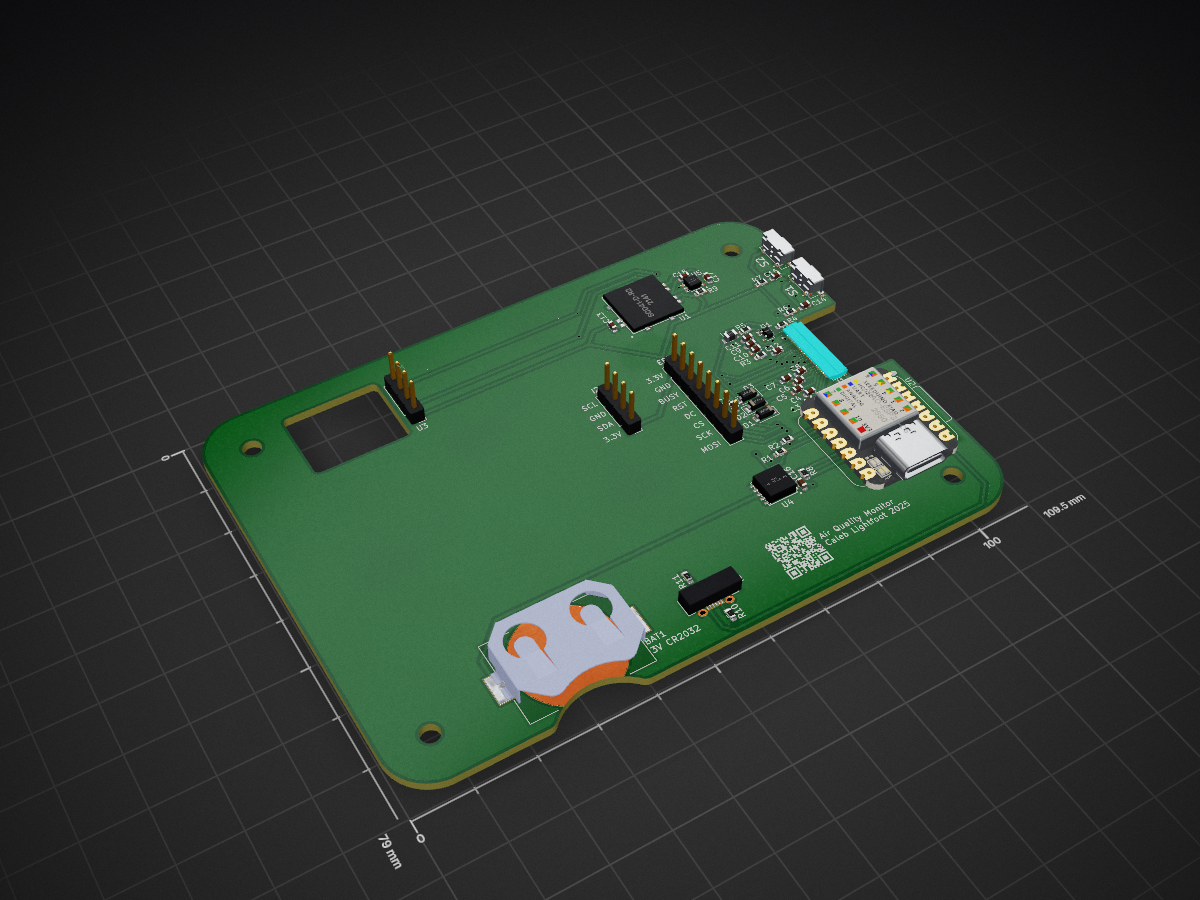
AirQuality is an open-source printed circuit board by Tsquash, from the Tsquash/AirQualityMonitor repository on GitHub, published under the Apache-2.0 licence. It is a 4-layer board of 109.5 × 79 mm with 47 parts on 56 nets, routed with 399 tracks and 50 vias.
It is built around the DHT20, SGP41-D-R4 and MAX31328NELB+T, with the SCD41-D-R2, TL3330AF260QG and BAT-HLD-001 among its other parts. Its parts include 18 capacitors, 11 resistors, 5 ICs, 4 connectors and 3 diodes. It belongs with the sensors and measurement and radio and wireless boards and the ESP32 and RISC-V boards of this library.


AQM is an ESP32-C6-based, Matter compatible, indoor air-quality monitor. It measures carbon dioxide, temperature, humidity, VOC, and NOx, displays the latest readings on an e-paper display, and publishes its measurements through Matter over Wi-Fi. It can also pair with the companion PM sensor particle over Bluetooth Low Energy (BLE) to add PM2.5 and PM10 measurements to its existing Matter endpoint.
The primary pin assignments are defined in
main/sense.cpp, main/screen.cpp, and
main/buttons.h:
| Signal | GPIO |
|---|---|
| I2C SDA | 22 |
| I2C SCL | 23 |
| RTC interrupt | 2 |
| E-paper MOSI | 18 |
| E-paper SCK | 19 |
| E-paper chip select | 17 |
| E-paper data/command | 21 |
| E-paper reset | 20 |
| Top button | 0 |
| Bottom button | 1 |
The AQM is a Matter-over-Wi-Fi device and requires a 2.4 GHz Wi-Fi network and a Matter controller. On an uncommissioned device, the display shows the Matter QR code and manual pairing code. Scan the QR code with a Matter-compatible controller app and complete the app's setup flow for Matter devices. This project uses Matter development credentials and is not Matter-certified, so the controller may ask for confirmation before adding it. Although all devices have the same pairing code, multiple AQM devices on one network is tested working.
After commissioning, the AQM obtains local time over the network. It determines
the UTC offset from https://ipapi.co/utc_offset/, synchronizes system time with
pool.ntp.org, writes that time to the MAX31328 RTC, and attempts another RTC
sync once per hour. The hourly sync re-queries the current UTC offset, and supports DST.
If the RTC already contains valid time, the local display can continue operating
before Matter commissioning completes.
The SGP41 is sampled once per second to maintain the VOC and NOx gas-index algorithms. Ten seconds before each minute, the RTC wakes the firmware to take new DHT20 and SCD41 readings, finalize any PM reading received for that minute, update the Matter attributes, and append CO2, VOC, and NOx values to the 60-sample history. At the start of the next minute, the active display page is redrawn.
The main page shows the date, time, temperature, relative humidity, CO2, VOC,
NOx, and the overall air-quality level. The second page graphs the most recent
60 one-minute CO2, VOC, and NOx readings. The display performs a full refresh at
:00 and :30 each hour and uses partial refreshes between them.
The AQM can pair with the companion Matter PM sensor over BLE.
Put both devices into pairing mode and keep them nearby:
Pairing with PM.Pairing Successful. Both pairing windows last up to 120 seconds.The devices discover and authenticate each other automatically. If either device displays Pairing Timed Out, put both devices back into pairing mode and retry with them nearby.
On success, the PM peer is saved in non-volatile storage and the AQM reconnects
to it automatically on later boots.
The AQM sends its RTC time and measurement schedule to the PM sensor. The PM sensor returns one-minute PM1.0, PM2.5, and PM10 averages, which the AQM exposes through Matter. If the BLE connection is interrupted, the AQM retains the last PM reading for up to three missed minutes and clears it after the fourth. All other AQM sensing and display functions continue without a linked PM sensor.
| Button | GPIO | At boot | During operation |
|---|---|---|---|
| Top | 0 | Erase the complete NVS partition, including Matter commissioning, Wi-Fi credentials, and the saved PM peer | No action |
| Bottom | 1 | Enter PM-pairing mode and replace the previously saved PM peer after successful pairing | Change display page |
A boot action requires the button to be held continuously for at least one second during the two-second startup check. Factory reset takes priority if both buttons are held. After a factory reset, the device restarts and displays its Matter commissioning screen.
The AQM measures or receives the following values:
µg/m³. That displayed unit is incorrect:
the numeric values are still unitless VOC and NOx indices and must not be
interpreted as physical concentrations.The overall air-quality value is the worst of the current CO2, VOC, NOx, PM1.0, PM2.5, and PM10 bands. It is reported as Good, Fair, Moderate, Poor, Very Poor, or Extremely Poor.
Install PlatformIO and the Espressif platform dependencies, connect the XIAO ESP32-C6, then run these commands from the project directory:
pio run -e esp32c6
pio run -e esp32c6 -t upload
pio device monitor -b 115200
The PlatformIO environment is defined in platformio.ini.
The project uses the Arduino and ESP-IDF frameworks and is configured for the
seeed_xiao_esp32c6 board. Serial diagnostics run at 115200 baud. Upload-port
selection may need to be configured for the host computer. A clean or first
compile can take 10 minutes or longer while PlatformIO builds the ESP-IDF and
Matter dependencies, but later incremental builds are faster since the build is cached.
lib/Max31328RTC is a local fork of Analog Devices'
MAX31328 Arduino Driver.
The upstream library did not work unchanged with the ESP32-C6, so this fork:
Wire.begin()
from the RTC constructor, which would initialize the bus before the AQM
assigns its SDA and SCL pins;Wire.write() overload, fixing the compile error; andThe upstream driver is licensed under Apache-2.0, which permits modification
and redistribution. The fork retains the upstream copyright and modification
notices and includes the complete license at
lib/Max31328RTC/LICENSE.txt.
The original firmware, PCB and schematic files, manufacturing files, enclosure files, UI assets, and documentation in this repository are available under the Apache License 2.0. You may use, modify, manufacture from, and share, the original or modified project, provided that you follow the license terms :)
main/                  Firmware source, embedded display assets, and component config
  myBitmap/            Embedded monochrome display bitmaps
  myFont/              Embedded Adafruit GFX fonts
lib/                   Project-local libraries, including the altered MAX31328 driver
KICAD/                 PCB schematic, layout, symbols, and footprints
Production/            Manufacturing BOMs and Gerber archive
2D/                    Enclosure and PCB cutout drawings
3D/                    Board, spacer, and enclosure models
UI/                    Display mockups, fonts, and bitmaps
.vscode/               VS Code project configuration
platformio.ini         PlatformIO build environment
LICENSE                Apache License 2.0 project license
sdkconfig.defaults.*   ESP-IDF default configurations
huge_app.csv           ESP-IDF flash partition table
The primary firmware files are:
main/main.cpp: boot flow, Matter startup, scheduling, and
the main loopmain/sense.cpp: sensor initialization and sampling, gas
indices, RTC alarms, network time, and overall air-quality calculationmain/screen.cpp: e-paper initialization, status screens,
measurement pages, and history graphsmain/buttons.cpp: boot-hold detection and display-page
button handlingmain/matter_air_quality_sensor.cpp:
Matter endpoint, measurement clusters, and attribute updatesmain/pm_link.cpp: BLE PM pairing, reconnection, timing,
and PM-reading receptionmain/pm_protocol.h: BLE data structures shared with
the companion PM project[Time] or [RTC] errors.| Qty | Value | Footprint | References |
|---|---|---|---|
| 10 | 1uF | Capacitor_SMD:C_0603_1608Metric | C1, C3, C4, C5, C6, C7, C8, C10, C12, C16 |
| 3 | 1N5819 | Diode_SMD:D_SOD-123 | D1, D2, D3 |
| 2 | 100K | Resistor_SMD:R_0603_1608Metric | R6, R7 |
| 2 | 1µF | Capacitor_SMD:C_0603_1608Metric | C17, C18 |
| 2 | 220nF | Capacitor_SMD:C_0603_1608Metric | C14, C15 |
| 2 | 4.7K | Resistor_SMD:R_0603_1608Metric | R1, R2 |
| 2 | 4.7uF | Capacitor_SMD:C_0603_1608Metric | C2, C11 |
| 2 | 5.1K | Resistor_SMD:R_0603_1608Metric | R10, R11 |
| 2 | TL3330AF260QG | AirQualityFootprints:SW_TL3330AF260QG | S1, S2 |
| 1 | 0 | Resistor_SMD:R_0603_1608Metric | R3 |
| 1 | 0.47 | Resistor_SMD:R_0603_1608Metric | R4 |
| 1 | 100nF | Capacitor_SMD:C_0603_1608Metric | C9 |
| 1 | 10K | Resistor_SMD:R_0603_1608Metric | R8 |
| 1 | 10K/0 | Resistor_SMD:R_0603_1608Metric | R5 |
| 1 | 10uF | Capacitor_SMD:C_0603_1608Metric | C13 |
| 1 | 4.7Ω | Resistor_SMD:R_0603_1608Metric | R9 |
| 1 | 68uH | Inductor_SMD:L_0805_2012Metric | L1 |
| 1 | BAT-HLD-001 | AirQualityFootprints:BAT_BAT-HLD-001 | BAT1 |
| 1 | Conn_01x08_Socket | Connector_PinHeader_2.54mm:PinHeader_1x08_P2.54mm_Vertical | J4 |
| 1 | DHT20 | Connector_PinHeader_2.54mm:PinHeader_1x04_P2.54mm_Vertical | U3 |
| 1 | FH34SRJ-24S-0.5SH_50_ | AirQualityFootprints:HRS_FH34SRJ-24S-0.5SH_50_ | J1 |
| 1 | I2C Test | Connector_PinHeader_2.54mm:PinHeader_1x04_P2.54mm_Vertical | J3 |
| 1 | LOGO | AirQualityFootprints:AQ-QR | G*** |
| 1 | MAX31328NELB+T | AirQualityFootprints:21-0140AK_L1055M-1_MXM | U4 |
| 1 | SCD41-D-R2 | AirQualityFootprints:QFN20_SCD41-D-R2_SEN | U1 |
| 1 | SGP41-D-R4 | AirQualityFootprints:XDCR_SGP41-D-R4 | U5 |
| 1 | Si1308EDL | Package_TO_SOT_SMD:SOT-323_SC-70 | Q1 |
| 1 | UJ20-C-V-C-1-SMT-TR | AirQualityFootprints:CUI_UJ20-C-V-C-1-SMT-TR | J2 |
| 1 | XIAO-ESP32-C6 | AirQualityFootprints:XIAO-ESP32C6-DIP | U2 |

Accessibilita/recline-controls
Hardware project for open source wheel chair recline control electronics


EOSCogniton/ELIZ-2022
Le Git Artemiz de l'EPSA. Contient le Catia, ainsi que la documentation en cours et quelques modèles.

oomlout/oomlout_oomp_project_bot_v_2

Thaddeus-Maximus/dotclock
An ESP32-based alarm clock with a dot matrix LED display, rotary encoder interface, MP3 audio playback, and a web configuration UI.

pushtiujeniya/esp32-c6-environmental-logger
This repository contains an Environmental Sensor Station and Data Logger powered by the ESP32-C6-WROOM-1 microcontroller.

aleemacc/air_quality_sensor
PCB design for a custom air quality measuring device
It measures 109.5 × 79 mm and has 4 copper layers, 1.6 mm thick.
47 parts, built around the DHT20, SGP41-D-R4, MAX31328NELB+T and SCD41-D-R2. The full list of its parts is on this page, with links to each part's symbol and footprint where PCBKit's library has them.
From the Tsquash/AirQualityMonitor repository on GitHub, at the commit this page was made from: the board is KICAD/AirQuality.kicad_pcb and its schematic KICAD/AirQuality.kicad_sch. PCBKit opens the board in the browser, with nothing to install.
Its repository publishes it under the Apache-2.0 licence: you may reuse it on that licence's terms (keep the author's notice, and for a copyleft licence share your changes alike).