4 layers85 × 56 mm
Lobby
oclyke/cm4crypto
cm4crypto is an adapter board that allows you to use an M-Key M.2 compatible module with the Raspberry Pi Compute Module 4 (cm4).
41 parts

 tseary/Sergo1
RC Servo controller for Lego Power Functions
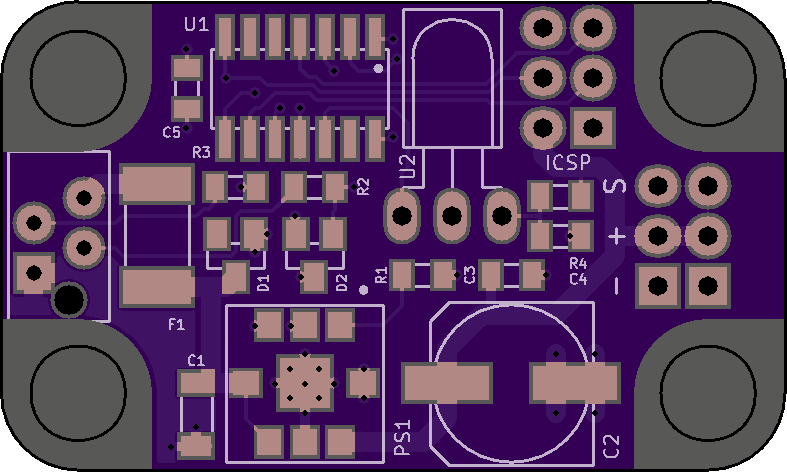
Sergo is an open-source printed circuit board by tseary, from the tseary/Sergo repository on GitHub. It is a 2-layer board of 39.8 × 23.8 mm with 20 parts on 20 nets, routed with 223 tracks and 38 vias.
It is built around the MYLSM00502ERPL and TSOP38238. Its parts include 5 capacitors, 4 resistors, 3 connectors, 2 ICs and 2 diodes. It belongs with the AVR (ATmega, ATtiny) boards of this library.


Sergo is a custom circuit board I made to interface hobby servos (or Geek servos) with Lego Power Functions. It has an ATTINY84 microcontroller and a 5 V, 2.5 A buck converter. It supports up to two servos, and can be controlled either from a PF receiver or directly by IR remote. It is programmed in Arduino.
Disclaimer: This is not a how-to guide. I have shared this project for general interest and in case the source code is useful to anyone. However, if you want to make your own Sergo, I am assuming you already have some knowledge of surface-mount soldering. You will need reflow soldering materials and equipment. This project cannot be assembled with only a soldering iron!
The bare PCB without components can be ordered from OSH Park.
Here is a Digikey cart with all of the components. The cost of parts for one board is about $15.61 CAD (or $13.92 CAD if the IR receiver is omitted).
It is recommended to apply solder paste to the board with a stencil. I used a polyimide film stencil of 0.005" thickness from OSH Stencils. The stencil gerber file is "KiCad/gerbers/Sergo-F_Paste.gbr". Alternatively, solder paste may be applied freehand with a syringe. Particular care should be taken to apply the paste neatly under the buck converter PS1.
More details to come...
If you do attempt to build this project, I'd like to see it! Find me on Eurobricks.
| Qty | Value | Footprint | References |
|---|---|---|---|
| 3 | 0.1uF | Custom_Library:0805 | C3, C4, C5 |
| 2 | 10k | Custom_Library:0805 | R2, R3 |
| 1 | 1.5A | Custom_Library:1812 | F1 |
| 1 | 15V | Custom_Library:SOT-23_Diode_ANK | D1 |
| 1 | 1k | Custom_Library:0805 | R1 |
| 1 | 220uF 10V | Custom_Library:C_SMT_D8 | C2 |
| 1 | 33 | Custom_Library:0805 | R4 |
| 1 | 47uF | Custom_Library:1206 | C1 |
| 1 | ATTINY84-S | Custom_Library:SOIC-14 | U1 |
| 1 | CH1 | Custom_Library:0805_JUMPER | JP1 |
| 1 | CH2 | Custom_Library:0805_JUMPER | JP2 |
| 1 | ICSP | Custom_Library:Pin_Header_02x03 | P2 |
| 1 | MYLSM00502ERPL | Custom_Library:DC-DC_MYLSM00502ERPL | PS1 |
| 1 | POWER FUNCTIONS | Custom_Library:Conn_Micro-MaTch_215570-4 | P1 |
| 1 | SERVOS | Custom_Library:Pin_Header_02x03 | P3 |
| 1 | TSOP38238 | Custom_Library:TSOP382_RA | U2 |
| 1 | ZENER 4.3V | Custom_Library:SOT-23 | D2 |
It measures 39.8 × 23.8 mm and has 2 copper layers, 1.6 mm thick.
20 parts, built around the MYLSM00502ERPL and TSOP38238. The full list of its parts is on this page, with links to each part's symbol and footprint where PCBKit's library has them.
From the tseary/Sergo repository on GitHub, at the commit this page was made from: the board is KiCad/Sergo.kicad_pcb. PCBKit opens the board in the browser, with nothing to install.
Its repository states no licence, so its author keeps all rights: ask tseary before reusing the design.
oclyke/cm4crypto
cm4crypto is an adapter board that allows you to use an M-Key M.2 compatible module with the Raspberry Pi Compute Module 4 (cm4).


ajvizganapathy-pixel/FlipperZero-DIY-STM32WB55-NucleusDark
DIY Flipper Zero clone using STM32WB55CGU6 — KiCad PCB, Momentum firmware, 200+ apps, BadUSB scripts, wiring diagrams

CmdrZin/chips_avr_examples
AVR assembly and C code for robotics and other projects.


keener2u/CoinPCB
Simple ESP8266 breakout board shaped like a challenge coin. Built to be a hackable extendable board for IOT projects and given out for recognition and to spark staff's imagination.

Accessible-AAC/AAC-Devices
Augmentative and alternative communications device design files based on inexpensive and open source technologies.