2 layers92 × 84 mm
 todo-assert/project.pcb
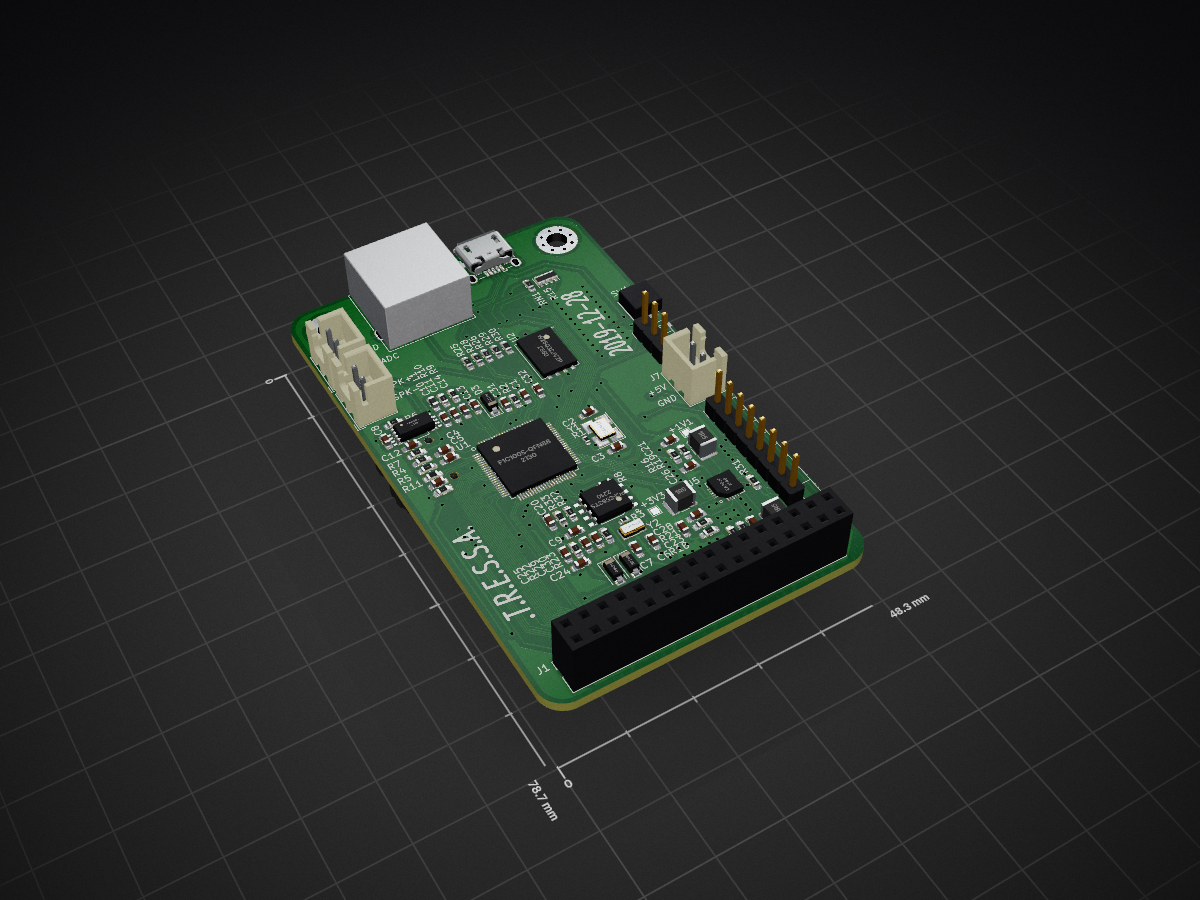
F1C100s i80 is an open-source printed circuit board by todo-assert, from the todo-assert/project.pcb repository on GitHub, published under the MIT licence. It is a 2-layer board of 48.3 × 78.7 mm with 88 parts on 112 nets, routed with 1,334 tracks and 145 vias.
It is built around the LN4990MM-G, W25Q32JVZPIQ and EA3036QDR, with the PCF8563TS/5 among its other parts. Its parts include 29 resistors, 28 capacitors, 9 connectors, 5 ICs and 4 inductors.


| Qty | Value | Footprint | References |
|---|---|---|---|
| 12 | 1uF | Capacitor_SMD:C_0603_1608Metric_Pad1.05x0.95mm_HandSolder | C4, C5, C8, C9, C11, C13, C14, C20, C24, C25, C31, C32 |
| 5 | 22R | Resistor_SMD:R_0603_1608Metric_Pad1.05x0.95mm_HandSolder | R14, R25, R26, R28, R29 |
| 4 | 0.1uF | Capacitor_SMD:C_0603_1608Metric_Pad1.05x0.95mm_HandSolder | C10, C26, C27, C28 |
| 4 | 100K | Resistor_SMD:R_0603_1608Metric_Pad1.05x0.95mm_HandSolder | R16, R19, R22, R23 |
| 4 | 4K7 | Resistor_SMD:R_0603_1608Metric_Pad1.05x0.95mm_HandSolder | R2, R8, R32, R33 |
| 3 | 1.5uH | Inductor_SMD:L_1210_3225Metric | L2, L3, L4 |
| 3 | 100nF | Capacitor_SMD:C_0603_1608Metric_Pad1.05x0.95mm_HandSolder | C17, C29, C30 |
| 3 | 10uF | Capacitor_SMD:C_0603_1608Metric_Pad1.05x0.95mm_HandSolder | C21, C22, C23 |
| 3 | 1N4149 | Diode_SMD:D_SOD-123 | D1, D2, D3 |
| 3 | 20K | Resistor_SMD:R_0603_1608Metric_Pad1.05x0.95mm_HandSolder | R4, R5, R7 |
| 2 | 0R | Resistor_SMD:R_0603_1608Metric_Pad1.05x0.95mm_HandSolder | R11, R30 |
| 2 | 12pF | Capacitor_SMD:C_0603_1608Metric_Pad1.05x0.95mm_HandSolder | C2, C3 |
| 2 | 1M | Resistor_SMD:R_0402_1005Metric | R1, R3 |
| 2 | 200K | Resistor_SMD:R_0603_1608Metric_Pad1.05x0.95mm_HandSolder | R9, R10 |
| 2 | 22pF | Capacitor_SMD:C_0603_1608Metric_Pad1.05x0.95mm_HandSolder | C6, C7 |
| 2 | 47K | Resistor_SMD:R_0603_1608Metric_Pad1.05x0.95mm_HandSolder | R15, R17 |
| 2 | M3 | MountingHole:MountingHole_3.2mm_M3_Pad_Via | M3, M3 |
| 1 | +1V2 | TestPoint:TestPoint_Pad_1.0x1.0mm | +1V1 |
| 1 | +2V5 | TestPoint:TestPoint_Pad_1.0x1.0mm | +2V5 |
| 1 | +3V3 | TestPoint:TestPoint_Pad_1.0x1.0mm | +3V3 |
| 1 | 10K | Resistor_SMD:R_0603_1608Metric_Pad1.05x0.95mm_HandSolder | R6 |
| 1 | 110K | Resistor_SMD:R_0603_1608Metric_Pad1.05x0.95mm_HandSolder | R18 |
| 1 | 152K | Resistor_SMD:R_0603_1608Metric_Pad1.05x0.95mm_HandSolder | R20 |
| 1 | 1K | Resistor_SMD:R_0603_1608Metric_Pad1.05x0.95mm_HandSolder | R31 |
| 1 | 1nF | Capacitor_SMD:C_0603_1608Metric_Pad1.05x0.95mm_HandSolder | C12 |
| 1 | 220pF | Capacitor_SMD:C_0603_1608Metric_Pad1.05x0.95mm_HandSolder | C1 |
| 1 | 24MHz | Crystal:Crystal_SMD_SeikoEpson_TSX3225-4Pin_3.2x2.5mm_HandSoldering | Y1 |
| 1 | 2KΩ 100MHz | Inductor_SMD:L_0603_1608Metric_Pad1.05x0.95mm_HandSolder | L1 |
| 1 | 32.768KHz | Crystal:Crystal_SMD_3215-2Pin_3.2x1.5mm | Y2 |
| 1 | 47K | Resistor_SMD:R_Cat16-4 | RN1 |
| 1 | 510K | Resistor_SMD:R_0603_1608Metric_Pad1.05x0.95mm_HandSolder | R21 |
| 1 | Battery | qmechanics:CR1220-2 | BT1 |
| 1 | EA3036 | qchip:EA3036-QFN-20_EP_3.55x3.55_Pitch0.4mm | U5 |
| 1 | F1C100S-QFN88 | qchip:F1C100S-QFN-88_EP_10x10_Pitch0.4mm_Handsoldering | U1 |
| 1 | Key Export | Connector_PinHeader_2.54mm:PinHeader_1x08_P2.54mm_Horizontal | J2 |
| 1 | LCD_I8080_CONNECTOR_16x2-DIP | Connector_PinSocket_2.54mm:PinSocket_2x16_P2.54mm_Vertical | J1 |
| 1 | LN4990 | qchip:LN4990E-MSOP-8 | U4 |
| 1 | LRADC | Connector_JST:JST_XH_B2B-XH-A_1x02_P2.50mm_Vertical | J4 |
| 1 | Micro_SD_Card | qconnectors:TF-015 | J8 |
| 1 | PCF8563TS | qchip:PCF8563-SO8 | U3 |
| 1 | Power | Connector_JST:JST_XH_B2B-XH-A_1x02_P2.50mm_Vertical | J7 |
| 1 | SPK | Connector_JST:JST_XH_B2B-XH-A_1x02_P2.50mm_Vertical | J3 |
| 1 | SW_Push | qmechanics:SW-Button-TS-018 | SW1 |
| 1 | UART | Connector_PinHeader_2.54mm:PinHeader_1x03_P2.54mm_Horizontal | J5 |
| 1 | USB_A | qconnectors:USB-AF90 | J9 |
| 1 | USB_B_Micro | Connector_USB:USB_Micro-B_Wuerth_629105150521 | J10 |
| 1 | W25Q32JVZP | qchip:GD5F1GQ4xBxIG_Handsoldering | U2 |


adlerweb/uPoff
Small circuit/library to shut down a µC to save power for battery powered applications

balmerdx/AllwinnerV3S_KiCad
Its a cheap "single board computer". Closest analogue Lichee PI.


Thecactusman0/Nebula-openwatch
Nebula is a ESP32 based smartwatch that features a rotating bezel encoder

TreeNewbeer/Coonix
Coonix is a funny project about building a application platform in Allwinner-v3s processor.

naguirre/mds-builder
The Manufacture du Son network player is a custom board built around an Allwinner f1c200s SoC running Linux and an ESP32-C3 companion chip providing Wi-Fi and BLE. Audio is routed out over SPDIF.

vrubel/indicator-fun-V3s
"indicator.fun" device implementation on the processor Allwinner V3s
It measures 48.3 × 78.7 mm and has 2 copper layers, 1.6 mm thick.
88 parts, built around the LN4990MM-G, W25Q32JVZPIQ, EA3036QDR and PCF8563TS/5. The full list of its parts is on this page, with links to each part's symbol and footprint where PCBKit's library has them.
From the todo-assert/project.pcb repository on GitHub, at the commit this page was made from: the board is KiCAD/F1C100s-i80/F1C100s-i80/F1C100s-i80.kicad_pcb. PCBKit opens the board in the browser, with nothing to install.
Its repository publishes it under the MIT licence: you may reuse it on that licence's terms (keep the author's notice, and for a copyleft licence share your changes alike).