
2 layers130.4 × 76.6 mm
Gb stream cart
Staacks/gbinterceptor
Capture or stream Game Boy gameplay footage via USB without modifying the Game Boy.
80 parts542

CoPiCo PCB KiCad
Copico is an open-source printed circuit board by thomasshanks, from the thomasshanks/copico-board repository on GitHub, published under the MIT licence. It is a 2-layer board of 100 × 96 mm with 55 parts on 115 nets, routed with 2,324 tracks and 341 vias.
It is built around the SN74LVC245AN, 74LS133PC and SN74LVC4245APW. Its parts include 12 capacitors, 9 ICs, 5 connectors, 4 resistors and 1 diode. It belongs with the RP2040 boards of this library.


The CoPiCo is a cartridge for the Tandy Color Computer that adds WiFi to and serves as a boot ROM for the system. It is based on the Raspberry Pi Pico W microcontroller dev board, which includes onboard WiFi.
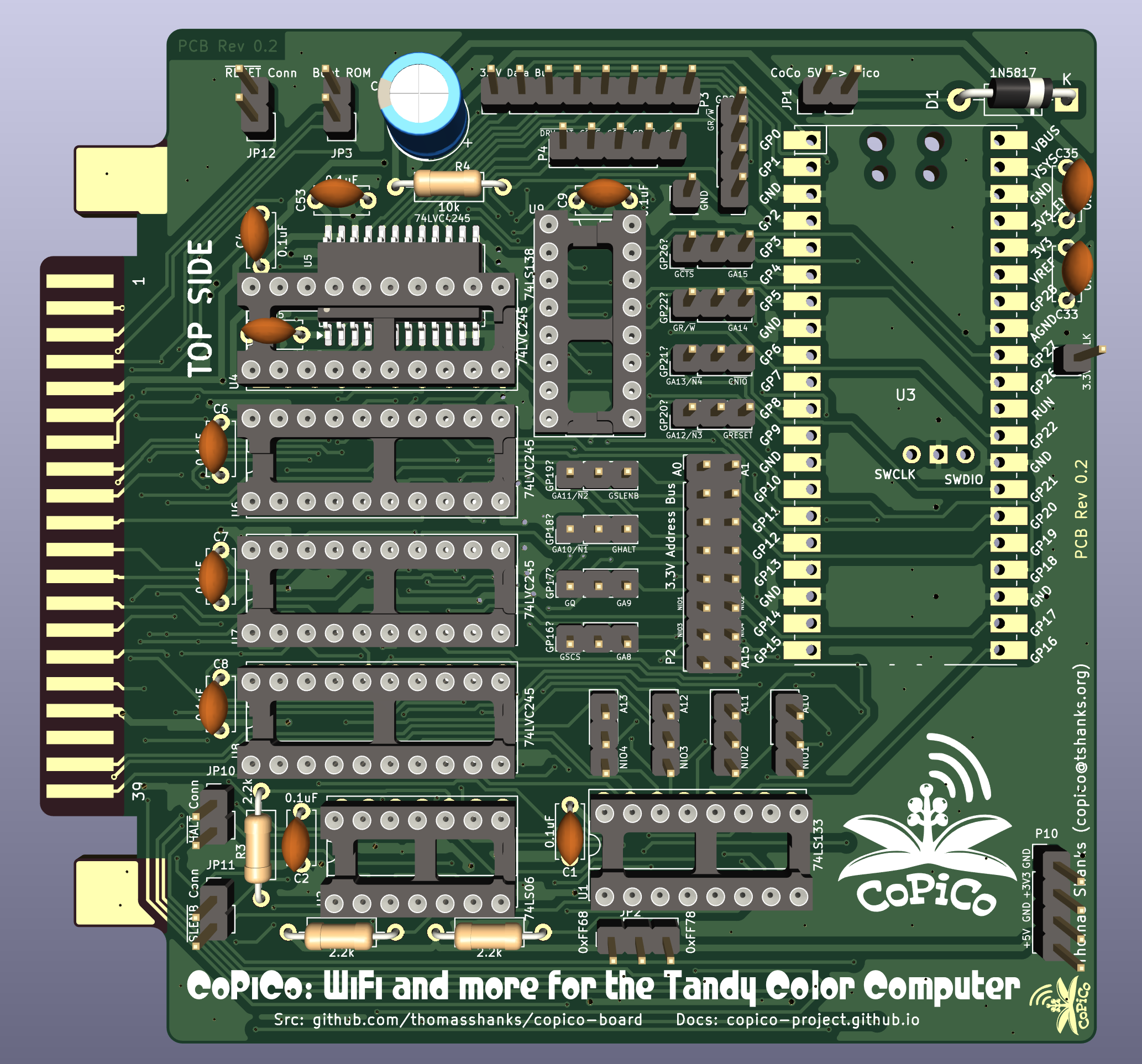
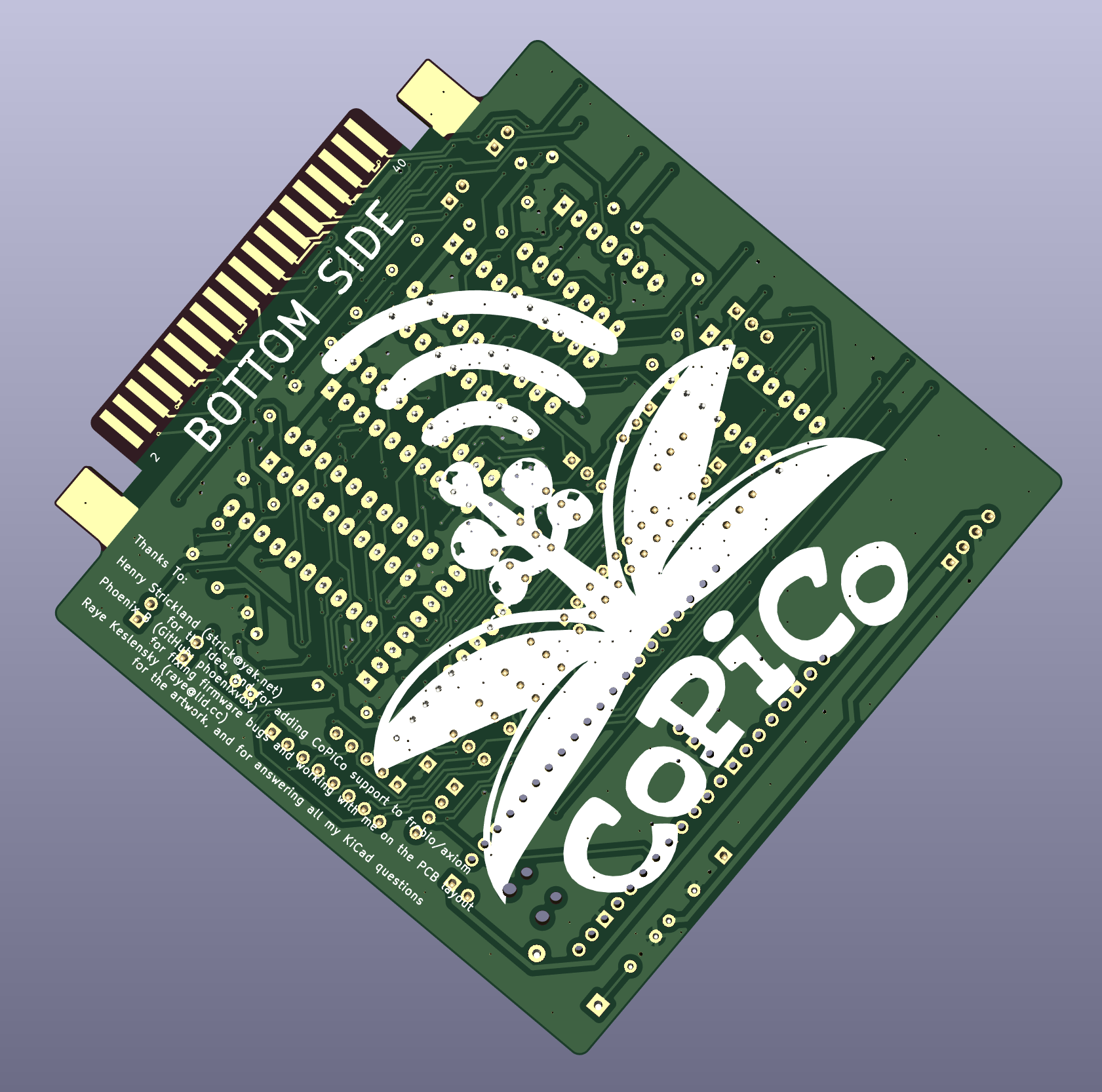
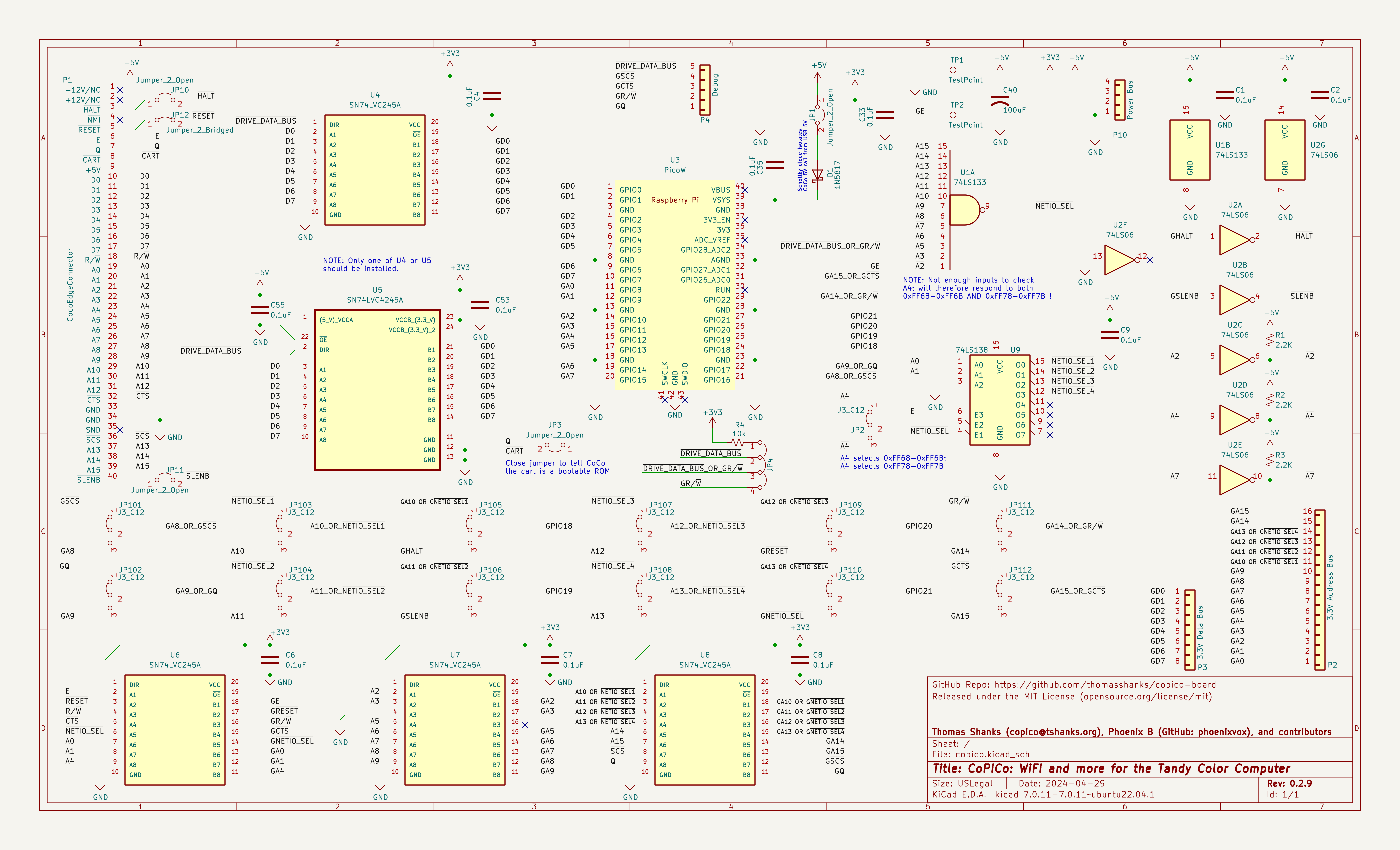 copico_rev0.2_schematic_v0.2.9.pdf
The firmware (see 'copico-firmware' repo) will behave more like a SPI WiFi module or the WizNet chip (or perhaps both, depending on mode). It will, of course, also allow listing and connecting to the desired WiFi network.
CoPiCo will also support boot ROM emulation (initially just for a 1 KB ROM due to limitations of first revision of the CoPiCo PCB). Henry Strickland (@strickyak) plans to use this feature to load a version of his "axiom" network boot ROM (see https://github.com/strickyak/frobio/tree/main/frob3/booting).
Future capabilities for the CoPiCo may include:
Please star this repo and/or watch this space for updates as development continues!
Thank you for being a part of the Retrocomputing community!
Thomas Shanks (copico@tshanks.org)
| Qty | Value | Footprint | References |
|---|---|---|---|
| 13 | J3_C12 | Connector_PinHeader_2.54mm:PinHeader_1x03_P2.54mm_Vertical | JP2, JP101, JP102, JP103, JP104, JP105, JP106, JP107, JP108, JP109, JP110, JP111, JP112 |
| 11 | 0.1uF | Capacitor_THT:C_Disc_D5.0mm_W2.5mm_P5.00mm | C1, C2, C4, C6, C7, C8, C9, C33, C35, C53, C55 |
| 4 | Jumper_2_Open | Connector_PinHeader_2.54mm:PinHeader_1x02_P2.54mm_Vertical | JP1, JP3, JP10, JP11 |
| 4 | SN74LVC245A | Package_DIP:DIP-20_W7.62mm_Socket_LongPads | U4, U6, U7, U8 |
| 3 | 2.2K | Resistor_THT:R_Axial_DIN0207_L6.3mm_D2.5mm_P10.16mm_Horizontal | R1, R2, R3 |
| 2 | TestPoint | Connector_PinHeader_2.54mm:PinHeader_1x01_P2.54mm_Vertical | TP1, TP2 |
| 1 | 100uF | Capacitor_THT:CP_Radial_D7.5mm_P2.50mm | C40 |
| 1 | 10k | Resistor_THT:R_Axial_DIN0207_L6.3mm_D2.5mm_P10.16mm_Horizontal | R4 |
| 1 | 1N5817 | Diode_THT:D_DO-41_SOD81_P10.16mm_Horizontal | D1 |
| 1 | 3.3V Address Bus | Connector_PinHeader_2.54mm:PinHeader_2x08_P2.54mm_Vertical | P2 |
| 1 | 3.3V Data Bus | Connector_PinHeader_2.54mm:PinHeader_1x08_P2.54mm_Vertical | P3 |
| 1 | 74LS06 | Package_DIP:DIP-14_W7.62mm_Socket_LongPads | U2 |
| 1 | 74LS133 | Package_DIP:DIP-16_W7.62mm_Socket_LongPads | U1 |
| 1 | 74LS138 | Package_DIP:DIP-16_W7.62mm_Socket_LongPads | U9 |
| 1 | CocoEdgeConnector | 00_Custom:CocoCardEdge | P1 |
| 1 | Debug | Connector_PinHeader_2.54mm:PinHeader_1x05_P2.54mm_Vertical | P4 |
| 1 | Jumper_2_Bridged | Connector_PinHeader_2.54mm:PinHeader_1x02_P2.54mm_Vertical | JP12 |
| 1 | LOGO | 00_Custom:logo_small | G0 |
| 1 | LOGO | 00_Custom:logo_medium | G2 |
| 1 | LOGO | 00_Custom:logo_larger | G*** |
| 1 | PicoW | RPi_Pico:RPi_PicoW_SMD_TH | U3 |
| 1 | Power Bus | Connector_PinHeader_2.54mm:PinHeader_1x04_P2.54mm_Vertical | P10 |
| 1 | SN74LVC4245A | Package_SO:SOIC-24W_7.5x15.4mm_P1.27mm | U5 |
| 1 | jp_ser_4pin_23cl | Connector_PinHeader_2.54mm:PinHeader_1x04_P2.54mm_Vertical | JP4 |
Staacks/gbinterceptor
Capture or stream Game Boy gameplay footage via USB without modifying the Game Boy.

DLehenbauer/econopet
Mainboard replacement for Commodore PET/CBM series machines

fook42/1541-rePico
replacement of analog-part of Commodore 1541-Floppy devices based on Pi-Pico(2)


lolakkalol/6502-computer-project
A 6502-based computer project! Explore the docs » View Demo Programs · Report Bug · Request Feature

strickyak/tfr9
The TFR/9 Single Board Computer for Hitachi 6309E or Motorola 6809E CPUs (TFR/901)
It measures 100 × 96 mm and has 2 copper layers, 1.6 mm thick.
55 parts, built around the SN74LVC245AN, 74LS133PC and SN74LVC4245APW. The full list of its parts is on this page, with links to each part's symbol and footprint where PCBKit's library has them.
From the thomasshanks/copico-board repository on GitHub, at the commit this page was made from: the board is copico.kicad_pcb and its schematic copico.kicad_sch. PCBKit opens the board in the browser, with nothing to install.
Its repository publishes it under the MIT licence: you may reuse it on that licence's terms (keep the author's notice, and for a copyleft licence share your changes alike).