
2 layers370.8 × 298.5 mm
8 Bit Computer
The-Invent0r/8-bit-Computer-PCB
These are the KiCAD files for my 8-Bit Computer.
323 parts142

 thecraftynuisance/bcd-bus-visualizer
1-digit BCD Bus Visualizer for the Crafty Computer
Bcd bus visualizer is an open-source printed circuit board by thecraftynuisance, from the thecraftynuisance/bcd-bus-visualizer repository on GitHub, published under the CERN-OHL-P-2.0 licence. It is a 2-layer board of 14 × 34 mm with 12 parts on 23 nets, routed with 192 tracks and 29 vias.
It is built around the SM420561N. Its parts include 7 resistors, 2 capacitors, 2 ICs and 1 connector.
This component is part of the Crafty Computer series.
It is designed in KiCad 10.0 and released under the CERN-OHL-P, either version 2 or (at your option) any later version. This design is not backwards compatible with KiCad 9.0 or earlier.
Please refer to the documentation/ and production/ folders for PDF schematics and Gerber files.
The Crafty Computer includes a lot of 4-bit buses to move data around the ALU and to/from/between the digit units. This optional add-on displays the value currently on the bus on a seven-segment display.
The bus header can also be connected to an oscilloscope or left unpopulated. The value on the bus is always shown on four LEDs, so this is just a convenience.
This module does not follow the general design principles of the Crafty Computer. To keep it small enough that it doesn't obscure the view of the entire board it's attached to, it uses a 7-segment decoder IC to do all the work. You can disconnect this module from the computer with no impact on its operation, demonstrating that the IC is not secretly the brain of the operation.
It doesn't try to handle a floating bus gracefully. If it shows junk, that's the same junk that a real reader would read from the bus. It also uses a 0-9 decimal decoder that doesn't show the invalid a-f values, because those values should rarely be seen in a BCD computer. Specifically, they are seen as intermediate values inside the ALU before being corrected by adding 6 to get 0x10 instead of 0xa, but the 1-digit BCD Bus Visualizer is not the right tool to visualize that "bus". You would need a 4-bit Bus Visualizer, or a scope.
This open source hardware is provided under the CERN-OHL-P, either version 2 or (at your option) any later version.
© 2026 The Crafty Nuisance
You may redistribute and modify this documentation and make products using it under the terms of the CERN-OHL-P v2 (https:/cern.ch/cern-ohl). This documentation is distributed WITHOUT ANY EXPRESS OR IMPLIED WARRANTY, INCLUDING OF MERCHANTABILITY, SATISFACTORY QUALITY AND FITNESS FOR A PARTICULAR PURPOSE. Please see the CERN-OHL-P v2 for applicable conditions.
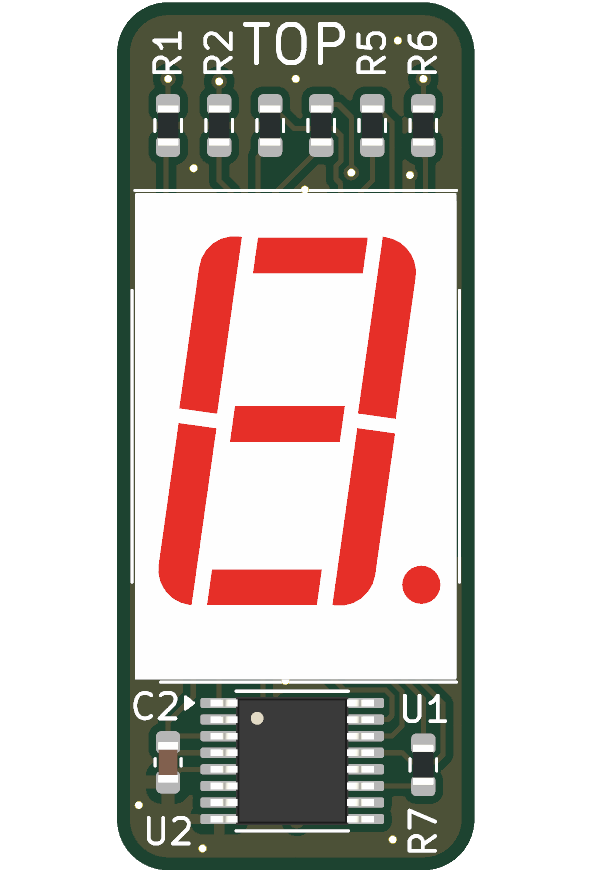
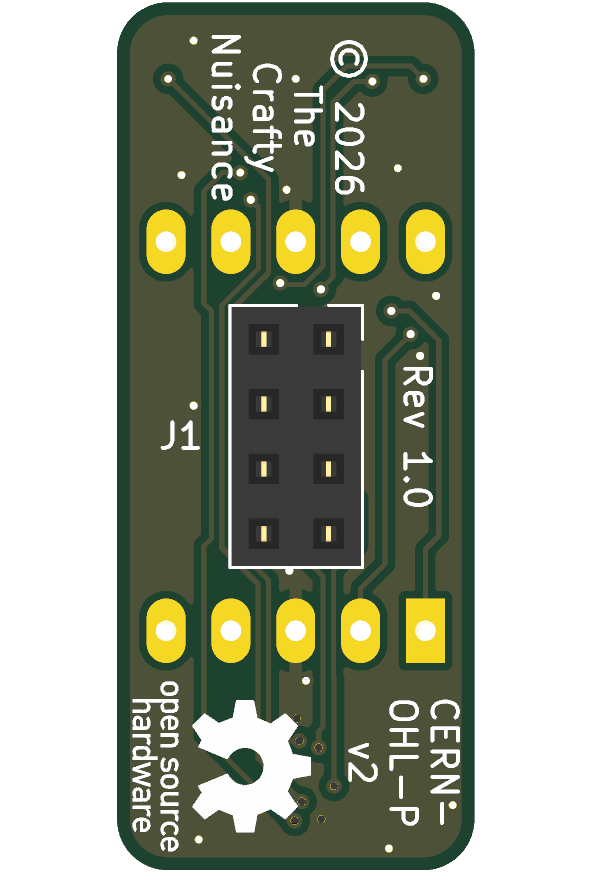
| Qty | Value | Footprint | References |
|---|---|---|---|
| 7 | 1k | Resistor_SMD:R_0603_1608Metric | R1, R2, R3, R4, R5, R6, R7 |
| 1 | 100nF | Capacitor_SMD:C_0603_1608Metric | C2 |
| 1 | 10uF | Capacitor_SMD:C_0603_1608Metric | C1 |
| 1 | 2x4 Female Pin Header | Connector_PinSocket_2.54mm:PinSocket_2x04_P2.54mm_Vertical | J1 |
| 1 | CD4511BPWR | Package_SO:TSSOP-16_4.4x5mm_P0.65mm | U2 |
| 1 | SM420561N | Display_7Segment:7SegmentLED_LTS6760_LTS6780 | U1 |
It measures 14 × 34 mm and has 2 copper layers, 1.6 mm thick.
12 parts, built around the SM420561N. The full list of its parts is on this page, with links to each part's symbol and footprint where PCBKit's library has them.
From the thecraftynuisance/bcd-bus-visualizer repository on GitHub, at the commit this page was made from: the board is hardware/kicad/bcd-bus-visualizer.kicad_pcb and its schematic hardware/kicad/bcd-bus-visualizer.kicad_sch. PCBKit opens the board in the browser, with nothing to install.
Its repository publishes it under the CERN-OHL-P-2.0 licence: you may reuse it on that licence's terms (keep the author's notice, and for a copyleft licence share your changes alike).
The-Invent0r/8-bit-Computer-PCB
These are the KiCAD files for my 8-Bit Computer.


89Mods/LVDC
Replica of the Launch Vehicle Digital Computer using 74-series logic


aapaetsch/HardwareMonitorArduino
Code, pcb files and schematics for building a hardware monitor based around the atmega328p


