Skip to the content
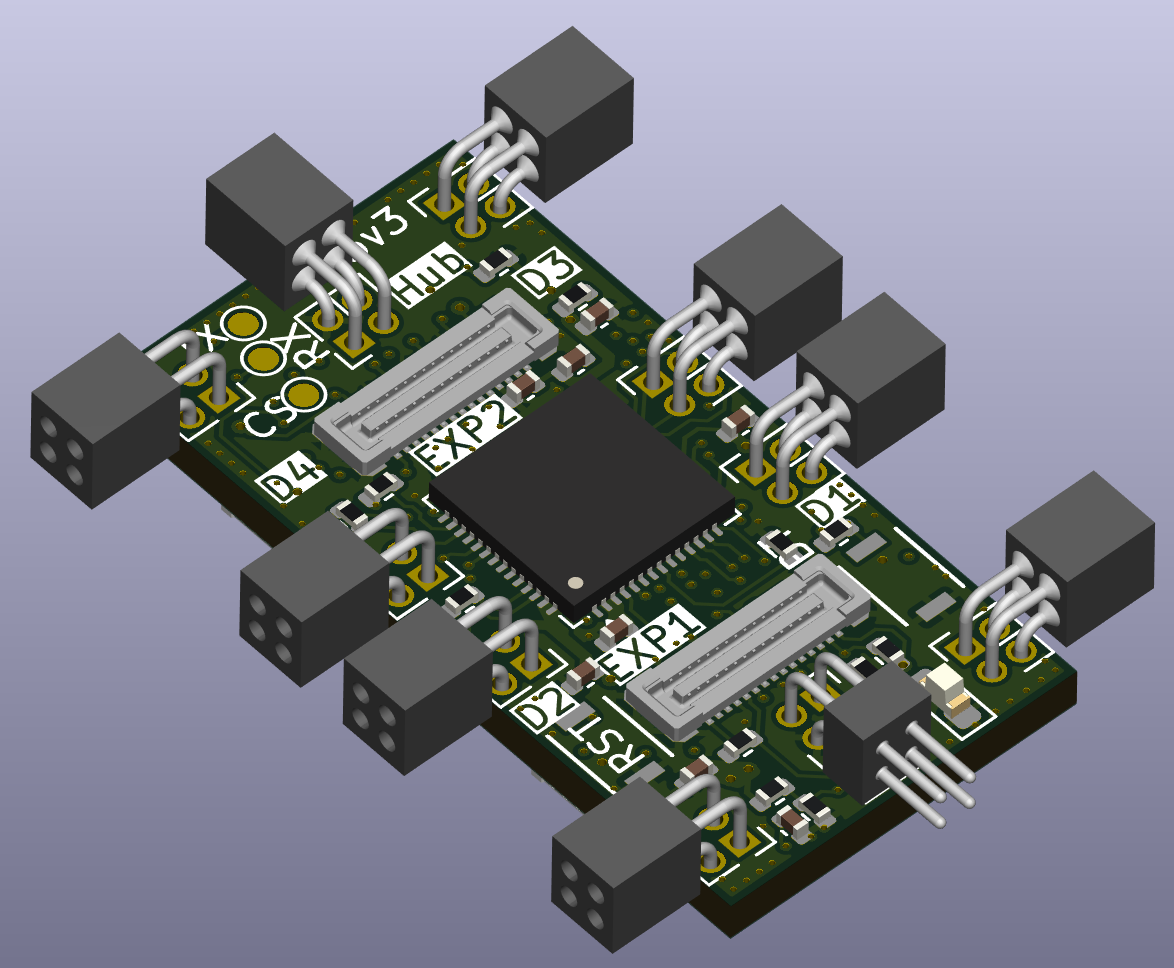
6 layers15 × 30 mmESP32-S3 Hub, the printed circuit board in 3D

4 port 2 sensor ESP32-S3 control hub. This is part of a modular control board ecosystem, CACKLE. https://github.com/techy-robot/CACKLE

Size
15 × 30 mm
Copper layers
6
Thickness
1.6 mm
Parts
73
Nets
88
Pads
375
Tracks, vias
1,914, 222
Pours
15
Routed
Yes
KiCad
KiCad 9.0 (file 20241229)
Created
7 Nov 2025
Updated
14 Jul 2026

Overview

ESP32-S3 Hub is an open-source printed circuit board by techy-robot, from the techy-robot/CACKLE-Hub-ESP32-S3 repository on GitHub. It is a 6-layer board of 15 × 30 mm with 73 parts on 88 nets, routed with 1,914 tracks and 222 vias.

It is built around the SN74LV595AD and TS5A3159DCK. Its parts include 22 capacitors, 22 resistors, 16 connectors, 6 ICs and 2 switches. It belongs with the ESP32 boards of this library.

Main components

2

README

README.md

modified: 2025-11-07T22:07:35-07:00

ESP32-S3 Hub

[!TIP] This board is part of a larger modular control board ecosystem, CACKLE

This is a 4-driver hub based on the Espressif ESP32-S3FH4 chip. It has two cores powerful running at 240 mhz, and 4mb of flash memory. Other variants of the ESP32-S3 can be used as long as they have built in flash memory.

The ESP32-S3 chip does not quite have enough pins for driving 4 motors and several sensors, so some cuts were made. For example, on all 4 ports for the ADCs, only two out of three pins are actually connected. This will work for brushed and brushless FOC control, but it may not work for other use cases. I also had to use the USB lines for a tri-state shift register, which controls all the SPI chip select lines. I am planning on programming the chip via UART, which means that the RS485 lines must be disconnected.

The SPI bus should be able to operate at 80mhz, though this has not been tested yet. For all practical use-cases I am limiting this to 20mhz.

Schematic PDF

Partial 3D picture (headers not shown) Esp32-s3 hub 3D picture

Parts

73
QtyValueFootprintReferences
9Precidip 853-87-004-20-001101custom_Connector:Precidip 853-87-004-20-001101J1, J2, J4, J6, J7, J9, J10, J12, J15
810kResistor_SMD:R_0402_1005MetricR2, R7, R13, R17, R18, R19, R20, R22
61uFCapacitor_SMD:C_0402_1005MetricC2, C7, C9, C13, C15, C16
5100nFCapacitor_SMD:C_0402_1005MetricC4, C5, C6, C8, C10
410nFCapacitor_SMD:C_0402_1005MetricC19, C20, C21, C22
4FPC 0.3mm Aces 51688-0070Mcustom_Connector:fpc_7pin_0.3mm_connector AcesJ3, J5, J8, J11
333ohmResistor_SMD:R_0402_1005MetricR3, R4, R5
2100kResistor_SMD:R_0402_1005MetricR1, R14
212pFCapacitor_SMD:C_0201_0603MetricC11, C12
22.2kResistor_SMD:R_0402_1005MetricR8, R9
222uFCapacitor_SMD:C_0402_1005MetricC1, C14
2Mitsumi R-667996Misumi switches:R-667995_MITSW1, SW2
2SN74LV595APackage_DFN_QFN:DHVQFN-16-1EP_2.5x3.5mm_P0.5mm_EP1x2mmU2, U5
2TE 3-2363961-0 receptaclecustom_testpoints:TE_mezzanine_rec_3-2363961-0J13, J16
1100 ohmResistor_SMD:R_0402_1005MetricR10
110uFCapacitor_SMD:C_0402_1005MetricC3
1120ohmResistor_SMD:R_0402_1005MetricR16
1150kResistor_SMD:R_0402_1005MetricR21
12 pin 40MHZ, 10ppm tol., 20ppm stab., 10pFcustom_Crystal:Crystal_SMD_1612-4Pin_1.6x1.2mmY1
12.6~3.1 Fv Green 5maLED_SMD:LED_0603_1608Metric_Pad1.05x0.95mm_HandSolderD1
12.7nFCapacitor_SMD:C_0402_1005MetricC18
122 ohmResistor_SMD:R_0201_0603MetricR6
13.3nFCapacitor_SMD:C_0402_1005MetricC17
1332kResistor_SMD:R_0402_1005MetricR12
1470kResistor_SMD:R_0402_1005MetricR11
16.04kResistor_SMD:R_0402_1005MetricR15
1ESP32-S3 FN8Package_DFN_QFN:QFN-56-1EP_7x7mm_P0.4mm_EP4x4mmU1
1Precidip 852-10-004-20-001101custom_Connector:Precidip 852-10-004-20-001101J18
1RTSTestPoint:TestPoint_Pad_D1.0mmTP20
1RXTestPoint:TestPoint_Pad_D1.0mmTP2
1THVD1420DRLRPackage_TO_SOT_SMD:SOT-583-8U3
1TPS2521ARPWRcustom_Power_QFN:QFN-10_10VQFN_2x2mm_P0.5mmU4
1TS5A3159DCKPackage_TO_SOT_SMD:SOT-363_SC-70-6U6
1TXTestPoint:TestPoint_Pad_D1.0mmTP3

Similar boards

  • 4 layers150 × 90 mmMotherboard, the printed circuit board in 3D

    Motherboard

    Foosa7/koi_8x8

    The controller board for Koi 8×8. Carries a Raspberry Pi Pico (RP2040) and hosts up to 8 daughterboards in PCIe-x4 card-edge slots, addressing each board's DAC/ADC over a shared SPI bus. Formerly codenamed MOBO.

    56 parts2
  • 6 layers76 × 46.4 mmRp2350 driver, the printed circuit board in 3D

    Rp2350 driver

    sequoia-hope/rp2350-motor-controller

    An RP2350 based brushless motor controller

    291 parts39
  • 4 layers401.5 × 130.1 mmOssw, the printed circuit board in 3D

    Ossw

    BinaryS010/ossw

    Open SCART Switch

    336 parts8GPL-3.0
  • 2 layers75 × 56 mmGba cart read rp2350, the printed circuit board in 3D

    Gba cart read rp2350

    Daft-Freak/gba-cart-read

    Reads GBA cartridges as a USB storage device. TODO: more interesting name.

    49 parts7
  • 2 layers70.4 × 84 mmHeterodyne Board, the printed circuit board in 3D

    Heterodyne Board

    wwaltz2/ECE445-UIUC-Heterodyne

    For ease of sharing files, journals, code, and schematics while we design, revise, build, and report on our senior design project.

    72 parts
  • 6 layers83.6 × 89.8 mmLowstepper hardware, the printed circuit board in 3D

    Lowstepper hardware

    kitspace-test-repos/kicad6-file-collection

    73 partsMIT
  • 6 layers61.1 × 72.8 mmDevboard, the printed circuit board in 3D

    Devboard

    napowderly/STM32H723VG

    73 partsMIT
  • 6 layers50 × 50 mmSolarCell+Y, the printed circuit board in 3D

    SolarCell+Y

    spacecraft-design-lab-2019/Solar-Panel-plus-Y

    73 parts

Questions

How big is the ESP32-S3 Hub PCB?

It measures 15 × 30 mm and has 6 copper layers, 1.6 mm thick.

What parts does the ESP32-S3 Hub use?

73 parts, built around the SN74LV595AD and TS5A3159DCK. The full list of its parts is on this page, with links to each part's symbol and footprint where PCBKit's library has them.

Where can I download the ESP32-S3 Hub KiCad files?

From the techy-robot/CACKLE-Hub-ESP32-S3 repository on GitHub, at the commit this page was made from: the board is ESP32-S3 Hub.kicad_pcb and its schematic Connectors.kicad_sch. PCBKit opens the board in the browser, with nothing to install.

Can I use the ESP32-S3 Hub design in my own project?

Its repository states no licence, so its author keeps all rights: ask techy-robot before reusing the design.