2 layers191.8 × 121.3 mm
8-Bit CPU 32k
slu4coder/Minimal-UART-Computer-1-2
Legacy: Version 1 and 2 of my TTL-only CPU featuring UART I/O, an expansion port, 512KB SSD at up to 10MHz clock speed
109 parts184

 TBMGIT-HUB/CircuitsCourses
Ce projet consiste à réaliser un jeu électronique de Shifumi (Pierre–Feuille–Ciseaux) sur un PCB conçu avec KiCad.
ProjetKicad is an open-source printed circuit board by TBMGIT-HUB, from the TBMGIT-HUB/CircuitsCourses repository on GitHub. It is a 2-layer board of 93.8 × 187.8 mm with 22 parts on 45 nets, routed with 226 tracks and 39 vias.
It is built around the 74HC86D, 74HC00D and 74HC164, with the TPS63031DSK among its other parts. Its parts include 7 ICs, 5 switches, 3 resistors, 3 diodes and 2 capacitors. It belongs with the ESP32 boards of this library.


Ce projet consiste à réaliser un jeu électronique de Shifumi (Pierre–Feuille–Ciseaux) sur un PCB conçu avec KiCad.
Le système possède un bouton START permettant de lancer une partie et un bouton END permettant de terminer la partie. Trois boutons supplémentaires permettent au joueur de sélectionner son choix : Pierre, Feuille ou Ciseaux.
Le fonctionnement du système repose sur un ESP32-S3 associé à plusieurs circuits logiques, notamment des 74HC164, 74HC00 et 74HC86. L'ESP32 permet de contrôler le fonctionnement général du jeu et de générer un nombre pseudo-aléatoire compris entre 1 et 3. Le 74HC164 participe au traitement de cette génération pseudo-aléatoire.
Une fois la partie lancée, l'écran OLED SSD1306 intégré à la boîte Creakit affiche un décompte. À la fin du décompte, le système récupère le nombre généré et affiche sur l'écran le symbole correspondant : Pierre pour 1, Feuille pour 2 et Ciseaux pour 3.
L'alimentation du circuit est assurée par un TPS63031DSK, qui permet de fournir une tension régulée de 3,3 V nécessaire au fonctionnement des différents composants du circuit. Des condensateurs sont également utilisés pour assurer le découplage et la stabilité de l'alimentation.
Le PCB regroupe ainsi la partie alimentation, les circuits logiques, l'ESP32-S3, les boutons de commande et l'interface avec l'écran OLED.
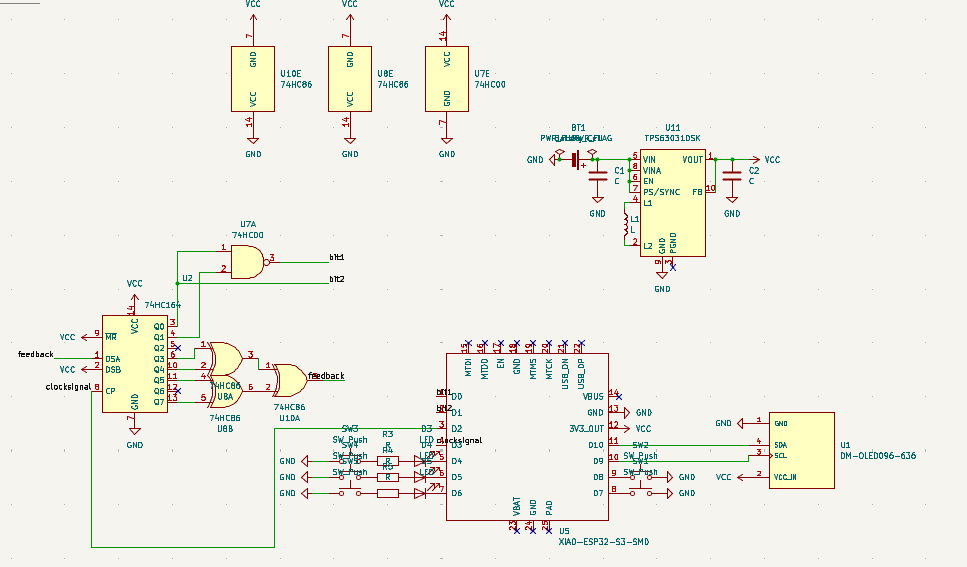
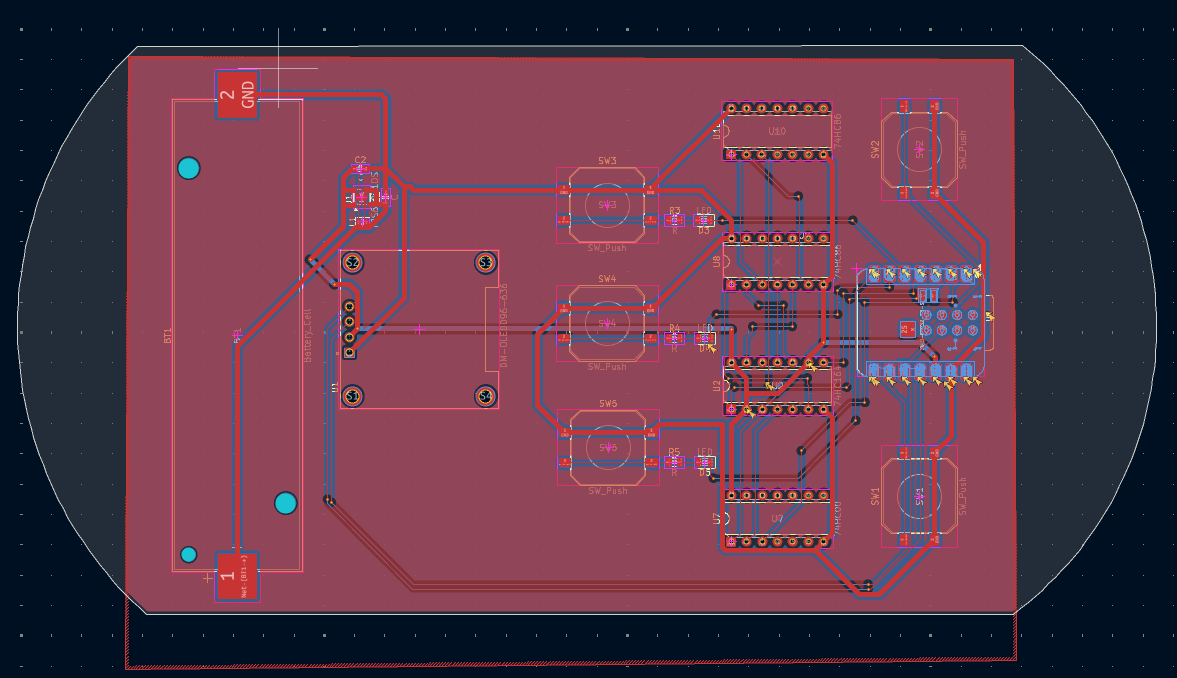
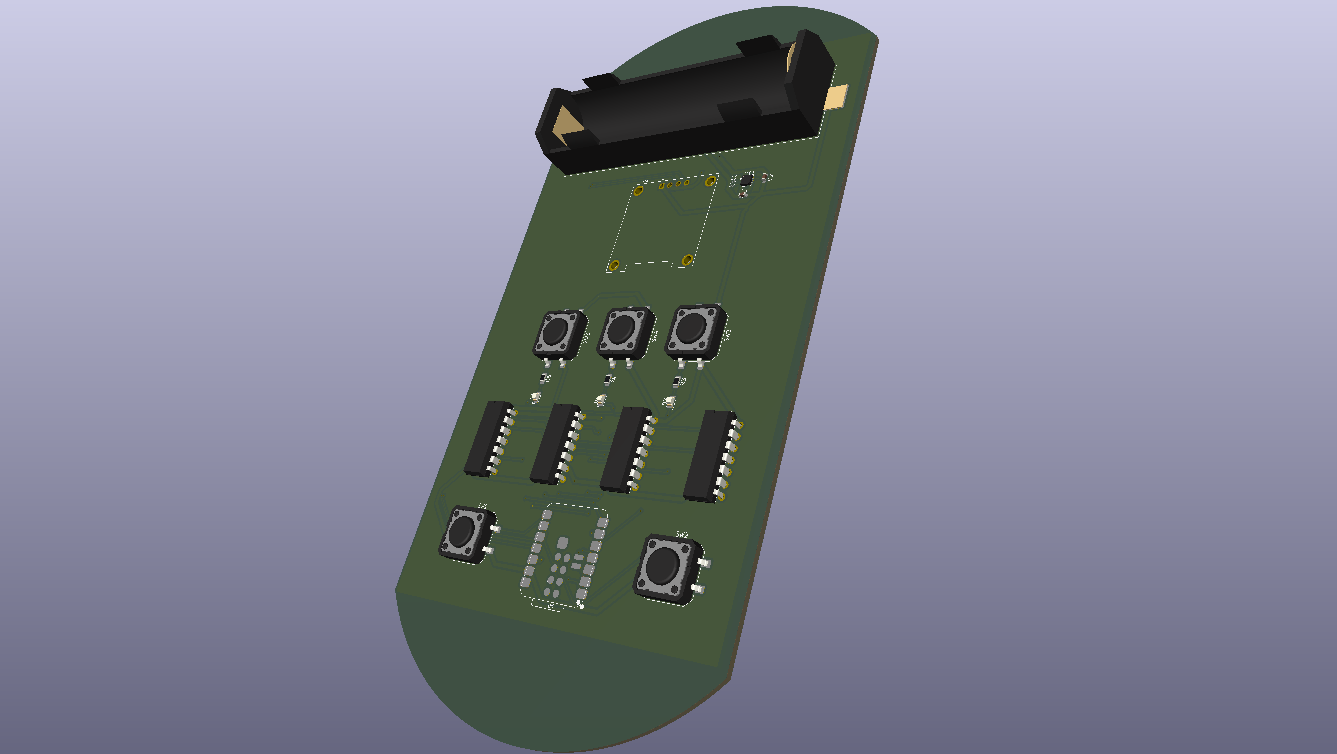
L'ESP32-S3 assure le contrôle du système. Les 74HC164 sont utilisés dans la partie logique du système et la génération pseudo-aléatoire, tandis que les 74HC00 et 74HC86 permettent de réaliser différentes fonctions logiques NAND et XOR. L'écran OLED SSD1306 permet d'afficher le décompte et le résultat de la partie. Enfin, le TPS63031DSK assure la conversion et la régulation de l'alimentation à 3,3 V.
| Qty | Value | Footprint | References |
|---|---|---|---|
| 5 | SW_Push | Button_Switch_SMD:SW_Push_1P1T_NO_CK_PTS125Sx43SMTR | SW1, SW2, SW3, SW4, SW5 |
| 3 | LED | LED_SMD:LED_0805_2012Metric | D3, D4, D5 |
| 3 | R | Resistor_SMD:R_0805_2012Metric | R3, R4, R5 |
| 2 | 74HC86 | Package_DIP:DIP-14_W7.62mm | U8, U10 |
| 2 | C | Capacitor_SMD:C_0603_1608Metric | C1, C2 |
| 1 | 74HC00 | Package_DIP:DIP-14_W7.62mm | U7 |
| 1 | 74HC164 | Package_DIP:DIP-14_W7.62mm | U2 |
| 1 | Battery_Cell | Battery:BatteryHolder_Keystone_1042_1x18650 | BT1 |
| 1 | DM-OLED096-636 | DM-OLED096-636:MODULE_DM-OLED096-636 | U1 |
| 1 | L | Inductor_SMD:L_CommonModeChoke_Coilcraft_0603USB | L1 |
| 1 | TPS63031DSK | Package_SON:WSON-10-1EP_2.5x2.5mm_P0.5mm_EP1.2x2mm | U11 |
| 1 | XIAO-ESP32-S3-SMD | Seeed_Studio_XIAO_Series:XIAO-ESP32-S3-SMD | U5 |
It measures 93.8 × 187.8 mm and has 2 copper layers, 1.6 mm thick.
22 parts, built around the 74HC86D, 74HC00D, 74HC164 and TPS63031DSK. The full list of its parts is on this page, with links to each part's symbol and footprint where PCBKit's library has them.
From the TBMGIT-HUB/CircuitsCourses repository on GitHub, at the commit this page was made from: the board is FirstKicadProject/ProjetKicad.kicad_pcb and its schematic FirstKicadProject/ProjetKicad.kicad_sch. PCBKit opens the board in the browser, with nothing to install.
Its repository states no licence, so its author keeps all rights: ask TBMGIT-HUB before reusing the design.
slu4coder/Minimal-UART-Computer-1-2
Legacy: Version 1 and 2 of my TTL-only CPU featuring UART I/O, an expansion port, 512KB SSD at up to 10MHz clock speed


slu4coder/Arduino-Nano-PC
1 Arduino Nano + 1 Logic Chip = Personal Computer with VGA and PS/2

