2 layers196.9 × 125.1 mm
8-Bit CPU 32k
slu4coder/Minimal-UART-Computer-1-2
Legacy: Version 1 and 2 of my TTL-only CPU featuring UART I/O, an expansion port, 512KB SSD at up to 10MHz clock speed
106 parts184
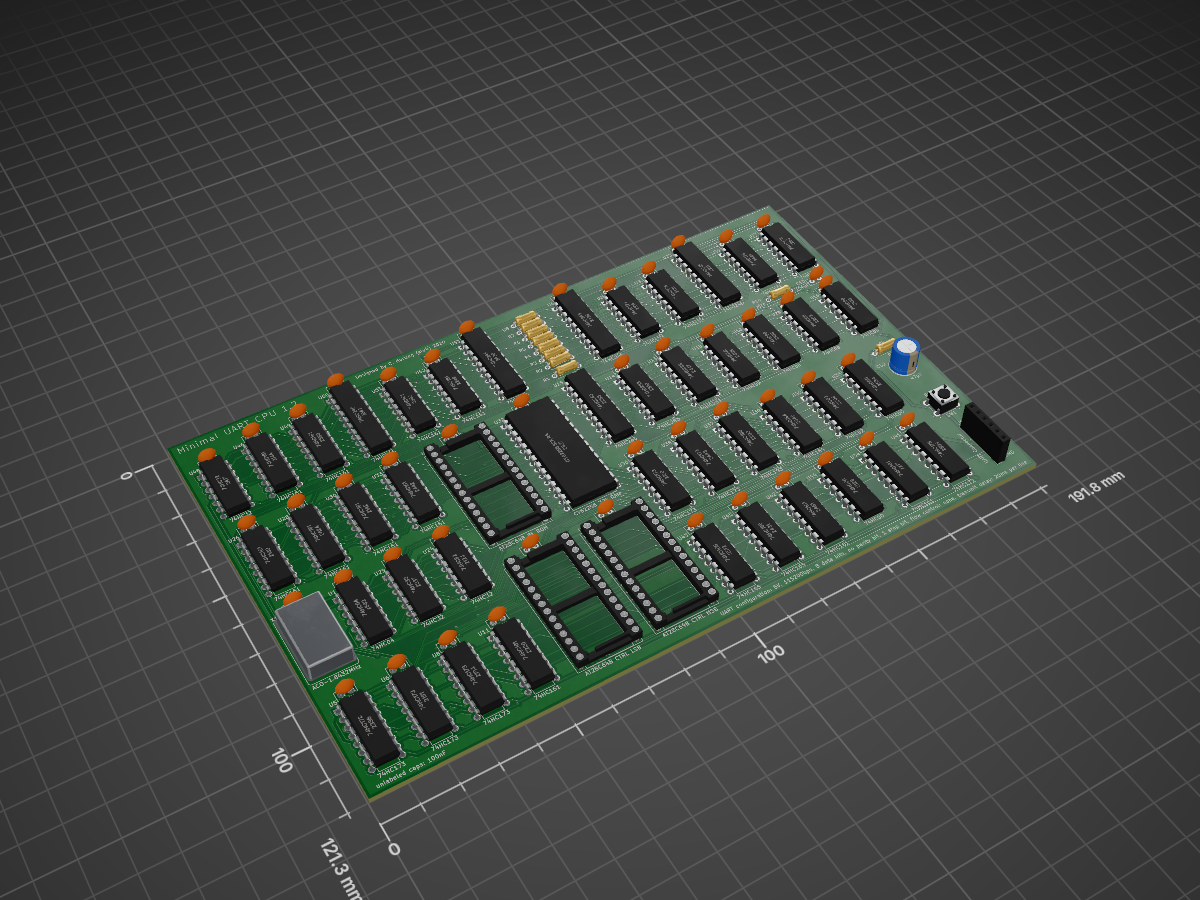
 slu4coder/Minimal-UART-Computer-1-2184
Legacy: Version 1 and 2 of my TTL-only CPU featuring UART I/O, an expansion port, 512KB SSD at up to 10MHz clock speed
8-Bit CPU 32k is an open-source printed circuit board by slu4coder, from the slu4coder/Minimal-UART-Computer-1-2 repository on GitHub. It is a 2-layer board of 191.8 × 121.3 mm with 109 parts on 166 nets, routed with 4,283 tracks and 81 vias.
It is built around the 74HC245D, 74HC161S and 74HC173D, with the 74HC32D, 74HC00D and 74HC02 among its other parts. Its parts include 49 capacitors, 47 ICs, 10 resistors, 1 connector and 1 switch. It belongs with the retro computing and games boards of this library.


See tbd for the latest version 3. See https://github.com/slu4coder/Minimal-64x4-Home-Computer for a more feature-rich version.
This is a free and non-commercial project. I am in no way associated with any activies selling this as a product. Any such activity represents a license violation. Individual licenses apply for hardware and software parts. Please refer to appropriate documentations for detailed licensing information.
Minimal CPU 2.0 'Ultra' is now running at 10MHz(!) and may well be the fastest 8-bit general purpose 74HC logic breadboard computer to this date:
Latest PCB version 1.5:
● Build your own 'Minimal CPU System' on breadboards: https://www.youtube.com/watch?v=Gz1VVOsNn_8
● Python-like high-level programming language MIN released: https://www.youtube.com/watch?v=H342TwW4R7k
● 'Minimal VGA Extension Card' released! https://github.com/slu4coder/DIY-VideoRAM/tree/main/KiCAD
● 'Minimal CPU System' Emulator released! See user manual chapter 'Minimal Emulator' for details.
● Native assembler and text editor released!
● User Manual and Reference: https://docs.google.com/document/d/1c2ZHtLd1BBAwcBAjBZZJmCA3AXpbpv80dlAtsMYpuF4/edit?usp=sharing
● Revision 1.5 is out now featuring 512KB FLASH SSD, 3.6864MHz clock speed and an expansion port! https://www.youtube.com/watch?v=osVi06VKvA0
● Minimal Python Assembler released: https://www.youtube.com/watch?v=rdKX9hzA2lU
● The Minimal CPU System now has a dedicated hardware serial 'Minimal Terminal': https://github.com/slu4coder/Minimal-Terminal but can also be operated via a USB-to-serial breakout board and a terminal emulation (e. g. Tera Term) of cause.
I've built my own Computer from scratch - using nothing but TTL chips, because, well, why not? I wanted a CPU that is easy to understand, fun to build and powerful enough to allow for programming educational stuff and little games on it. Ah, and by the way - it should be as simple as possible - sort of the "Simplest Usable Personal Computer". This repo provides you with everything you need to follow my one-and-a-half-year journey down this rabbit hole. Besides running some video game classics, this little DIY CPU is capable of parsing arbitrary mathmatical expressions and performing floating point calculations in single (32-bit) precision. And it comes with an SSD file system, too, since it uses it's own FLASH IC as permanent SSD storage. Over the last year I have written an entire native toolchain: a text editor, an assembler and the Python-like high-level programming language MIN.
WHAT YOU GET:
● Block diagram of the CPU and overview it's instruction set
● KiCAD project files with detailed schematics and PCB layout
● Gerber files ready to be submitted at any PCB manufacturer of your choice
● Bill of material
● Images in .bin format of both the ROM and the CPU's control microcode
● Source code of the minimal operating system MinOS and several demos and games
● Cross-assembler 'asm.exe' running on Windows (or Python) to comfortably write, assemble and upload your own software
TECHNICAL SPECIFICATION:
● Processing power (1.0Mips @8.3MHz) comparable to 2.3 x Commodore 64 or Apple II
● Clear(est?) and simple(st? – you judge!) design for fun and education
● 8-bit data bus, 16-bit address bus, Von-Neumann architecture
● 64 instructions (conditional branching, subroutines, stack and word ops)
● 32KB RAM / 512KB FLASH ROM (OS, memory monitor, disassembler, tools)
● SSD file system (commands LOAD, SAVE, DIR, DELETE, FORMAT as you'd expect)
● UART interface (up to 500kbps) for terminal display, keyboard input and file I/O
● Expansion port (I/O card and VGA card available, build your own!)
● 24 (16) control signals, 2 registers A and B, ALU (arithmetic and logic unit) = simple adder, 3 flags (negative, carry and zero)
● Built from 74HCxx TTL logic on 120mm x 190mm PCB or 8 breadboards
I hope you find this information useful, educational or otherwise interesting. I'd love to hear about your build, so meet me on YouTube.
https://www.youtube.com/channel/UCXYQcMpUBT3aaQKfmAVJNow
Have fun!
| Qty | Value | Footprint | References |
|---|---|---|---|
| 47 | 100nF | Capacitor_THT:C_Disc_D5.0mm_W2.5mm_P2.50mm | C1, C2, C11, C12, C13, C14, C16, C17, C18, C19, C20, C21, C22, C23, C24, C25 +31 |
| 11 | 74HC161 | Package_DIP:DIP-16_W7.62mm | U11, U26, U28, U30, U33, U34, U42, U46, U49, U51, U52 |
| 10 | 74HC173 | Package_DIP:DIP-16_W7.62mm | U2, U3, U5, U6, U8, U10, U17, U36, U38, U41 |
| 8 | 470 | Resistor_THT:R_Axial_DIN0207_L6.3mm_D2.5mm_P7.62mm_Horizontal | R1, R2, R3, R4, R5, R6, R7, R8 |
| 5 | 74HC245 | Package_DIP:DIP-20_W7.62mm | U4, U15, U23, U50, U53 |
| 3 | 74HC32 | Package_DIP:DIP-14_W7.62mm | U24, U29, U48 |
| 2 | 74HC00 | Package_DIP:DIP-14_W7.62mm | U35, U44 |
| 2 | 74HC02 | Package_DIP:DIP-14_W7.62mm | U18, U40 |
| 2 | 74HC165 | Package_DIP:DIP-16_W7.62mm | U43, U45 |
| 2 | 74HC283 | Package_DIP:DIP-16_W7.62mm | U13, U14 |
| 2 | 74HC86 | Package_DIP:DIP-14_W7.62mm | U12, U16 |
| 1 | 100pF | Capacitor_THT:C_Disc_D5.0mm_W2.5mm_P2.50mm | C10 |
| 1 | 10k | Resistor_THT:R_Axial_DIN0207_L6.3mm_D2.5mm_P7.62mm_Horizontal | R9 |
| 1 | 47µF | Capacitor_THT:CP_Radial_D7.5mm_P2.50mm | C52 |
| 1 | 74HC04 | Package_DIP:DIP-14_W7.62mm | U1 |
| 1 | 74HC08 | Package_DIP:DIP-14_W7.62mm | U19 |
| 1 | 74HC164 | Package_DIP:DIP-14_W7.62mm | U39 |
| 1 | 74HC193 | Package_DIP:DIP-16_W7.62mm | U37 |
| 1 | ACO-1.8432MHz | Oscillator:Oscillator_DIP-14 | X1 |
| 1 | AT28C64B 8k ROM | Package_DIP:DIP-28_W15.24mm_Socket | U31 |
| 1 | AT28C64B CTRL LSB | Package_DIP:DIP-28_W15.24mm_Socket | U9 |
| 1 | AT28C64B CTRL MSB | Package_DIP:DIP-28_W15.24mm_Socket | U7 |
| 1 | CY62256 32k RAM | Package_DIP:DIP-28_W15.24mm | U32 |
| 1 | RESET | Button_Switch_THT:SW_PUSH_6mm | SW1 |
| 1 | UART | Connector_PinSocket_2.54mm:PinSocket_1x06_P2.54mm_Vertical | J1 |
| 1 | wire | Resistor_THT:R_Axial_DIN0207_L6.3mm_D2.5mm_P7.62mm_Horizontal | R10 |
slu4coder/Minimal-UART-Computer-1-2
Legacy: Version 1 and 2 of my TTL-only CPU featuring UART I/O, an expansion port, 512KB SSD at up to 10MHz clock speed

slu4coder/Minimal-UART-Computer-1-2
Legacy: Version 1 and 2 of my TTL-only CPU featuring UART I/O, an expansion port, 512KB SSD at up to 10MHz clock speed

slu4coder/Minimal-UART-Computer-1-2
Legacy: Version 1 and 2 of my TTL-only CPU featuring UART I/O, an expansion port, 512KB SSD at up to 10MHz clock speed

slu4coder/Minimal-UART-Computer-1-2
Legacy: Version 1 and 2 of my TTL-only CPU featuring UART I/O, an expansion port, 512KB SSD at up to 10MHz clock speed


slu4coder/Minimal-64x4-Home-Computer
My DIY TTL home computer with VGA and PS/2 and 4x the processing power of a Commodore C64 or Apple II.

slu4coder/Minimal-64-Home-Computer
Legacy: Full TTL-only home computer with VGA and PS/2 and twice the processing power of a Commodore 64

Trilobyte-CPU/8-bit-computer
A DIY 8-bit computer built mostly with discrete logic chips

slu4coder/Minimal-UART-Computer-3
Version 3 of my educational DIY TTL computer built around a UART serial interface - now with blinkenlights!


ifilot/sap-smd
Modular 8-bit computer built with TTL logic units to create a "Simple as Possible" system
It measures 191.8 × 121.3 mm and has 2 copper layers, 1.6 mm thick.
109 parts, built around the 74HC245D, 74HC161S, 74HC173D and 74HC32D. The full list of its parts is on this page, with links to each part's symbol and footprint where PCBKit's library has them.
From the slu4coder/Minimal-UART-Computer-1-2 repository on GitHub, at the commit this page was made from: the board is Revisions 0.9 - 1.2 (EEPROM)/Revision 1.2 (EEPROMs)/KiCAD/8-Bit CPU 32k.kicad_pcb. PCBKit opens the board in the browser, with nothing to install.
Its repository states no licence, so its author keeps all rights: ask slu4coder before reusing the design.