
2 layers287.8 × 126.7 mm

 snize/BOB-PMW3360-SUMI14
This project is licensed under the CERN OHL-P v2. You may use, distribute, and modify this design under the terms of the CERN OHL-P v2. Original design by snize.
BOB PMW3360-SUMI is an open-source printed circuit board by snize, from the snize/BOB-PMW3360-SUMI repository on GitHub, published under the CERN-OHL-P-2.0 licence. It is a 2-layer board of 30 × 20 mm with 14 parts on 18 nets, routed with 71 tracks and 5 vias.
It is built around the PMW3360DM-T2QU. Its parts include 4 capacitors, 3 resistors, 2 ICs and 1 connector.
ブレイクアウトボード自体はBoothから購入もできます https://bulblub.booth.pm/items/6164153
PMW3360用のコンパクトで低コストなブレイクアウトボードです。PMW3610 breakout board - SEIBOKU(青墨)と同様の設計思想で設計され、自作キーボードや自作トラックボールの試作や流用・組み込みを意識しています。
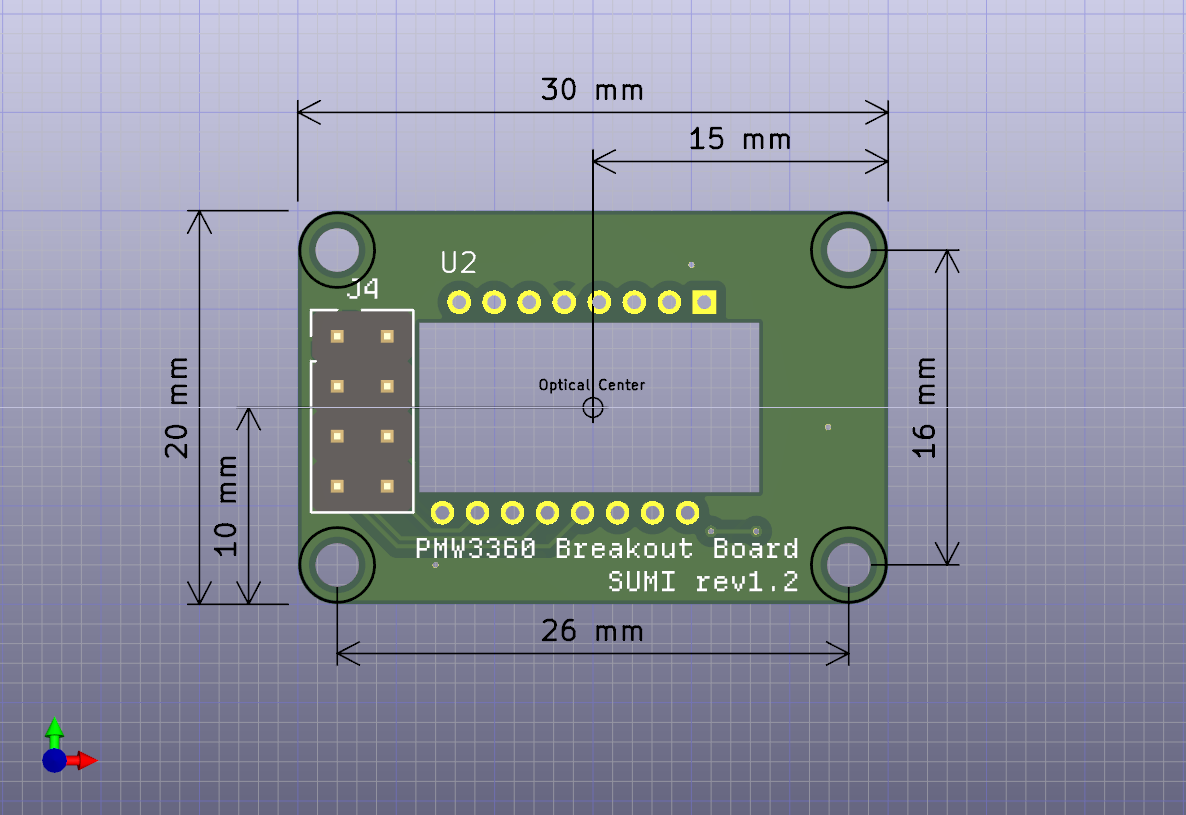
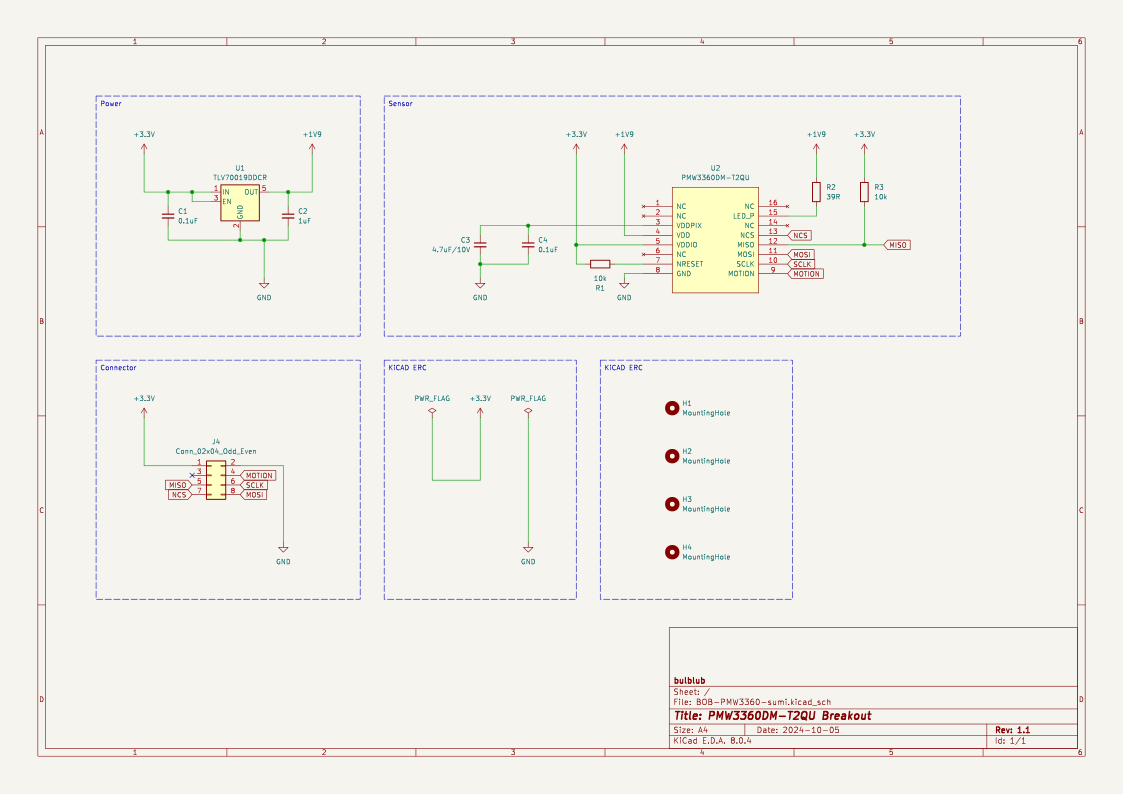
https://kicanvas.org/?github=https://github.com/snize/BOB-PMW3360-SUMI
| Reference | Value | Qty |
|---|---|---|
| C1, C4 | 0.1uF | 2 |
| C2 | 1uF | 1 |
| C3 | 4.7uF/10V | 1 |
| R1, R3 | 10k | 2 |
| R2 | 39R | 1 |
| U1 | TLV70019DDCR | 1 |
| U2 | PMW3360DM-T2QU | 1 |
本プロジェクトでは、Departure Mono フォントを使用しています。rektdeckard/departure-mono
This project is licensed under the CERN OHL-P v2. You may use, distribute, and modify this design under the terms of the CERN OHL-P v2. Original design by snize.
DiscussionsやSNSでお知らせください!
| Qty | Value | Footprint | References |
|---|---|---|---|
| 4 | MountingHole | MountingHole:MountingHole_2.2mm_M2_DIN965 | H1, H2, H3, H4 |
| 2 | 0.1uF | Capacitor_SMD:C_0805_2012Metric_Pad1.18x1.45mm_HandSolder | C1, C4 |
| 2 | 10k | Resistor_SMD:R_0805_2012Metric_Pad1.20x1.40mm_HandSolder | R1, R3 |
| 1 | 1uF | Capacitor_SMD:C_0805_2012Metric_Pad1.18x1.45mm_HandSolder | C2 |
| 1 | 39R | Resistor_SMD:R_0805_2012Metric_Pad1.20x1.40mm_HandSolder | R2 |
| 1 | 4.7uF/10V | Capacitor_SMD:C_0805_2012Metric_Pad1.18x1.45mm_HandSolder | C3 |
| 1 | Conn_02x04_Odd_Even | Connector_PinHeader_2.54mm:PinHeader_2x04_P2.54mm_Vertical | J4 |
| 1 | PMW3360DM-T2QU | sumi-footprints:PMW3360DM-T2QU | U2 |
| 1 | TLV70019_SOT23-5 | Package_TO_SOT_SMD:SOT-23-5_HandSoldering | U1 |

Bastardkb/charybdis-pmw-3360-sensor-pcb
A PCB for the PMW3360 sensor. Designed for the Charybdis keyboard, can be used in other projects.

great-houk/mouse-project
Contains all the relevant folders for the entire custom mouse project


LilyRose2798/beeball
A PCB combining a Seeeduino XIAO, PMW3360, and Kailh Choc switches for use as a trackball mouse.


It measures 30 × 20 mm and has 2 copper layers, 1.6 mm thick.
14 parts, built around the PMW3360DM-T2QU. The full list of its parts is on this page, with links to each part's symbol and footprint where PCBKit's library has them.
From the snize/BOB-PMW3360-SUMI repository on GitHub, at the commit this page was made from: the board is BOB-PMW3360-sumi.kicad_pcb and its schematic BOB-PMW3360-sumi.kicad_sch. PCBKit opens the board in the browser, with nothing to install.
Its repository publishes it under the CERN-OHL-P-2.0 licence: you may reuse it on that licence's terms (keep the author's notice, and for a copyleft licence share your changes alike).