

4 layers13.6 × 19.4 mm
Build your own portable, graphing CO₂ sensor
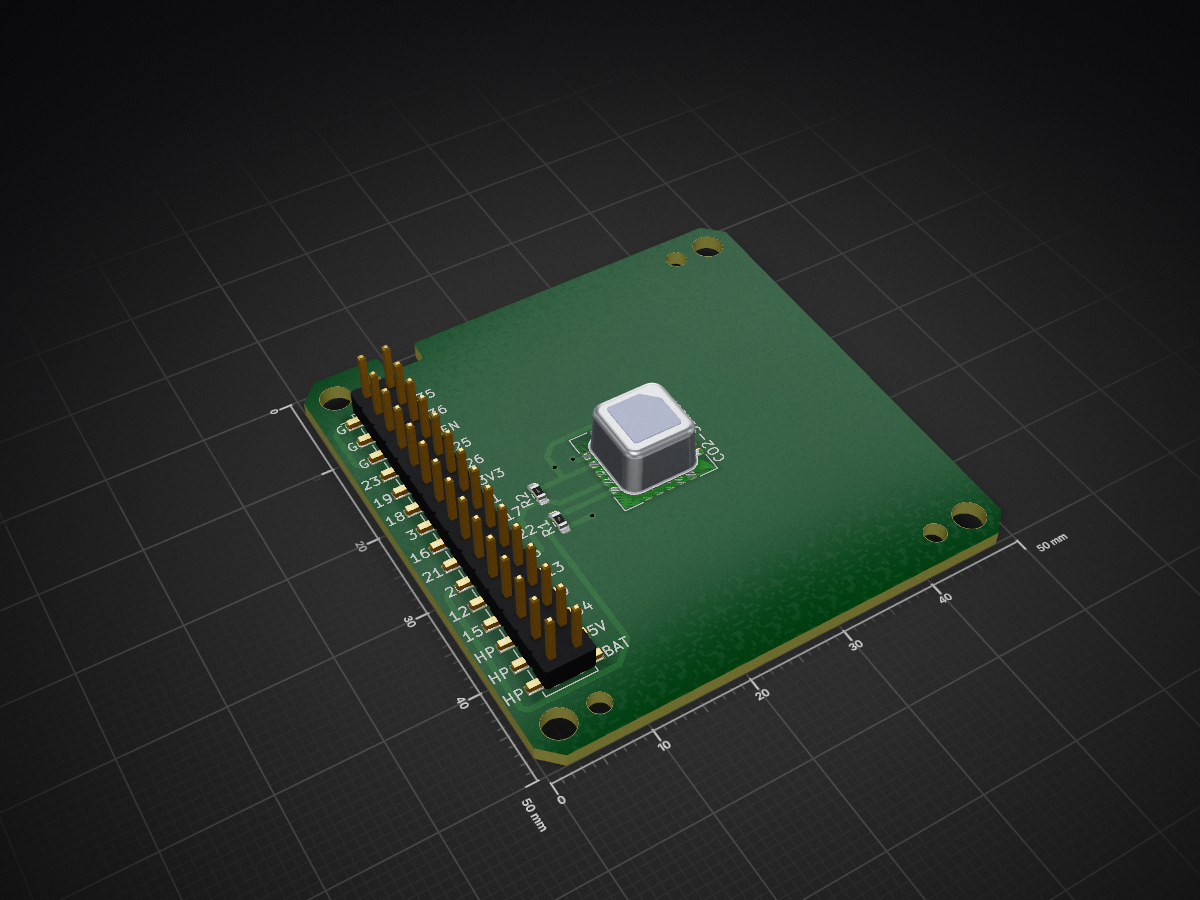
Bf-021 is an open-source printed circuit board by smoca-ag, from the smoca-ag/m5stack_co2_sensor repository on GitHub. It is a 2-layer board of 50 × 50 mm with 12 parts on 25 nets, routed with 58 tracks and 3 vias.
It is built around the SCD40-D-R2. Its parts include 2 resistors and 1 connector. It belongs with the sensors and measurement boards of this library.
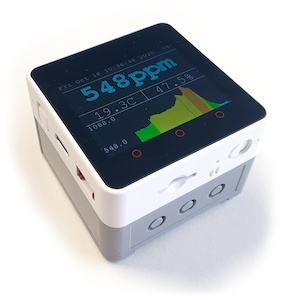
CO₂ levels measured indoors can be used as an indicator of air quality.
Outdoor air has a CO₂ ppm level of 400 ppm. Humans exhale air with 40000 ppm. You can calculate the percentage of exhaust air you are breathing by dividing measured CO₂ level above outdoor by the human exhaust level. Used air might contain aerosols which might contain the corona virus.
High indoor CO₂ levels also have an impact on the cognitive performance of humans.
Smoca AG decided to build this easy to reproduce CO₂ measuring device to help slow the spread of the corona virus in offices. It supports its users in deciding when ventilating the room begin monitored is advisable. It also raises awareness for the correlation between CO₂ level and air quality.
The following hardware is needed:
| description | cost | link |
|---|---|---|
| Sensirion SCD30 | 54 USD | https://www.digikey.com/en/products/detail/sensirion-ag/SCD30/8445334 Switzerland: https://www.bastelgarage.ch/co2-sensor-scd30-sensirion |
| M5 Stack Core2 | 39.9 USD | https://www.digikey.com/en/products/detail/m5stack-technology-co-ltd/K010/13151126?s=N4IgTCBcDaILYFYDOAXAhgYwNYAIMHsAnAUwgF0BfIA Switzerland: https://www.bastelgarage.ch/m5stack-core2-esp32-iot-entwicklungs-kit |
| M5 Stack Proto Board | 2.95 USD | https://www.digikey.com/en/products/detail/m5stack-technology-co-ltd/M001/10492145 Switzerland: https://www.bastelgarage.ch/m5stack-core-development-proto-board |
| M5 Stack PLC Base | 9.95 USD | https://m5stack.com/collections/m5-base/products/plc-proto-industrial-board-module Switzerland: https://www.bastelgarage.ch/m5stack-plc-proto-base-industrial-board |
| M5 Stack Battery (optional) | 7.95 USD | https://www.digikey.com/en/products/detail/m5stack-technology-co-ltd/M002/10492127 Switzerland: https://www.bastelgarage.ch/m5stack-battery-module-700mah-fur-esp32-core |
Note: The optional battery increases the battery operation time from 6 to 10 hours.
| Description | Image |
|---|---|
| 1. Power the Core2 module. A factory test application should be loaded. Test the device. | |
| 2. Remove the bottom of the Core2 module. Keep the battery there or replace it with the optional bigger one. | 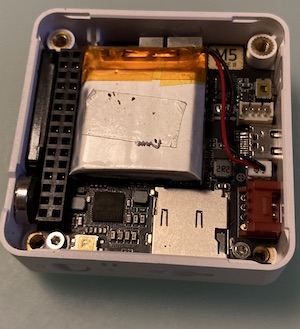 |
| 3. Remove the PCB from the proto module. | |
| 4. Connect the SCD30 module to the proto module. We used pin headers. | 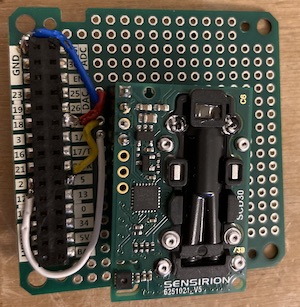 |
| 5. Connect VDD with 3V3, GND with GND, TX/SCL with pin 5 and RX/SDA with pin 2. The other pins don't need to be connected to the proto module. | 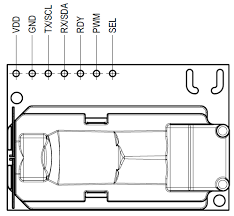 |
| 5. Screw the proto module to the PLC Base | |
| 6. Screw the PLC Base to the Core2 module | 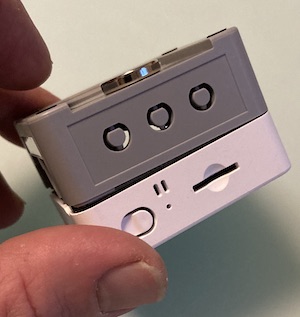 |
| 7. HW Done, load the software |
To initialise the device do the following:
co2-sensor project foldermain.cpp script to your M5 Stack Core2 with pio run -t upload --upload-port {your_device}. You can see a list of your devices with pio device list. Dependencies are installed automatically.The SCD30 can be calibrated manually or automatically. For manual calibration, the device must be placed outdoors for at least five minutes. Then the calibration can be adjusted. Fresh air has a CO₂ concentration of about 400 ppm. To use automatic calibration, the device must have access to fresh air for at least one hour a day.
To use MQTT, synchronization and update functionality the device must have internet connection. To add WiFi credentials the device opens an access point with a web interface (Default IP is 192.168.4.1).
MQTT can be used to send the sensors data to a custom MQTT broker. Server, Port, Topic, Device name, Username and Password can also be configured in the web interface. Each minute the device sends its data in the following format: {TOPIC}/{CATEGORY} {VALUE}. Here an example: sensor/co2 650.
Topics are able to have subtopics: office2/meeting_room1/co2 1100.
The following categories are provided by the device: /co2, /humidity, /temperature.
To keep time up to date the device synchronizes with a time server each night between two and three o'clock.
Is a new firmware available, it can manually be updated via WiFi.
Using SNMP you are able to read the values of the co2, temperature and humidity sensors and also check the battery status of the device:
net-snmp-config --default-mibdirs./snmp-mib/sensorhub.mib into one of the listed directories. e.g. cp snmp-mib/sensorhub.mib ~/.snmp/mibssnmptable -m +SENSORHUB-MIB -c public {IP-Address} shSensorTable
SNMP table: SENSORHUB-MIB::shSensorTable

shSensorName
        SCD30
BATTERYsnmptable -m +SENSORHUB-MIB -c public {IP-Address} shMeasurementTable
SNMP table: SENSORHUB-MIB::shMeasurementTable

shMeasurementType shMeasurementValue
            co2                  617
    temperature                  207
       humidity                  433
        voltage                  3
electricCurrent 276Disclaimer This is not a safety device. Always follow the local regulations regarding corona safety. No warranty is provided
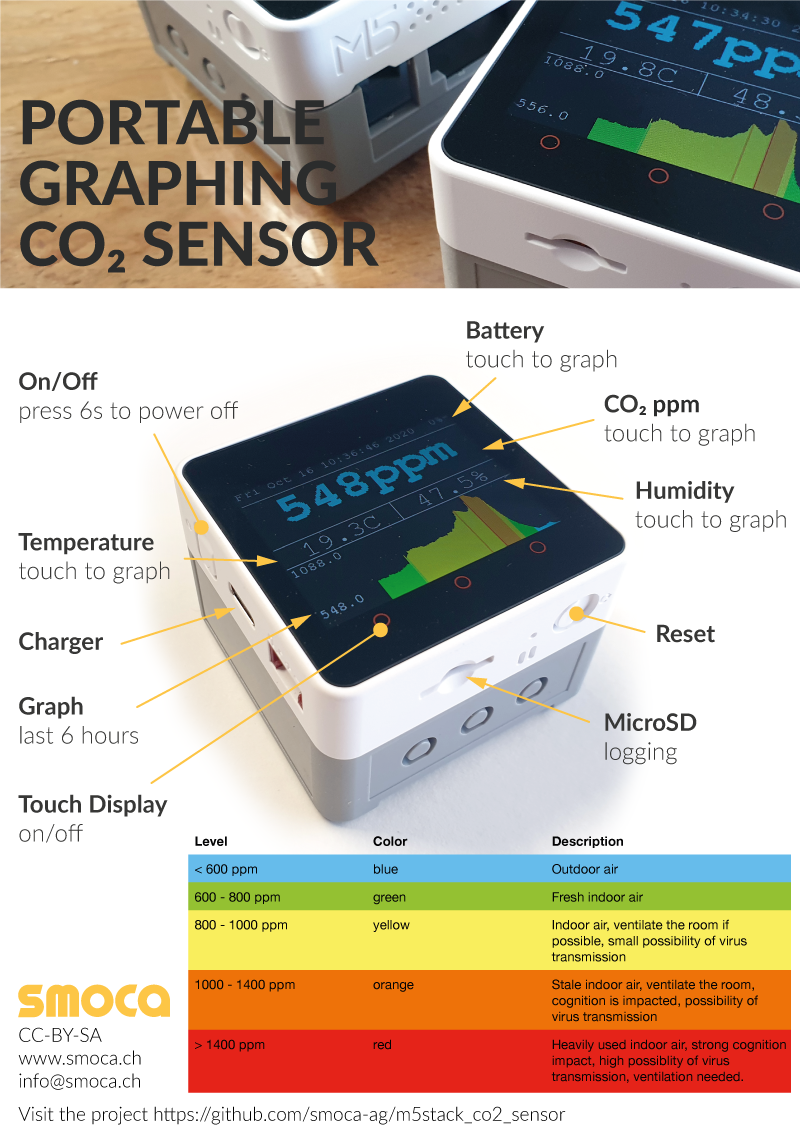
If a microsd card formated with fat is present, a csv file, data.txt will be written every 2 seconds with the timestamp, the co2 level, the humidity, the temperature and the current battery charge.
| level | color | description |
|---|---|---|
| < 600 ppm | blue | outdoor air |
| 600 - 800 ppm | green | fresh indoor air |
| 800 - 1000 ppm | yellow | indoor air, ventilate the room if possible, small possibility of virus transmission |
| 1000 - 1400 ppm | orange | used indoor air, ventilate the room, cognition is impacted, possibility of virus transmission |
| > 1400 ppm | red | heavy used indoor air, heavy cognition impact, high possiblity of virus transmission, ventilation needed. |
There is a PCB in the PCB folder for SCD41 Support. The Code Supports transparently SCD40 and SCD30 at the moment.
If you have any suggestions for the project feel free to file an issue. If you want to build the device on a bigger scale / have any other development / prototyping needs, feel free to contact us: info@smoca.ch
Copyright (c) 2020 David Gunzinger / smoca AG www.smoca.ch
Code: GPL v3
Text / Graphics / Photographs: CC BY-SA
| Qty | Value | Footprint | References |
|---|---|---|---|
| 4 | MountingHole | bf:BF@MountingHole_2.2mm_M2 | H5, H6, H7, H8 |
| 4 | MountingHole | bf:BF@MountingHole_3.2mm_M3 | H1, H2, H3, H4 |
| 2 | 10k | Resistor_SMD:R_0603_1608Metric_Pad0.98x0.95mm_HandSolder | R1, R2 |
| 1 | M-BUS | bf:BF@M5Stack_MBUS | J1 |
| 1 | SCD40-D-R2 | Sensor:Sensirion_SCD4x-1EP_10.1x10.1mm_P1.25mm_EP4.8x4.8mm | CO2-Sensor |

emertcakir/OpenAirScope
Open-source air quality and environmental monitoring node with STM32H743 + ESP32-C3, LoRaWAN, RS485, USB-C, Li-ion charging, and multi-sensor support.

cscott/watchy-co2-pcb
Simple PCB to mount the Sensirion SCD40 CO2 sensor next to Watchy


romkey/pdxhackerspace-portable-co2-monitor
Open source hardware and software portable CO2/air quality monitor

Daniel-Abdi/Matter-CO2-AirQuality-Sensor
Create an ESP32-C6 based air quality sensor for Matter. Grab CO2 concentration in real time and update in any Matter compatible app.

nobodyguy/zigbee_air_quality_monitor_hardware
Opensource HA compatible air quality monitor with CO2, temperature and humidity measurements

AkilaA25/Spoilage-Monitor_PCB
Battery-powered PCB that detects food spoilage in a fridge using a BME680 (VOC/humidity) and SCD40 (CO₂) sensor pair, an MSP430FR2355 MCU, and an IoT module header for phone connectivity.
It measures 50 × 50 mm and has 2 copper layers, 1.6 mm thick.
12 parts, built around the SCD40-D-R2. The full list of its parts is on this page, with links to each part's symbol and footprint where PCBKit's library has them.
From the smoca-ag/m5stack_co2_sensor repository on GitHub, at the commit this page was made from: the board is pcb/bf-021.kicad_pcb and its schematic pcb/bf-021.kicad_sch. PCBKit opens the board in the browser, with nothing to install.
Its repository states no licence, so its author keeps all rights: ask smoca-ag before reusing the design.