
2 layers101.6 × 53.3 mm
BatteryAnalyzer MkII
Moragor/BatteryAnalyzer_MkII
Updated Version of the battery analyzer, now with constant current
25 parts12MIT
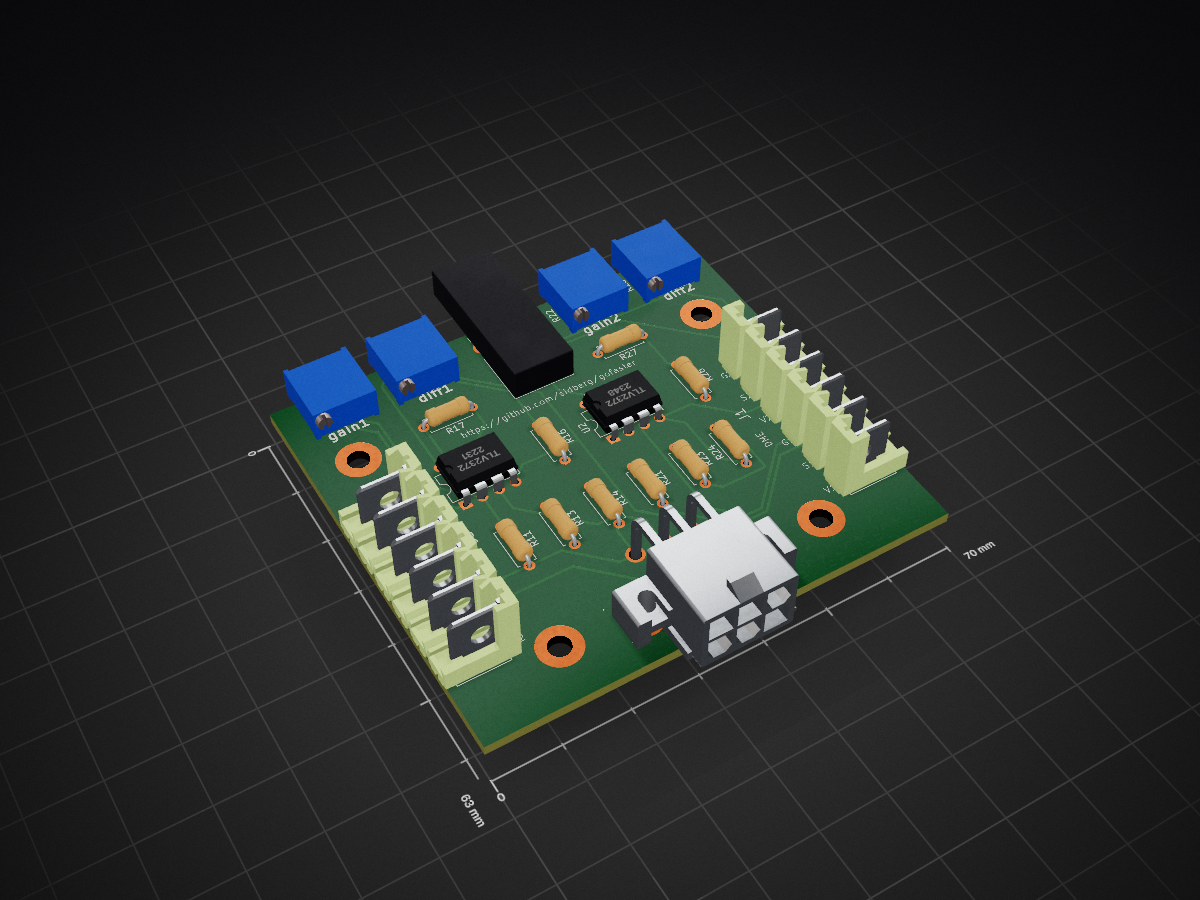
 sidberg/gofaster
BMW auxiliary accelerator adapter
Gofaster is an open-source printed circuit board by sidberg, from the sidberg/gofaster repository on GitHub. It is a 2-layer board of 70 × 63 mm with 24 parts on 26 nets, routed with 190 tracks and 1 via.
It is built around the TLV2372IP. Its parts include 14 resistors, 3 connectors, 2 ICs and 1 switch.
| Qty | Value | Footprint | References |
|---|---|---|---|
| 10 | 100K | Resistor_THT:R_Axial_DIN0207_L6.3mm_D2.5mm_P7.62mm_Horizontal | R11, R13, R14, R16, R17, R21, R23, R24, R26, R27 |
| 2 | 1M | Potentiometer_THT:Potentiometer_Bourns_3339S_Horizontal | R15, R25 |
| 2 | 50K | Potentiometer_THT:Potentiometer_Bourns_3339S_Horizontal | R12, R22 |
| 2 | TLV2372 | Package_DIP:DIP-8_W7.62mm | U1, U2 |
| 1 | DME | gofaster-library:CUI_TB002-500-06BE | J1 |
| 1 | Foot | gofaster-library:CUI_TB002-500-06BE | J3 |
| 1 | Hand | gofaster-library:39294069 | J2 |
| 1 | SW_Slide_DPDT | gofaster-library:PBH2UEEKZXNAG1RBLK | SW1 |
The 20 most common of 24 parts.
Moragor/BatteryAnalyzer_MkII
Updated Version of the battery analyzer, now with constant current


devjamescollier/STM-32_Based_Waveform_Generator
USB-powered programmable function generator built around an STM32C031K6T6 microcontroller and MCP4901 DAC. Generates clean sine, triangle, and square waveforms with amplitude control via potentiometer, mode selection…

dnz1666/impedance-buffer-pcb
Analog circuit design (impedance buffer + LP filter) – KiCad schematic & PCB layout for a student EV project at RWTH Aachen


jensboe/Modellbahn
columns 1 block:selfmade block:base columns 1 nucleo adapter["adapter board A"] end space expansion1["expansion board A 1"] space expansionn["expansion board A n"] space expansionb["expansion board B"] adapter…

jkbkwcn/harm_meas_using_os
An electronic circuit project designed to measure mains current harmonics with amplitudes below one Least Significant Bit (LSB) of an Analog-to-Digital Converter.

JohnRipple/turbine-sensor
After taking a look at the kit it was lacking content. It could be built in about 10 minutes. With a 45 minute time slot for each class there was a lot of time to fill, so I decided to make a more interesting turbine…
It measures 70 × 63 mm and has 2 copper layers, 1.6 mm thick.
24 parts, built around the TLV2372IP. The full list of its parts is on this page, with links to each part's symbol and footprint where PCBKit's library has them.
From the sidberg/gofaster repository on GitHub, at the commit this page was made from: the board is gofaster.kicad_pcb and its schematic gofaster.kicad_sch. PCBKit opens the board in the browser, with nothing to install.
Its repository states no licence, so its author keeps all rights: ask sidberg before reusing the design.