
2 layers99 × 90 mm

An all in one smart home automation board!
Nif T is an open-source printed circuit board by SharKingStudios, from the SharKingStudios/Nif-T repository on GitHub, published under the MIT licence. It is a 4-layer board of 100 × 100 mm with 115 parts on 124 nets, routed with 1,323 tracks and 298 vias.
It is built around the CH340C, DP1435-5V and LAN8720A-CP-TR, with the AMS1117-3.3, SK6812 and 1N4148W-E3-08 among its other parts. Its parts include 22 diodes, 20 capacitors, 15 resistors, 11 ICs and 8 transistors. It belongs with the home automation and IoT boards and the ESP32 boards of this library.


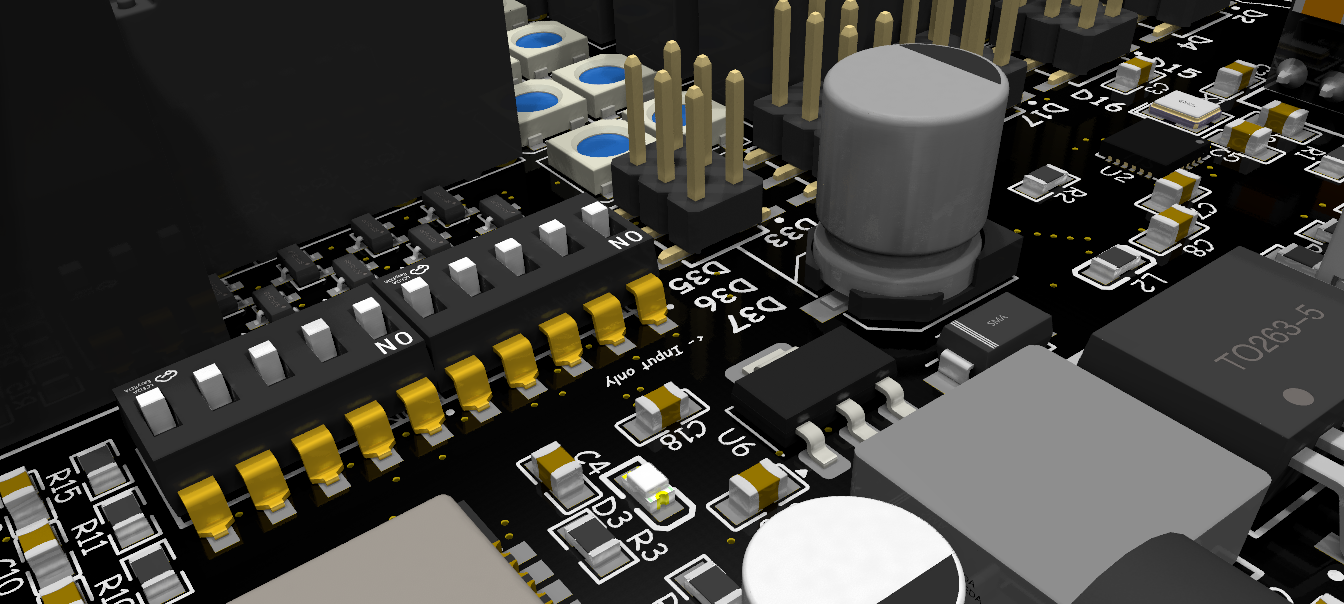
Visuals because everyone loves eye candy.
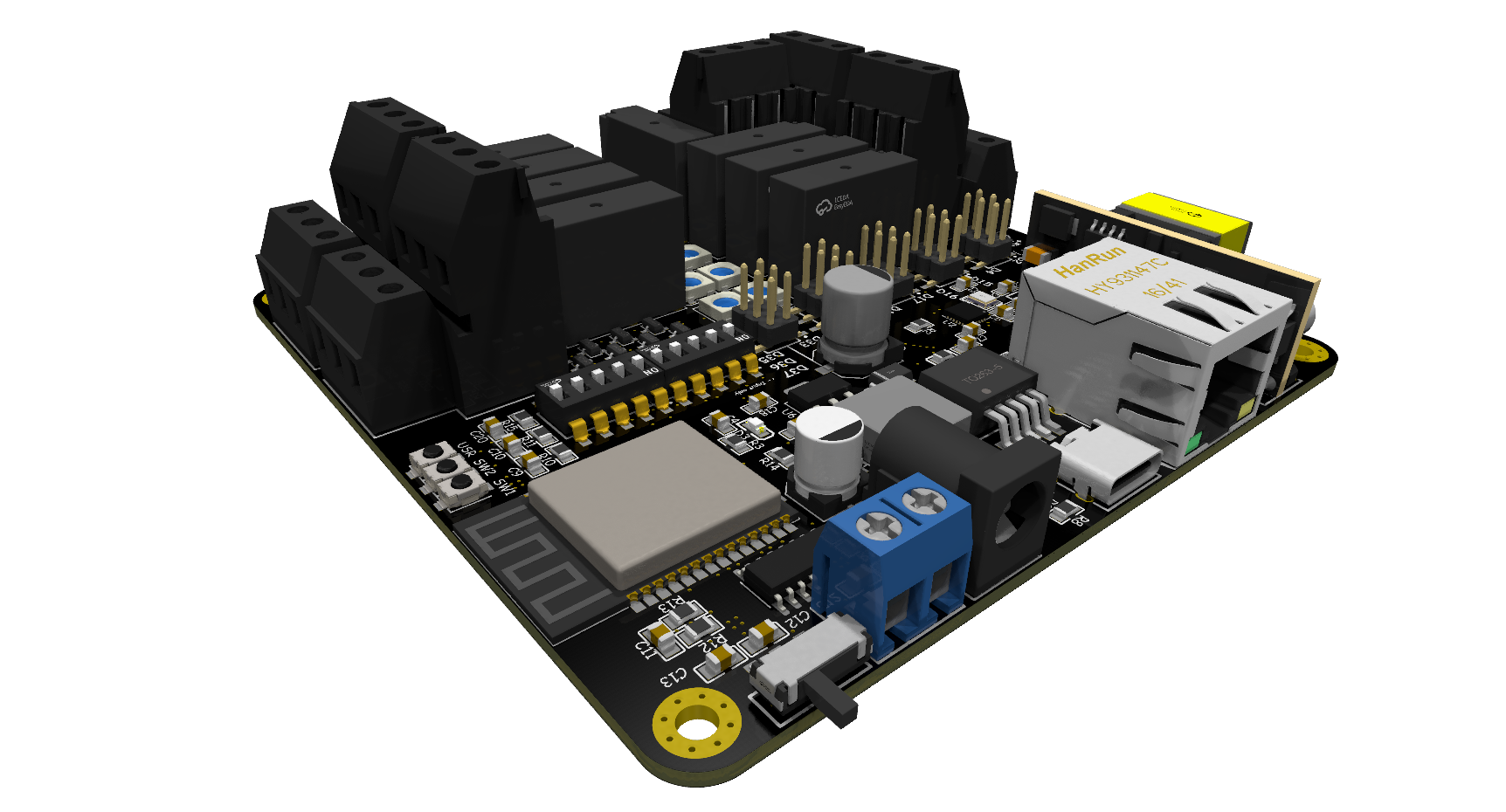
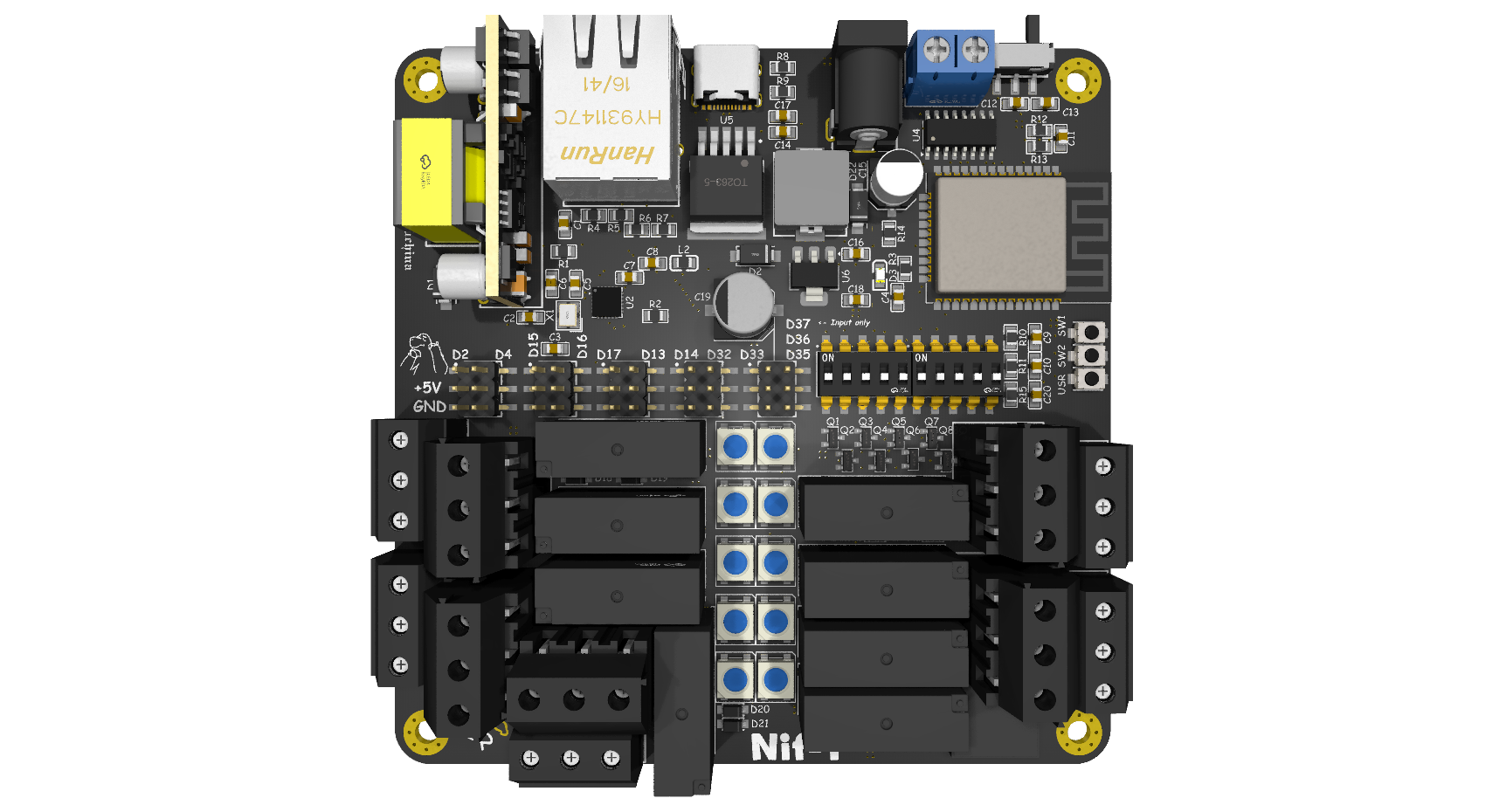
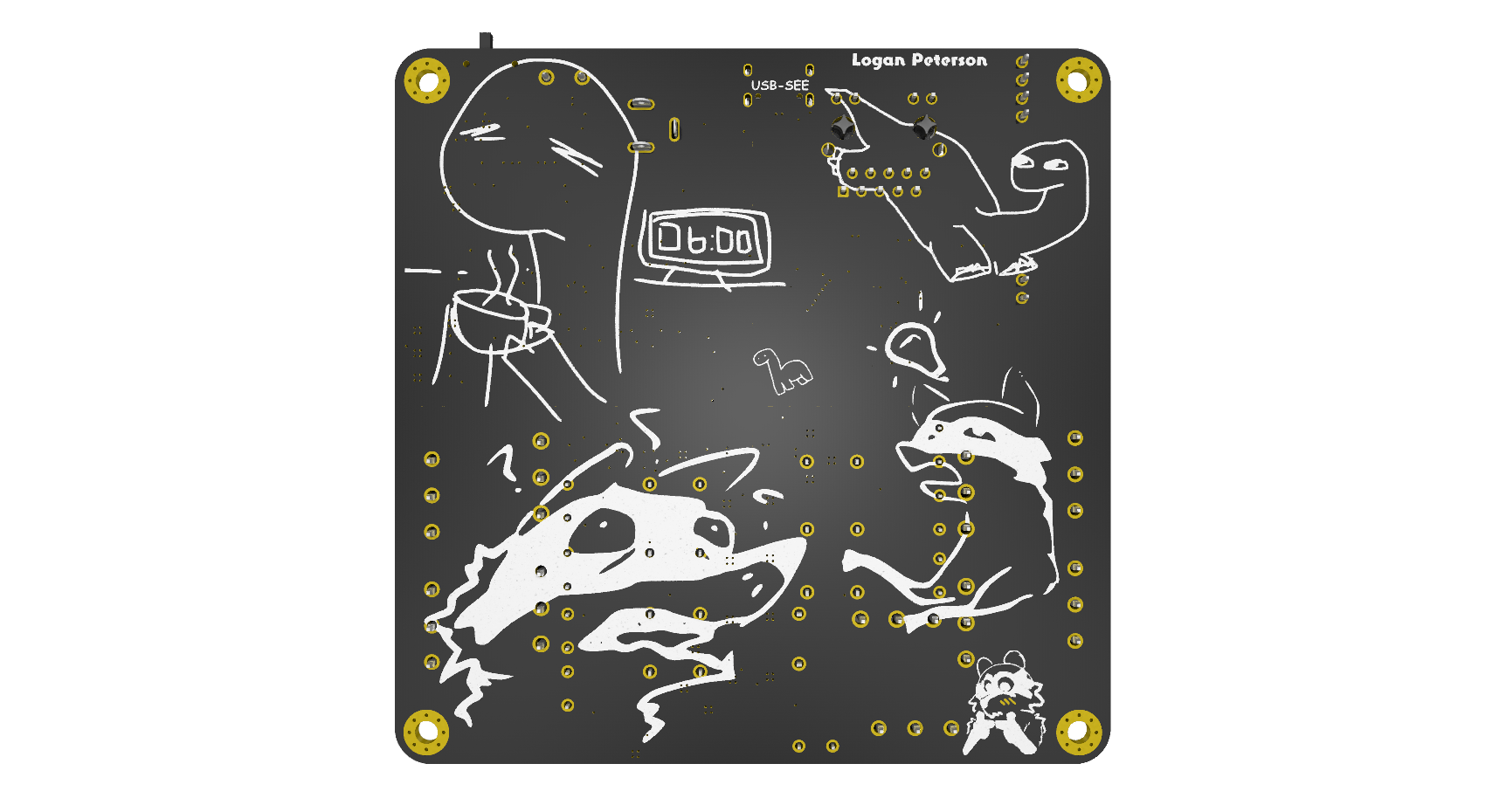
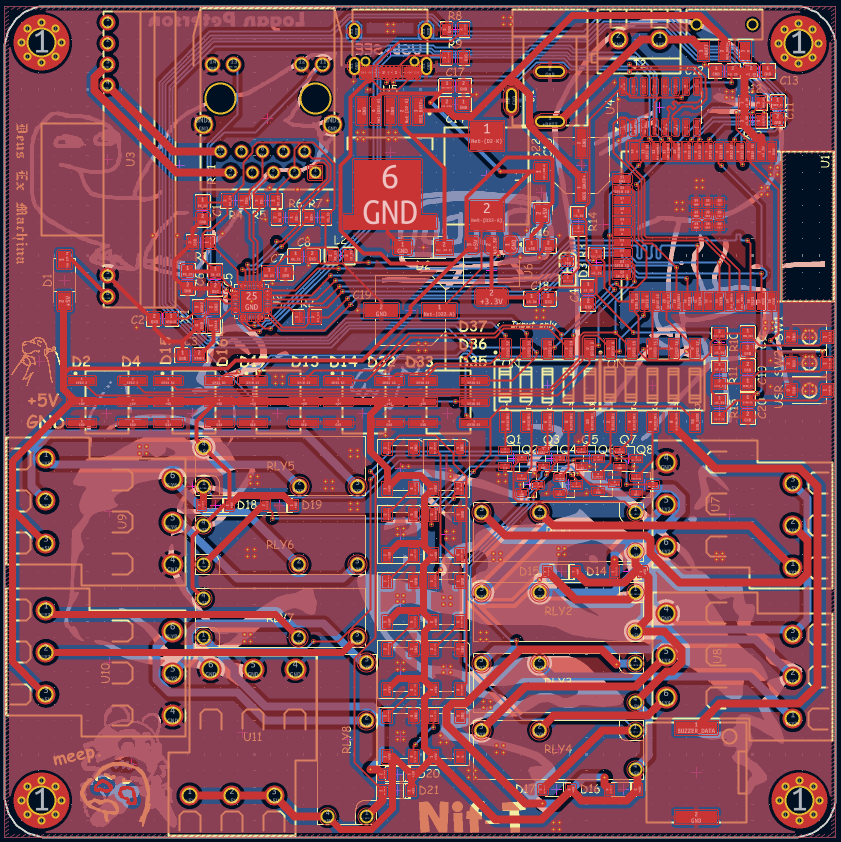
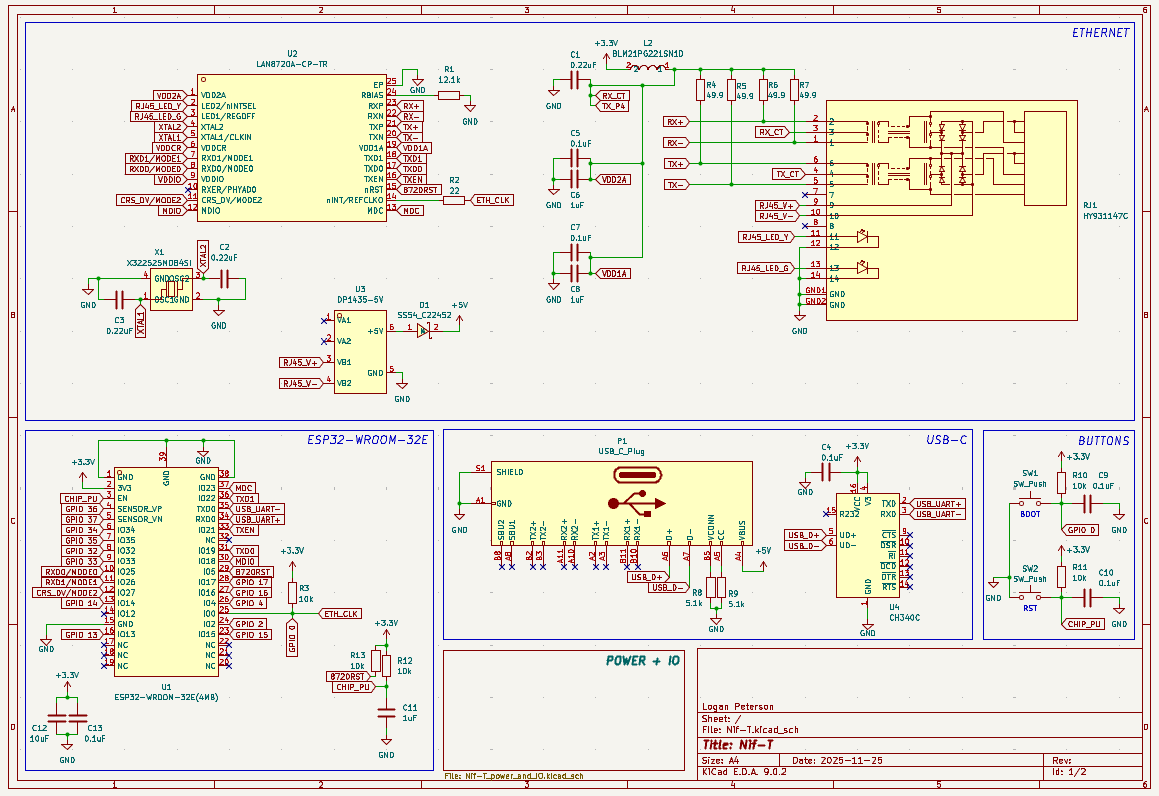
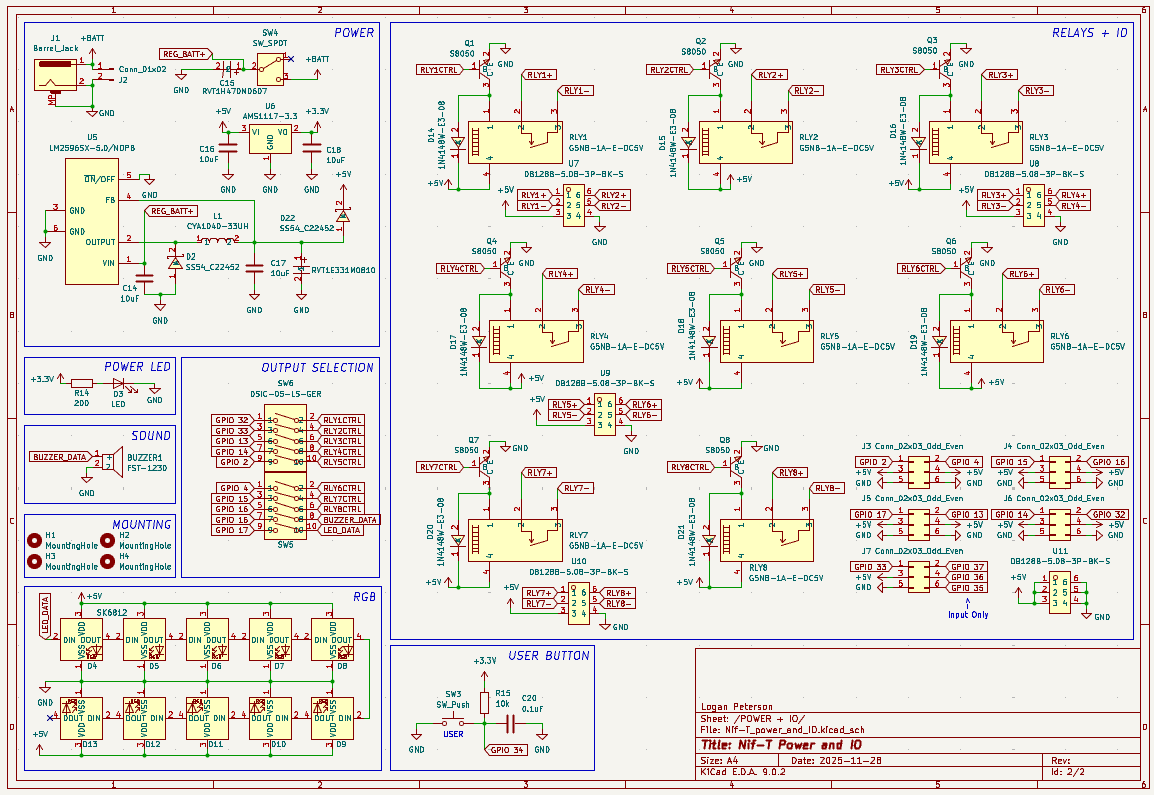
The middle ground planes are hidden in the PCB Routing render
All the silicon, magnetics, and clicky-relay goodness live here.
Main characters:
(See BOM.md for full part values, footprints, and sourcing.)
Nif-T is a wired smart-home automation controller built around an ESP32-WROOM-32E, designed to be the thing that actually flips real switches when you ask your house to do something.
It’s meant for:
Unlike a lot of Wi-Fi-only smart devices, Nif-T speaks Ethernet — and it can be powered over the same cable using PoE. One cable in, automation out.
At a high level, Nif-T:
“Hey Google, turn on the big light.”
…and something actually happens.
(Please don’t hot-switch mains unless you know what you’re doing.)
Because reliability matters — and wall warts are annoying.
Plug in Ethernet. That’s it.
Because silent boards are boring.
| Function | Notes |
|---|---|
| Relays | 8× GPIO-controlled outputs |
| LED Data | SK6812 GRBW strip (10 LEDs) |
| Ethernet RMII | LAN8720A w/ external 50 MHz oscillator |
| PoE Input | IEEE 802.3af compliant |
| User Button | Input-only GPIO (external pull-ups) |
| Buzzer | GPIO-driven piezo output |
(See schematic for full pin mapping and signal names.)
At a high level:
Because:
Nif-T exists to be:
Ideas, improvements, and constructive roasting welcome.
This project is open-source, built for fun, and tested only in theory.
If you:
That’s on you.
Be careful, be smart, and enjoy having a house that actually listens.
| Qty | Value | Footprint | References |
|---|---|---|---|
| 10 | SK6812 | LED_SMD:LED_SK6812_PLCC4_5.0x5.0mm_P3.2mm | D4, D5, D6, D7, D8, D9, D10, D11, D12, D13 |
| 8 | 1N4148W-E3-08 | new_imported_components:SOD-123_L2.8-W1.8-LS3.7-RD | D14, D15, D16, D17, D18, D19, D20, D21 |
| 8 | G5NB-1A-E-DC5V | new_imported_components:RELAY-TH_G5NB-1A-E-DCXX | RLY1, RLY2, RLY3, RLY4, RLY5, RLY6, RLY7, RLY8 |
| 8 | LOGO | LOGO | G***, G***, G***, G***, G***, G***, G***, G*** |
| 8 | S8050 | new_imported_components:SOT-23-3_L2.9-W1.3-P1.90-LS2.4-BR | Q1, Q2, Q3, Q4, Q5, Q6, Q7, Q8 |
| 7 | 0.1uF | imported_components:C0805 | C4, C5, C7, C9, C10, C13, C20 |
| 6 | 10k | imported_components:R0805 | R3, R10, R11, R12, R13, R15 |
| 5 | 10uF | imported_components:C0805 | C12, C14, C16, C17, C18 |
| 5 | Conn_02x03_Odd_Even | imported_components:HDR-SMD_6P-P2.54-V | J3, J4, J5, J6, J7 |
| 5 | DB128B-5.08-3P-BK-S | new_imported_components:CONN-TH_DB128B-5.08-3P-XX-S | U7, U8, U9, U10, U11 |
| 4 | 49.9 | imported_components:R0805 | R4, R5, R6, R7 |
| 4 | MountingHole | MountingHole:MountingHole_3.2mm_M3_Pad_Via | H1, H2, H3, H4 |
| 3 | 0.22uF | imported_components:C0805 | C1, C2, C3 |
| 3 | 1uF | imported_components:C0805 | C6, C8, C11 |
| 3 | SS54_C22452 | imported_components:SMA_L4.4-W2.8-LS5.4-R-RD | D1, D2, D22 |
| 3 | SW_Push | imported_components:SW-SMD_L3.9-W3.0-P4.45 | SW1, SW2, SW3 |
| 2 | 5.1k | imported_components:R0805 | R8, R9 |
| 2 | DSIC-05-LS-GER | new_imported_components:SW-SMD_DSIC-05-LS-GER | SW5, SW6 |
| 1 | 12.1k | imported_components:R0805 | R1 |
| 1 | 200 | imported_components:R0805 | R14 |
| 1 | 22 | imported_components:R0805 | R2 |
| 1 | AMS1117-3.3 | Package_TO_SOT_SMD:SOT-223-3_TabPin2 | U6 |
| 1 | BLM21PG221SN1D | new_imported_components:L0805 | L2 |
| 1 | Barrel_Jack | imported_components:DC-IN-TH_DC-005-A200 | J1 |
| 1 | CH340C | Package_SO:SOIC-16_3.9x9.9mm_P1.27mm | U4 |
| 1 | CYA1040-33UH | imported_components:IND-SMD_L11.6-W10.1 | L1 |
| 1 | Conn_01x02 | imported_components:CONN-TH_P5.00_KF301-5.0-2P | J2 |
| 1 | DP1435-5V | new_imported_components:PWRM-TH_DP1435-XX | U3 |
| 1 | ESP32-WROOM-32E(4MB) | new_imported_components:WIFI-SMD_ESP32-WROOM-32E | U1 |
| 1 | FST-1230 | imported_components:BUZ-SMD_L12.0-W12.0_FUET-1230 | BUZZER1 |
| 1 | HY931147C | new_imported_components:RJ45-TH_HY931147C | RJ1 |
| 1 | LAN8720A-CP-TR | new_imported_components:QFN-24_L4.0-W4.0-P0.50-BL-EP2.6 | U2 |
| 1 | LED | imported_components:LED0805-RD | D3 |
| 1 | LM2596SX-5.0/NOPB | imported_components:TO-263-5_L10.2-W8.9-P1.70-TL | U5 |
| 1 | RVT1E331M0810 | imported_components:CAP-SMD_BD8.0-L8.3-W8.3-LS9.3-FD-1 | C19 |
| 1 | RVT1H470M0607 | imported_components:CAP-SMD_BD6.3-L6.6-W6.6-LS7.6-FD | C15 |
| 1 | SW_SPDT | imported_components:SW-SMD_MST-12D18G4-SPDT-SLIDE-SWITCH | SW4 |
| 1 | USB_C_Plug | imported_components:USB-C_SMD-TYPE-C-31-M-12 | P1 |
| 1 | X322525MOB4SI | new_imported_components:CRYSTAL-SMD_4P-L3.2-W2.5-BL | X1 |
It measures 100 × 100 mm and has 4 copper layers, 1.6 mm thick.
115 parts, built around the CH340C, DP1435-5V, LAN8720A-CP-TR and AMS1117-3.3. The full list of its parts is on this page, with links to each part's symbol and footprint where PCBKit's library has them.
From the SharKingStudios/Nif-T repository on GitHub, at the commit this page was made from: the board is PCB/Nif-T.kicad_pcb and its schematic PCB/Nif-T.kicad_sch. PCBKit opens the board in the browser, with nothing to install.
Its repository publishes it under the MIT licence: you may reuse it on that licence's terms (keep the author's notice, and for a copyleft licence share your changes alike).

SharKingStudios/Fracture
An infinitely expandable, velocity sensing split midi keyboard.


Andreuxxx1977/esp32-p4
An open-hardware, actively cooled ESP32-P4 board for heavy multimedia work: a 2-lane MIPI camera, a 2-lane MIPI display, USB 2.0 High-Speed, 10/100 Ethernet, UHS-I microSD, 32 MB flash and 32 MB PSRAM.


MF-Room/mseq_pcb
KiCad 10 hardware design for MSeq embedded, the microcontroller implementation of the MSeq MIDI sequencer.

azais-corentin/espion
Multi-camera IR marker tracking: ESP32-P4/C5 firmware, Rust host, KiCad hardware

dotstartech/wall-panel
Wall mounted 4 inch touch display panel with CM4 inside