ESPHome Indoor Multi Sensor
mikelawrence/esphome-indoor-multi-sensor-hardware
ESPHome Indoor Multi-Sensor hardware. This design supports Radar/PIR Presence, Temperature, Humidity, Pressure, Light, CO2, CO, VOC, NOX and PM sensors.

ESPHome based all-in-one sensor
AIOsense is an open-source printed circuit board by Schluggi, from the Schluggi/AIOsense repository on GitHub, published under the MIT licence. It is a 2-layer board of 56.4 × 78.4 mm with 25 parts on 45 nets, routed with 240 tracks and 4 vias.
It is built around the GY-302, EKMC1603111 and INMP441, with the HLK-LD2410C and HLK-LD2450 among its other parts. Its parts include 11 connectors and 5 ICs. It belongs with the home automation and IoT and sensors and measurement boards and the ESP32 boards of this library.
Based on the idea of an all-in-one sensor AIOsense was born.
The goal is to provide you with a sensor that is modular, affordable and easy to solder (no SMD) as an alternative for commercially available sensors. We also focus on upgrade-ability, so you don't have to buy all parts again in case of a new PCB release. In most cases, this sensor is cheaper and better than the commercially ones.
Coming soon:
All supported sensors & modules are listed in the documentation: Sensor Modules
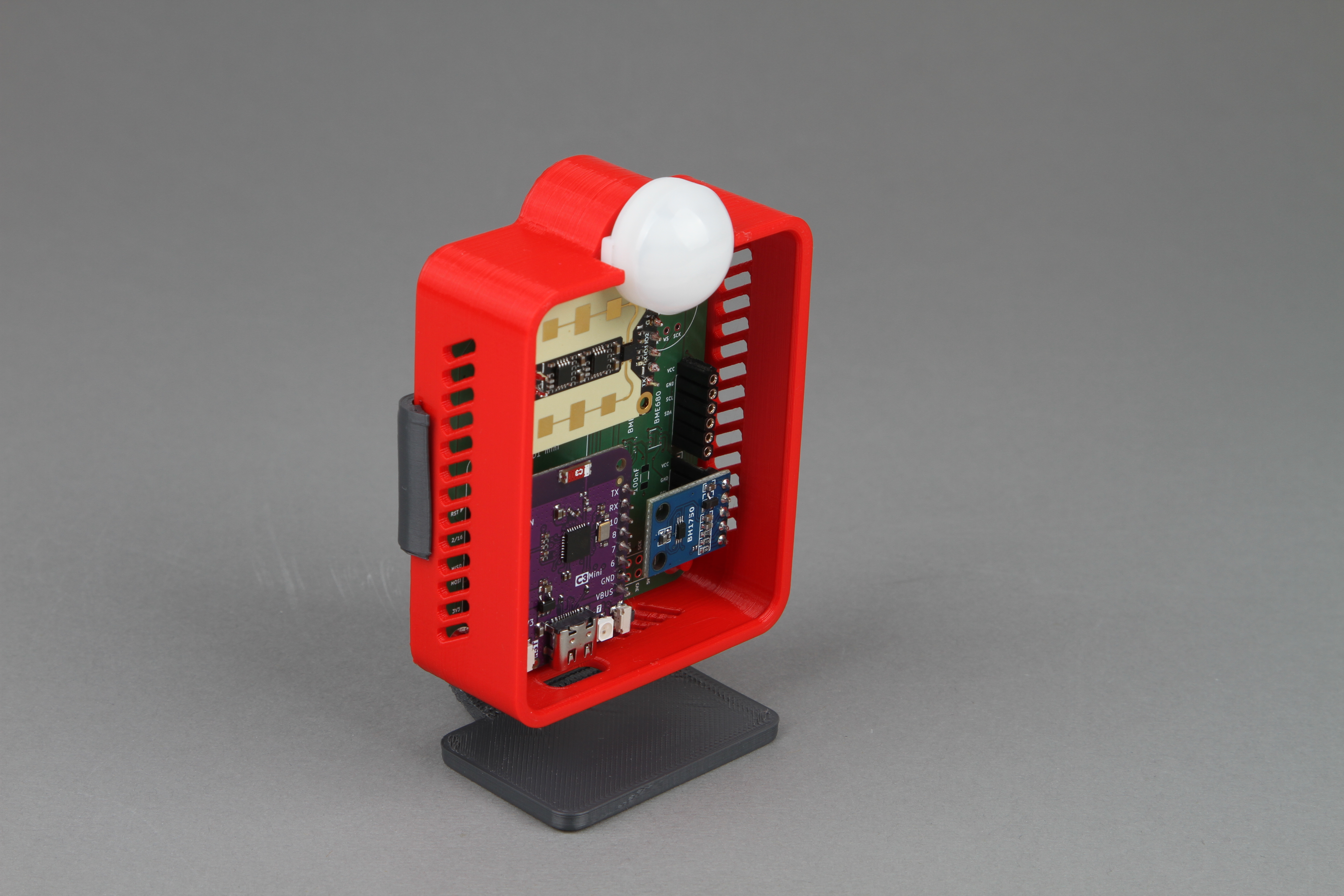
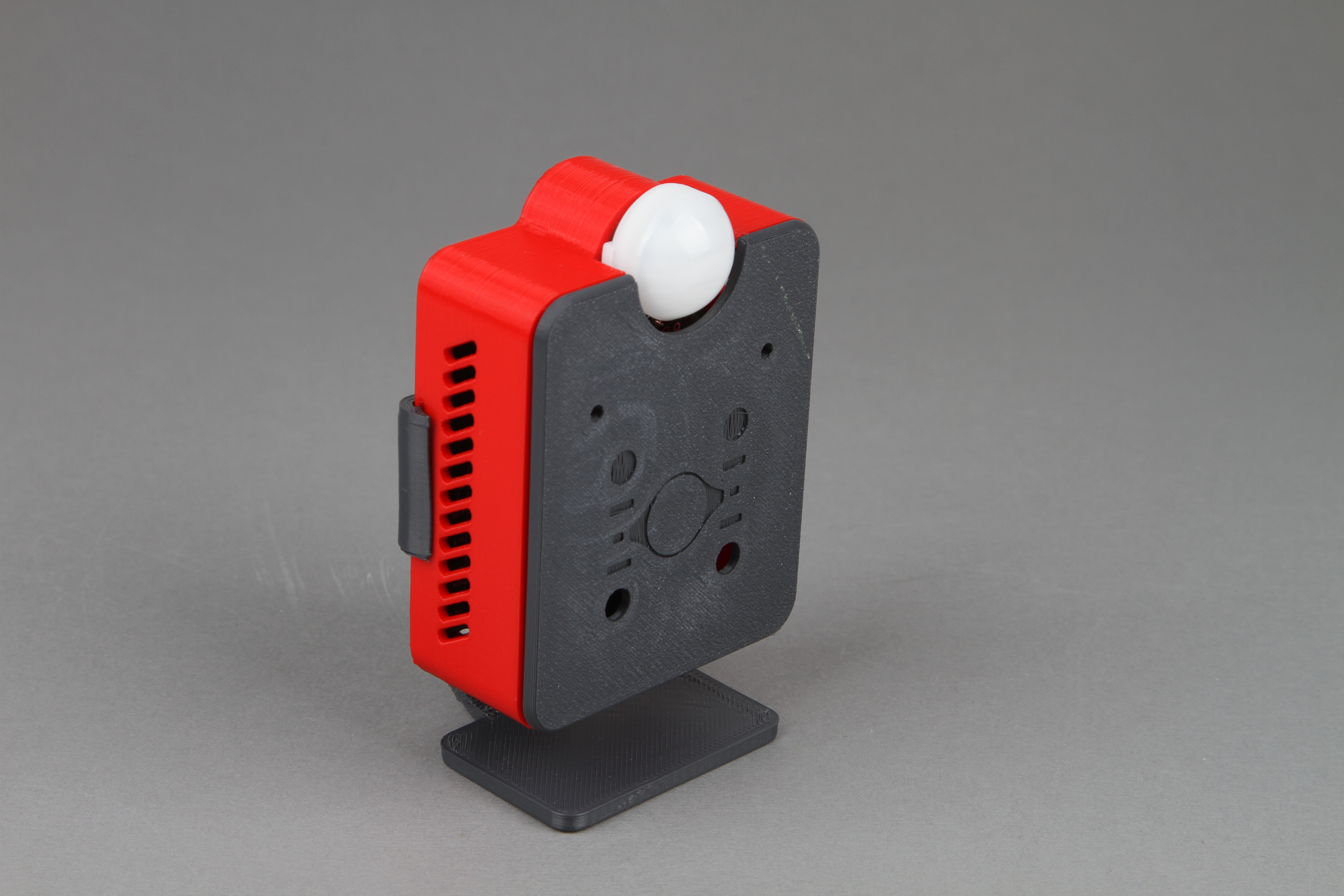
| Without lid | With lid |
|---|---|
Note: The PCB in this image is not fully equipped either is this the final case design (issue).
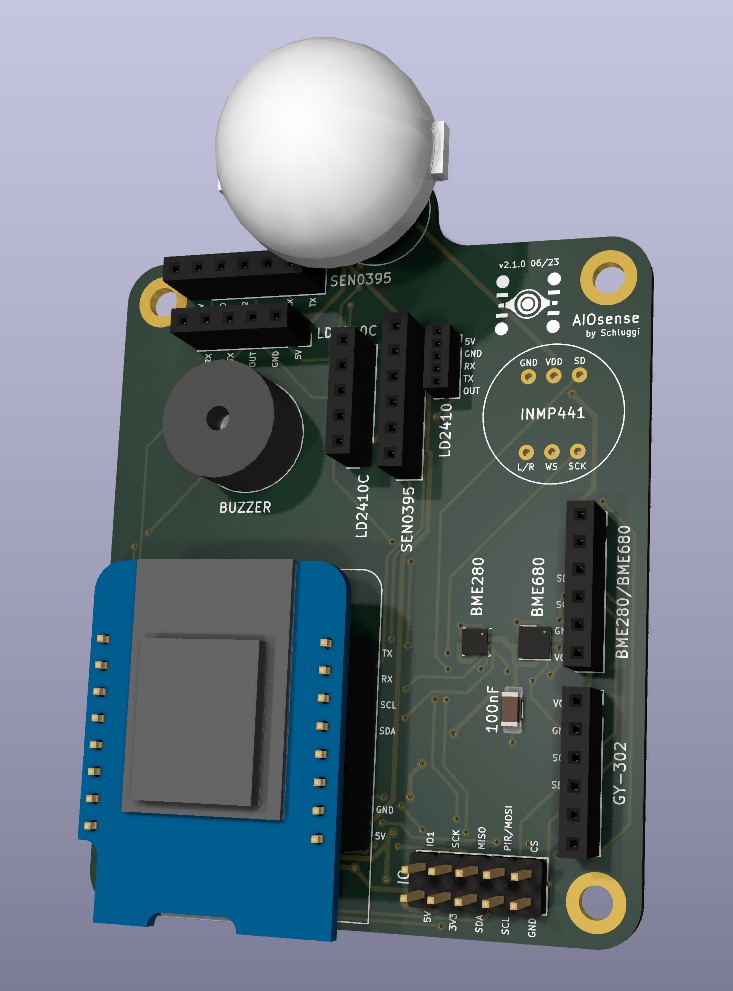
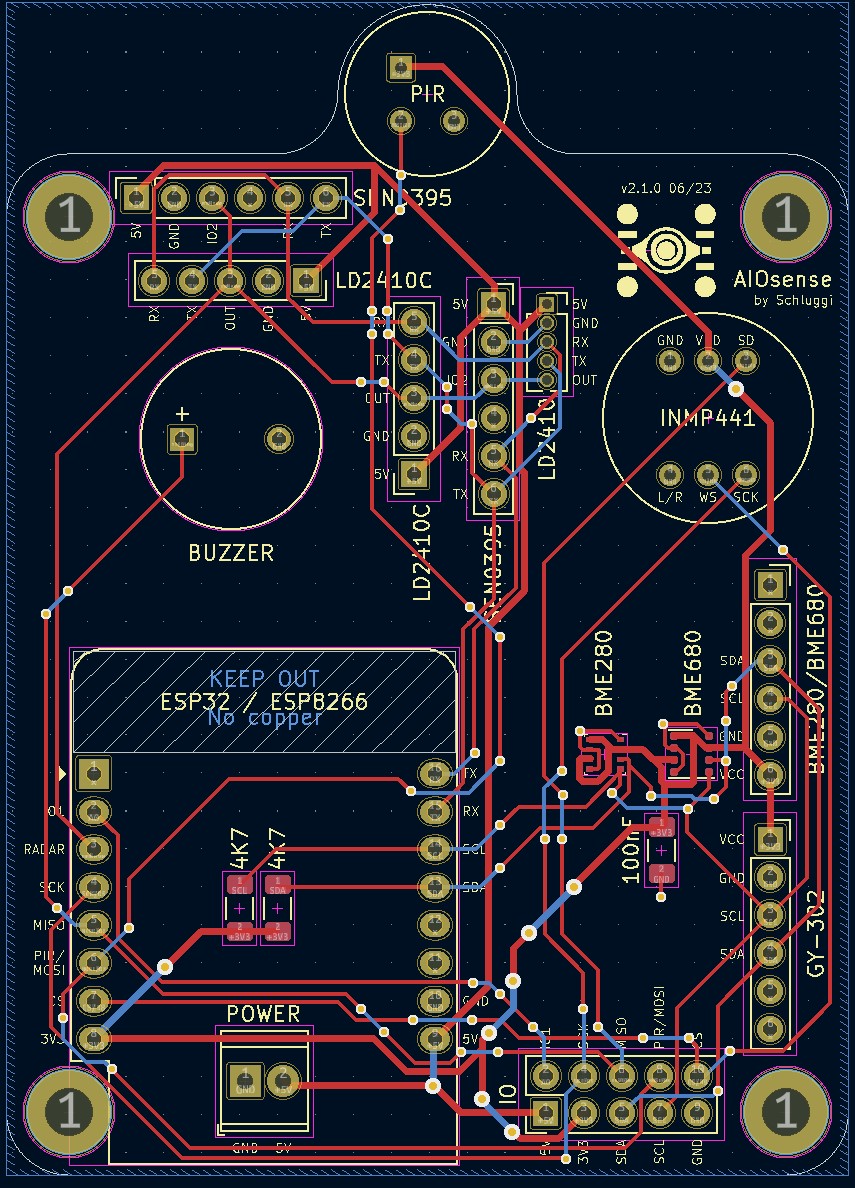
| 3D | 2D |
|---|---|
![]() | ![]() |
You can find the schematic here.
The power consumption depends on your configuration. On a fully equipped Board (ESP32-C3 + mmWave + PIR + BME280 + LightSensor) we measured an idle power consumption of 0.45W / 0.09A some peaks around 0.78W / 0.15A.
Without a mmWave sensor the idle power consumption is around 0.11W / 0.02A and peak near 0.45W / 0.09A.
You want to make your own AIOsense?
Let's jump right into the documentation.
Just open an issue :)
Created and maintained by Lukas Schulte-Tickmann / Schluggi.
Inspired by EverythingSmartHome.
| Qty | Value | Footprint | References |
|---|---|---|---|
| 4 | MountingHole | MountingHole:MountingHole_3.2mm_M3_DIN965_Pad | H1, H2, H3, H4 |
| 1 | 2307 | AIOsense:Speaker_2307 | LS1 |
| 1 | 3013 | AIOsense:Speaker_3013 | LS2 |
| 1 | BME280/BME680 | Connector_PinSocket_2.54mm:PinSocket_1x06_P2.54mm_Vertical | J7 |
| 1 | Conn_01x08_Pin | Connector_PinHeader_2.54mm:PinHeader_1x08_P2.54mm_Vertical | J11 |
| 1 | EKMC1603111 | AIOsense:PIR_EKMC1603111_TO-5 | U1 |
| 1 | GY-302 | Connector_PinSocket_2.54mm:PinSocket_1x06_P2.54mm_Vertical | J2 |
| 1 | HLK-LD2410 | Connector_PinSocket_1.27mm:PinSocket_1x05_P1.27mm_Vertical | J8 |
| 1 | HLK-LD2410C | Connector_PinSocket_2.54mm:PinSocket_1x05_P2.54mm_Vertical | J6 |
| 1 | HLK-LD2410C:alt | Connector_PinSocket_2.54mm:PinSocket_1x05_P2.54mm_Vertical | J9 |
| 1 | HLK-LD2450 | Connector_PinSocket_2.00mm:PinSocket_2x04_P2.00mm_Vertical | J10 |
| 1 | INMP441 | myStuff:INMP441 | U5 |
| 1 | LOGO | LOGO | G*** |
| 1 | MAX98357A | AIOsense:Adafruit_MAX98357A | U3 |
| 1 | RTTTL Buzzer | AIOsense:Buzzer_D12mm_P6.5mm | BZ1 |
| 1 | SEN0395 | Connector_PinSocket_2.54mm:PinSocket_1x06_P2.54mm_Vertical | J3 |
| 1 | SEN0395:alt | Connector_PinSocket_2.54mm:PinSocket_1x06_P2.54mm_Vertical | J4 |
| 1 | Sipeed_I2S_Mic | AIOsense:Sipeed_I2S_Mic | U4 |
| 1 | SpeakerWireHole | AIOsense:Hole_Unplated_3.0mm | H5 |
| 1 | WEMOS_S3_Mini | AIOsense:WEMOS_S3_Mini | U2 |
| 1 | external IO | Connector_PinHeader_2.54mm:PinHeader_2x05_P2.54mm_Vertical | J1 |
| 1 | external power | TerminalBlock_TE-Connectivity:TerminalBlock_TE_282834-2_1x02_P2.54mm_Horizontal | J5 |
It measures 56.4 × 78.4 mm and has 2 copper layers, 1.6 mm thick.
25 parts, built around the GY-302, EKMC1603111, INMP441 and HLK-LD2410C. The full list of its parts is on this page, with links to each part's symbol and footprint where PCBKit's library has them.
From the Schluggi/AIOsense repository on GitHub, at the commit this page was made from: the board is kicad/AIOsense/AIOsense.kicad_pcb and its schematic kicad/AIOsense/AIOsense.kicad_sch. PCBKit opens the board in the browser, with nothing to install.
Its repository publishes it under the MIT licence: you may reuse it on that licence's terms (keep the author's notice, and for a copyleft licence share your changes alike).

mikelawrence/esphome-indoor-multi-sensor-hardware
ESPHome Indoor Multi-Sensor hardware. This design supports Radar/PIR Presence, Temperature, Humidity, Pressure, Light, CO2, CO, VOC, NOX and PM sensors.


Gerafftes/Observatory
Experimental 1TX/4RX WiFi CSI system researching camera-free presence, movement, room position, heart rate, and breathing rate.

art-mon/orrery
This open-source project gathers small signals from the world and turns them into daily broadcasts of art, language, and atmosphere.

Markus4771/Fenstersteuerung
Dieser Ordner enthält historische KiCad-PCB-Zwischenstände der Hauptplatine.

AlexD717/HA-Sensor-Node
Sensor node featuring a temperature, humidity, and mmWave sensor

mgiesen/Magic-Tabmount
Der "Magic Tabmount" ist eine smarte Wandhalterung für das iPad (Generation 5 bis 9). Durch ein integriertes Magnetsystem kann das iPad mit einem Handgriff an der Wand befestigt oder wieder entfernt werden.