
4 layers154.1 × 141 mm

 samiul000/PCB1
A repository of different PCB designs
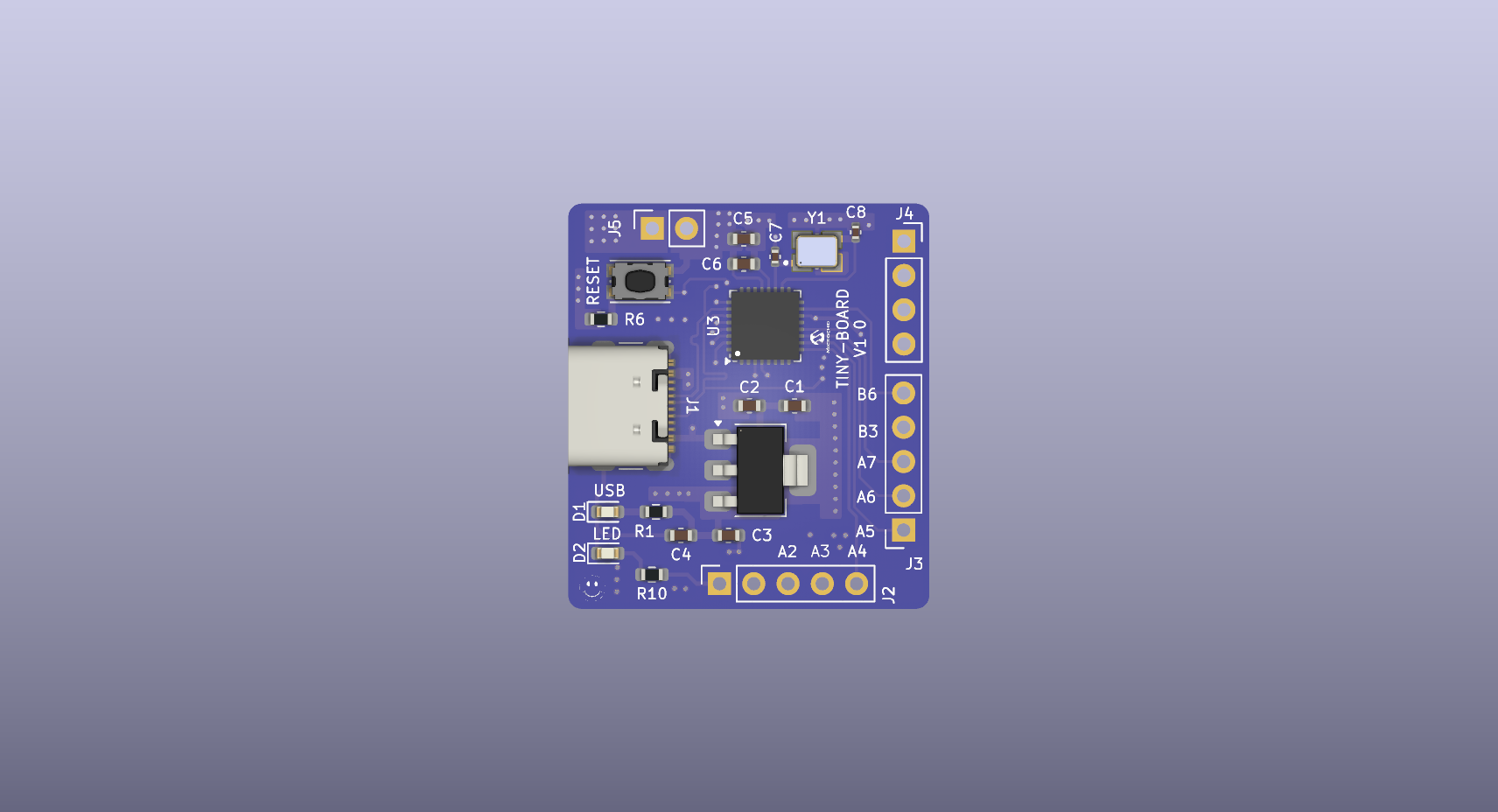
ATTiny board is an open-source printed circuit board by samiul000, from the samiul000/PCB repository on GitHub, published under the LGPL-2.1 licence. It is a 4-layer board of 26.8 × 30 mm with 32 parts on 37 nets, routed with 305 tracks and 88 vias.
It is built around the ATTINY87-MU. Its parts include 10 resistors, 8 capacitors, 5 connectors, 2 ICs and 2 diodes. It belongs with the AVR (ATmega, ATtiny) boards of this library.
| Qty | Value | Footprint | References |
|---|---|---|---|
| 4 | 0.1u | Capacitor_SMD:C_0603_1608Metric | C2, C3, C4, C6 |
| 4 | 5.1K | Resistor_SMD:R_0603_1608Metric | R2, R3, R4, R5 |
| 2 | 1.5K | Resistor_SMD:R_0603_1608Metric | R6, R7 |
| 2 | 10u | Capacitor_SMD:C_0603_1608Metric | C1, C5 |
| 2 | 22p | Capacitor_SMD:C_0402_1005Metric | C7, C8 |
| 2 | 4.7K | Resistor_SMD:R_0603_1608Metric | R8, R9 |
| 2 | Conn_01x05_Socket | Connector_PinSocket_2.54mm:PinSocket_1x05_P2.54mm_Vertical | J2, J3 |
| 2 | LED | LED_SMD:LED_0603_1608Metric | D1, D2 |
| 1 | 1K | Resistor_SMD:R_0603_1608Metric | R1 |
| 1 | 330 | Resistor_SMD:R_0603_1608Metric | R10 |
| 1 | ATtiny87-M | Package_DFN_QFN:QFN-32-1EP_5x5mm_P0.5mm_EP3.1x3.1mm | U3 |
| 1 | AZ1117CH2-3.3 | Package_TO_SOT_SMD:SOT-223-3_TabPin2 | U2 |
| 1 | Conn_01x02_Socket | Connector_PinSocket_2.54mm:PinSocket_1x02_P2.54mm_Vertical | J5 |
| 1 | Conn_01x04_Socket | Connector_PinSocket_2.54mm:PinSocket_1x04_P2.54mm_Vertical | J4 |
| 1 | Crystal_GND2 | C3E-12.000-18-3030-X-R:XTAL_C3E-12.000-18-3030-X-R | Y1 |
| 1 | LOGO | logo:smiley | G*** |
| 1 | LOGO | logo:microchip_logo | G*** |
| 1 | LOGO | logo:bd_logo_3x4.1 | G*** |
| 1 | SW_Push | Button_Switch_SMD:SW_Push_1P1T_NO_CK_KMR2 | SW1 |
| 1 | USB_C_Receptacle_USB2.0_16P | Connector_USB:USB_C_Receptacle_GCT_USB4105-xx-A_16P_TopMnt_Horizontal | J1 |


matthuszagh/fmcw
6GHz frequency-modulated continuous-wave radar with real-time range detection

jbilander/Amiga_DB23_video_adapter
A PCB for creating Amiga SCART or Amiga VGA cables. You can also use this adapter to feed a new clock to the Amiga via XCLK making your machine true PAL/NTSC switchable

andreika-git/hellen-one
Hellen-One Hardware Platform for rusEFI Engine Management System

sondrehr/Flight_Controller
The code used on my STM32 diy drone flight controller


a-little-wifi/Tinyriser6
Tinyriser for the Tiny6 and Tiny7 generations of Lenovo Tiny PCs
It measures 26.8 × 30 mm and has 4 copper layers, 1.6 mm thick.
32 parts, built around the ATTINY87-MU. The full list of its parts is on this page, with links to each part's symbol and footprint where PCBKit's library has them.
From the samiul000/PCB repository on GitHub, at the commit this page was made from: the board is ATTiny_board/ATTiny_board.kicad_pcb and its schematic ATTiny_board/ATTiny_board.kicad_sch. PCBKit opens the board in the browser, with nothing to install.
Its repository publishes it under the LGPL-2.1 licence: you may reuse it on that licence's terms (keep the author's notice, and for a copyleft licence share your changes alike).