2 layers351.6 × 128.3 mm

 rpedde/r60
Yet another 60% keyboard. This one is mine.
R60 is an open-source printed circuit board by rpedde, from the rpedde/r60 repository on GitHub. It is a 2-layer board of 285.8 × 95.3 mm with 148 parts on 93 nets, routed with 851 tracks and 54 vias.
It is built around the ATMEGA32U4-AU, K0 and K1, with the K2, K3 and K4 among its other parts. Its parts include 64 switches, 63 diodes, 8 capacitors, 4 resistors and 1 IC. It belongs with the keyboards and input boards and the AVR (ATmega, ATtiny) boards of this library.


Seems like all the cool kids are making their own keyboards, this one is mine. Hopefully this makes me cool.
Like most, it's a 16MHz Atmega32U4 running the quantum mechanical keyboard firmware.
This is a 60% keyboard, and I am trying to make it fit in generic 60% cases like the poker case or the WASD Code-61 case (which is nice and heavy -- I like it quite a bit).
Key layout is a bit odd, but is for more metas closer to the thumb but without going into crazy planck type zones.
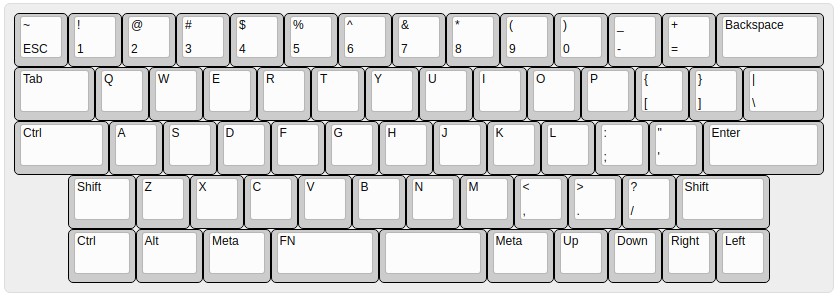
The 2u spacebars are going to be tough to find, though.
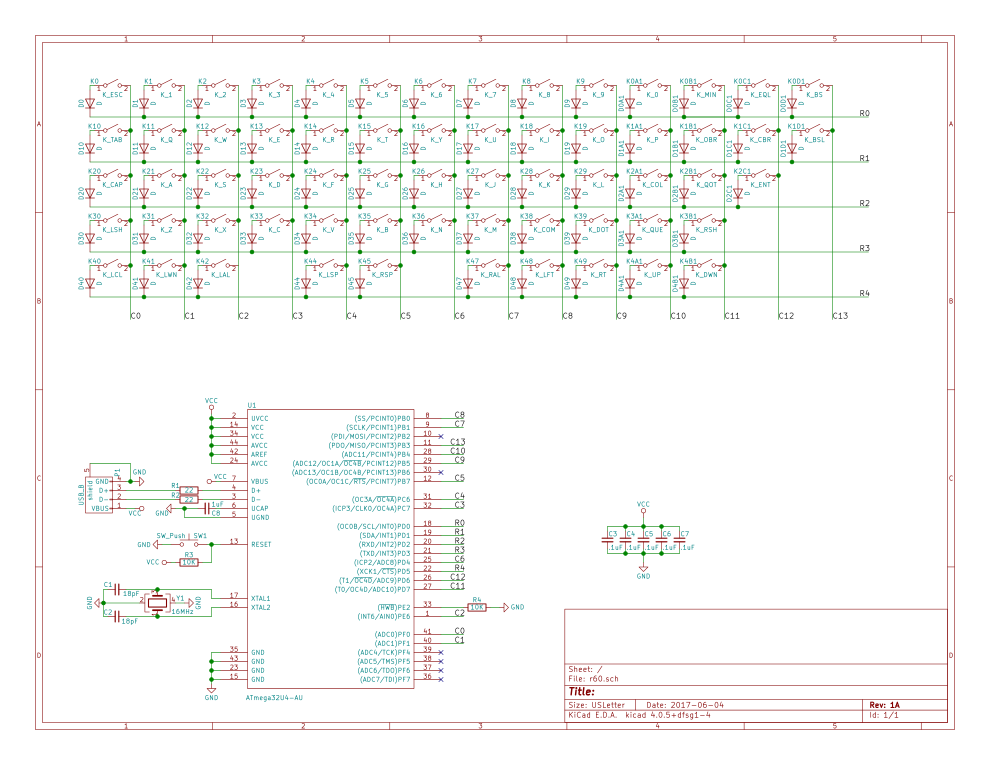
Note well that I have not actually built this yet, so I don't know that it works.
Layouts and plates in the layouts directory. Rev tags represent working versions I have generated boards from.
Rev A:
| Qty | Value | Footprint | References |
|---|---|---|---|
| 63 | D | Diodes_SMD:D_0805 | D0, D0A1, D0B1, D0C1, D0D1, D1, D10, D11, D12, D13, D14, D15, D16, D17, D18, D19 +47 |
| 5 | .1uF | Capacitors_SMD:C_0805_HandSoldering | C3, C4, C5, C6, C7 |
| 2 | 10K | Resistors_SMD:R_0805_HandSoldering | R3, R4 |
| 2 | 18pF | Capacitors_SMD:C_0805_HandSoldering | C1, C2 |
| 2 | 22 | Resistors_SMD:R_0805_HandSoldering | R1, R2 |
| 1 | 16MHz | Crystals:Crystal_SMD_3225-4pin_3.2x2.5mm_HandSoldering | Y1 |
| 1 | 1uF | Capacitors_SMD:C_0805_HandSoldering | C8 |
| 1 | ATmega32U4-AU | Housings_QFP:TQFP-44_10x10mm_Pitch0.8mm | U1 |
| 1 | K_0 | Keyboard:CHERRY_PCB_100H | K0A1 |
| 1 | K_1 | Keyboard:CHERRY_PCB_100H | K1 |
| 1 | K_2 | Keyboard:CHERRY_PCB_100H | K2 |
| 1 | K_3 | Keyboard:CHERRY_PCB_100H | K3 |
| 1 | K_4 | Keyboard:CHERRY_PCB_100H | K4 |
| 1 | K_5 | Keyboard:CHERRY_PCB_100H | K5 |
| 1 | K_6 | Keyboard:CHERRY_PCB_100H | K6 |
| 1 | K_7 | Keyboard:CHERRY_PCB_100H | K7 |
| 1 | K_8 | Keyboard:CHERRY_PCB_100H | K8 |
| 1 | K_9 | Keyboard:CHERRY_PCB_100H | K9 |
| 1 | K_A | Keyboard:CHERRY_PCB_100H | K21 |
| 1 | K_B | Keyboard:CHERRY_PCB_100H | K35 |
| 1 | K_BS | Keyboard:CHERRY_PCB_200H | K0D1 |
| 1 | K_BSL | Keyboard:CHERRY_PCB_150H | K1D1 |
| 1 | K_C | Keyboard:CHERRY_PCB_100H | K33 |
| 1 | K_CAP | Keyboard:CHERRY_PCB_175H | K20 |
| 1 | K_CBR | Keyboard:CHERRY_PCB_100H | K1C1 |
| 1 | K_COL | Keyboard:CHERRY_PCB_100H | K2A1 |
| 1 | K_COM | Keyboard:CHERRY_PCB_100H | K38 |
| 1 | K_D | Keyboard:CHERRY_PCB_100H | K23 |
| 1 | K_DOT | Keyboard:CHERRY_PCB_100H | K39 |
| 1 | K_DWN | Keyboard:CHERRY_PCB_100H | K4B1 |
| 1 | K_E | Keyboard:CHERRY_PCB_100H | K13 |
| 1 | K_ENT | Keyboard:CHERRY_PCB_225H | K2C1 |
| 1 | K_EQL | Keyboard:CHERRY_PCB_100H | K0C1 |
| 1 | K_ESC | Keyboard:CHERRY_PCB_100H | K0 |
| 1 | K_F | Keyboard:CHERRY_PCB_100H | K24 |
| 1 | K_G | Keyboard:CHERRY_PCB_100H | K25 |
| 1 | K_H | Keyboard:CHERRY_PCB_100H | K26 |
| 1 | K_I | Keyboard:CHERRY_PCB_100H | K18 |
| 1 | K_J | Keyboard:CHERRY_PCB_100H | K27 |
| 1 | K_K | Keyboard:CHERRY_PCB_100H | K28 |
| 1 | K_L | Keyboard:CHERRY_PCB_100H | K29 |
| 1 | K_LAL | Keyboard:CHERRY_PCB_125H | K42 |
| 1 | K_LCL | Keyboard:CHERRY_PCB_125H | K40 |
| 1 | K_LFT | Keyboard:CHERRY_PCB_100H | K48 |
| 1 | K_LSH | Keyboard:CHERRY_PCB_125H | K30 |
| 1 | K_LSP | Keyboard:CHERRY_PCB_200H | K44 |
| 1 | K_LWN | Keyboard:CHERRY_PCB_125H | K41 |
| 1 | K_M | Keyboard:CHERRY_PCB_100H | K37 |
| 1 | K_MIN | Keyboard:CHERRY_PCB_100H | K0B1 |
| 1 | K_N | Keyboard:CHERRY_PCB_100H | K36 |
| 1 | K_O | Keyboard:CHERRY_PCB_100H | K19 |
| 1 | K_OBR | Keyboard:CHERRY_PCB_100H | K1B1 |
| 1 | K_P | Keyboard:CHERRY_PCB_100H | K1A1 |
| 1 | K_Q | Keyboard:CHERRY_PCB_100H | K11 |
| 1 | K_QOT | Keyboard:CHERRY_PCB_100H | K2B1 |
| 1 | K_QUE | Keyboard:CHERRY_PCB_100H | K3A1 |
| 1 | K_R | Keyboard:CHERRY_PCB_100H | K14 |
| 1 | K_RAL | Keyboard:CHERRY_PCB_125H | K47 |
| 1 | K_RSH | Keyboard:CHERRY_PLATE_175H | K3B1 |
| 1 | K_RSP | Keyboard:CHERRY_PCB_200H | K45 |
| 1 | K_RT | Keyboard:CHERRY_PCB_100H | K49 |
| 1 | K_S | Keyboard:CHERRY_PCB_100H | K22 |
| 1 | K_T | Keyboard:CHERRY_PCB_100H | K15 |
| 1 | K_TAB | Keyboard:CHERRY_PLATE_150H | K10 |
| 1 | K_U | Keyboard:CHERRY_PCB_100H | K17 |
| 1 | K_UP | Keyboard:CHERRY_PCB_100H | K4A1 |
| 1 | K_V | Keyboard:CHERRY_PCB_100H | K34 |
| 1 | K_W | Keyboard:CHERRY_PCB_100H | K12 |
| 1 | K_X | Keyboard:CHERRY_PCB_100H | K32 |
| 1 | K_Y | Keyboard:CHERRY_PCB_100H | K16 |
| 1 | K_Z | Keyboard:CHERRY_PCB_100H | K31 |
| 1 | SW_Push | Buttons_Switches_SMD:SW_SPST_TL3342 | SW1 |
| 1 | USB_B | Connectors:USB_Mini-B | P1 |
The 142 most common of 148 parts.
It measures 285.8 × 95.3 mm and has 2 copper layers, 1.6 mm thick.
148 parts, built around the ATMEGA32U4-AU, K0, K1 and K2. The full list of its parts is on this page, with links to each part's symbol and footprint where PCBKit's library has them.
From the rpedde/r60 repository on GitHub, at the commit this page was made from: the board is r60.kicad_pcb. PCBKit opens the board in the browser, with nothing to install.
Its repository states no licence, so its author keeps all rights: ask rpedde before reusing the design.


wenbu/keyboard
KiCad component library, PCB schematics, layouts, etc. for custom keyboards


