
2 layers114.1 × 94.7 mm

 RoboticsBrno/RB0005-UniversalStepDown26
Universal step-down module
UniversalStepDown is an open-source printed circuit board by RoboticsBrno, from the RoboticsBrno/RB0005-UniversalStepDown repository on GitHub, published under the CC-BY-SA-4.0 licence. It is a 4-layer board of 19.5 × 10.5 mm with 15 parts on 8 nets, routed with 40 tracks and 81 vias.
It is built around the SY8105ADC. Its parts include 7 capacitors, 4 resistors, 1 IC, 1 diode and 1 connector.
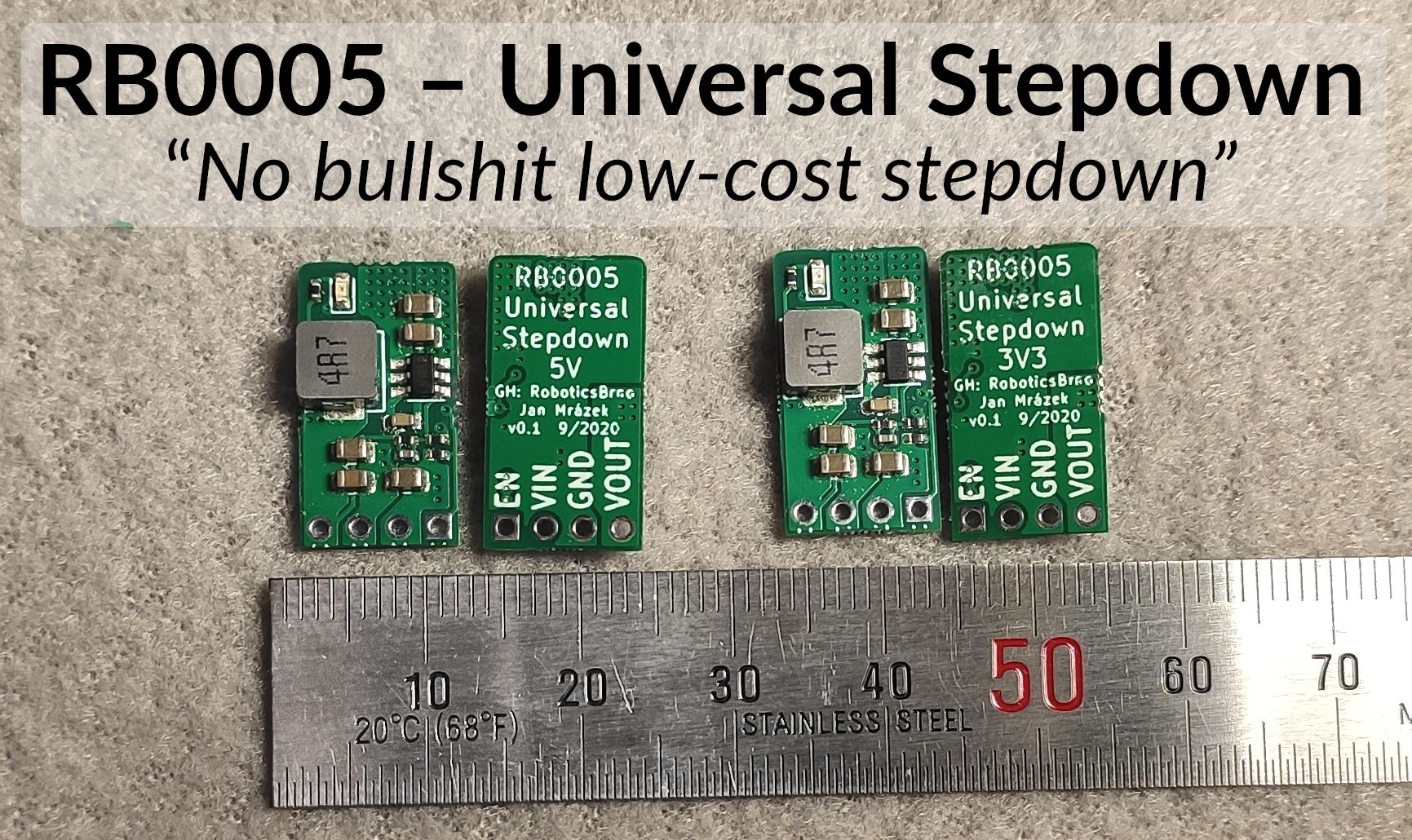

Most of our projects at RoboticsBrno are powered either by Li-ion cells or 12V power sources. However, most of our servos and boards require either 5V or 3V3 power source.
We used to buy cheap stepdown modules from Aliexpress to do the job. They are inexpensive but their performance is questionable. Also, it is always a surprise what you get in the envelope – some batches of them operate better, some of them worse. One day, we decided to stop wasting our time with poor-performing modules and we designed our own custom module – the RB0005 Universal Stepdown.
It is a simple and low-cost design based on the SY8105. And it gets the job done – see the evaluation of our design below. You can also look at our design on the project repository.
To quickly distinguish our projects at RoboticsBrno, e.g., when ordering, we decided to give a each project a unique code.
We aim for usability. Usually, you need to lower your voltage to 5 V (servos) or 3.3 V (powering MCU) in DIY robotics. Having an adjustable version increases the chances of misconfiguration.
Well, it depends on your needs. If you need a certain level of reliability, it might be beneficial to know what to expect from your device. With our stepdown, you know it: see evaluation of the 5V version or the the 3V3 version. You could buy a module from Aliexpress and measure it by yourself. However, that is laborious and you cannot be sure that you will get the same-performing module when you order it again.
RB0005 – Universal
Stepdown by Jan
Mrázek is licensed under CC BY-NC-SA
4.0  .
| Qty | Value | Footprint | References |
|---|---|---|---|
| 5 | 22u | Capacitor_SMD:C_0805_2012Metric | C1, C4, C5, C6, C7 |
| 1 | 100n | Capacitor_SMD:C_0603_1608Metric | C2 |
| 1 | 1M | Resistor_SMD:R_0402_1005Metric | R3 |
| 1 | 200k | Resistor_SMD:R_0402_1005Metric | R1 |
| 1 | 27k (for 5V)/44.2k (for 3V3) | Resistor_SMD:R_0402_1005Metric | R2 |
| 1 | 47k | Resistor_SMD:R_0402_1005Metric | R4 |
| 1 | 47p | Capacitor_SMD:C_0402_1005Metric | C3 |
| 1 | 4u7 | universalStepDown:MWSA0503S | L1 |
| 1 | IO | universalStepDown:PinHeader_1x04_P2.54mm_Horizontal | J1 |
| 1 | LED | LED_SMD:LED_0603_1608Metric | D1 |
| 1 | SY8105 | Package_TO_SOT_SMD:TSOT-23-6 | U1 |

RoboticsBrno/RB0004-NeopixelBooster
Booster for Neopixel LED strips

aminjahanpour/flight_computer_pcb
This repo contains KiCad files for an open source flight computer PCB.

JanM321/esphome-lg-controller
Wired controller for LG HVAC units using ESPHome and ESP32


niklasekstrom/clockport_pi_interface
Amiga clock port to Raspberry Pi interface
It measures 19.5 × 10.5 mm and has 4 copper layers, 1 mm thick.
15 parts, built around the SY8105ADC. The full list of its parts is on this page, with links to each part's symbol and footprint where PCBKit's library has them.
From the RoboticsBrno/RB0005-UniversalStepDown repository on GitHub, at the commit this page was made from: the board is board/universalStepDown.kicad_pcb. PCBKit opens the board in the browser, with nothing to install.
Its repository publishes it under the CC-BY-SA-4.0 licence: you may reuse it on that licence's terms (keep the author's notice, and for a copyleft licence share your changes alike).