2 layers100 × 100 mm
RAMROM Board
roberto314/Unicomp3
A modular 8-bit Computer able to recreate (nearly) every Retro computer of the late 70s to mid 80s.
105 partsBSD-2-Clause
 roberto314/Unicomp3
A modular 8-bit Computer able to recreate (nearly) every Retro computer of the late 70s to mid 80s.
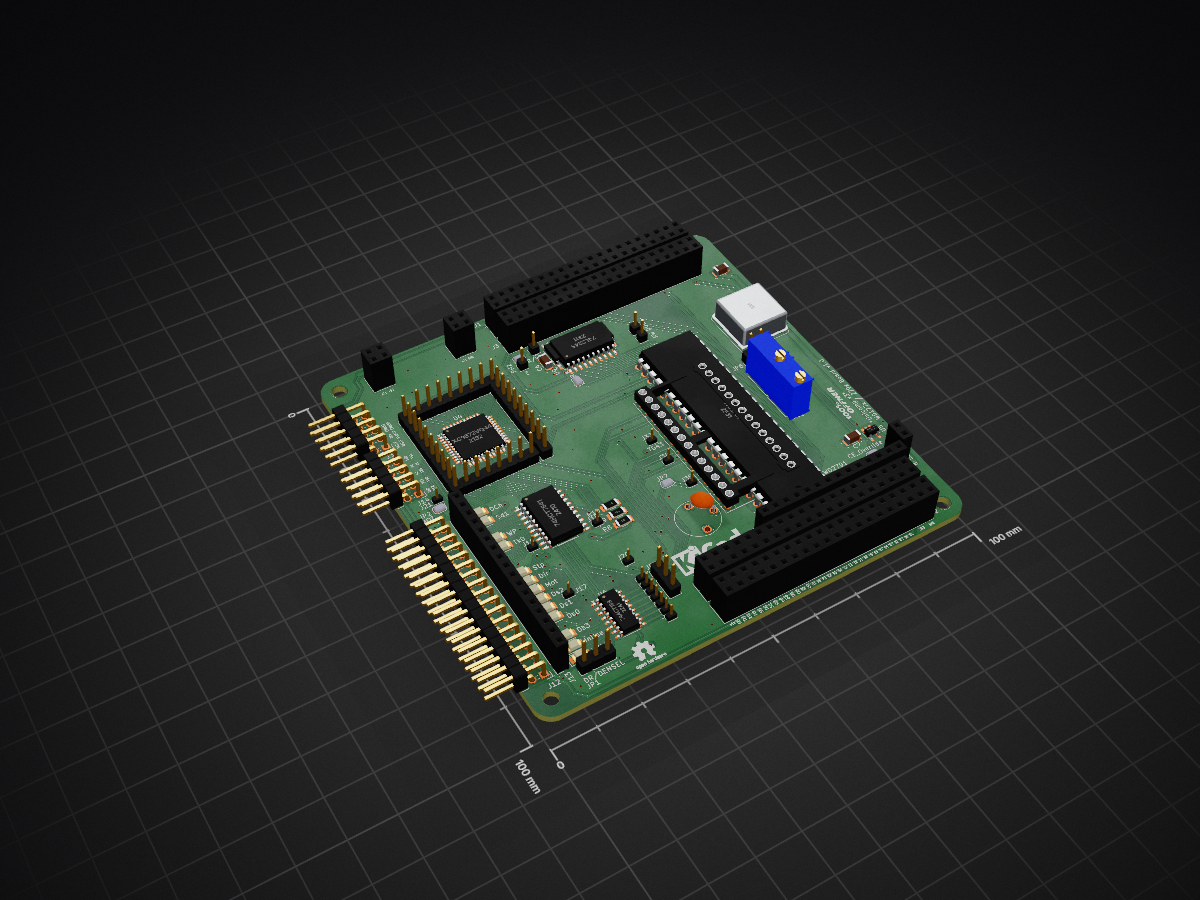
WD1771 Board is an open-source printed circuit board by roberto314, from the roberto314/Unicomp3 repository on GitHub, published under the BSD-2-Clause licence. It is a 2-layer board of 100 × 100 mm with 122 parts on 180 nets, routed with 1,704 tracks and 121 vias.
It is built around the 74HCT7540D, 74HCT7541D and 74LS245SC, with the 74ACT139PC, 74AHC1G08GW and SN74LVCC4245ANSR among its other parts. Its parts include 35 connectors, 29 resistors, 14 capacitors, 14 diodes and 11 ICs. It belongs with the retro computing and games boards and the FPGA and CPLD boards of this library.


Version 3.00
A modular 8-bit Computer able to recreate (nearly) every microcomputer of the mid 70s to early 80s in Hardware without FPGAs (although an FPGA can be added). Can also be used as a teaching tool for:
It is different from other designs because of these points:
Unicomp plus Logic Analyzer:

USB-Serial board:
CPU board:
Multi Serial boaŕd:
Multi Parallel boaŕd:
RAMROM board:
Prototype board:
MAX-II (EPM240) board:
self made module:
The configuration is done with 1Mx16 fast ram on the RAMROM board. It is configured from the STM32F401. The cs = 15 is for writing the main RAM, cs = 14 is the Write Disable. The rest is free.
| Name | prim. IO | chips used | os | weblink |
|---|---|---|---|---|
| Motorola MEK D2 | serial | MC6802, MĆ6850 | newbug, xswtbug, mondeb | Link: https://www.retrotechnology.com/restore/smithbug.html |
| Motorola MEK D1 | serial | MC6802, MĆ6821 (plus Arduino) | Mikbug | Link: https://www.retrotechnology.com/restore/smithbug.html |
| SWTPC 6800 | serial | MC6802, MĆ6821 (plus Arduino) | Mikbug | Link: https://deramp.com/swtpc.com/ |
| SWTPC 6800 | serial | MC6802, MĆ6850 | SWTBUG, SWTBUGA, Mondeb, xSWTBUG | Link: https://deramp.com/swtpc.com/ |
| Heathkit ET3400 | serial | MC6802, MĆ6850 | MITS BASIC, TSC MicroBASIC,... | Link: https://github.com/jefftranter |
| HD6303 Board (Eric Klaus) | serial | HD6303 or MC6803 | Monitor +BASIC | Link: https://sites.google.com/site/ericmklaus/projects-1/hd6303cpuboard |
| MC3 Computer | serial | HD6303 or MC6803 | Monitor | Link: https://www.waveguide.se/?article=mc3-a-diy-8-bit-computer |
| Grant Searle 6809 board | serial | MC6809E, MC6850 | MS Basic | Link: http://searle.x10host.com/6809/Simple6809.html |
| Grant Searle 6502 board | serial | MOS6502, MC6850 | OSI Basic | Link: http://searle.x10host.com/6502/Simple6502.html |
| Daryl Rictor 6502 board | serial | MOS6502, R6551 | SBC-2 (monitor only) | Link: https://sbc.rictor.org/info2.html |
| Daryl Rictor 6502 board | serial | MOS6502, MC6850 | SBC-2 (monitor only) | Link: https://sbc.rictor.org/info2.html |
| SYM1 | serial | MOS6502, UM6532 | SYM1 ( +BASIC +RAE) | Link: http://retro.hansotten.nl/6502-sbc/synertek-sym-ktm/sym-1/ |
| KIM1 | serial | MOS6502, UM6532 | KIM1 | Link: http://retro.hansotten.nl/6502-sbc/kim-1-manuals-and-software/ |
| Apple I | serial | MOS6502, MĆ6821 (plus Arduino) | Wozmon + BASIC | Link: http://retro.hansotten.nl/6502-sbc/apple-1/ |
| DREAM 6800 | BAS (Video) | MC6802, MAX-II | DREAM operating System (Chip8) | Link: http://www.mjbauer.biz/DREAM6800.htm |
| Psion Organizer I | LCD | HD6303 | Psion OS | Link: https://www.jaapsch.net/psion/index.htm |
UC3_upload.py: multi-function script. up- or download RAM Content, write or read the clock chip, set the reset pin, upload configuration data from file, upload RAM data from file, gets version number,
UC3_make_uploadfile.py: creates an .ucb file for upload. It can have multiple RAM locations and lengths.
compiling the vhdl (or verilog) code must be done on a computer with the Xilinx ISE 14.7 toolchain installed. Link: https://www.xilinx.com/support/download/index.html/content/xilinx/en/downloadNav/vivado-design-tools/archive-ise.html
compiling itself can be done inside ISE or with the supplied makefile (look inside the bord directory in cpld firmware)
a simple make will compile the firmware and a make prog will transfer the file to the stm32 for programming.
The unicomp Project started a couple of years ago and is developed in my spare time. It is intended to be a module system to test out different hardware configurations or CPLD- or FPGA- extensions and to recreate old systems and test software and operating systems.
Differences Unicomp2 from Unicomp1:
Differences Unicomp3 from Unicomp2:
| Qty | Value | Footprint | References |
|---|---|---|---|
| 27 | 1k | Resistor_SMD:R_1206_3216Metric_Pad1.30x1.75mm_HandSolder | R1, R2, R10, R11, R12, R13, R14, R15, R16, R17, R18, R19, R20, R21, R22, R23 +11 |
| 13 | RED | LED_SMD:LED_1206_3216Metric_Pad1.42x1.75mm_HandSolder | D2, D3, D4, D5, D6, D7, D8, D9, D10, D11, D12, D13, D14 |
| 12 | 100n | Capacitor_SMD:C_1206_3216Metric | C1, C2, C3, C4, C5, C6, C7, C11, C12, C13, C14, C15 |
| 11 | Conn_01x01 | Connector_PinHeader_1.27mm:PinHeader_1x01_P1.27mm_Vertical | J17, J18, J19, J20, J22, J23, J24, J25, J27, J28, J29 |
| 4 | M3 | MountingHole:MountingHole_3.2mm_M3 | H1, H2, H3, H4 |
| 2 | 10k | Potentiometer_THT:Potentiometer_Vishay_T73XW_Horizontal | RV1, RV2 |
| 2 | 10k | Resistor_SMD:R_1206_3216Metric_Pad1.30x1.75mm_HandSolder | R4, R5 |
| 2 | BUS | Connector_PinSocket_2.54mm:PinSocket_2x20_P2.54mm_Vertical | J1, J2 |
| 2 | Conn_01x08 | Connector_PinHeader_2.54mm:PinHeader_1x08_P2.54mm_Vertical | J7, J16 |
| 2 | Conn_01x09 | Connector_PinHeader_2.54mm:PinHeader_1x09_P2.54mm_Vertical | J6, J15 |
| 2 | Conn_02x02_Odd_Even | Connector_PinSocket_2.54mm:PinSocket_2x02_P2.54mm_Vertical | J30, J31 |
| 2 | DR/DENSEL | Connector_PinHeader_2.54mm:PinHeader_1x03_P2.54mm_Vertical | JP1, JP3 |
| 2 | Spare | Connector_PinSocket_2.54mm:PinSocket_2x20_P2.54mm_Vertical | J3, J4 |
| 1 | 1N4148 | Diode_SMD:D_1206_3216Metric_Pad1.42x1.75mm_HandSolder | D1 |
| 1 | 220n | Capacitor_SMD:C_1206_3216Metric | C8 |
| 1 | 74ACT139 | Package_SO:SOIC-16_3.9x9.9mm_P1.27mm | U6 |
| 1 | 74AHC1G08 | Package_TO_SOT_SMD:SOT-23-5_HandSoldering | U5 |
| 1 | 74HCT7540 | Package_SO:SO-20_5.3x12.6mm_P1.27mm | U1 |
| 1 | 74HCT7540 | Package_SO:SO-20_12.8x7.5mm_P1.27mm | U11 |
| 1 | 74HCT7541 | Package_SO:SO-20_12.8x7.5mm_P1.27mm | U10 |
| 1 | 74HCT7541 | Package_SO:SO-20_5.3x12.6mm_P1.27mm | U2 |
| 1 | 74LS245 | Package_SO:SOIC-20W_7.5x12.8mm_P1.27mm | U8 |
| 1 | 8" | Connector_PinHeader_2.54mm:PinHeader_1x02_P2.54mm_Vertical | JP6 |
| 1 | 8-70p | my_own:Capacitor_Trim | C9 |
| 1 | 8M | Oscillator:Oscillator_DIP-8 | X1 |
| 1 | CE_Override | Jumper:SolderJumper-2_P1.3mm_Open_RoundedPad1.0x1.5mm | JP4 |
| 1 | Conn_01x02 | Connector_PinSocket_2.54mm:PinSocket_1x02_P2.54mm_Vertical | J26 |
| 1 | Conn_01x14 | Connector_PinSocket_2.54mm:PinSocket_1x14_P2.54mm_Vertical | J11 |
| 1 | E | Connector_PinHeader_2.00mm:PinHeader_1x01_P2.00mm_Vertical | J8 |
| 1 | EXT | Connector_PinHeader_2.54mm:PinHeader_2x05_P2.54mm_Horizontal | J32 |
| 1 | Floppy | Connector_PinHeader_2.54mm:PinHeader_2x17_P2.54mm_Horizontal | J12 |
| 1 | JTAG | Connector_PinHeader_2.54mm:PinHeader_2x05_P2.54mm_Horizontal | J14 |
| 1 | LOGO | my_own:Logo_100ProzentOffner_10x2.7mm | G*** |
| 1 | Logo Open Source Hardware | Symbol:OSHW-Logo2_7.3x6mm_SilkScreen | H6 |
| 1 | Logo kicad | Symbol:KiCad-Logo2_6mm_SilkScreen | H5 |
| 1 | MOT | Jumper:SolderJumper-2_P1.3mm_Open_RoundedPad1.0x1.5mm | JP2 |
| 1 | PH2 | Jumper:SolderJumper-2_P1.3mm_Bridged_RoundedPad1.0x1.5mm | JP9 |
| 1 | R/W | Jumper:SolderJumper-2_P1.3mm_Bridged_RoundedPad1.0x1.5mm | JP8 |
| 1 | R/~{W}_e | Connector_PinHeader_2.00mm:PinHeader_1x01_P2.00mm_Vertical | J5 |
| 1 | READY | Connector_PinHeader_1.27mm:PinHeader_1x01_P1.27mm_Vertical | J34 |
| 1 | RW | Connector_PinHeader_2.00mm:PinHeader_1x01_P2.00mm_Vertical | J9 |
| 1 | SIDE | Connector_PinHeader_1.27mm:PinHeader_1x01_P1.27mm_Vertical | J35 |
| 1 | SIDE | Jumper:SolderJumper-2_P1.3mm_Open_RoundedPad1.0x1.5mm | JP7 |
| 1 | SN74LVCC4245ANSR | Package_SO:SO-24_5.3x15mm_P1.27mm | U9 |
| 1 | TEST | Jumper:SolderJumper-2_P1.3mm_Open_RoundedPad1.0x1.5mm | JP5 |
| 1 | TG43 | Connector_PinHeader_1.27mm:PinHeader_1x01_P1.27mm_Vertical | J33 |
| 1 | Test | Connector_PinSocket_2.54mm:PinSocket_1x17_P2.54mm_Vertical | J13 |
| 1 | WD1770 | Package_DIP:DIP-28_W15.24mm_Socket | U3 |
| 1 | WD2791 | Package_DIP:DIP-40_W15.24mm | U7 |
| 1 | XC9572VQ44 | Package_QFP:TQFP-44_10x10mm_P0.8mm | U4 |
| 1 | ~{DOE} | Connector_PinHeader_2.00mm:PinHeader_1x01_P2.00mm_Vertical | J10 |
| 1 | ~{EN} | Connector_PinHeader_1.27mm:PinHeader_1x01_P1.27mm_Vertical | J21 |
roberto314/Unicomp3
A modular 8-bit Computer able to recreate (nearly) every Retro computer of the late 70s to mid 80s.

roberto314/Unicomp3
A modular 8-bit Computer able to recreate (nearly) every Retro computer of the late 70s to mid 80s.

roberto314/Unicomp3
A modular 8-bit Computer able to recreate (nearly) every Retro computer of the late 70s to mid 80s.

roberto314/Unicomp3
A modular 8-bit Computer able to recreate (nearly) every Retro computer of the late 70s to mid 80s.

roberto314/Unicomp3
A modular 8-bit Computer able to recreate (nearly) every Retro computer of the late 70s to mid 80s.

roberto314/Unicomp3
A modular 8-bit Computer able to recreate (nearly) every Retro computer of the late 70s to mid 80s.

roberto314/Unicomp3
A modular 8-bit Computer able to recreate (nearly) every Retro computer of the late 70s to mid 80s.

roberto314/Unicomp3
A modular 8-bit Computer able to recreate (nearly) every Retro computer of the late 70s to mid 80s.

roberto314/Unicomp3
A modular 8-bit Computer able to recreate (nearly) every Retro computer of the late 70s to mid 80s.

roberto314/Unicomp3
A modular 8-bit Computer able to recreate (nearly) every Retro computer of the late 70s to mid 80s.

roberto314/Unicomp3
A modular 8-bit Computer able to recreate (nearly) every Retro computer of the late 70s to mid 80s.

roberto314/Unicomp3
A modular 8-bit Computer able to recreate (nearly) every Retro computer of the late 70s to mid 80s.

roberto314/Unicomp2
A modular 8-bit Computer able to recreate (nearly) every Retro computer of the late 70s to mid 80s.

snorklerjoe/useful6502
A homebrew 65c02s-based computer and custom operating system, with a handful of modern features.


fordp2002/music2xxx
A clone of the Hybrid Music2000 Midi interface for the Acorn BBC Microcomputer


LIV2/A500-2Meg-Chip-ram
An Adapter to retrofit a 2MB agnus into a 1MB Amiga 500/2000

elixpo/elixpo_chapter
Elixpo’s canonical collection for public build-and-release Chapters, bringing open-source software, reproducible research, hardware, and community contributions into one attributable record.

It measures 100 × 100 mm and has 2 copper layers, 1.6 mm thick.
122 parts, built around the 74HCT7540D, 74HCT7541D, 74LS245SC and 74ACT139PC. The full list of its parts is on this page, with links to each part's symbol and footprint where PCBKit's library has them.
From the roberto314/Unicomp3 repository on GitHub, at the commit this page was made from: the board is FloppyControllerBoards/schematics_v10/WD1771_Board/WD1771_Board.kicad_pcb. PCBKit opens the board in the browser, with nothing to install.
Its repository publishes it under the BSD-2-Clause licence: you may reuse it on that licence's terms (keep the author's notice, and for a copyleft licence share your changes alike).